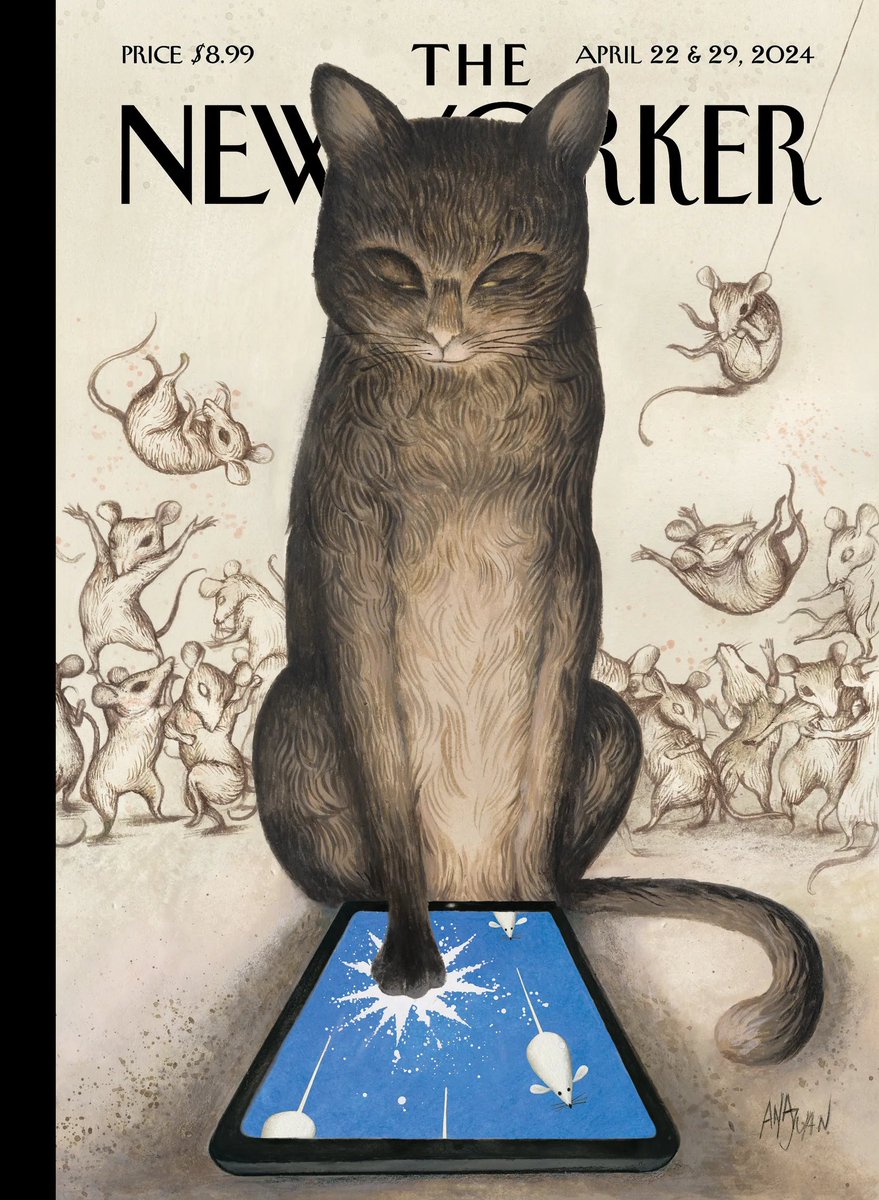
The New Yorker (April 15, 2024): The new issue‘s cover featuresAna Juan’s “Clickbait” – The artist captures the mesmerizing—and distracting—glow of modern entertainment.
Can the World Be Simulated?
Video-game engines were designed to closely mimic the mechanics of the real world. They’re now used for movies, TV shows, architecture, military trainings, virtual reality, and the metaverse.
Can hard-core gamers learn to play well with others? By Spencer Kornhaber
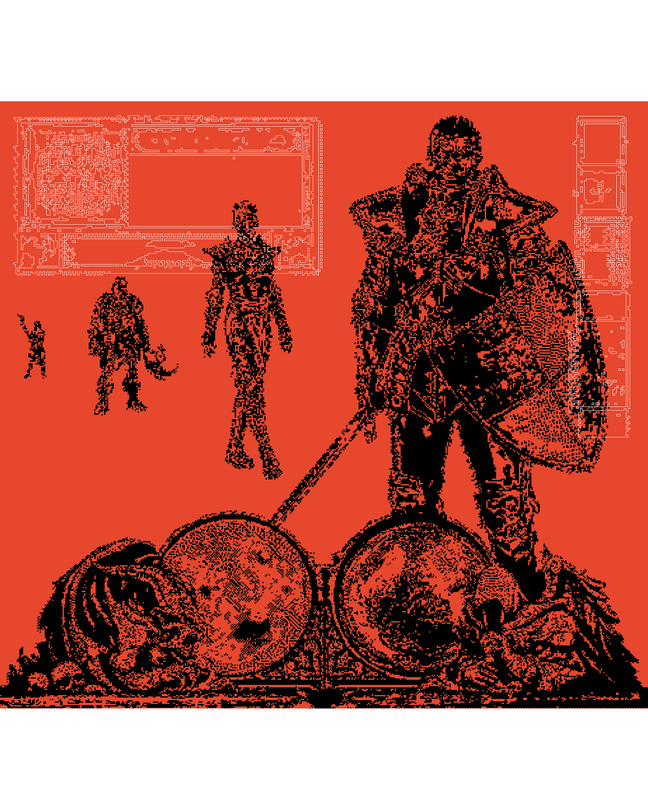
Playing a prerelease version of Diablo IV, the latest installment in a 26-year-old adventure series about battling the forces of hell, I faced swarms of demons that yowled and belched. My character, a sorcerer, shot them with lightning bolts, producing a jet-engine roar.
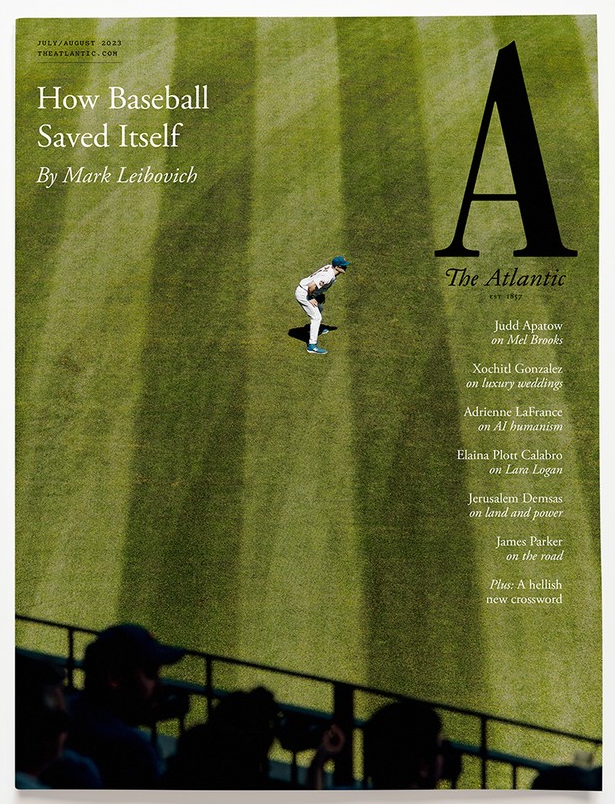
Inside the desperate effort to rescue America’s pastime from irrelevance By Mark Leibovich
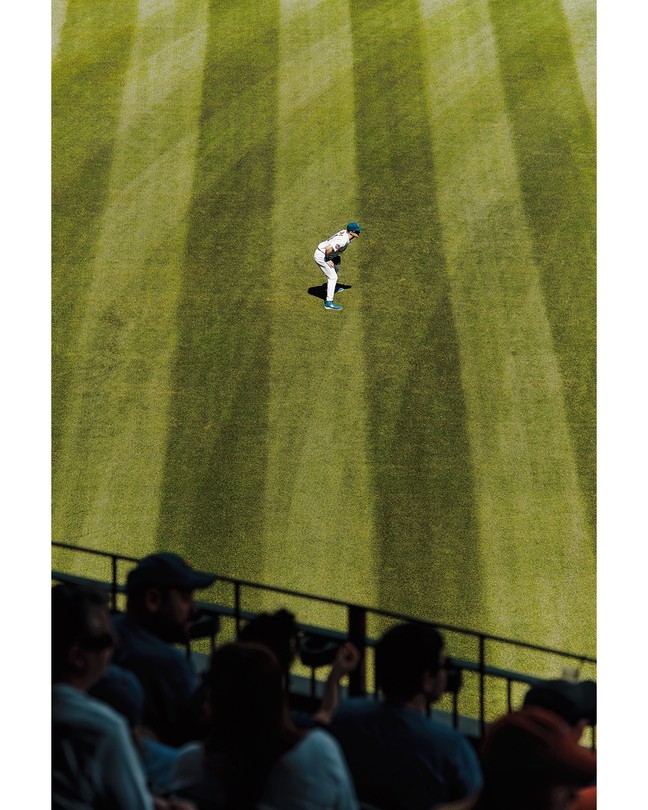
Where in the name of human rain delays is Juan Soto?
The stud outfielder is late. Everyone keeps checking their phones—the antsy Major League Baseball officials, the San Diego Padres PR guy, the handful of reporters, and the assorted hangers-on you encounter around baseball clubhouses. Everyone is wondering when the Padres superstar will show up. He was supposed to be here half an hour ago, just after this baseball players’ sanctum opened and we were allowed to join them in their most elemental of baseball activities: waiting around.
The lightning-fast spread of a seemingly milder coronavirus variant may represent a shift from pandemic to endemic; we ask how that would change global responses.
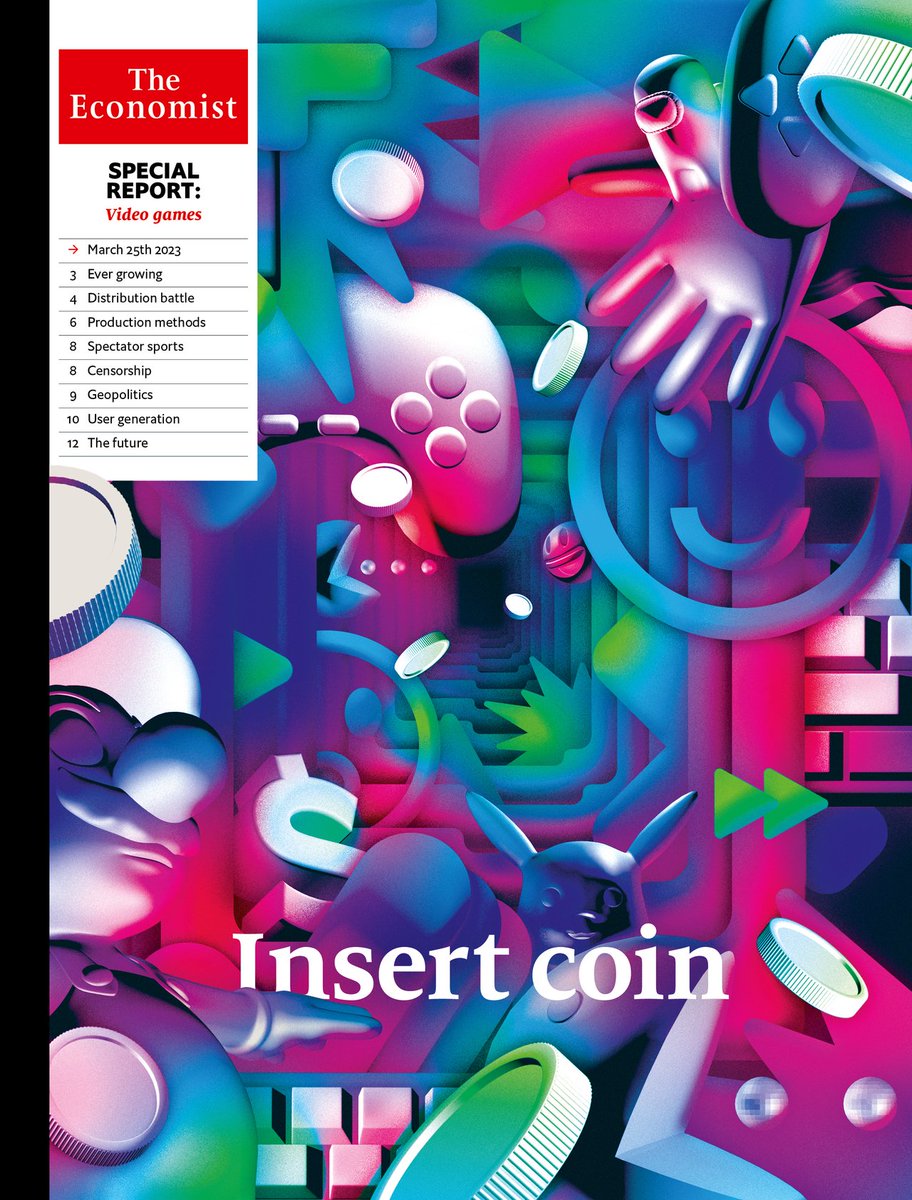
Concern about video-game addictiveness is as old as video games themselves—but the business models of modern gaming may be magnifying the problem. And newly publicised photographs shed light on Bangladesh’s brutal war for independence.
A video game provides players with insights into pandemic responses, giant pandas and our annual festive fun.
In this episode:
01:02 Balancing responses in a video game pandemic
In the strategy video-game Plague Inc: The Cure, players assume the role of an omnipotent global health agency trying to tackle outbreaks of increasingly nasty pathogens. We find out how the game was developed, and how it might help change public perception of pandemic responses.
The first of our festive songs, we head back to July this year, and the launch of three separate space missions to the red planet. Scroll to the transcript section at the bottom of the page for the lyrics.
12:54 Research Highlights
Giant pandas roll in piles of poo to keep warm, and how different bread-baking styles have led to distinct lineages of baker’s yeast.
15:17 The Nature Podcast Audio Charades Competition: Lockdown edition
In this year’s festive competition, our reporters try to describe some of the biggest science stories, using only homemade sound effects. Results are mixed, at best…
24:15 Nature’s 10
We hear about some of the people who made it on to this year’s Nature’s 10 list this year.
In our final festive song, we celebrate a huge scientific achievement, and one that’s offering a little hope for 2021. Scroll to the transcript section at the bottom of the page for the lyrics.
It is impossible to ignore the ongoing impact the Covid-19 pandemic is having on our lives. This month our infographic shows how some aspects of daily life have changed as a result. The widespread closure of schools, for example, is thought to have affected up to 1.38 billion learners as of late March. Meanwhile, the sudden shift to remote working is one such change expected to have long-lasting effects. Following the pandemic, 68% of Germans have stated they would like to work remotely more often.
Our designer Raphael Hammer has created an isometric-style illustration, with each topic area allocated its own quarter of the infographic. Each topic is then afforded its own principle colour and corresponding design details. The almost monochrome effect of the illustrations allows them to perfectly complement the data presented. Especially effective, are the subtle movements which bring the entire graphic to life.










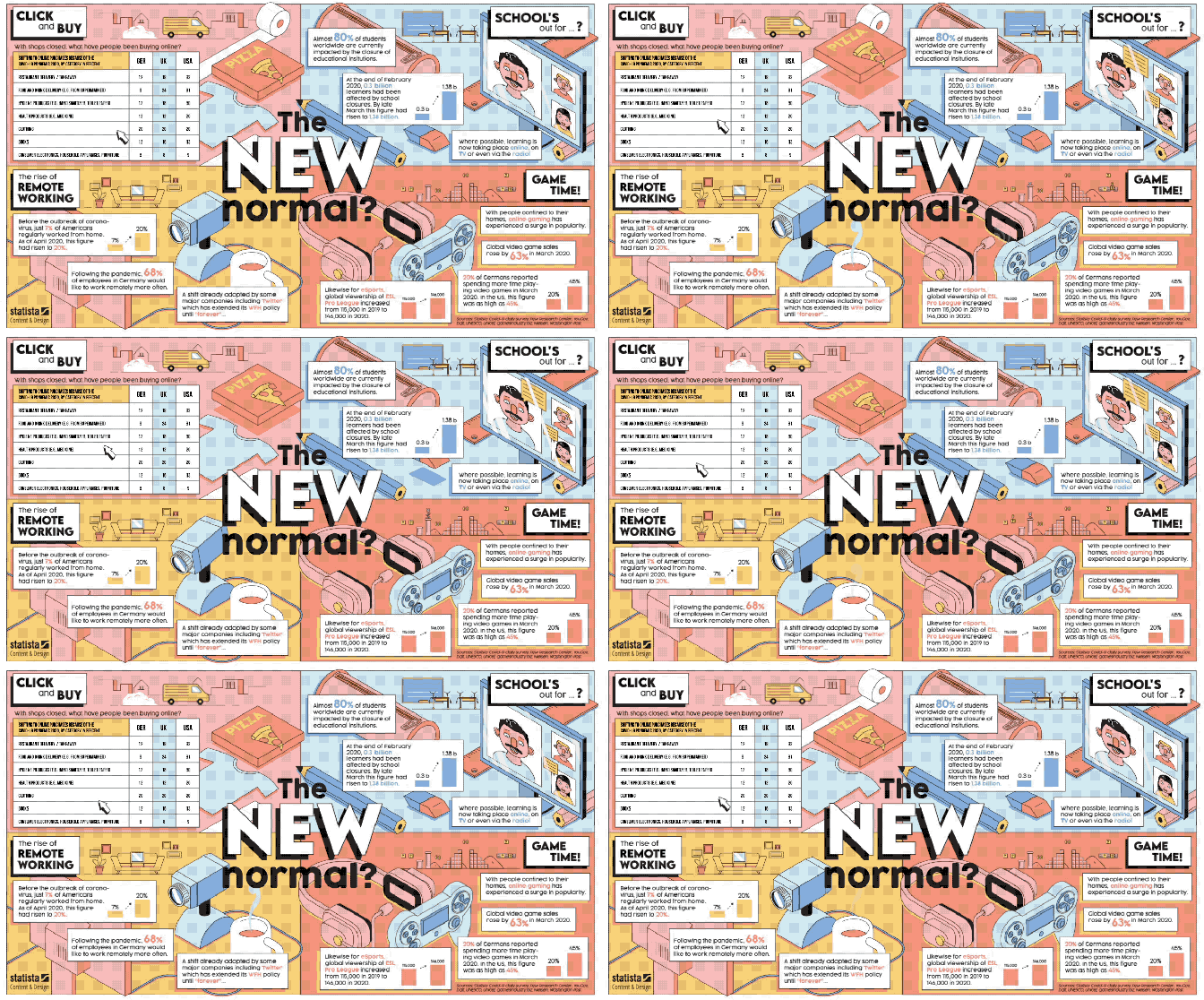

 It is impossible to ignore the ongoing impact the Covid-19 pandemic is having on our lives. This month our infographic shows how some aspects of daily life have changed as a result. The widespread closure of schools, for example, is thought to have affected up to 1.38 billion learners as of late March. Meanwhile, the sudden shift to remote working is one such change expected to have long-lasting effects. Following the pandemic, 68% of Germans have stated they would like to work remotely more often.
 Boomers Daily