
Tag Archives: Technology

World Economic Forum: Top Stories – Oct 14, 2023

World Economic Forum (October 14, 2023) – This week’s top stories of the week include:

0:15 Why engagement in the news is in decline – A massive media survey looked at trust and engagement in the news and found both are in steady decline. Just 48% of people say they are very or extremely interested in the news in 2023 down from 63% in 2017. Trust in the news has fallen 2 percentage points in a year. Now, only 40% say they trust the news most of the time and 36% say they actively avoid the news sometimes or often.

1:53 This robot can help people with disabilities dress – The robot was designed by a team at Carnegie Mellon University (CMU). They used a simulation to teach it how to perform its task. The team used an AI-driven approach called ‘reinforcement learning’. The robot was rewarded each time it correctly placed a shirt further along an arm.

3:25 Company captures and stores CO2 with limestone – Heirloom takes crushed limestone and heats it in a kiln powered by renewable energy. The reaction generates two products. These are CO2, which can be permanently stored underground or in materials like concrete and a powder, which is hydrated with water to make calcium hydroxide. When the calcium hydroxide is spread onto trays, it absorbs CO2 from the air to become limestone and the whole process can begin again.

5:24 How to use ChatGPT more safely – ChatGPT is an AI tool that gives detailed, natural language answers to prompts based on a database of 300 billion words drawn from books and articles. The AI learns from its interactions with you, so here are 5 ways to ensure you’re using it safely.

_____________________________________________

The World Economic Forum is the International Organization for Public-Private Cooperation. The Forum engages the foremost political, business, cultural and other leaders of society to shape global, regional and industry agendas. We believe that progress happens by bringing together people from all walks of life who have the drive and the influence to make positive change.

Space: NASA’s $1 Billion Metal Asteroid Mission

Wall Street Journal (October 13, 2023) – NASA launched a spacecraft on Friday to study the Psyche asteroid, which is believed to be made out of metal.

Video timeline: 0:00 NASA’s mission 0:46 The psyche asteroid 1:45 Why metal matters 3:04 What we can learn from the mission

The rocky inner planets of our solar system are thought to have mostly metallic cores. WSJ breaks down why this mission matters and what it could tell us about Earth’s origins.

Science And Technology: Issues Magazine (Fall ’23)

Image

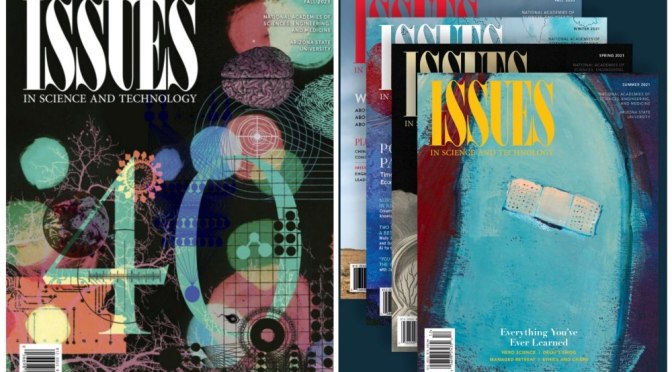
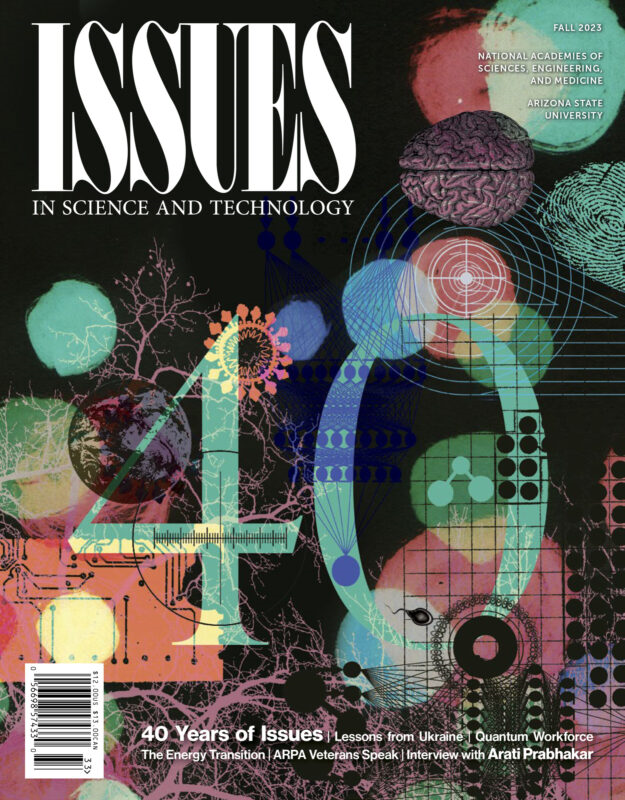
ISSUES IN SCIENCE AND TECHNOLOGY MAGAZINE (FALL 2023): The latest issue of @ISSUESinST features Lessons from Ukraine, Quantum Workforce, The Energy Transition, Why Space Debris Flies Through Regulatory Gaps and more…

Blue Dreams

REBECCA RUTSTEIN

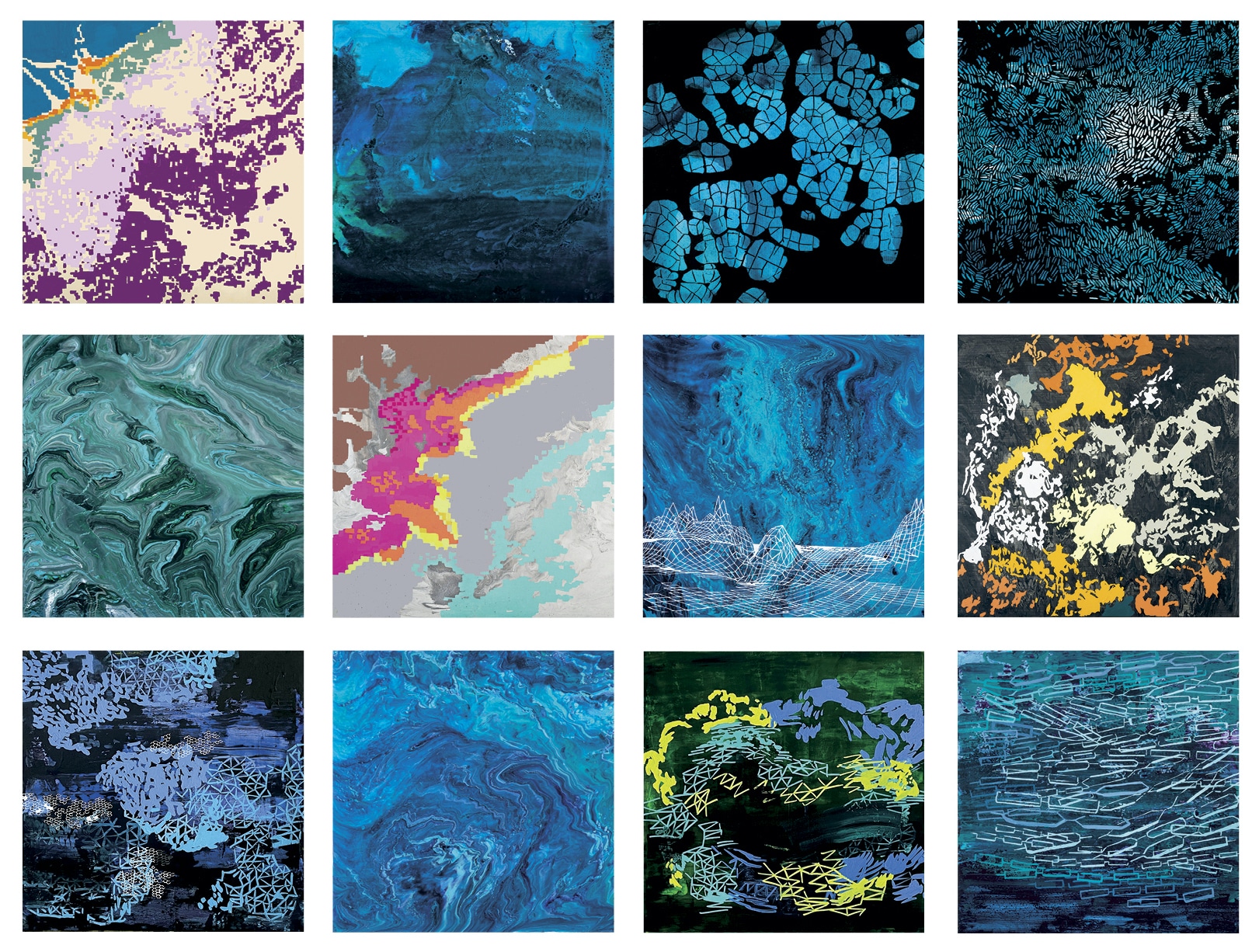
Blue Dreams is an immersive video experience inspired by microbial networks in the deep sea and beyond. Using stunning undersea video footage, abstract imagery, and computer modeling, the work offers a glimpse into the complicated relationships among the planet’s tiniest—yet most vital—living systems.

Why Space Debris Flies Through Regulatory Gaps

MARILYN HARBERTASHA BALAKRISHNAN

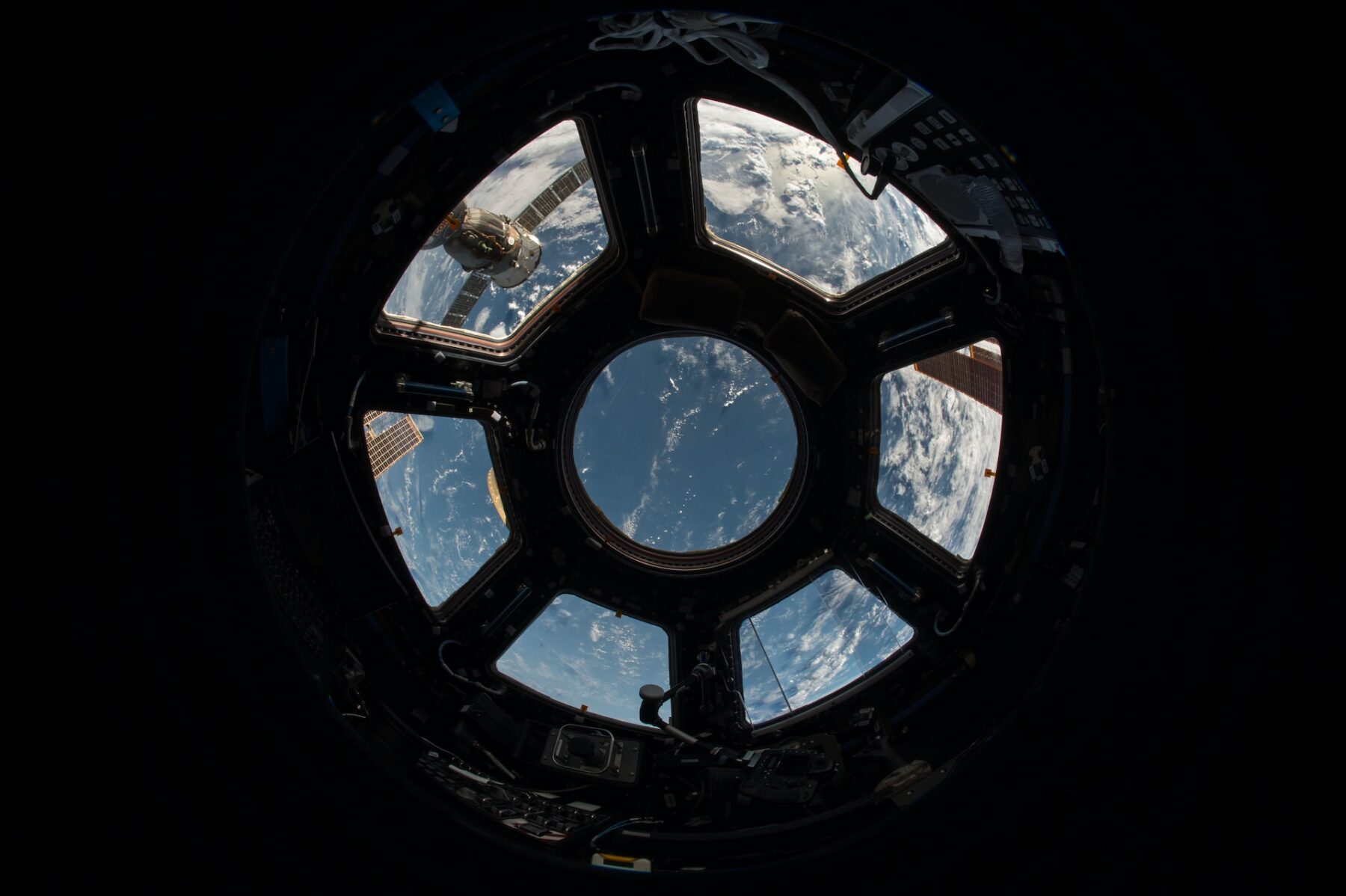
Orbital debris has been a looming issue for decades, and it’s only getting worse as activities in space increase. With technical expertise and authority over space activities widely distributed across the US government, officials need to determine the appropriate regulations and policies to address how space is changing.

World Economic Forum: Top Stories – Oct 7, 2023

World Economic Forum (October 7, 2023) – This week’s top stories of the week include:


0:15 Start-up turns trees destined for landfills into products – Every year, US cities lose 36 million trees. They succumb to old age or disease or are felled to make space for development Much of this wood could be made into useful products but instead it’s turned into woodchips or used as firewood and 12 million tonnes end up in US landfills each year. To prevent this, Cambium Carbon partners with sawmills, arborists, and manufacturers to build local, circular supply chains. Wood destined for landfill is diverted and upcycled into siding, flooring, furniture and more. Cambium calls its product ‘Carbon Smart Wood’.

1:55 These solar panels work even on snowy days – A new coating causes snow to slide off panels ensuring they can generate power all year round. The coating was developed by a team at the University of Toledo. It can be easily retrofitted to existing equipment.

3:28 US women pay billions more for healthcare than men – Researchers at Deloitte analyzed data on 16 million workers with health coverage. They found women spend $15.4 billion more every year on healthcare than men,. That works out to a premium of $266 for the average womanor around 18% more than men. This discrepancy exists for all women of working age.

4:57 French supermarket launches packaging return scheme – Customers in 100 Carrefour stores can buy products in reusable packaging. They pay a small deposit which is refunded when they drop the empty packaging back at the store. This system is called Loop. It’s the brainchild of waste management firm TerraCycle

_____________________________________________

The World Economic Forum is the International Organization for Public-Private Cooperation. The Forum engages the foremost political, business, cultural and other leaders of society to shape global, regional and industry agendas. We believe that progress happens by bringing together people from all walks of life who have the drive and the influence to make positive change.

Technology Quarterly – The Economist (Oct 2023)

Image

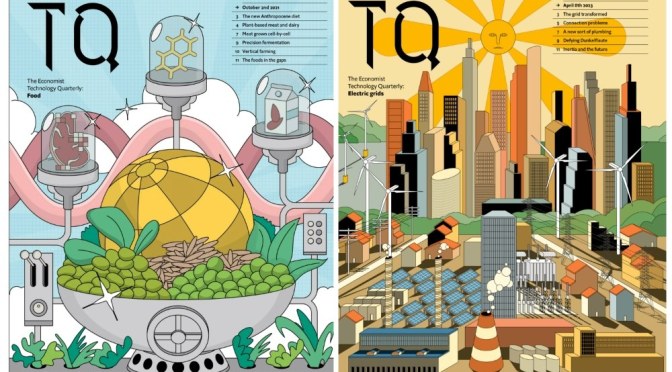
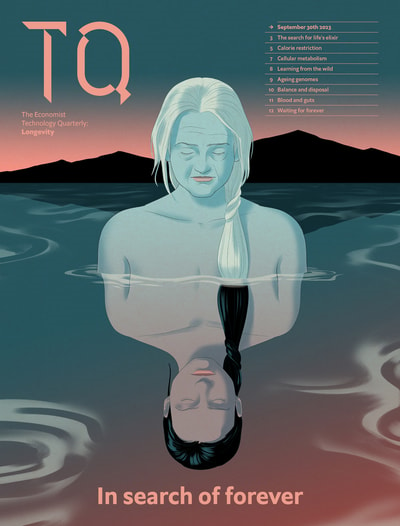
TECHNOLOGY QUARTERLY (SEPTEMBER 27, 2023) – The new issue features ‘In search of forever’ – Slowing, let alone reversing, the process of ageing was once alchemical fantasy. Now it is a subject of serious research and investment, Geoffrey Carr reports.

Slowing human ageing is now the subject of serious research

A horizontal sand timer with an elderly woman and a girl on each side looking at each other

And some of it is making progress, writes Geoffrey Carr

“All my possessions for a moment of time.” Those, supposedly, were the last words of Elizabeth I, who as queen of England had enough possessions to be one of the richest women of her era. Given her patronage of alchemists—who searched, among other things, for an elixir of life—she may have meant it literally. But to no avail. She had her last moment of time in March 1603, a few months short of the three score years and ten asserted by the Bible to be “the days of our years”.

Eating fewer calories can ward off ageing

A hand holding a fork with tiny vegetables on it

And various existing medicines may offer similar benefits

In 1991 eight volunteers sealed themselves into a huge greenhouse in the desert near Tucson, Arizona. They were part of an experiment seeking to discover whether a carefully curated selection of plants and animals could develop into a self-sustaining ecosystem: a “Biosphere 2” independent of “Biosphere 1”, aka the outside world.

Analysis: Meta, PayPal & X Race To Build A ‘Super App’

Wall Street Journal (September 7, 2023) – Meta. PayPal. X. All of these tech companies have made attempts at a “super app” in the U.S., following the success of WeChat in China, but have yet to get one off the ground. Tech leaders have struggled to combine elements like social media, messaging, payment and more into one place.

Video timeline: 0:00 App efficiency 0:37 The appeal 2:18 U.S. issues 4:03 Regulation 4:48 What’s next?

So what’s holding the U.S. back from having a super app available? WSJ explains why, despite challenges, companies still see it as their holy grail product.

#Superapp#WeChat#WSJ

World Economic Forum: Top Stories – Sept 2, 2023

World Economic Forum (September 2, 2023) – This week’s top stories of the week include:

0:15 India lands a spacecraft on the moon – India made history by landing a spacecraft on the Moon’s south pole for the first time. The mission, called Chandrayaan-3, is designed to search for water ice on the Moon. The data and images collected by the lander and rover will help scientists to better understand the Moon’s water resources and the future of Moon exploration.

1:11 These are the results of an 85 year study on happiness – The Harvard Study of Adult Development is the world’s longest-running happiness study. It launched in 1938, following 724 men from teenagehood to old age. Later, the study incorporated their spouses and 1,300 of their descendants. Participants answer regular questions about their health, habits, income and relationships as well as their hopes, joys, disappointments and regrets.

2:43 GPUs are powering the AI revolution – The H100 is a graphics processing unit (GPU) chip manufactured by Nvidia. It is the most powerful GPU chip on the market and is designed specifically for artificial intelligence (AI) applications. The H100 is in high demand due to its powerful performance and its ability to accelerate AI applications.

4:50 Britain builds its first women-only apartment building – It will offer 102 flats at affordable rates for women facing abuse or social disadvantage. The block will stand in Ealing, West London. The flats will be designed specifically for women with features such as lower kitchen counters and ventilation for menopausal women experiencing hot flushes. Only single women can take a tenancy. Men can live there too but only if they’re in a relationship with a tenant. Transgender women will be allowed but nobody with a history of violence against women.

_____________________________________________

The World Economic Forum is the International Organization for Public-Private Cooperation. The Forum engages the foremost political, business, cultural and other leaders of society to shape global, regional and industry agendas. We believe that progress happens by bringing together people from all walks of life who have the drive and the influence to make positive change.

World Economic Forum: Top Stories- Aug 26, 2023

World Economic Forum (August 26, 2023) – This week’s top stories of the week include:

0:15 Scientists develop concrete battery – It could one day be built into the foundations of homes or incorporated into a roadway so electric cars can charge contactlessly as they drive. MIT researchers discovered a new ‘supercapacitor’ by combining cement with carbon black. A sooty residue left over when things burn, and mixing them both with water.

1:48 3 farmers tell how heat is affecting their crops – Experts rank the food supply crisis as one of the world’s top 5 currently manifesting risks. This German farmer has started planting lavender. It’s best suited to the sandy soils and sunshine of the Mediterranean but climate change is bringing these conditions to southern Germany. The lavender is used in cosmetics and perfumes. Matthias Tafelmeier planted his first lavender crop in 2019 after what he says was a decade of declining soil quality. Farmers in the region are also trying other crops more suited to warmer climates such as chickpeas and kidney beans.

3:25 Smartwatch detects Parkinson’s 7 years early – By keeping track of our movement, they can help doctors spot who is vulnerable, years before visible symptoms show up. Cardiff University scientists looked at data from 100,000 smartwatch wearers. Tracking their speed of movement over a single week between 2013 and 2016. Using AI, the team could distinguish those who went on to develop Parkinson’s from those who didn’t and detect early signs up to 7 years in advance.

5:04 Cleaning your house can help tidy your mind – “Cleaning is a great practice, which reminds you of the connection with the ground and the Earth and the universe.” To Buddhists, cleaning is not just cleaning. In Zen Buddhism, it’s known as samu, or work practice and it offers the chance to meditate and be present in the midst of daily tasks.

_____________________________________________

The World Economic Forum is the International Organization for Public-Private Cooperation. The Forum engages the foremost political, business, cultural and other leaders of society to shape global, regional and industry agendas. We believe that progress happens by bringing together people from all walks of life who have the drive and the influence to make positive change.

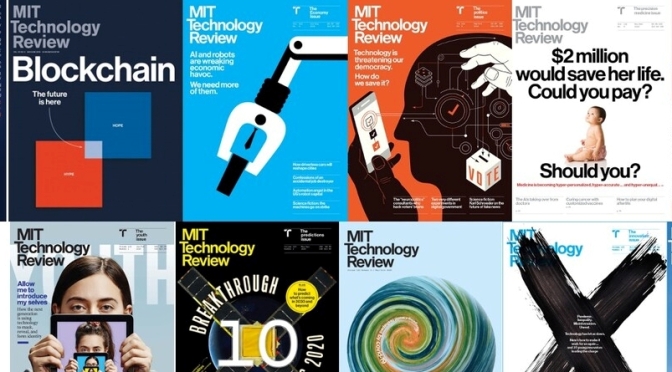
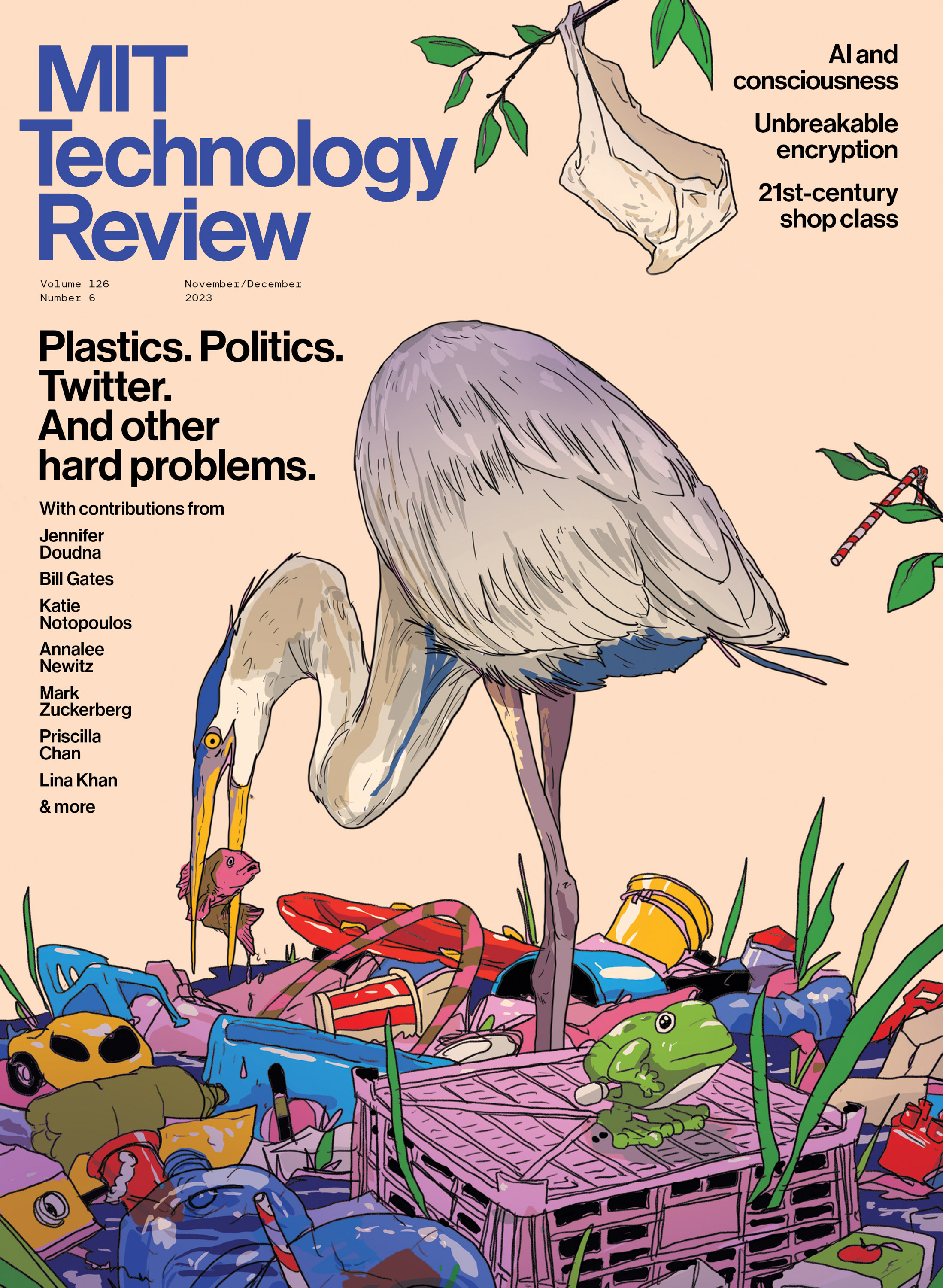
Preview: MIT Technology Review – September 2023

Image

MIT Technology Review – September/October 2023: ‘The Ethics issue’ features Experimental Drugs – Who should get them?; Eric Schmidt on transforming science; When AI goes to war, and more…

Who gets to decide who receives experimental medical treatments?

a bottle of pills with a "fast forward" icon on the label

For many patients, pushing for access to unproven treatments is their best chance of survival. And that’s worth the risk.

Previews: The New Yorker Magazine – August 28, 2023

A colorful woman eats watermelon.

The New Yorker – August 28, 2023 issue: This week’s cover features Olimpia Zagnoli’s “Cocomero”, the vibrant throes of summertime.

Elon Musk’s Shadow Rule

Elon Musk holding the earth between his fingers.

How the U.S. government came to rely on the tech billionaire—and is now struggling to rein him in.

By Ronan Farrow

Last October, Colin Kahl, then the Under-Secretary of Defense for Policy at the Pentagon, sat in a hotel in Paris and prepared to make a call to avert disaster in Ukraine. A staffer handed him an iPhone—in part to avoid inviting an onslaught of late-night texts and colorful emojis on Kahl’s own phone. Kahl had returned to his room, with its heavy drapery and distant view of the Eiffel Tower, after a day of meetings with officials from the United Kingdom, France, and Germany. A senior defense official told me that Kahl was surprised by whom he was about to contact: “He was, like, ‘Why am I calling Elon Musk?’ ”

The Mysteries of Pittsburgh

Herzog in an attic with industrial chimneys behind.

I was searching for truth. Instead, I found a family.

By Werner Herzog

By the time I was twenty-one, I had made two short films and was dead set on making a feature. I had gone to a distinguished school in Munich, where I had few friends, and which I hated so passionately that I imagined setting it on fire. There is such a thing as academic intelligence, and I didn’t have it. Intelligence is always a bundle of qualities: logical thought, articulacy, originality, memory, musicality, sensitivity, speed of association, and so on. In my case, the bundle seemed to be differently composed. I remember asking a fellow-student to write a term paper for me, which he did quite easily. In jest, he asked me what I would do for him in return, and I promised that I would make him immortal. His name was Hauke Stroszek. I gave his last name to the main character in my first film, “Signs of Life.” I called another film “Stroszek.”