BY INTELLICUREAN, JULY 21, 2025:
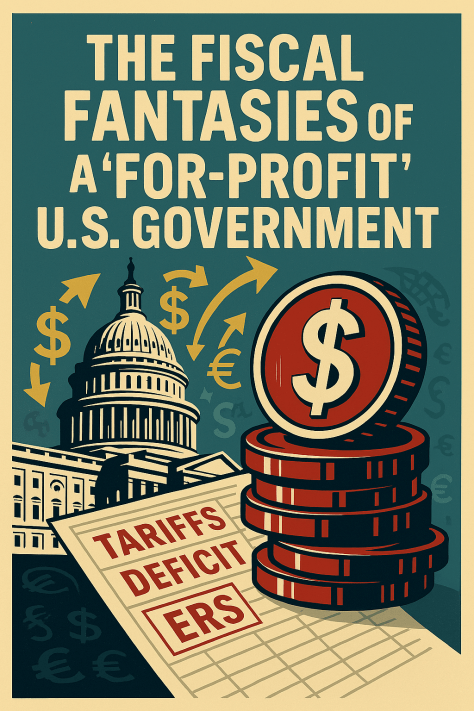
In the summer of 2025, former President Donald Trump and Commerce Secretary Howard Lutnick unveiled a bold proposal: the creation of an External Revenue Service (ERS), a federal agency designed to collect tariffs, fees, and other payments from foreign entities. Framed as a patriotic pivot toward self-sufficiency, the ERS would transform the U.S. government from a tax-funded service provider into a revenue-generating enterprise, capable of offsetting domestic tax burdens through external extraction. The idea, while politically magnetic, raises profound questions: Can the U.S. federal government become a “for-profit” entity? And if so, can the ERS be a legitimate mechanism for such a transformation?
This essay argues that while the concept of external revenue generation is not unprecedented, the rebranding of the U.S. government as a profit-seeking enterprise risks undermining its foundational principles. The ERS proposal conflates revenue with legitimacy, and profit with power, leading to a fundamental misunderstanding of the government’s role in society. We explore the constitutional, economic, and geopolitical dimensions of the ERS proposal, drawing on recent analyses from the Peterson Institute for International Economics, The Diplomat, and The New Yorker, to assess its fiscal viability, strategic risks, and national security implications.
Constitutional Foundations: Can a Republic Seek Profit?
The U.S. Constitution grants Congress the power to “lay and collect Taxes, Duties, Imposts and Excises” and to “regulate Commerce with foreign Nations” (Article I, Section 8). These provisions clearly authorize the federal government to generate revenue through tariffs and fees. Historically, tariffs served as a primary source of federal income, funding everything from infrastructure to military expansion during the 19th century.
However, the Constitution does not envision the government as a profit-maximizing entity. Its purpose, as articulated in the Preamble, is to “establish Justice, ensure domestic Tranquility, provide for the common defence, [and] promote the general Welfare.” These are public goods, not commercial outputs. The government’s legitimacy is grounded in its service to the people—not in its ability to generate surplus revenue.
The Federal Reserve offers a useful analogy here. While not a for-profit institution, the Fed earns more than it spends through its monetary operations—primarily interest on government securities—and remits excess income to the Treasury. Between 2011 and 2021, these remittances totaled over $920 billion. But this is not “profit” in the corporate sense. The Fed’s primary mandate is macroeconomic stability, not shareholder returns. Even during economic stress (as seen in 2022–2025), the Fed may run negative remittances, underscoring its non-commercial orientation.
In contrast, the ERS is framed as a profit center—an entity designed to extract wealth from foreign actors to reduce domestic tax burdens. This shift raises critical questions: Who are the “customers” of the ERS? What are the “products” it offers? And what happens when profit motives collide with diplomatic or humanitarian priorities?
Economic Modeling: Revenue vs. Net Gain
A rigorous analysis of Trump’s proposed tariffs comes from Chad P. Bown and Melina Kolb at the Peterson Institute for International Economics. In their April 2025 briefing, they use a global economic model to estimate the gross and net revenue generated by tariffs of 10%, 15%, and 20% on all imported goods.
Their findings are sobering:
- A 15% universal tariff could generate $3.9 trillion in gross revenue over a decade (2025–2034), assuming no foreign retaliation.
- However, after accounting for slower growth, reduced investment, and lower tax receipts from households and businesses, the net gain drops to $3.2 trillion.
- If foreign countries retaliate with reciprocal tariffs, the net gain falls further to $1.5 trillion.
- A 20% tariff results in the lowest net gain ($791 billion), due to intensified economic drag and retaliation.
These findings underscore a crucial distinction: tariffs are not free money. They impose costs on consumers, disrupt supply chains, and invite countermeasures. The ERS may collect billions, but its net contribution to fiscal health is far more modest—and potentially negative if retaliation escalates.
Additionally, tariff revenue is volatile and politically contingent. Tariffs can be reversed by executive order, invalidated by courts, or rendered moot by trade realignment. In short, the ERS lacks the predictability and stability necessary for a legitimate fiscal foundation. Tariffs are a risky and politically charged mechanism for revenue generation—making them an unreliable cornerstone for the country’s fiscal health.
Strategic Blowback: Reverse Friendshoring and Supply Chain Drift
Beyond economics, the ERS proposal carries significant geopolitical risks. In The Diplomat, Thiago de Aragao warns of a phenomenon he calls reverse friendshoring—where companies, instead of relocating supply chains away from China, move closer to it in response to U.S. tariffs.
The logic is simple: If exporting to the U.S. becomes prohibitively expensive, firms may pivot to serving Asian markets, leveraging China’s mature infrastructure and consumer base. This could undermine the strategic goal of decoupling from Chinese influence, potentially strengthening Beijing’s economic hand.
Examples abound:
- A firm that invested in Mexico to reduce exposure to China redirected its exports to Latin America after Mexico was hit with new tariffs.
- Another company shifted operations to Canada to avoid compounded U.S. duties—only to face new levies there as well.
This unpredictability erodes trust in U.S. trade policy and incentivizes supply chain diversification away from the U.S. As Aragao notes, “Protectionism may offer a temporary illusion of control, but in the long run, it risks pushing businesses away.”
The ERS, by monetizing tariffs, could accelerate this trend. If foreign firms perceive the U.S. as a hostile or unstable market, they will seek alternatives. And if allies are treated as adversaries, the strategic architecture of friendshoring collapses, leaving the U.S. economically isolated and diplomatically weakened.
National Security Costs: Alienating Allies
Perhaps the most damning critique of the ERS comes from Cullen Hendrix at the Peterson Institute, who argues that imposing tariffs on U.S. allies undermines national security. The U.S. alliance network spans over 60 countries, accounting for 38% of global GDP. These partnerships enhance deterrence, enable forward basing, and create markets for U.S. defense exports.
Tariffs—especially those framed as revenue tools—erode alliance cohesion. They signal that economic extraction trumps strategic cooperation. Hendrix warns that “treating alliance partners like trade adversaries will further increase intra-alliance frictions, weaken collective deterrence, and invite potential adversaries—none better positioned than China—to exploit these divisions.”
Moreover, the ERS’s indiscriminate approach—levying duties on both allies and rivals—blurs the line between economic policy and coercive diplomacy. It transforms trade into a zero-sum game, where even friends are fair targets. This undermines the credibility of U.S. commitments and may prompt allies to seek alternative trade and security arrangements.
Lutnick’s Barber Economics: Rhetoric vs. Reality
The ERS proposal is not merely a policy—it’s a performance. Nowhere is this clearer than in Howard Lutnick’s keynote at the Hill and Valley Forum, as reported in The New Yorker on July 21, 2025. Addressing a room of venture capitalists, defense contractors, and policymakers, Lutnick attempted to explain trade deficits using personal analogies: “I have a trade deficit with my barber,” he said. “I have a trade deficit with my grocery store. Right? I just buy stuff from them. That’s ridiculous.”
The crowd, described as “sophisticated tech and finance attendees,” was visibly uncomfortable. Lutnick’s analogies, while populist in tone, misread the room and revealed a deeper disconnect between economic complexity and simplistic transactionalism. As one attendee noted, “It’s obvious why Lutnick’s affect appeals to Trump. But it’s Bessent’s presence in the Administration that reassures us there is someone smart looking out for us.”
This contrast between Lutnick and Treasury Secretary Scott Bessent is telling. Bessent, who reportedly flew to Mar-a-Lago to urge Trump to pause the tariffs, represents the limits of ideological fervor when confronted with institutional complexity. Lutnick, by contrast, champions the ERS as a populist vessel—a way to turn deficits into dues, relationships into revenue, and governance into a business plan.
The ERS, then, is not just a fiscal experiment—it’s a philosophical battleground. Lutnick’s vision of government as a money-making enterprise may resonate with populist frustration, but it risks trivializing the structural and diplomatic intricacies of global trade. His “barber economics” may play well on cable news, but it falters under scrutiny from economists, allies, and institutional stewards.
Conclusion: Profit Is Not Purpose
The idea of a “for-profit” U.S. government, embodied in the External Revenue Service, is seductive in its simplicity. It promises fiscal relief without domestic taxation, strategic leverage through economic pressure, and a reassertion of American dominance in global trade. But beneath the surface lies a tangle of contradictions.
Constitutionally, the federal government is designed to serve—not to sell. Its legitimacy flows from the consent of the governed, not the extraction of foreign wealth. Economically, tariffs may generate gross revenue, but their net contribution is constrained by retaliation, inflation, and supply chain disruption. Strategically, the ERS risks alienating allies, incentivizing reverse friendshoring, and weakening collective security.
With Howard Lutnick as the plan’s leading voice—offering anecdotes like the barber and grocery store as proxies for international trade—the ERS becomes more than a revenue mechanism; it becomes a prism for reflecting the Administration’s governing style: transactional, simplified, and rhetorically appealing, yet divorced from systemic nuance. His “barber economics” may evoke applause from certain circles, but in the forums that shape long-term policy, it has landed with discomfort and disbelief.
The comparison between Lutnick and Treasury Secretary Scott Bessent, as reported in The New Yorker, captures this divide. Bessent, attempting to temper Trump’s protectionist instincts, represents the limits of ideological fervor when confronted with institutional complexity. Lutnick, by contrast, champions the ERS as a populist vessel—a way to turn deficits into dues, relationships into revenue, and governance into a business plan.
Yet governance is not a business, and the nation’s global responsibilities cannot be monetized like a corporate balance sheet. If America begins to treat its allies as clients, its rivals as profit centers, and its global footprint as a monetizable asset, it risks transforming foreign policy into a ledger—and leadership into a transaction.
The External Revenue Service, in its current form, fails to reconcile profit with purpose. It monetizes strength but neglects stewardship. It harvests dollars but undermines trust. And in doing so, it invites a broader reckoning—not just about trade and taxation, but about what kind of republic America wishes to be. For now, the ERS remains an emblem of ambition unmoored from architecture, where the dream of profit collides with the duty to govern.
THIS ESSAY WAS WRITTEN AND EDITED BY INTELLICUREAN USING AI





 Boomers Daily