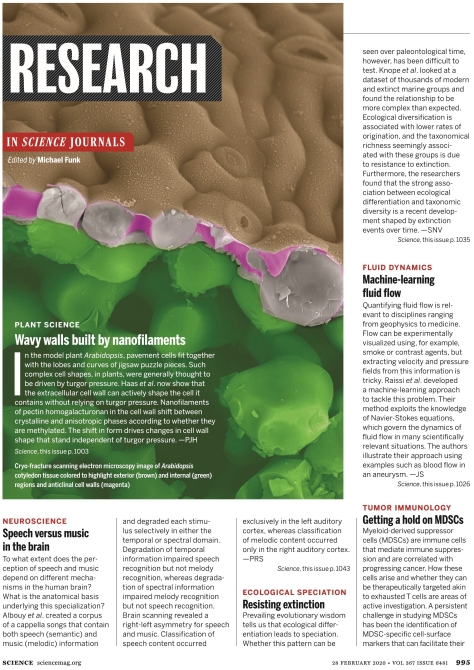


But was this new ruler of a Maya city really from a separate culture? New techniques being used at the Tikal and Teotihuacan sites have revealed conflicting evidence as to whether Teotihuacan really held sway over a much larger region than previously estimated.
Sarah also talks with Rashid Sumaila, professor and Canada research chair in interdisciplinary ocean and fisheries economics at the University of British Columbia, Vancouver’s Institute for the Oceans and Fisheries. You may have heard of illegal fishing being bad for the environment or bad for maintaining fisheries—but as Sumaila and colleagues report this week in Science Advances, the illegal fishing trade is also incredibly costly—with gross revenues of between $8.9 billion and $17.2 billion each year.
This week, the brain pathways of egg laying in fruit flies, preventing fractures in metallic glass, moth’s fuzz as superior acoustic camouflage and a coronavirus update.In this episode:
00:46 Working out the wiring behind fruit fly behaviour
Researchers have identified a neural circuit linking mating and egg laying in female fruit flies. Research Article: Wang et al.
06:01 Research Highlights
Ancient, cave-dwelling cockroaches, and hairy moths dampen sound. Research Highlight: Cockroaches preserved in amber are the world’s oldest cave dwellers; Research Highlight: Stealth flyers: moths’ fuzz is superior acoustic camouflage
07:57 Making better metallic glass
Metallic glasses have many desirable properties, but these materials are prone to fracturing. Now, a new manufacturing process may have overcome this issue. Research article: Pan et al.; News and Views: Metallic glasses rejuvenated to harden under strain
13:47 News Chat
Coronavirus outbreak updates, a survey shows Indian bird numbers are in decline, and the genomes of New York rats. News: Coronavirus: latest news on spreading infection; News: Hundreds of bird species in India are declining; News: Genomes reveal how New York City’s rats thrive in the urban jungle
On this week’s show, Staff Writer Robert F. Service talks with host Sarah Crespi about manipulating microbes to make them produce building materials like bricks—and walls that can take toxins out of the air.
Sarah also talks with Paul Davids, principal member of the technical staff in applied photonics & microsystems at Sandia National Laboratories, about an innovation in converting waste heat to electricity that uses similar materials to solar cells but depends on quantum tunneling. And in a bonus segment, producer Meagan Cantwell talks with Online News Editor David Grimm on stage at the AAAS annual meeting in Seattle.
They discuss how wildfires can harm your lungs, crime rates in so-called sanctuary states, and how factors such as your gender and country of origin influence how much trust you put in science.
This week, machine learning helps batteries charge faster, and using bacterial nanowires to generate electricity from thin air.In this episode:
00:46 Better battery charging
A machine learning algorithm reveals how to quickly charge batteries without damaging them. Research Article: Attia et al.
07:12 Research Highlights
Deciphering mouse chit-chat, and strengthening soy glue. Research Highlight: The ‘silent’ language of mice is decoded at last; Research Article: Gu et al.
09:21 Harnessing humidity
A new device produces electricity using water in the air. Research Article: Liu et al.
16:30 News Chat
Coronavirus outbreak updates, the global push to conserve biodiversity, and radar reveals secrets in an ancient Egyptian tomb. News: Coronavirus: latest news on spreading infection; News: China takes centre stage in global biodiversity push
On this week’s show, senior correspondent Jeffrey Mervis joins host Sarah Crespi to discuss a new National Institutes of Health (NIH) grant program that aims to encourage diversity at the level of university faculty with the long-range goal of increasing the diversity of NIH grant recipients.
Sarah also talks with Pierre Gagnepain, a cognitive neuroscientist at INSERM, the French biomedical research agency, about the role of memory suppression in post-traumatic stress disorder. Could people that are better at suppressing memories be more resilient to the aftermath of trauma?
Hear the latest from the world of science, brought to you by Nick Howe and Shamini Bundell. This week, uncovering the structure of materials with useful properties, and quantum entanglement over long distances.
In this episode:
Analogues of the paint pigment Prussian blue are used in a variety of chemical processes. Now, researchers have uncovered their atomic structure. Research Article: Simonov et al.; News and Views: Ordered absences observed in porous framework materials
Teenagers’ natural sleep cycles impact on academic performance, and an extinct, giant rodent with a surprisingly tiny brain. Research Highlight: A teenager’s body clock can ring in school success; Research Highlight: Giant extinct rodent was all brawn and little brain
Researchers have demonstrated quantum entanglement between two points separated by 50 km of fibre optic cables. Research Article: Yu et al.
The latest on the coronavirus outbreak, and gene editing gets an upgrade. News: Coronavirus: latest news on spreading infection; News: Super-precise CRISPR tool enhanced by enzyme engineering
On this week’s show, Staff Writer Jennifer Couzin-Frankel joins host Sarah Crespi to talk about a Science paper that combines two hot areas of research—CRISPR gene editing and immunotherapy for cancer—and tests it in patients.
Sarah also talks with Damien Finch, a Ph.D. candidate in the School of Earth Sciences at the University of Melbourne, about the Kimberly region of Australia and dating its ice age cave paintings using charcoal from nearby wasp nests.
From a CalTech news article (February 4, 2020):
The hope, Lee says, is that ultrasound will kill cancer cells in a specific way that will also engage the immune system and arouse it to attack any cancer cells remaining after the treatment.
A new technique could offer a targeted approach to fighting cancer: low-intensity pulses of ultrasound have been shown to selectively kill cancer cells while leaving normal cells unharmed.
Ultrasound waves—sound waves with frequencies higher than humans can hear—have been used as a cancer treatment before, albeit in a broad-brush approach: high-intensity bursts of ultrasound can heat up tissue, killing cancer and normal cells in a target area. Now, scientists and engineers are exploring the use of low-intensity pulsed ultrasound (LIPUS) in an effort to create a more selective treatment.
A study describing the effectiveness of the new approach in cell models was published in Applied Physics Letters on January 7. The researchers behind the work caution that it is still preliminary—it still has not been tested in a live animal let alone in a human, and there remain several key challenges to address—but the results so far are promising.