The Globalist Podcast, Monday, August 7 2023: We discuss the events from the Ukraine peace summit in Jeddah and find out about Niger’s emboldened Islamic insurgents following the country’s coup.
Also, the latest fashion news and flick through the day’s papers.
The Globalist Podcast, Tuesday, August1, 2023: Italy is the latest European country to rethink ties with China. Also, Israel proposes a new rail line to Saudi Arabia, and the latest theatre news.
The Globalist Podcast, Thursday, July 20, 2023: MI6 invites dissident Russians to spy for Britain and Putin agrees not to attend the BRICS summit in Johannesburg.
Also in the programme: We discuss the anti-government protests in Peru and look ahead to the Women’s World Cup in Australia and New Zealand.
The Globalist Podcast, Wednesday, July 19, 2023: A US national is detained in North Korea and Washington deploys submarines near Busan, South Korea. Hazel Smith of Soas University of London explains the situation.
Plus: Saudi Arabia signs a major arms deal with Turkey and Germany recommends an unusual solution for extreme heat.
The Globalist Podcast, Tuesday, June 27, 2023: New Zealand’s prime minister, Chris Hipkins, visits China for trade talks as Saudi Arabia sends a top delegation to an economic forum in Tianjin.
Kiwi journalist Lisette Reymer and China analyst Isabel Hilton discuss what’s on the agenda and why Beijing is turning its attentions to the Middle East. Plus: the latest claims from Russian mercenary leader Yevgeny Progizhin and Guatemalans go to the polls in an election mired by democratic backsliding.
Plus: US secretary of state Antony Blinken visits Saudi Arabia, Brazil says goodbye to a bossa nova legend and why the French military working with science-fiction writers.
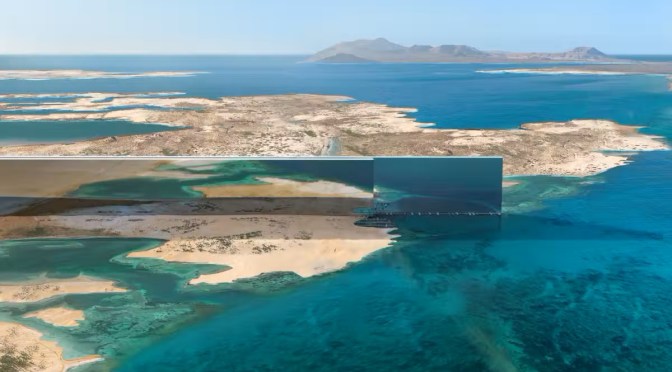
The Line is a proposed smart linear city in Saudi Arabia in Neom, Tabuk, currently under construction, which is designed to have no cars, streets or carbon emissions.
The Line is being described as a one-building vertical city outfitted with exterior mirrors, big enough to house 9 million people — along with everything they need, from parks and waterfalls to flying taxis and robot maids. There are even plans to include an artificial moon for residents to gaze upon.
With its proposed width of only 656 feet, The Line will rely primarily on its height to encompass its residents and a host of modern trappings, such as a high-speed rail to connect sections of the 106-mile city. Saudi Arabian officials claim The Line will be otherwise devoid of roads, cars or emissions and will be powered strictly by clean energy (although details have not been released). Here are a few of most notable proposed features of The Line:
A selection of three essential articles read aloud from the latest issue of The Economist. This week, a new-look Gulf, Vladimir Putin’s partial mobilization (10:45), and the Google-Meta advertising duopoly (15:00).
A selection of three essential articles read aloud from the latest issue of The Economist. This week, MBS: despot in the desert, the era of big-tech exceptionalism may be over (49:05), and why it’s OK not to be perfect at work (55:30).
No roads, cars or emissions, it will run on 100% renewable energy and 95% of land will be preserved for nature. People’s health and wellbeing will be prioritized over transportation and infrastructure, unlike traditional cities. Only 200 meters wide, but 170 kilometers long and 500 meters above sea level.
THE LINE will eventually accommodate 9 million people and will be built on a footprint of just 34 square kilometers. This will mean a reduced infrastructure footprint, creating never-before-seen efficiencies in city functions. The ideal climate all-year-round will ensure that residents can enjoy the surrounding nature. Residents will also have access to all facilities within a five-minute walk, in addition to high-speed rail – with an end-to-end transit of 20 minutes.
News, Views and Reviews For The Intellectually Curious


 Boomers Daily