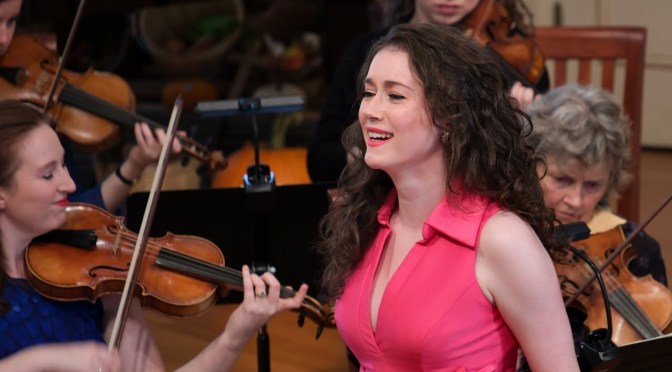
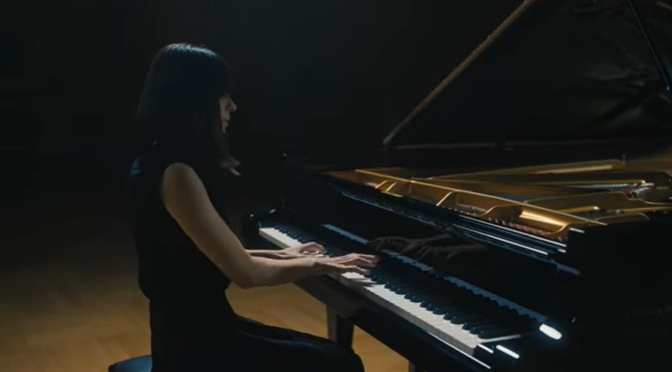
Voices of Music (October 12, 2024): Mozart’s motet Exsultate Jubilate, performed on original instruments by the award winning Early Music ensemble Voices of Music. Nola Richardson, soprano. The complete is work presented here for the first time in 8K video on period instruments.
Video timeline: 0:00 I. Exsultate Jubilate 5:00 II. Recit: Fulget amica dies 6:04 III. Aria: Tu Virginum Corona 13:11 IV. Alleluia 16:05 Credits
Reconstruction of the recitative: directors Hanneke van Proosdij and David Tayler reconstructed the recitativo accompagnato string parts from Mozart’s continuo part, and this receives its world premiere here. Months after completing the Divertimento in D Major,
Leopold and Wolfgang Mozart left for their third tour of Italy, with a first stop in Milan. There they met the soprano castrato, composer, and harpsichordist Venanzio Rauzzini, who was cast as one of the leads in Wolfgang Mozart’s new opera Lucio Silla opposite the prima donna Anna Lucia de Amicis.
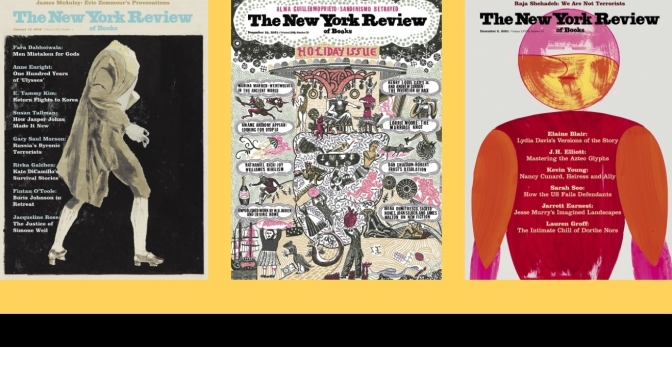
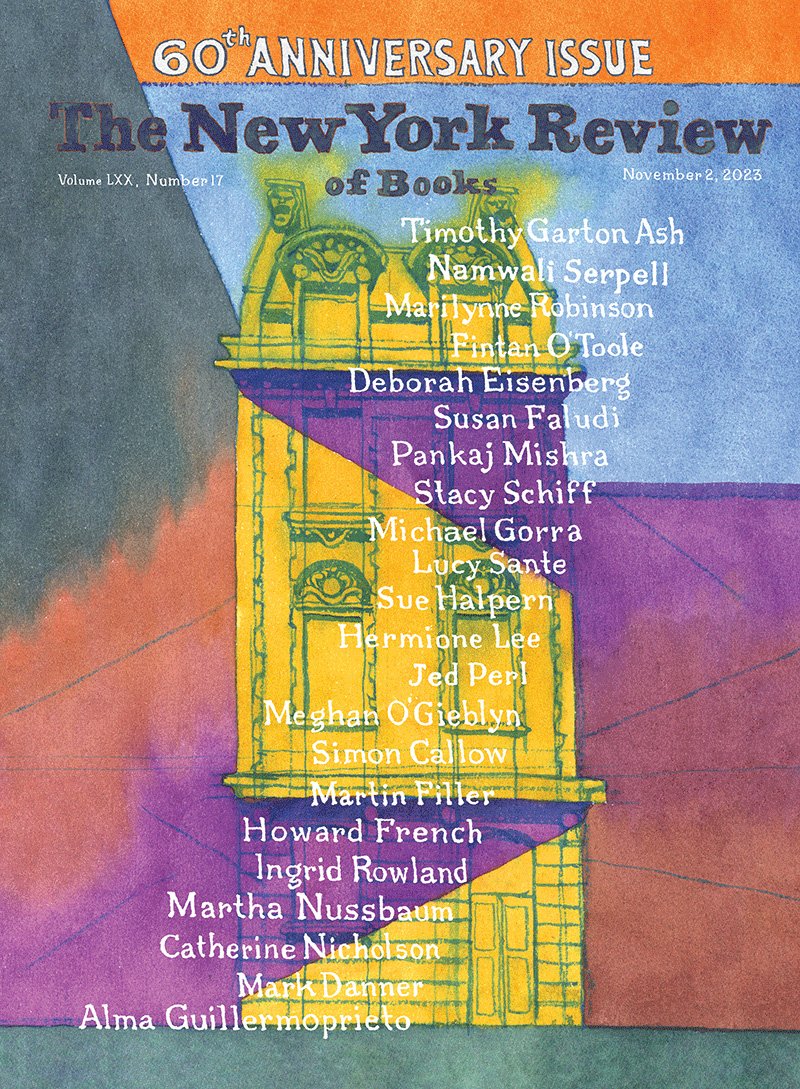
The New York Review of Books (November 2, 2023) – The latest features the 60th Anniversary Issue— with Pankaj Mishra on writing in the face of fascism, Lucy Sante on the kaleidoscopic Blaise Cendrars, Fintan O’Toole on the battles over wokeness, Deborah Eisenberg on the enchantments of Elsa Morante, Timothy Garton Ash on the dream of a free Europe, Simon Callow on vertiginous Mozart, Jed Perl on the Warholization of Picasso, Marilynne Robinson on Iowa’s tattered ideals, Catherine Nicholson on Shakespeare’s First Folio, Susan Faludi on abortion in the nineteenth century, Martha Nussbaum on the rights of whales, poems by Anne Carson and Ishion Hutchinson, and much more.
Uwe Wittstock’s new account of writers considering whether to flee or to remain in Germany during Hitler’s rise to power sheds light on the choices faced by many writers in India and Russia today.
by Uwe Wittstock, translated from the German by Daniel Bowles
“It will have become clear to you now,” Joseph Roth wrote to Stefan Zweig in mid-February 1933, “that we are heading for a great catastrophe.” Two weeks previously, on January 30, Germany’s eighty-five-year-old president, Paul von Hindenburg, had appointed as chancellor a man who for more than a decade had spoken and written frankly about his resolve to extirpate democracy and Jews from the country. Roth, who left Berlin the same morning Adolf Hitler came to power and never returned to Germany, was desperate to make his complacent friend recognize the perils before them.
Biographies of composers are a relatively recent genre; those of Mozart were among the first examples.Though his life was not as sensational as that of Gesualdo, for example, who murdered his wife, Mozart was, from his early years, an international celebrity whose very personality posed questions beyond the eternal riddle of creativity. How could a mere child—he started performing publicly on the clavichord at the age of six—be so astoundingly versatile? As he toured Europe, going from court to court and salon to salon with his father, Leopold, and his older sister, Maria Anna—a talented musician as well—the delightful little boy in his nattily embroidered outfits enchanted his listeners, readily obliging them with requests, however crass: now playing with the keys covered, now with only one finger, to delighted applause.
Brilliant Classics (September 1, 2023): New classical music from Chopin, Rachmaninoff, Mozart, J.S. Bach and lesser known but still excellent composers.
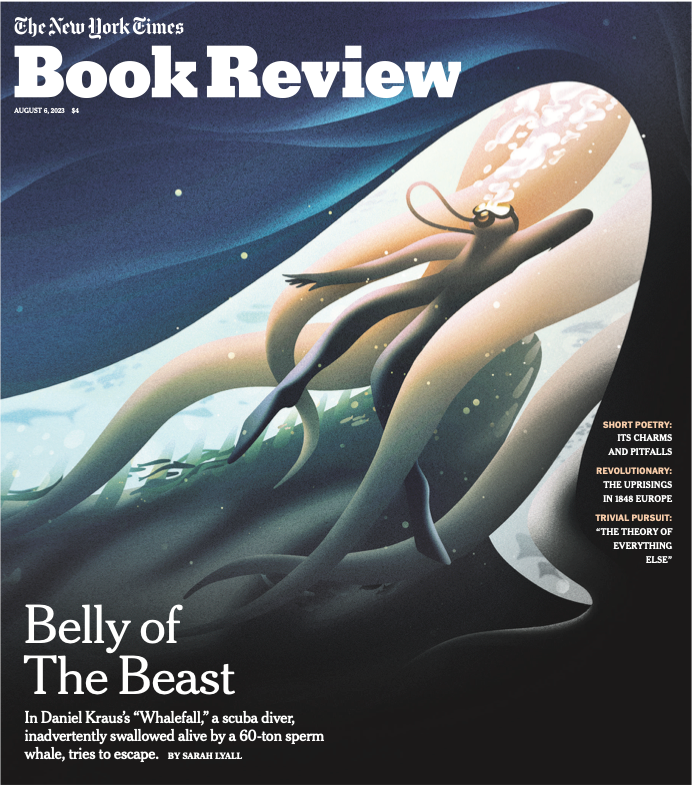
In marine biology, a whale fall is the body of a dead whale that has slowly descended to the bottom of the ocean. Scavengers strip its flesh, crustaceans and other creatures colonize its skeleton and its decaying bones help sustain countless organisms for years to come, part of the delicate balance of the undersea ecosystem.
While Billy Wilder’s 1957 film adaptation portrays Ariane (played by Audrey Hepburn) as a doe-eyed ingénue, Claude Anet’s original character is considerably more enigmatic. Credit…Allied Artists/Getty Images
Reading Claude Anet’s provocative 1920 novel “Ariane: A Russian Girl,” the reader may yearn for a little less conversation.
By Gemma Sieff
It would be nice if we had put to bed, so to speak, witless and reductive double standards about female promiscuity. Have you heard the one that goes, “A key that opens many locks is a master key, yet a lock that is opened by many keys” is … unprintably bad? Me neither — until I saw it on TikTok.
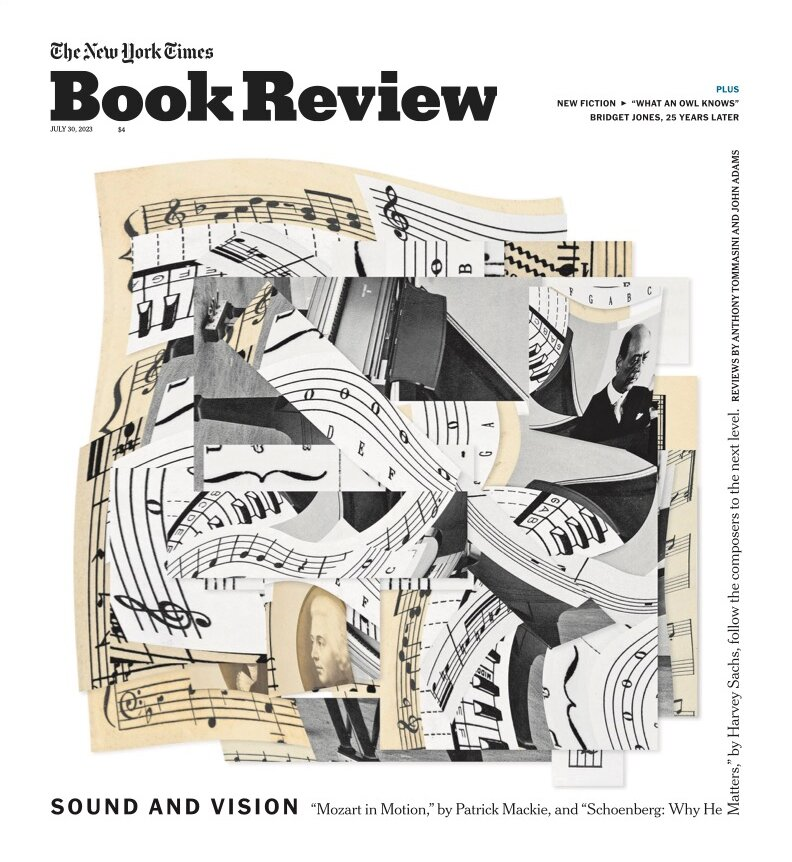
On this week’s cover, we feature biographies of composers Arnold Schoenberg and Wolfgang Amadeus Mozart that emphasize the extent to which each was a singular genius attuned to his culture and times; our reviews are by Anthony Tommasini (formerly The Times’s chief classical music critic) and the composer John Adams.
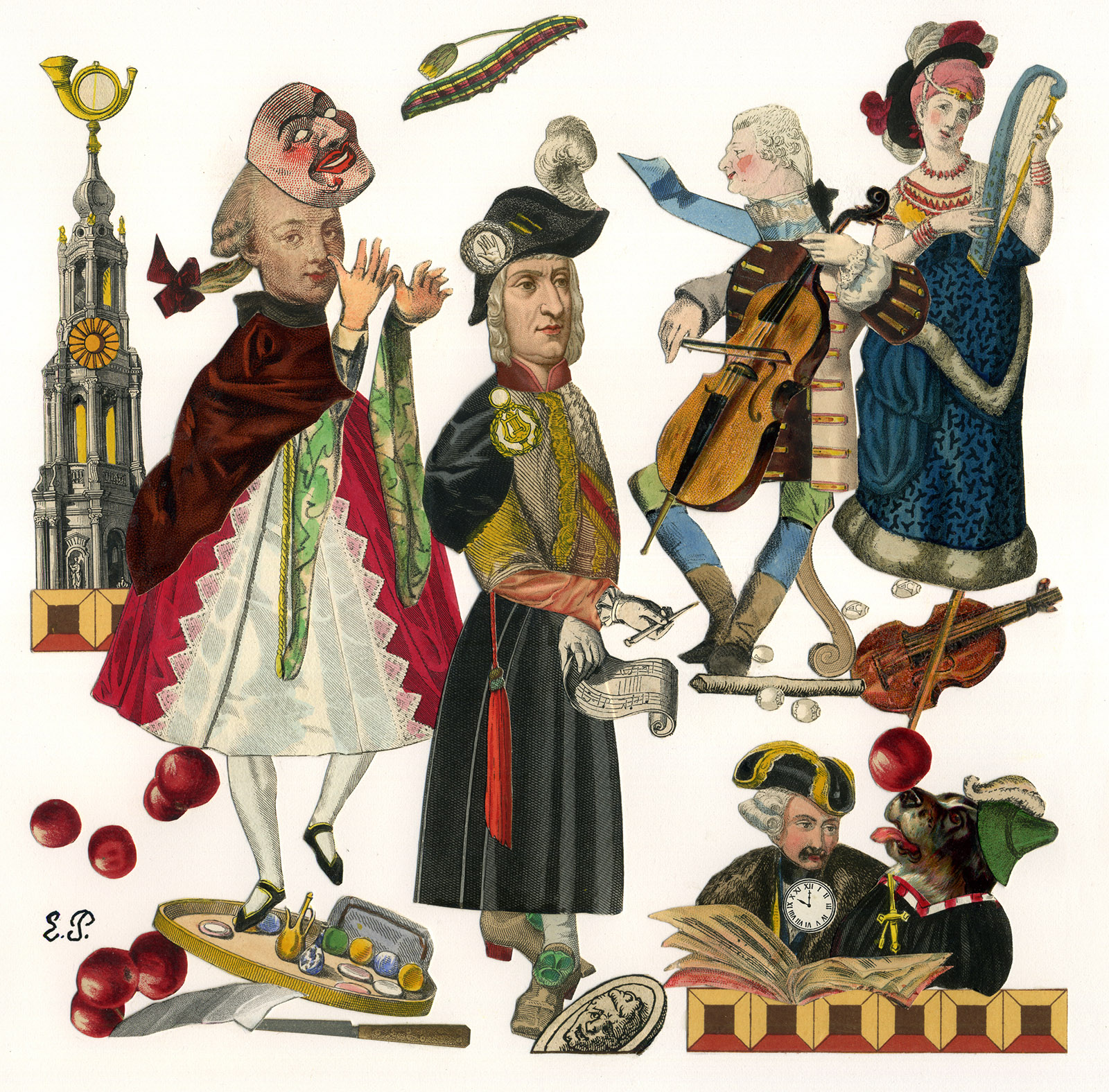
In Patrick Mackie’s “Mozart in Motion,” the socially observant composer embraces modernity.
Musicians tend to be wary of ascribing specific meanings to music or making too much of a piece’s extra-musical associations. In one of his Norton Lectures at Harvard in 1973, turning to Beethoven’s “Pastoral” Symphony, Leonard Bernstein asked the audience to forget all about “birds and brooks and rustic pleasures” and instead concentrate on “pure” music. He then demonstrated how every phrase of the entire first movement is derived from little motifs of notes and rhythms in the first four bars of the score.
John Adams reviews “Schoenberg: Why He Matters,” in which Harvey Sachs explores the artistic, academic and spiritual life of a 20th-century cultural giant.
In 1955 Henry Pleasants, a critic of both popular and classical music, issued a cranky screed of a book, “The Agony of Modern Music,” which opened with the implacable verdict that “serious music is a dead art.” Pleasants’s thesis was that the traditional forms of classical music — opera, oratorio, orchestral and chamber music, all constructions of a bygone era — no longer related to the experience of our modern lives. Composers had lost touch with the currents of popular taste, and popular music,
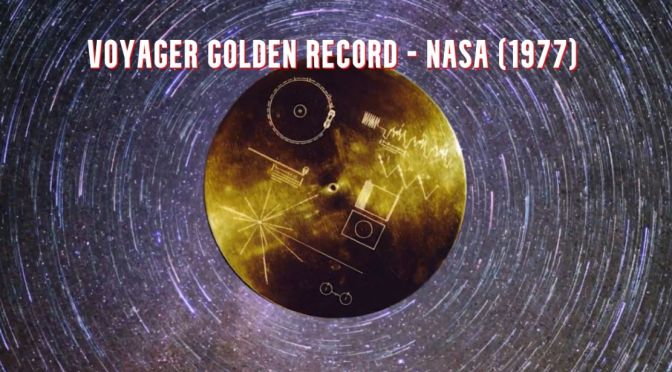
Sotheby’s (July 20, 2023) – The Voyager Golden Record is a unique audio-visual time capsule developed by NASA and affixed to the Voyager 1 and 2 spacecrafts.
Designed to communicate to possible space-faring civilizations something of the diversity of life and culture on our world, the Golden Record consisted of greetings in 59 human languages and those of the humpback whales, 115 images of life here, the sounds of Earth, and 27 pieces from the world’s musical traditions. It has been called the beginning of the concept of “world music.”
It was Voyager 1 that looked homeward from high above Neptune to take, at Carl Sagan’s behest, the iconic Pale Blue Dot photograph. Upon flawlessly completing the first phase of their mission, the NASA Voyagers 1 and 2 made for the open sea of interstellar space, teaching us the actual shape of our solar system as it moves through the galaxy. The Golden Record is an unparalleled document in the history of space exploration and our civilization.
“Mozart really belonged to the 19th century”, says Icelandic star-pianist Víkingur Ólafsson about Wolfgang Amadeus Mozart “He belonged to a new area, where the artist was a free thinker. Image, if he had lived a little longer and would have had a dialogue with Ludwig van Beethoven.”
Ólafsson has no doubt that Mozart was a so-called Wunderkind. “He did have a divine gift.” But to Ólafsson another aspect of Mozart’s music is even more fascinating. According to Ólafsson Mozart wrote his best works after the age of 25, when his life was in deep crisis and the Vienna aristocracy had turned its back on him.
“The greater the music became, the less popularity he had.” To Ólafsson Mozart’s legacy must be seen in the light of the tragedy. Víkingur Ólafsson grew up in Reykjavík and started playing the piano at an early age under the tutelage of his mother, a piano teacher. He studied at the Juilliard School in New York, earning bachelor’s and master’s degrees under the supervision of Jerome Lowenthal and Robert McDonald. He also took lessons with Ann Schein.
In 2011, Ólafsson was the soloist in the opening concert of Harpa in Reykjavik, playing Edvard Grieg’s piano concerto with the Iceland Symphony Orchestra. Since he has developed into one of the most recognized and award-winning artists within classical and contemporary music.
In 2016, Víkingur signed an exclusive recording contract with the renowned label Deutsche Grammophon releasing four albums featuring the music of Philip Glass, Johann Sebastian Bach, Debussy & Rameau as well as Mozart & Contemporaries. Ólafsson has collaborated with many contemporary artists among them John Adams, Philipp Glass, Daniel Bjarnason and Icelandic singer Bjørk. He has also recorded the soundtrack of Darkest Hour, a film directed by Joe Wright, and released Bach Reworks, featuring six ‘remixed’ works by Johann Sebastian Bach from the likes of Ben Frost, Peter Gregson, Valgeir Sigurdsson as well as Ólafsson himself.
Víkingur Ólafsson was interviewed by Marc-Christoph Wagner at the Louisiana Museum of Modern Art in November 2021. Camera: Jarl Therkelsen Kaldan Edited by: Jarl Therkelsen Kaldan Produced by Marc-Christoph Wagner Copyright: Louisiana Museum of Modern Art, 2021 Louisiana Channel is supported by Den A.P. Møllerske Støttefond, Ny Carlsbergfondet and C.L. Davids Fond og Samling




 Brilliant Classics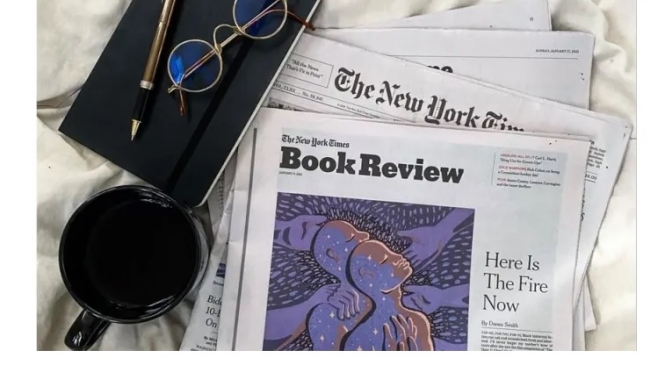





 Sotheby’s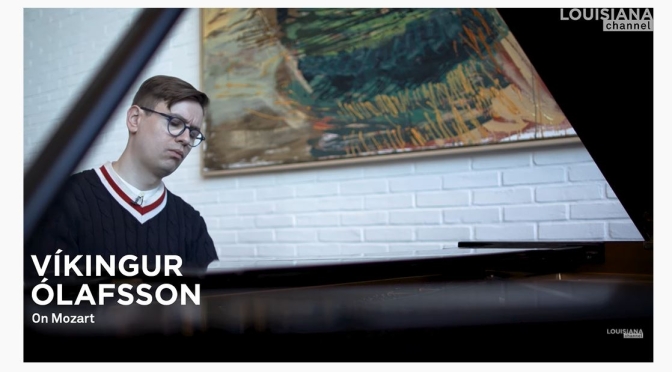

 Boomers Daily