
Tag Archives: Middle East

Analysis: The World Ahead In 2024 – The Economist

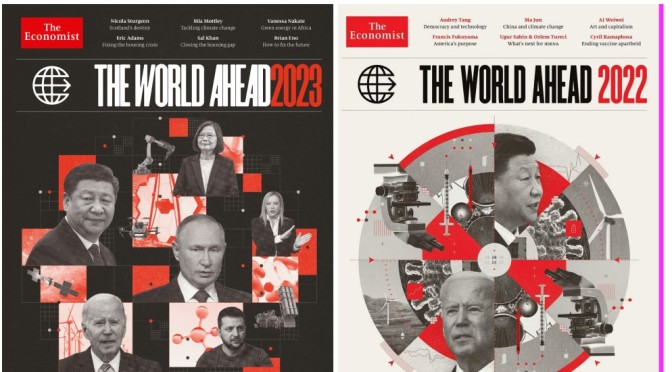
The Economist The World Ahead 2024 (November 14, 2023)Future-gazing analysis, predictions and speculation including Ten trends to watch in 2024; 2024 will be stressful for those who care about liberal democracy; America will need a new vocabulary to discuss its presidential election; Europe needs to step up support for Ukraine; Don’t give up on peace in the Middle East, and more…

Tom Standage’s ten trends to watch in 2024

A letter from the editor of The World Ahead

By Tom Standage

Life comes at you fast. Whether it’s the upsurge in armed conflict, the redrawing of the global energy-resources map or rapid progress in artificial intelligence (ai), the world is changing at mind-boggling speed. From the situation in the Middle East to the adoption of electric vehicles to the treatment of obesity, things look very different from the way they did just a year or two ago. Our aim is to help you keep your worldview up to date—and tell you what might be coming next. To kick things off, here are ten themes to watch in the coming year.

2024 will be stressful for those who care about liberal democracy

In theory it should be a triumphant year for democracy. In practice it will be the opposite

By Zanny Minton Beddoes

More than half the people on the planet live in countries that will hold nationwide elections in 2024, the first time this milestone has been reached. Based on recent patterns of voter turnout, close to 2bn people in more than 70 countries will head to the polls. Ballots will be cast from Britain to Bangladesh, from India to Indonesia. Yet what sounds like it should be a triumphant year for democracy will be the opposite.

The world must try to break a vicious cycle of insecurity 

A stick of dynamite with a lit fuse in the shape of a world map

The fragility of the Western coalition is a crucial weakness

By Patrick Foulis

As 2023 drew to a close, wars were raging in Africa, Israel and Gaza, and Ukraine. These crises are explosive in their own right. Combine them with a presidential race in America and 2024 promises to be a make-or-break year for the post-1945 world order.

The 2020s were destined to be dangerous. The West’s share of world gdp has fallen towards 50% for the first time since the 19th century. Countries such as India and Turkey believe the global institutions created after 1945 do not reflect their concerns. China and Russia want to go further and subvert this system.
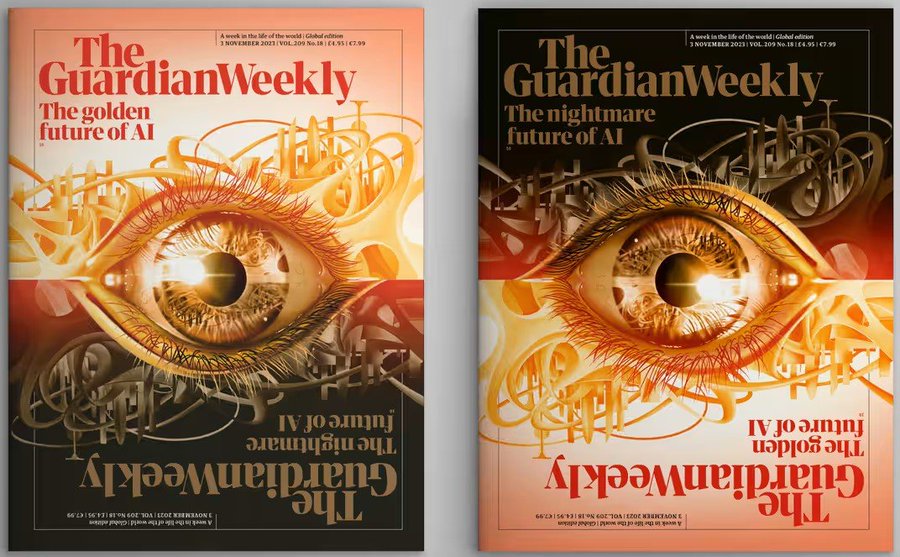
Politics: The Guardian Weekly – November 3, 2023

Image

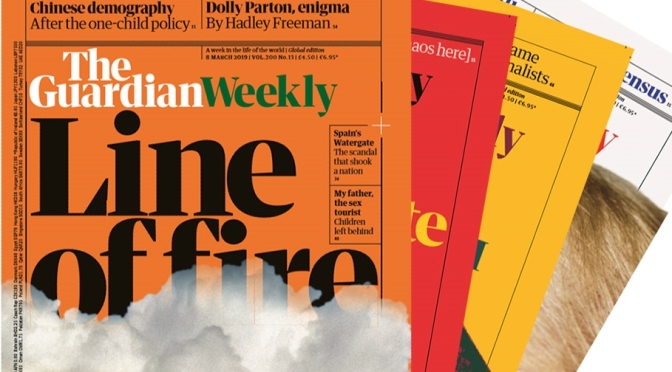
The Guardian Weekly (November 3, 2023) – The new issue features Bletchley Park, the main center of allied second world war codebreakers, and it’s no coincidence that the English country house was chosen as the venue for this week’s landmark summit on safety in artificial intelligence. The age of AI brings opportunities but also significant risks, as a number of experts in the field outlined in an open letter last week.

Global technology editor Dan Milmo discusses the pros and cons with one of the technology’s leading thinkers, Demis Hassabis, the CEO of Google DeepMind, who says the rise of AI must be thought of as seriously as the climate crisis. Then, Observer columnist Sonia Sodha argues that calling for AI to be reined in is not simply a sign of luddism.

As Israeli forces entered Gaza this week, Bethan McKernan and Rory Carroll report for us on the increasingly unbearable nature of life in the besieged enclave, and there’s expert analysis and commentary from Julian BorgerPeter Beaumont and Jason Burke.

Politics: The Guardian Weekly – October 27, 2023

Image

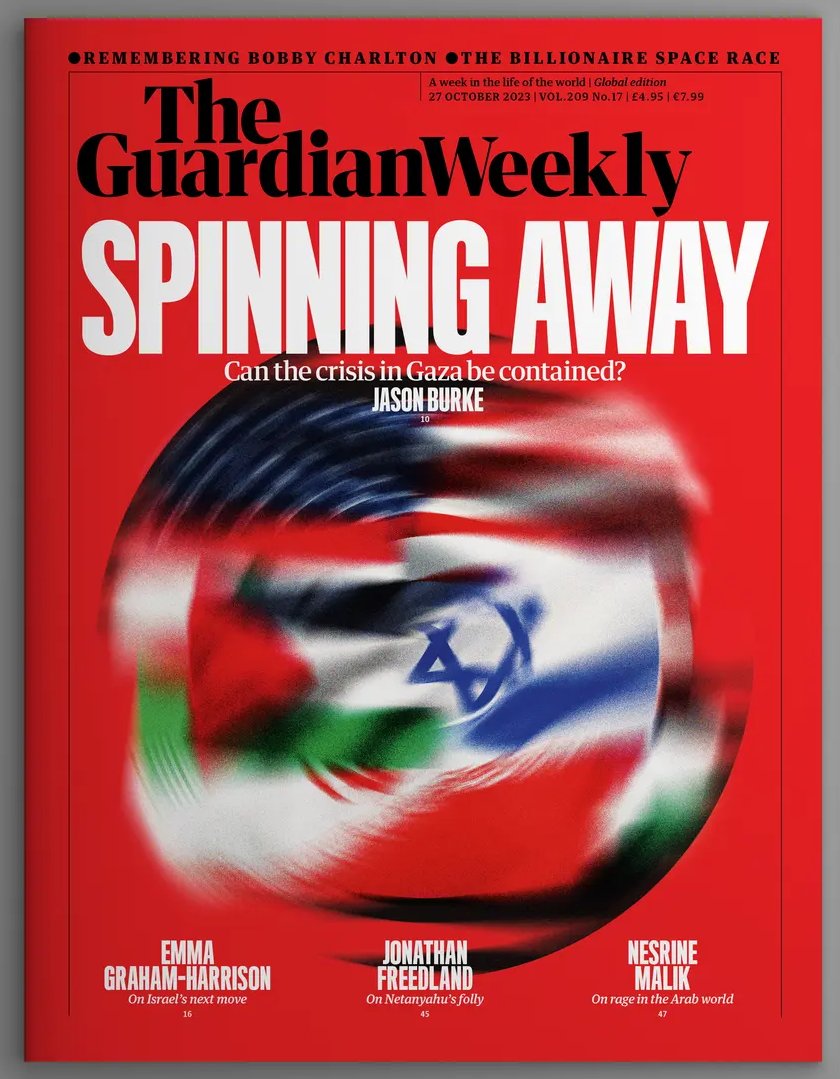
The Guardian Weekly (October 27, 2023) – The new issue features International security corespondent Jason Burke traceing the possible route to a wider war or, in the other direction, to at least a pause in hostilities.

Elsewhere, Ruth Michaelson and Julian Borger hear from terrified Gazans who have been pushed south, while Emma Graham-Harrison, Julian and Ruth consider the likely consequences of a “victorious” Israeli ground offensive.

There’s also a report on rising antisemitism against Jewish people across Europe since the 7 October Hamas terror attack on Israel and the subsequent Israeli bombardment of Gaza. And in the Opinion section, Jonathan Freedland and Nesrine Malik offer powerful perspectives on the conflict.

With much attention ranged on the Middle East, the war in Ukraine has fallen a little from the spotlight. Pjotr Sauer reports from Belgrade, where some young Serbs have been signing up to fight for Russia despite the risk of prosecution at home.

Tributes were paid this week after the death of Sir Bobby Charlton, the former Manchester United and England footballing legend. The Observer’s former football correspondent Paul Wilson remembers a player who became virtually synonymous with the English game.

Politics: The Guardian Weekly – October 20, 2023

Image

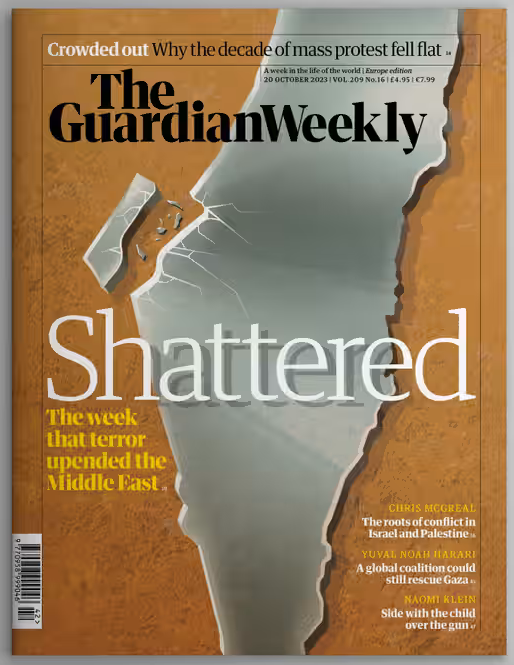
The Guardian Weekly (October 20, 2023) The new issue features escalating events in Israel and Gaza that continue to cause deep distress and alarm, with several thousand people known to be dead or wounded on either side of the border. US president Joe Biden was expected to visit Israel this week, amid growing expectations of a ground invasion of Gaza and fears of a wider regional escalation.

Also, a primer on the historical background to events by Chris McGreal, while on the opinion pages the Israeli author and historian Yuval Noah Harari and Guardian US columnist Naomi Klein provide thoughtful and grounded perspectives.

There was sadness for many Aboriginal Australians after a move to recognise Indigenous people in the country’s constitution was rejected in a referendum, as Sarah Collard and Elias Visontay report. Also from Oceania, Henry Cooke examines what aspects of Jacinda Ardern’s political legacy might survive after New Zealand elected a new conservative government.

From Egypt to Hong Kong, the 2010s were a decade when mass protest movements looked set to change the world. But in most cases, the hope embodied by many massive street demonstrations was soon crushed by authoritarian regimes. Vincent Bevins asks organisers and others who were there where it all went wrong.

Previews: The Economist Magazine – Sept 23, 2023

Image

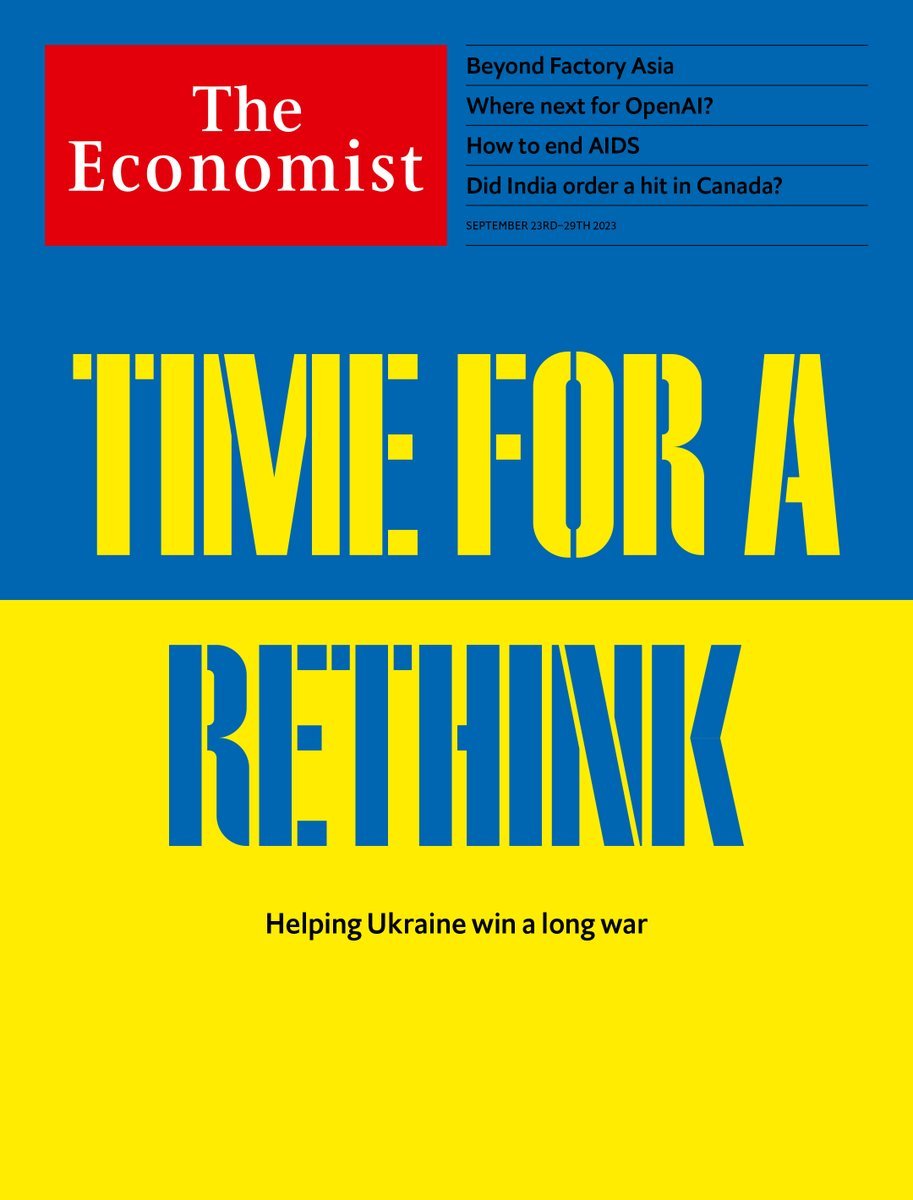
The Economist Magazine (September 23, 2023): The latest issue features ‘Ukraine faces a long war’ – A change of course is needed; Its backers should pray for a speedy victory—but plan for a long struggle.

Ukraine faces a long war. A change of course is needed

Its backers should pray for a speedy victory—but plan for a long struggle

The war in Ukraine has repeatedly confounded expectations. It is now doing so again. The counter-offensive that began in June was based on the hope that Ukrainian soldiers, equipped with modern Western weapons and after training in Germany, would recapture enough territory to put their leaders in a strong position at any subsequent negotiations.

If India ordered a murder in Canada, there must be consequences

Hardeep Singh Nijjar

Western countries have for too long acquiesced to the Indian government’s abuses

For years, India objected to Western strategists lumping it together with its violent and chaotic neighbour in the phrase “Indo-Pakistan”. Now recognised as a fast-growing giant and potential bulwark against China, India claims to have been “de-hyphenated”. Yet the explosive charge aired this week by Justin Trudeau suggests that diplomatic recalibration may have gone too far. Canada’s prime minister alleges that Indian agents were involved in the murder in Vancouver of a Canadian citizen sympathetic to India’s Sikh separatist movement

Previews: The Economist Magazine – Sept 16, 2023

All weekly editions | The Economist

The Economist Magazine (September 16, 2023): The latest issue reviews How AI can revolutionize science; Donald Trump will “never” support Putin, says Volodymyr Zelensky; The hard right is getting closer to power all over Europe, and more…

How artificial intelligence can revolutionise science

Consider the historical precedents

Debate about artificial intelligence (ai) tends to focus on its potential dangers: algorithmic bias and discrimination, the mass destruction of jobs and even, some say, the extinction of humanity. As some observers fret about these dystopian scenarios, however, others are focusing on the potential rewards. ai could, they claim, help humanity solve some of its biggest and thorniest problems. And, they say, ai will do this in a very specific way: by radically accelerating the pace of scientific discovery, especially in areas such as medicine, climate science and green technology.

Modi’s “one India” goal is good for the economy, but not for politics

Narendra Modi, India’s prime minister, presides over the closing session of the G20 Summit

In the next decade regional tensions will build in India

The world has been seeing the bright side of India. In August it landed a spacecraft on the Moon. In the latest quarter gdp grew at an annual rate of 7.8%, making it the world’s perkiest big economy. Narendra Modi, the prime minister, has just hosted a g20 summit where other leaders, including Joe Biden, courted Asia’s rising behemoth. Yet inside India the talk has turned to whether Mr Modi’s hunger for power and dreams of national renewal could lead him to bend the constitution. 

Opinion: The Middle East’s Future, Managing Wealth, London Bus Driver Health

‘Editor’s Picks’ Podcast (September 18, 2023) Three essential articles read aloud from the The Economist. This week, the future of the Middle East, Wall Street’s race to wealth management (10:00), and how London’s bus drivers revolutionised health (17:40).

Previews: The Economist Magazine – Sept 9, 2023

The Economist Magazine (September 9, 2023): The new Middle East has more money and less mayhem. For now…; America’s Supreme Court should adopt new ethics standards How artificial intelligence will affect the elections; Javier Milei would be a danger for democracy in Argentina….

The new Middle East has more money and less mayhem. For now

Economies are booming and wars are fading. But climate change is looming

If you thought the Middle East was stagnant, think again. The Gulf economies are among the richest and most vibrant on the planet, helped by a Brent crude oil price that rose back to over $90 per barrel this week. A $3.5trn fossil-fuel bonanza is being spent on everything from home-grown artificial intelligence models and shiny new cities in the desert, to filling the coffers of giant sovereign-wealth funds that roam the world’s capital markets looking for deals.

America’s Supreme Court should adopt new ethics standards

Three judges are struggling to hold up the roof of the Supreme Court

Lifetime tenure can easily slip into entitlement

Next term will be agonising for the Supreme Court. Some combination of voters and courts will determine whether Donald Trump becomes president again and whether he goes to prison. President Joe Biden’s son has a case before the courts. Dozens of states have changed their voting laws since 2020 and the nine justices on the Supreme Court may be asked to look at them. If the presidential election in 2024 is close, the court may have to step in and adjudicate. With so much at stake, America needs a Supreme Court that is broadly seen as legitimate and, ideally, impartial. Regrettably, trust in the court is at its lowest point since pollsters began asking about it.

Time-Lapse Travel: Qatar After The 2022 World Cup

Little Big World (August 29, 2023) – Qatar is a small country in the Middle East and received a lot of international attention by hosting the FIFA World Cup in 2022.

“I was invited by Visit Qatar to explore what Qatar has to offer beyond football. After two amazing and very hot weeks of shooting, I have condensed hours of footage into a bite sized film with less than 3 minutes that you might hopefully enjoy. Check out stunning desert landscapes, breathtaking art installations, amazing beaches, oriental markets and a vibrant and futuristic urban capital.”

A time-lapse & tilt-shift & aerial video by Joerg Daiber

Culinary Travels: Chef Luigi Stinga In Abu Dhabi

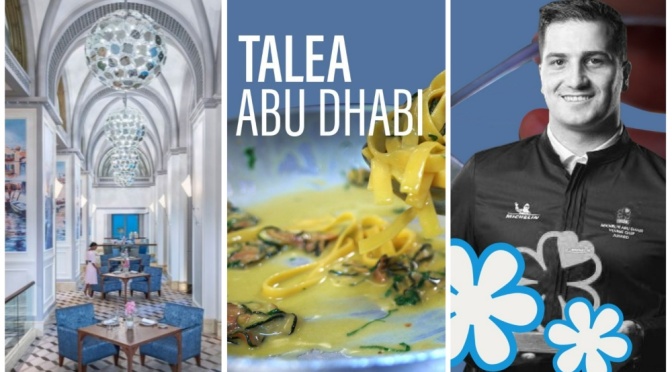
A chef’s tour around Abu Dhabi with Italian chef of one-MICHELIN star restaurant Talea by Antonio Guida, Luigi Stinga, taking food content creator, Harry Heal, around the city he now calls home.

We follow the pair as they explore the UAE capital; from the Malaysian eatery he regularly visits, the vegetable farm and bee farm near his restaurant, to the secluded sand bar he considers his little piece of paradise. Together, they spend their day adventuring around the chef’s favorite hidden gems in Abu Dhabi.

#MICHELINGuideAbuDhabi #OneMICHELINStar