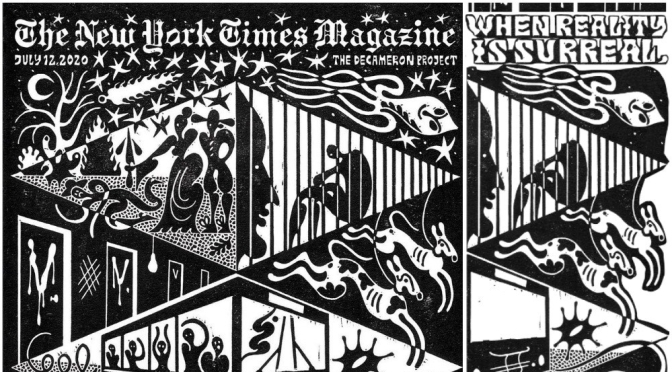
AS THE COVID-19 PANDEMIC SWEPT THE WORLD, WE ASKED 29 AUTHORS TO WRITE NEW SHORT STORIES INSPIRED BY THE MOMENT. WE WERE INSPIRED BY GIOVANNI BOCCACCIO’S “THE DECAMERON,” WRITTEN AS THE PLAGUE RAVAGED FLORENCE IN THE 14TH CENTURY. 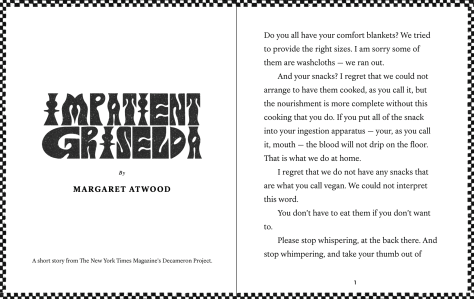
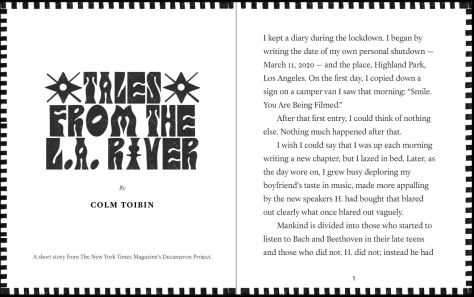
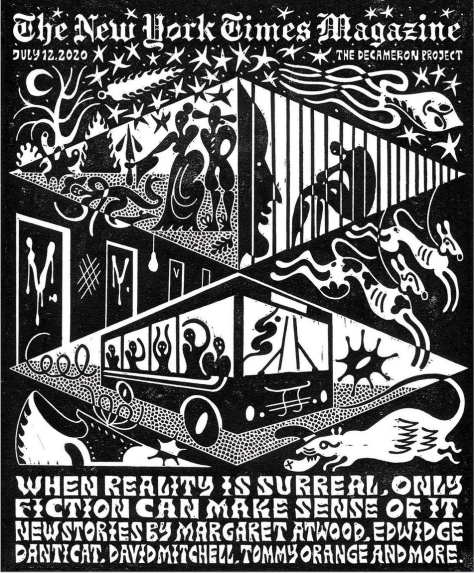

AS THE COVID-19 PANDEMIC SWEPT THE WORLD, WE ASKED 29 AUTHORS TO WRITE NEW SHORT STORIES INSPIRED BY THE MOMENT. WE WERE INSPIRED BY GIOVANNI BOCCACCIO’S “THE DECAMERON,” WRITTEN AS THE PLAGUE RAVAGED FLORENCE IN THE 14TH CENTURY.
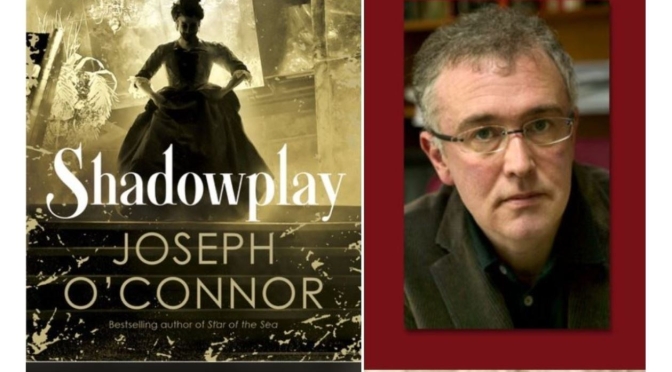
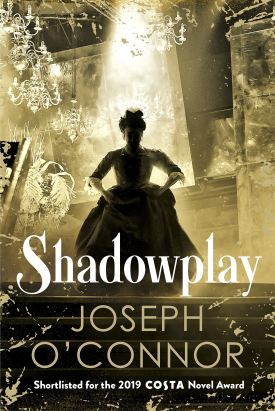 “Shadowplay” opens in Dublin in the winter of 1876, with O’Connor painting that ravishing city with a soft lyricism that Stoker himself might have envied: “Smacks heading down the estuary, trailing petticoats of nets, out towards the expanse of the sea.” Stoker, a government clerk who moonlights as a theater critic, is reeling from the visceral intensity of Irving’s performance in Dublin as Hamlet. “Eyes glowing red in the gaslight,” Irving terrifies the audience, “slinking towards the lip of the stage, left hand on hip, wiping his wet mouth with the back of his sleeve. Sneering, he regarded them. Then he spat.” (NY Times Review)
Henry Irving is Victorian London’s most celebrated actor and theater impresario. He has introduced groundbreaking ideas to the theater, bringing to the stage performances that are spectacular, shocking, and always entertaining. When Irving decides to open his own London theater with the goal of making it the greatest playhouse on earth, he hires a young Dublin clerk harboring literary ambitions by the name of Bram Stoker to manage it. As Irving’s theater grows in reputation and financial solvency, he lures to his company of mummers the century’s most beloved actress, the dazzlingly talented leading lady Ellen Terry, who nightly casts a spell not only on her audiences but also on Stoker and Irving both.
Bram Stoker’s extraordinary experiences at the Lyceum Theatre, his early morning walks on the streets of a London terrorized by a serial killer, his long, tempestuous relationship with Irving, and the closeness he finds with Ellen Terry, inspire him to write DRACULA, the most iconic and best-selling supernatural tale ever published.
A magnificent portrait both of lamp-lit London and of lives and loves enacted on the stage, Shadowplay’s rich prose, incomparable storytelling, and vivid characters will linger in readers’ hearts and minds for many years.
Novelist, screenwriter, playwright and broadcaster, Joseph O’Connor was born in Dublin. He is the author of nine novels including Star of the Sea, Ghost Light (Dublin One City One Book novel 2011) and Shadowplay (June 2019). Among his awards are the Prix Zepter for European Novel of the Year, France’s Prix Millepages, Italy’s Premio Acerbi, an American Library Association Award and the Irish Pen Award for Outstanding Achievement in Literature. His work has been translated into forty languages. In 2014 he was appointed Frank McCourt Professor of Creative Writing at the University of Limerick. Twice-Booker Prize-winner Peter Carey has written, ‘There are few living writers who can take us back in time so assuredly, through such gorgeous sentences. Joseph O’Connor is a wonder, and Shadowplay is a triumph.’
From Hyperallergic (June 13, 2020):
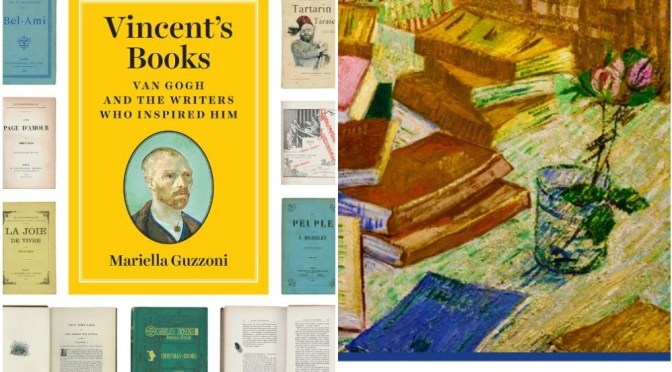
 In his paintings we see books on their own, or books in the company of people or other objects; small, lonely ziggurats of books, or a book beside a candle. That last juxtaposition is telling in the extreme. Vincent had a reverence for books. They were sacred ground. They have a kind of inner glow about them.
He reverenced books for their intellectual and emotional content.
He read Dickens, Carlyle, Flaubert, Balzac, Maupassant, and Zola in the original. Dickens and Carlyle were never very easy to read, then or now, but this Dutchman did so. He even read English poetry – John Keats, for example.
From BBC Culture (June 2, 2020):
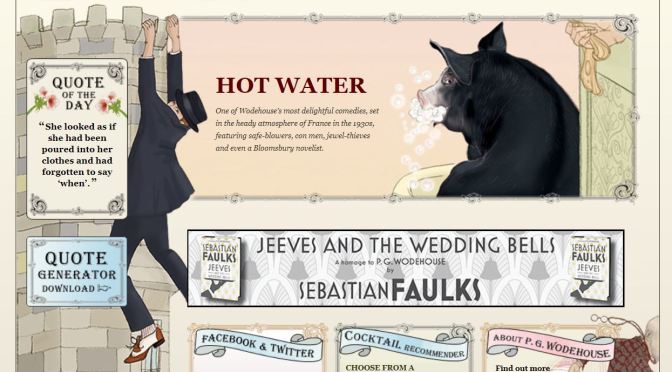
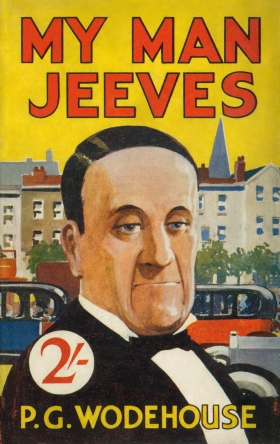 With every sparkling joke, every well-meaning and innocent character, every farcical tussle with angry swans and pet Pekingese, every utopian description of a stroll around the grounds of a pal’s stately home or a flutter on the choir boys’ hundred yards handicap at a summer village fete, he wanted to whisk us far away from our worries.
If we’re talking about culture that makes people happy, we have to start with the works of PG Wodehouse. There are two reasons why. One reason is that making people happy was Wodehouse’s overriding ambition. The other reason is that he was better at it than any other writer in history.
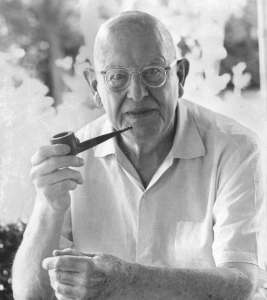 The author of almost a hundred books and the creator of Jeeves, Blandings Castle, Psmith, Ukridge, Uncle Fred and Mr Mulliner, P. G. Wodehouse was born in 1881 and educated at Dulwich College. After two years with the Hong Kong and Shanghai Bank he became a full-time writer, contributing to a variety of periodicals including Punch and the Globe. He married in 1914.
As well as his novels and short stories, he wrote lyrics for musical comedies with Guy Bolton and Jerome Kern, and at one time had five musicals running simultaneously on Broadway. His time in Hollywood also provided much source material for fiction.
At the age of ninty-three, in the New Year’s Honours List of 1975, he received a long-overdue knighthood, only to die on St Valentine’s Day some forty-five days later.
From Open Magazine (May 29, 2020):
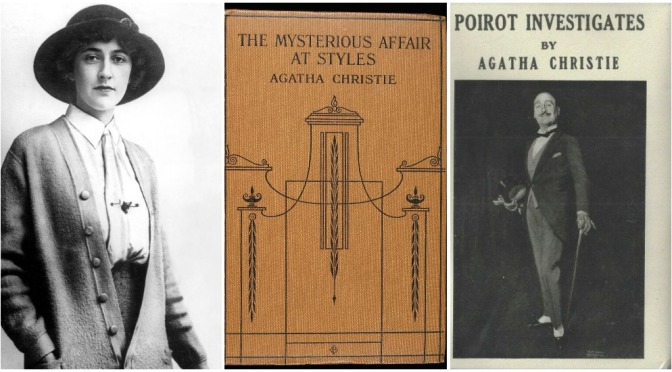
And with The Mysterious Affair at Styles (published a 100 years ago, in 1920) Christie would introduce readers to Monsieur Hercule Poirot, an old Belgian detective who resembled Holmes superficially (‘eccentric detective, stooge assistant’, as the author would admit in her autobiography later) but whose psychological insights and near-mystical idiosyncrasies would make him arguably the most successful and beloved literary sleuth of all time.
IN 1916, THE 26-year-old Agatha Christie finished writing her first detective novel at Dartmoor, a quiet upland in Devon, UK, known for its beautiful granite hilltops. Sir Arthur Conan Doyle had published The Hound of the Baskervilles, in 1902, which would become one of the most widely read Sherlock Holmes adventures—and the story was set in this same corner of the world, Dartmoor.
Books like Murder on the Orient Express (1934), The Murder of Roger Ackroyd (1926) and Death on the Nile (1937) remain some of the bestselling murder mysteries in the world today, over eight decades after their original publication (Christie’s net sales for all of her books combined are over two billion now).
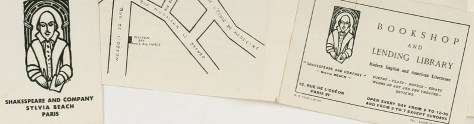
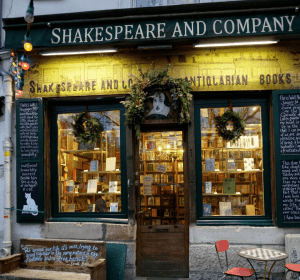 Gertrude Stein. James Joyce. Ernest Hemingway. Aimé Césaire. Simone de Beauvoir. Jacques Lacan. Walter Benjamin.
What do these writers have in common? They were all members of the Shakespeare and Company lending library.
In 1919, an American woman named Sylvia Beach opened Shakespeare and Company, an English-language bookshop and lending library in Paris. Almost immediately, it became the home away from home for a community of expatriate writers and artists now known as the Lost Generation. In 1922, she published James Joyce’s Ulysses under the Shakespeare and Company imprint, a feat that made her—and her bookshop and lending library—famous around the world. In the 1930s, she increasingly catered to French intellectuals, supplying English-language publications from the recently rediscovered Moby Dick to the latest issues of The New Yorker. In 1941, she preemptively closed Shakespeare and Company after refusing to sell her last copy of Joyce’s Finnegans Wake to a Nazi officer.
The Shakespeare and Company Project uses sources from the Beach Papers at Princeton University to reveal what the lending library members read and where they lived. The Project is a work-in-progress, but you can begin to explore now. Search and browse the lending library members and books. Read about joining the lending library. Download a preliminary export of Project data. In the coming months, check back for new features and essays.

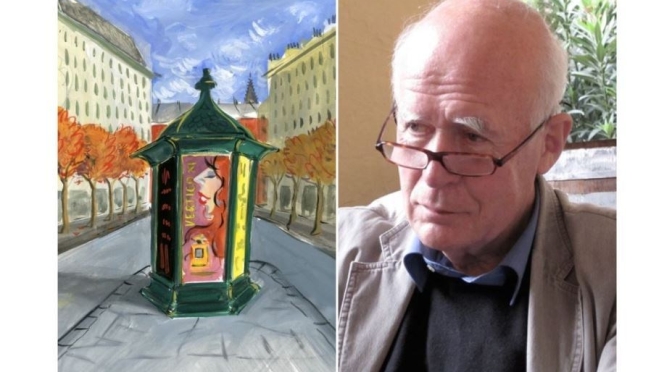
When asked what he did for a living, Peter would usually say he was a designer, or, a typographer. Designing for print – books, exhibition catalogues, magazines, posters – 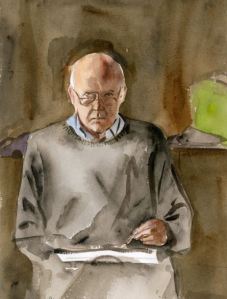 took up the most substantial part of his time, at the BBC in the 1960s and 1970s and thereafter as a freelance. He was also an illustrator, a journalist, an author of children’s books, an editor and a publisher. The great range of his professional work, and his encompassing interest in the work of others, made him a collaborator sought out by writers, publishers and artists.
Diana Souhami, who worked with Peter often, wrote in the Guardian after his death: “He had the ability to conceptualise what each publishing project needed and to get it right. He was hugely and diversely productive, but seldom hit a wrong note.”
Discussing his journalism in her appreciation in the London Review, Mary‑Kay Wilmers wrote: “There are people whom getting a grip doesn’t suit, who don’t want to be confined. One can honour the world in depth or across a wide range and there were few aspects of the world that Peter didn’t wish to honour.”
He probably would have been delighted by – and certainly modestly sceptical of – Alan Bennett’s appraisal, in the posthumous publication of a catalogue of his pictures in Artwork, that he was “an heir to Ardizzone, Bawden and Ravilious.”
Peter Campbell was born in Wellington, New Zealand in 1937. In 1960 he emigrated to London where he lived for the rest of his life. He died in 2011.





 Boomers Daily