
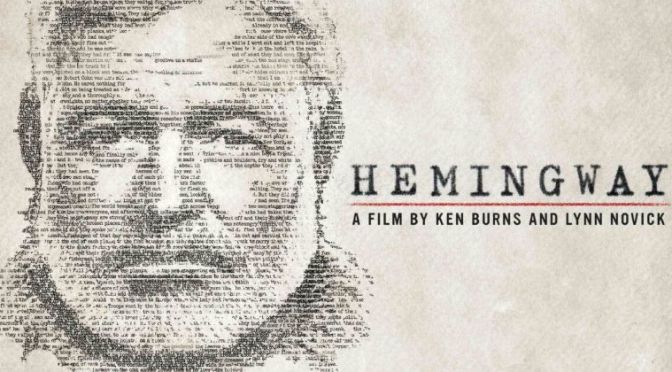
Get an inside look at Hemingway and discover why Ken Burns and Lynn Novick chose to explore the complex and iconic writer. Hemingway premieres April 5, 2021 on PBS.
Tag Archives: Literary Arts
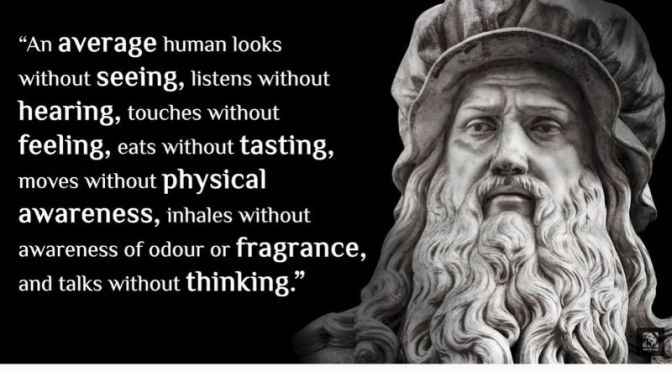
Great Quotes: ‘Leonardo da Vinci, 1452-1519’ (Video)
Leonardo da Vinci lived between 1452-1519. He was an Italian polymath of the High Renaissance who is widely considered one of the most diversely talented individuals ever to have lived. Performed by Chris Lines.

2021 Public Domain: F. SCOTT FITZGERALD’s ‘The Great Gatsby’ (Podcast)

NPR’s Scott Simon reflects on the legacy of F. Scott Fitzgerald’s The Great Gatsby. The literary classic’s copyright expired on the first day of 2021.
The copyright on F. Scott Fitzgerald’s The Great Gatsby expired on the first stroke of 2021 and the book entered the public domain.
The classic 1925 novel of love foiled, ambitions foisted, class and betrayal sold fewer than 25,000 copies before Fitzgerald died. It has since sold nearly 30 million. I gave our daughter the copy I had in high school when she read it last year. The Great Gatsby has been turned into stage productions, an opera, five film versions, a Taylor Swift song and inspired innumerable prequels, spinoffs and variations.
In the public domain, Gatsby may now become even more familiar. Two new editions are about to come out and who knows what kind of projects — a Gatsby rom-com? Gatsby joins The Avengers? — might now get a green light, which recalls the imperishably eloquent last passage of the book: “Gatsby believed in the green light, the orgastic future that year by year recedes before us.”
Gatsby’s Jazz Age Long Island may not look like a microcosm of contemporary America. Neither does Don Quixote, The Scarlet Letter, Macbeth or Their Eyes Were Watching God. We want young readers to be able to see themselves in stories; but literature can also show us that people we don’t think are much like us at all turn out to have some of the same heart, blood and dreams. That can be the power of empathy in art.

Video Profiles: French Nobel Prize Author Albert Camus (1913 -1960)
This week, we’re putting the focus on Nobel Prize-winning French author Albert Camus. As 2020 saw France mark 60 years since his death in a car crash, Camus’s seminal work “The Plague” was unexpectedly thrust back into the spotlight by the Covid-19 pandemic.
From the UK to Japan, the 1947 novel established itself as a global sensation, topping sales charts and pushing publishers into a rushed reprint. But Camus’s prolific and multi-faceted career extends far beyond this viral hit. We tell you more about the author’s life, starting with his humble beginnings in French-ruled Algeria.
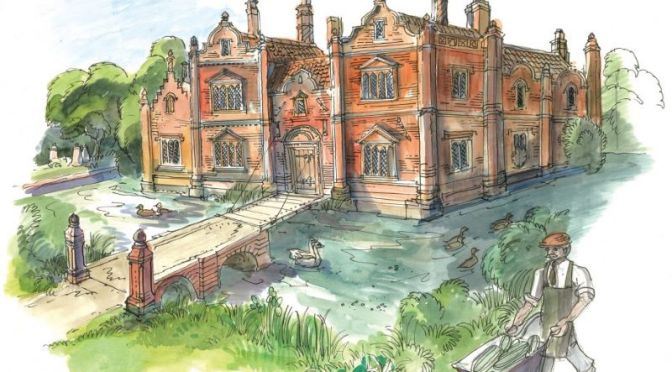
Literary Illustrators: ‘The Houses Of Sherlock Holmes’ By Matthew Rice
Dartmoor’s Baskerville Hall is one of the most famous country houses in English fiction. The arrival at its doors of Dr Watson, in the company of Sir Henry Baskerville, is a vivid piece of cinematic direction, artfully combining the Gothic horror tale with the more modern taste for detective thrillers.

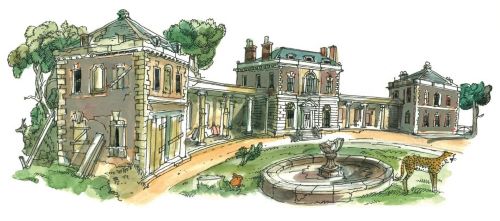


Passing a ruined black-granite lodge, Watson and Baskerville go through the gates that are ‘a maze of fantastic tracery in wrought iron’ before reaching an avenue where ‘old trees shot their branches in a sombre tunnel’. The hall is a ‘heavy block’, with a projecting porch, its façade ‘draped in ivy’ within which the odd window or heraldic display can be seen.

Arts & Literature: A Close Reading Of Poet Robert Frost (LRB Podcast)
 In the latest episode in their series of Close Readings, Seamus Perry and Mark Ford look at the life and work of Robert Frost, the great American poet of fences and dark woods.
(August 4, 2020)
They discuss Frost’s difficult early life as an occasional poultry farmer and teacher, his arrival in England in 1912 amid the flowering of Georgian poetry, and his emergence as the first 20th-century professional poet, whose version of the American wilderness myth, full of mischief and foreboding, took him to packed concert halls and a presidential inauguration.
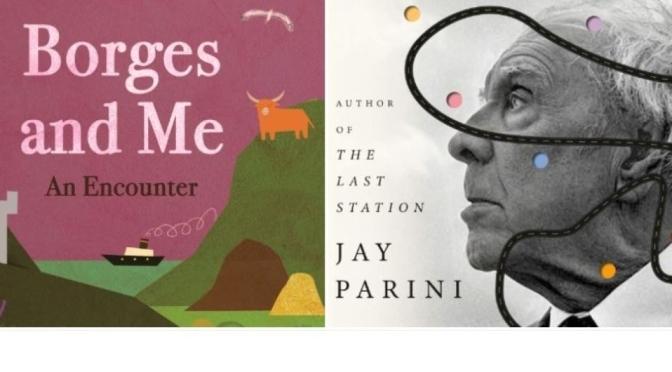
Travel & Literature Books: “Borges And Me” By Jay Parini – “A Vivid Road Trip”
An apprentice writer has an entirely unexpected encounter with literary genius Jorge Luis Borges that will profoundly alter his life and work. A poignant and comic literary coming-of-age memoir. “This is a jewel of a book.” –Ian McEwan
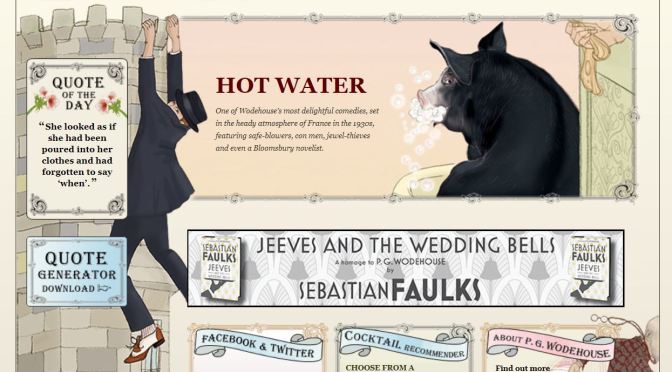
Literary Profiles: The “Sparkling, Perfect” Prose Of P.G. Wodehouse (BBC)
From BBC Culture (June 2, 2020):
 With every sparkling joke, every well-meaning and innocent character, every farcical tussle with angry swans and pet Pekingese, every utopian description of a stroll around the grounds of a pal’s stately home or a flutter on the choir boys’ hundred yards handicap at a summer village fete, he wanted to whisk us far away from our worries.
If we’re talking about culture that makes people happy, we have to start with the works of PG Wodehouse. There are two reasons why. One reason is that making people happy was Wodehouse’s overriding ambition. The other reason is that he was better at it than any other writer in history.
P. G. Wodehouse: A Brief History
 The author of almost a hundred books and the creator of Jeeves, Blandings Castle, Psmith, Ukridge, Uncle Fred and Mr Mulliner, P. G. Wodehouse was born in 1881 and educated at Dulwich College. After two years with the Hong Kong and Shanghai Bank he became a full-time writer, contributing to a variety of periodicals including Punch and the Globe. He married in 1914.
As well as his novels and short stories, he wrote lyrics for musical comedies with Guy Bolton and Jerome Kern, and at one time had five musicals running simultaneously on Broadway. His time in Hollywood also provided much source material for fiction.
At the age of ninty-three, in the New Year’s Honours List of 1975, he received a long-overdue knighthood, only to die on St Valentine’s Day some forty-five days later.

Literature: “Shakespeare And Company” Digitizes Reading Library Of Joyce, Hemingway & De Beauvoir

 Gertrude Stein. James Joyce. Ernest Hemingway. Aimé Césaire. Simone de Beauvoir. Jacques Lacan. Walter Benjamin.
What do these writers have in common? They were all members of the Shakespeare and Company lending library.
In 1919, an American woman named Sylvia Beach opened Shakespeare and Company, an English-language bookshop and lending library in Paris. Almost immediately, it became the home away from home for a community of expatriate writers and artists now known as the Lost Generation. In 1922, she published James Joyce’s Ulysses under the Shakespeare and Company imprint, a feat that made her—and her bookshop and lending library—famous around the world. In the 1930s, she increasingly catered to French intellectuals, supplying English-language publications from the recently rediscovered Moby Dick to the latest issues of The New Yorker. In 1941, she preemptively closed Shakespeare and Company after refusing to sell her last copy of Joyce’s Finnegans Wake to a Nazi officer.
The Shakespeare and Company Project uses sources from the Beach Papers at Princeton University to reveal what the lending library members read and where they lived. The Project is a work-in-progress, but you can begin to explore now. Search and browse the lending library members and books. Read about joining the lending library. Download a preliminary export of Project data. In the coming months, check back for new features and essays.
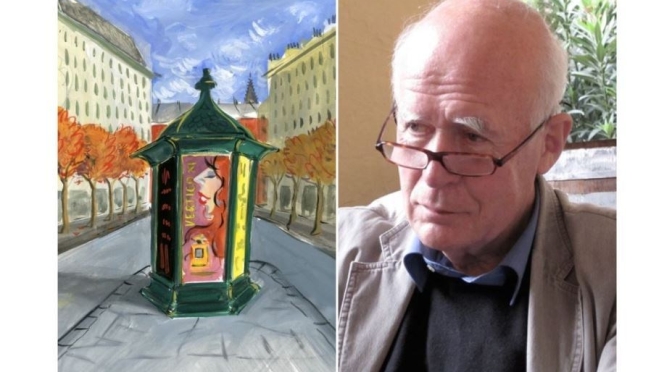
Literary Arts: New Website Archives Work Of British Illustrator And Designer Peter Campbell (1937-2011)
The website is about the work of the designer, writer and illustrator Peter Campbell (1937‑2011). The intention is to present an archive of Peter’s illustration, design and editorial work, as well as occasional selections from his writing.
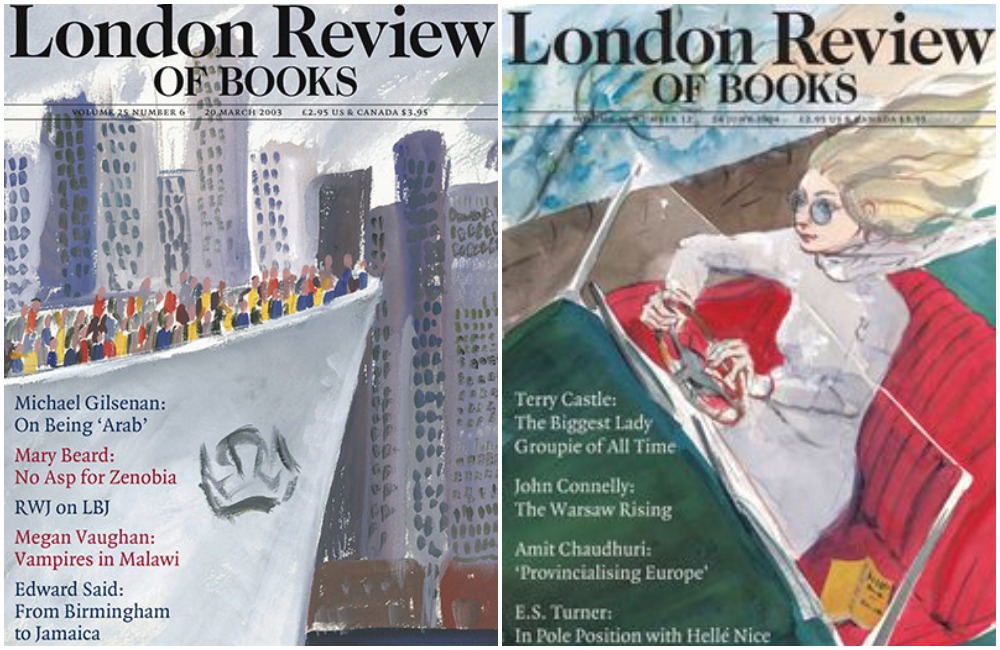
When asked what he did for a living, Peter would usually say he was a designer, or, a typographer. Designing for print – books, exhibition catalogues, magazines, posters –  took up the most substantial part of his time, at the BBC in the 1960s and 1970s and thereafter as a freelance. He was also an illustrator, a journalist, an author of children’s books, an editor and a publisher. The great range of his professional work, and his encompassing interest in the work of others, made him a collaborator sought out by writers, publishers and artists.
Diana Souhami, who worked with Peter often, wrote in the Guardian after his death: “He had the ability to conceptualise what each publishing project needed and to get it right. He was hugely and diversely productive, but seldom hit a wrong note.”
Discussing his journalism in her appreciation in the London Review, Mary‑Kay Wilmers wrote: “There are people whom getting a grip doesn’t suit, who don’t want to be confined. One can honour the world in depth or across a wide range and there were few aspects of the world that Peter didn’t wish to honour.”
He probably would have been delighted by – and certainly modestly sceptical of – Alan Bennett’s appraisal, in the posthumous publication of a catalogue of his pictures in Artwork, that he was “an heir to Ardizzone, Bawden and Ravilious.”
Peter Campbell was born in Wellington, New Zealand in 1937. In 1960 he emigrated to London where he lived for the rest of his life. He died in 2011.
 Boomers Daily