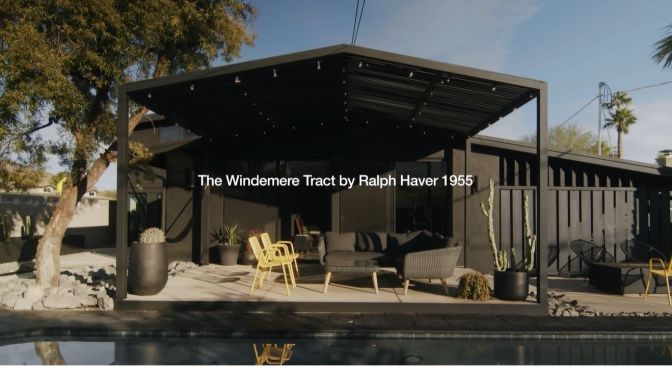
Open Space (March 5, 2023) – Ralph Haver AIA was an American Architect who was highly accredited to bringing Modernism to Arizona. Malcolm and Lea weren’t necessarily looking for a modernist home when they stumbled upon their current Ralph Haver home.
Always intrigued with design and making a space into their own, they saw the potential through their designer Joel Contreras who at the time was one of the few people redesigning historic homes in Arizona. Ralph Haver was known for his use of affordable and practical building materials, such as concrete block and plywood, which allowed him to create affordable postwar homes. Malcolm and Lea are a part of a small tract of Ralph Haver homes with only 30 homes in their neighborhood.
Throughout the past several years, they have seen a new generation of buyers coming into the neighborhood and lovingly caring/restoring/ remodeling the homes. Ralph Haver homes are reminiscent of the Cliff May homes in Southern California, similar construction, design elements and die hard homeowners that are uplifting the legacy of these architects.
The Local Project (March 3, 2023) – Surrounded by large fields, Casa di Campo is a modern farmhouse that responds to the landscape and offers an oasis-like lifestyle for its owners.
Video timeline: 00:00 – Surfshark VPN 00:10 – Introduction to the Modern Farmhouse 00:42 – Designing in Response to the Landscape 01:03 – The Brief and the Clients 01:34 – Impressions On Arrival 01:50 – A Walkthrough of the Home 03:00 – The Different Aspects 03:21 – The Material Palette and Textures 04:49 – Proud Moments 05:17 – Surfshark VPN
Located in Werribee South, Victoria, where homes are spaced out by green fields and red dirt landscapes, the family of second-generation market gardeners requested a modern farmhouse. Responding to the client’s brief, Neil Architecture built a home with inward facing courtyards, a private garden space and a pool that the family could find reprieve in. Whilst a calming residence from the inside, Casa di Campo appears as a solid monolithic form that stands out from nearby farming houses.
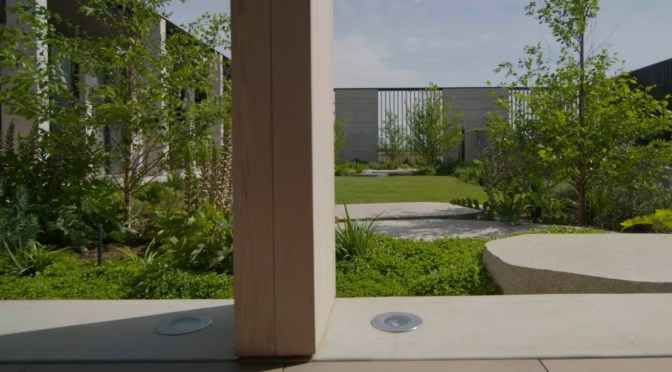
Once inside, the house tour first reveals a lush green garden that is designed like a Roman courtyard. With a portico that runs along two sides, the pond traditionally included is instead a swimming pool. Acre also installs cut granite boulders as stepping stones that become a major aspect to the garden’s function. Following a short passage leads into the family living rooms, which have been divided by a large centre fireplace.
With no white walls featuring in the interior design of the modern farmhouse, the architects have used textures throughout to provide a unique aspect to the home. The floor is also distinct, appearing as one poured slab with smooth edges and a fine aggregate finish that the clients have fallen in love with. Separate from the living zone, the children’s bedrooms offer a view through the colonnade and into the garden, giving them ample space to play and enjoy the modern farmhouse.
At the eastern end of the home, the main bedroom holds a small private courtyard that invites in the morning sun and offers a space for the parents to unwind and enjoy. Putting together material elements of the modern farmhouse, the architects employed rammed earth for its warm pale tone and unique interior experience. Alongside the rammed-earth architecture is timber wall panelling, Quartzite stone in the kitchen and bathrooms and a green elemental tone within the bathrooms and hallways that helps to sooth the interior features of the modern farmhouse.
Although set among the fields, where the brown rich soil and the bright greens mix harmoniously, the residence separates itself from the working environment and becomes its own destination. Taking on architecture, interior design and styling, Neil Architecture turns a family home into a pleasantly surprising paradise with an exterior that provides no clues as to what is inside.
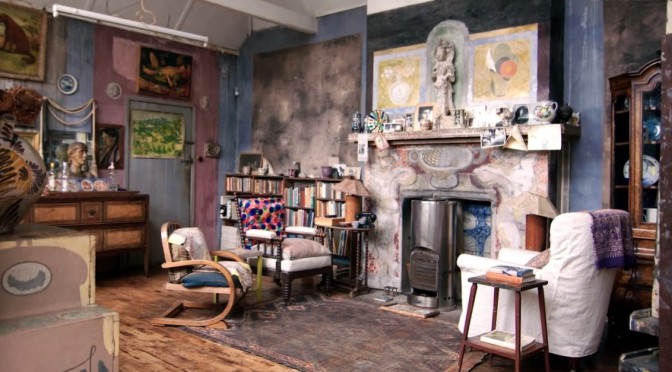
House & Garden (March 3, 2023) – Houses with History from Charleston House. Join Lucy Hammond Giles, Associate Director at Sibyl Colefax & John Fowler, as we tour Charleston House, once home to artists Vanessa Bell and Duncan Grant.
Vanessa and Duncan saw no particular distinction between art and interior design, and treated the house as a canvas, painting practically every wall and piece of furniture in their own distinctive styles. As a result, the house is not only a significant piece of art history, but a landmark in the history of interior decoration.
Charleston, in East Sussex, is a property associated with the Bloomsbury group, that is open to the public. It was the country home of Vanessa Bell and Duncan Grant and is an example of their decorative style within a domestic context, representing the fruition of more than sixty years of artistic creativity.
The Local Project (February 24, 2023) – Located in the Victorian seaside suburb of Brighton, Brighton House is a sophisticated family home that maximises living space and the surrounding gardens. Responding to the clients’ briefs, Hecker Guthrie has imbued a sophisticated family home with hints of the clients’ tastes and world travels.
Video timeline: 00:00 – Introduction to the Sophisticated Family Home 00:35 – The Brief 01:02 – The Process and the result 01:19 – Split Between Heritage and Modern 01:36 – Appealing Aspects of the Home 02:04 – A Walkthrough of the Contemporary Part of the Home 02:24 – A Southern Italian Aesthetic 02:50 – Framing Nature Through Windows 03:30 – An Insight into The Staircase 04:29 – Proud Moments 05:00 – Evoking Joy
Melding the modern and historical together, the architects have divided Brighton House into two zones, keeping the heritage form at the front and the contemporary extension to the rear. From the front of the sophisticated family home, the interior design adds a layer of charm and character. The structure has been renovated with care so that the original elements shine alongside the contemporary additions. In the modern section, light and space is introduced through large windows and doors to the gardens.
Yet through its unique implementation, the natural light does not overpower the extensions but instead works with each design element. Drawing from the clients’ travels for inspiration, Brighton Residence is crafted from rustic materiality, limestone and timber joinery. In addition to wanting an extension of space, the clients also desired a level of connection to nature and the sky. Each window within the home provides glimpses of nature or skies above, connecting the owners to the outside no matter the weather.
Built in between the old home and new extensions, an American Oak staircase by S&A Stairs takes advantage of the double height void and shines through the home like a form of art. With its smooth curves, the staircase complements the soft and sophisticated interior design choices made by Hecker Guthrie and turns an otherwise forgotten part of the home into one of its most memorable moments. As a sophisticated family home, Brighton Residence is a home that offers its owners a space to find reprieve while being surrounded by all that they love.
Located in Hawthorn, Victoria, Hermon is a fun and playful house set on a tree-lined street dotted with Edwardian and Federation homes. Stitching together the project’s Edwardian structure and contemporary changes, WOWOWA has introduced unique materials, a vibrant colour palette and elements to install vivacity into the family home.
00:00 – Introduction to the Playful House 00:23 – The Location 00:38 – Key Ambitions 01:01 – A Love for Renovations 01:22 – A Walkthrough of the House 01:50 – The Fun and Dreamy Kitchen 02:28 – Embracing Age 02:50 – The Materials and Colour Palette 03:28 – Laminex Pairings 04:15 – Focusing on the Little Moments and the Big 04:34 – Fresh and Nostalgic
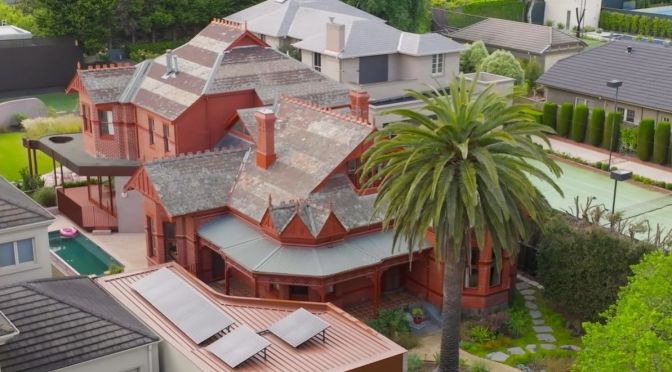
With a love for rejuvenation, WOWOWA has continued the residence’s charming heritage by using the original stone, bricks and gradient of the roof tiles for inspiration in the transformation of the fun and playful house. Beginning the house tour from the front gate, guests walk up a soft pebble walkway before entering into a traditional foyer with tall ornate walls and a spacious hallway. After passing through the threshold of the fun and playful house, WOWOWA’s contemporary renovations are revealed in the kitchen – the heart of the home.
Employing a colour story of reds, browns and terracotta to reference the surrounding landscape, the kitchen is full of moments of inspiration and reflection. Throughout the space, the architects have also installed wide windows and doors that reveal the vibrant and colourful gardens. Working with Laminex for the kitchen’s interior design, WOWOWA has used the bayleaf colour to partner with the warm hues throughout the home. Also implemented in the main bedroom, the bayleaf adds a cohesiveness to the interior design and brings the vibrancy of outside into the more intimate spaces.
With four bedrooms located upstairs, including a main bedroom with walk-in robe and ensuite, two children’s rooms and a guest room, the interior design throughout results in a fun and playful house for the owners. By embracing the traditional circles, geometry and patterns of Hermon, WOWOWA have used materials such as terrazzo, finger tiles, terracotta, steel and timber to add a contemporary twist. Furthermore, the modern elements reference the original stained-glass windows of the façade. Considering the Edwardian exterior architecture, WOWOWA have softened the harder architectural structure by adding planter boxes and new lush gardens around the house. With a focus on aligning the larger gestures with the smaller ones,
WOWOWA have made sure to inject the same amount of attention into each material choice and design element of the fun and playful house. Adding joyfulness and nostalgia to Hermon, WOWOWA have created a home that gives the owners opportunity to create new stories.
The Local Project (February 10, 2023) – A living work of art, La Scala by Richards & Spence is an architects’ own home that can be considered as a sequence of discovery and revelation. Located in Brisbane, the home is a contemporary monolithic structure of concrete, stone and greenery.
Video timeline: 00:00 – Introduction to the Iconic Monolithic Home 00:39 – The Inner-City Location 01:00 – Designing with Entertaining in Mind 01:35 – A Long Term Plan 01:52 – The Key to Planning 02:27 – A Walkthrough of the Home 02:53 – The Double Height Volume 04:00 – Spatial Contrast and Emotive Responses 04:44 – Blurring the Lines of Inside and Outside 05:32 – Materials for the Long Term 05:51 – Swaying from the City’s Nostalgia 06:08 – Building for a Hot Climate 06:33 – A Contrast to the Concrete 06:49 – The Project’s Biggest Success
Considering the life of the home and how it may look in 50 to 100 years, the architects have imagined a ruin-like appearance finished with raw materials and green life that blur the lines between liveable spaces. Designed as both a sanctuary for its owners and a place to entertain, the home’s layout unfolds from the ground up like a living work of art. Starting the home tour from the garage and lower ground, guests enter into a moody portico that offers privacy to the other levels upon arrival.
Moving on to the lower ground bedroom, the unique design showcases the owners’ desire to create an iconic residence that takes advantage of the homes location on the side of a hill. In the main bedroom, the architects employ reeded glass at the bottom of the double-height windows to add a playful reflection of light that turns the modern bedroom into a living work of art. Up on the middle floor, a guest bedroom and bathroom have been installed along with a spare bathroom for parties. However, in addition to the rooms, the middle level also holds a unique hallway with low height ceilings that terminates in a dark timber enclosure, suggesting a cave-like experience.
Lit only by a window that looks down into the lower bedroom, the enclosed hallway focuses upon spatial variety and the sequence of contrast throughout the home’s architecture. Comparing high and low, light and dark, rough and smooth, the architects have introduced materials and design choices that evoke an emotive response. Past the middle floor, the large room that holds the entertaining spaces, as well as the central courtyard, is filled with natural light and introduces plant life into the home, turning it into a living work of art. Filled with lush greenery, the middle courtyard is designed to let the plants grow without constraint. Ivy grows inside and out and blurs the lines between spaces, while the Zoysia grass has been chosen for its self-undulation.
With large single pours of concrete, the home appears as a living work of art that has been carved out of a single piece of material. Contrasting against the concrete and stone is brass and timber, which help to heighten the experience within and turns the masterpiece home into a living work of art. Holding and manipulating light, La Scala offers different experiences throughout the day, while the shared spaces bring a new level of social living for its owners and their guests.
The Local Project (February 3, 2023) – One of New Zealand’s best kept secrets, this modern farmhouse sits on a mountainous landscape surrounded by lakes and rivers, allowing the owners to insert themselves into the countryside.
Video timeline:00:00 – Introduction to the Modern Farm House 00:36 – A Mountain Location 01:04 – An All Seasons Site 01:32 – The Layout of the Pavilions 01:58 – The Integration of Farm and Terrace 02:32 – A Unique Brief 03:07 – Designed for Multiple Styles of Occupation 03:47 – The Materials 04:43 – Balancing the Materials 05:13 – Combining Old and New 06:23 – The House from a Distance 06:47 – Getting Better with Age
Following the Australian and New Zealand idea of farmhouse layouts, Patterson Associates has designed Pouaka Waikura as a set of pavilions that faces the Shotover River. Built as small and simple pavilions, the house tour of the modern farmhouse begins from the stone driveway that leads up to the mechanical shed and into the porte cochère. Beyond this are the two main pavilions, the guest house and main house, which have been separated by a wide outdoor space that allows the owners to entertain and connect with the surrounds.
Employing natural materials for the modern farmhouse, Patterson Associates has used Corten steel panels on the exterior, which are left to rust naturally, while waxed black steel, naturally oiled timber and in situ concrete are used on the inside. The materials come together naturally with minimalist detailing. Moreover, the blending of the materials immerses the home into the site with colours of rust, browns, golds and greys, all while the in situ concrete anchors the home into the land.
Patterson Associates uses materials that will patina over time and offer a sense of growth and permanency. Further allowing the owners to connect with their surroundings, the modern farmhouse opens up through bi-folding doors and adds flexible living spaces throughout. Aside from architecture, Patterson Associates contributed interior design, and seamlessly blended personal items from the clients’ existing cottage home with newer colourful and eclectic pieces. In the kitchen the use of waxed black steel panels references the exterior Corten panelling, while Belgium bluestone is used for the benchtops and wall splashbacks, which reference the fingerprinting and natural patina of the black steel.
Additionally, the dark tones frame the large awning windows and offer a view straight down to Shotover River and invite a wealth of light inside the home. The architects have designed Pouaka Waikura with lighting design that helps to open the home up and allow for a greater appreciation of the southern alps and winding rivers. Furthermore, embracing indoor-outdoor living also ensures that the owners can feel a deeper connection to their settings from either inside the modern farmhouse, or by the courtyard and fire space that sits between the pavilions. Encompassing everything that its owners need and more, New Zealand’s best kept secret is a modern farmhouse that uses materials, colours, objects and landscape that will only get better as the years pass by.
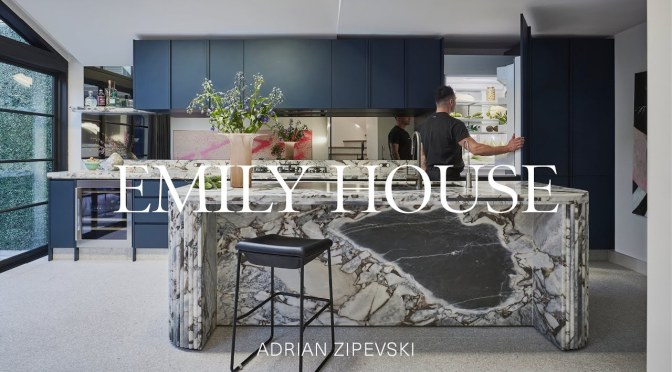
Working together, Aldini and Isaac Group have turned an abandoned warehouse into a modern dream home. Sitting on a small plot of land, the warehouse was in dire need of a contemporary lift – therefore the employment of organic shapes, elements and materials became the key focus for both interior designer and builder.
Video timeline: 00:00 – Introduction to the Modern Dream Home 00:25 – The Location of Emily House 00:38 – A Walkthrough of the Modern Dream Home 01:10 – Maximising the Previous Small Space 01:29 – The Builder 01:51 – Relationships and Working as a Team 02:14 – Utilising Natural Elements and Organic Shapes 03:10 – Elements of Softness and Curves 03:34 – Harnessing the Natural Light 04:02 – Favourite Parts of the Modern Dream Home 04:29 – Proud Moments
With a brief that only required the cathedral ceilings to be kept, the interior architecture was imbued with soft curves, natural shapes and materials, and a flood of natural light. In the end, the client’s home was turned into a modern dream home that would become a hub for connection, light and simple opulence.
Located in the inner west of Sydney, Emily House strikes an unassuming appearance with dark tones, leafy greens and a timber batten façade that hints at what is inside the modern dream home. Following the house tour inside, the front of the home contains the master bedroom and ensuite before offering a glimpse of the opulent kitchen – which is designed to be the hub for connection.
While using marble, granite and terrazzo throughout the modern dream home to add an opulence, the elements of curved bamboo, which is seen in the bathrooms and on the kitchen island bench, is used to soften the hardness of these materials. In the downstairs spaces, large steel windows, bi-fold doors and skylights have been installed to help bring more natural light inside while also adding to the sense of space inside.
Following the kitchen’s marble bench top and dark palette cabinetry, the dining and living room reference the same colours through the furnishings and marble that has been employed on the shelving and fireplace. To combat the hard lines of the steel and marble, the softening of elements has been encouraged throughout the interior design, which is seen in the soft curving of the Venetian plaster wall above the fireplace.
After the doors are opened, the courtyard helps to expand upon the liveable space and, with its terrazzo floor, curved seating arrangement and green wall the space, the downstairs living areas extend upon the client’s wish of creating a hub for connection. Upstairs, the inclusion of two more bedrooms and a bathroom further employs the use of stone, light and a natural colour palette.
Infused with natural light, the bedrooms offer guests an opulent stay that is reminiscent of five star hotels. Working together, the interior designer and builder established the modern dream home to become a space where the client could entertain. Additionally, the house is filled with a sense of softness – to which the client can find reprieve in the moments when it is needed.
The Local Project (January 13, 2023) – Renovating an old house in Hobart, Bence Mulcahy added a two-storey extension made of glass and steel. Named Greenhouse, the structure replaces a 1980s iteration in a manner that best engages the nearby veranda, courtyard and garden.
Video timeline: 00:00 – Cloudy Bay 00:12 – Introduction to the Greenhouse 00:53 – The Brief for the Renovation 01:19 – House Tour of the Home 02:16 – The Sandstone Base of the Building 02:30 – The Lower and Upper Floor of the Extension 03:15 – The Exterior of the Greenhouse 03:25 – The Interior Materials Chosen 03:48 – The Furniture and Furnishing of the House 04:50 – Cloudy Bay
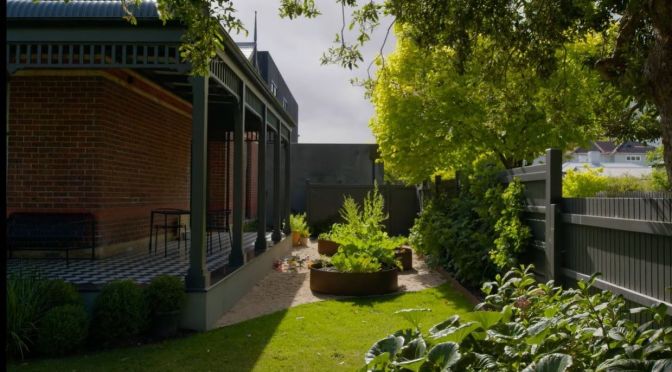
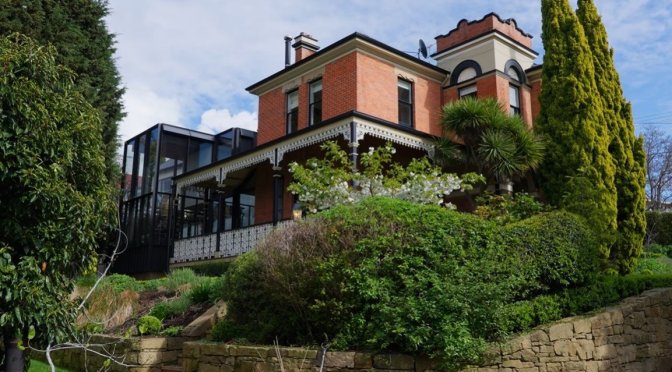
Located in the Hobart suburb of Mount Stuart, Greenhouse forms a contemporary addition to a red brick, Federation-style Italianate home. The new volume looks out onto the Derwent River and is supported by a veranda and a well-established garden complete with plants, trees and sandstone retaining walls. Bence Mulcahy identifies the key to renovating an old house is relating the extension to the main building – Greenhouse mirrors the scale of the existing dwelling, proposing a strong sense of verticality.
A house tour of the dream home begins at the formal entry space and transitions into the main hall. Beyond lies the beginning of the extension. The process of renovating an old house sees the final extension enclose the dining room, kitchen and an extra eating area. Upstairs, the addition houses an ensuite bathroom and walk-in wardrobe. Ample glazing then allows the home to borrow visual space from the external landscape.
Bence Mulcahy takes a seasoned approach to renovating an old house, inserting voids in order to manage the sense of privacy. A two-storey void is left over the dining room, whilst a separate alcove of the same size is located above the upstairs ensuite. Creating a glasshouse structure using a combination of glass and steel, Bence Mulcahy pays homage to a greenhouse inspiration. The durable nature of the material palette is particularly relevant to renovating an old house, promising an enduring outcome.
Internally, copper sinks and a copper island bench complement a wax-sealed timber floor and array of curated soft furnishings. Utilising the skills of local craftsmen, Bence Mulcahy does justice to the personal nature of the home. Greenhouse stands as a lesson in house renovation and embraces the tranquil quality of its natural surrounds.
The Local Project – Through natural material selections, Cheshire Architects has unveiled Waiheke House, a home that embraces its surrounds to become the best modern house in the world. Operating under the rule that grandeur does not need to be shown through scale but rather quality, Waiheke House is a place of respite for its owners with only one and a half bedrooms and a focus on entertaining areas.
Video timeline:00:00 – Introduction to the Best Modern House in the World 00:45 – An Island Location 01:05 – The Aspect of the House 01:35 – Tasked with Entertaining 02:01 – The House Plan and its Materials 03:39 – Hidden Openings and Passages 04:22 – Bathing Rituals 05:27 – The Goal Behind the Home 05:43 – Creating a Centred Feeling 06:09 – Becoming One with the Environment 06:33 – A Vessel for Experience 06:53 – A Home Made with Real Materials 07:20 – A Love for the Layered Experience
While the views of Waiheke House are only part of what establishes it as the best modern house in the world, it is how the structure inserts itself into the landscape that is awe-inspiring. Focused on evoking the numerous meanings of ‘shelter,’ Waiheke House acts as a platform that can open or close for the watching of the weather as it changes. Comprised of two pavilions, which are slightly offset from one another,
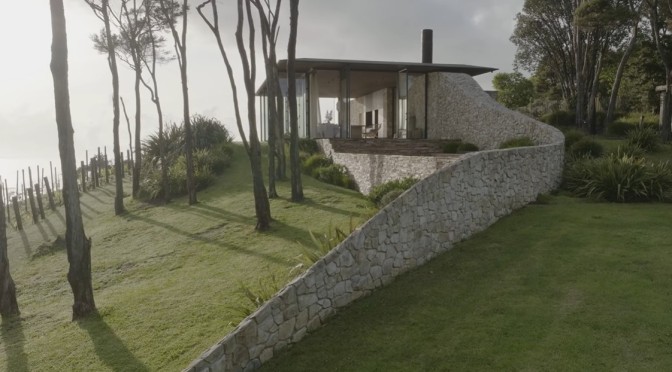
Cheshire Architects have separated the living spaces to designate a place of reprieve and a place to entertain. The larger of the two pavilions, known as the seaward pavilion, is framed by landscaping. Shaped by the stone wall that curves around and holds the home, the idea of anchoring the seaward pavilion is seen through the home’s distinct architectural theme. To make the best modern house in the world feel warm and comfortable, the use of stone, wood and brass help the house insert itself into the surrounding nature. Created for entertaining, the seaward pavilion is intentionally designed to be small, with only a kitchen, large dining section and lounge.
Framed by glass on three sides, doors butterfly open so that the living areas can connect seamlessly with the lawn. Conceptually thought of as a canopy atop a mouth of a cave, Cheshire Architects has formed the best modern house in the world to navigate a spatial dialect that speaks to both broad ocean views and small, contained spaces. Throughout the house tour, it is evident that the selected surfaces and materials are chosen to act as a vessel for experience – an idea that Cheshire Architects hopes will still be embodied in 100 years as the home ages in place.
Seen in the stacked stone of the wall to the layered floor, Cheshire Architects avoids using crisp whites or laminates and instead imbues the home with richness from natural materials. Throughout the second pavilion, the adaption of narrower halls, lower ceilings and darker tones have been employed to create a dynamic internal contrast. Intended as a retreat for the owners, Waiheke House is a place to align and connect with the natural surroundings. By focusing on simple, high-quality design choices over scale, Cheshire Architects has created the best modern house in the world so that it may amplify what already exists.
News, Views and Reviews For The Intellectually Curious







 Boomers Daily