Hope lies not in expecting a late-in-life conversion experience in the Oval Office but in carrying out the ordinary work of civic life. By David Remnick
Tim Berners-Lee Invented the World Wide Web. Now He Wants to Save It
In 1989, Sir Tim revolutionized the online world. Today, in the era of misinformation, addictive algorithms, and extractive monopolies, he thinks he can do it again. By Julian Lucas
Carol Burnett Plays On
The ninety-two-year-old comedy legend has influenced generations of performers. In a string of recent TV roles, she has been co-starring with some of her closest comedic heirs. By Rachel Syme
Where the Battle Over Free Speech Is Leading Us
Doxing, deplatforming, defunding, persecuting, firing, and sometimes killing—all are part of an escalating war over words. What happens next? By Louis Menand
Now you see them, now you don’t: Roger Morgan-Grenville treads the ephemeral sea paths of Britain, those often-ancient routes at the mercy of the tides
A stitch in time
Deborah Nicholls-Lee unearths Mr Darcy’s shirt, Bertie Wooster’s dressing gown and Poldark’s tricorn hat in a fascinating trawl through the Cosprop wardrobes
Property market
A quartet of significant West Country houses is seeking buyers, reports Penny Churchill
Properties of the week
A Devon longhouse, Cornwall cottage and Somerset thatch catch Arabella Youens’s eye
When your art is in the right place
To whom do the experts turn for the best in framing, restoring and valuing? Leading art and antique dealers open their little black books for Amelia Thorpe
Leslie MacLeod Miller’s favourite painting
The impresario picks a portrait of a 19th-century singing sensation
Country-house treasures
The fortunes of a Cumbrian castle rest with the ‘Luck of Muncaster’, finds John Goodall
A Regency prospect
Steven Brindle looks at the remarkable story behind a fine Georgian creation — Samuel Wyatt’s Belmont House in Kent
The legacy
Emma Hughes toasts the genius of Dennis Potter, the man who gave us the darkly comic and gritty Singing Detective
Beginning to see the light
John Lewis-Stempel and his dogs are up with the skylark to witness the dawning of a spectacular September day
Luxury
Amie Elizabeth White on tartan, tweed, timepieces and fruity jewels, plus a few of Victoria Pendleton’s favourite things
Interiors
Amelia Thorpe admires the makeover of a guest bedroom at a Scottish country house and picks the best bedside tables
Plum advice
Charles Quest-Ritson shares his favourite forms of plum, gage, mirabelle and damson from the 20-plus varieties he has grown
Slightly foxed
Second-hand bookshops can be a goldmine of gardening wisdom, says John Hoyland
Scale model
David Profumo is transported back to childhood by the spiny, swashbuckling stickleback
Travel
Mark Hedges takes a break from reality on Bryher, a heather-clad haven in the Isles of Scilly
Arts & antiques
Art dealer John Martin tells Carla Passino why he can never part with a panel he stumbled upon by Nigerian sculptor Asiru Olatunde
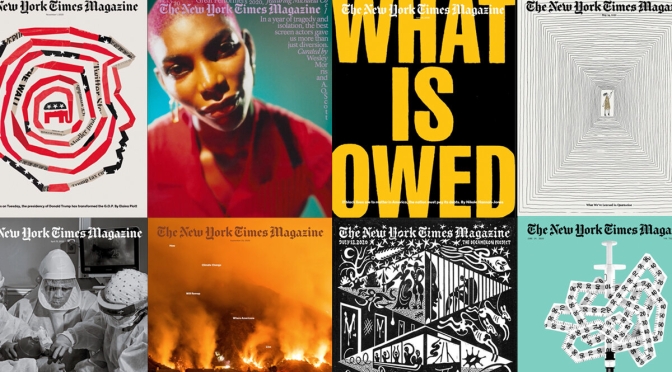
THE NEW YORK TIMES MAGAZINE: The 9.21.25 Issue features David Wallace-Wells on how the world has soured on climate politics; Christina Cauterucci on a new brand of climate activism; Brook Larmer on China’s green-tech ambitions; David Gelles interviews six world leaders about their plans to navigate climate change; and more.
The actor and producer booked her first big role when she was 14 years old. More than 30 years later, she’s an entertainment-industry powerhouse. By Lulu Garcia-Navarro
The President and his allies are using the power of the state to silence speech they dislike. By Isaac Chotiner
The Great Student Swap
For years, public universities have aggressively recruited out-of-state and international students, charging them higher tuition. But those pipelines may be drying up. By Jeffrey Selingo
J. D. Vance, Charlie Kirk, and the Politics-as-Talk-Show Singularity
Broadcasting from the White House, the Vice-President seemed to complete the merger of politics and red-meat live streams—and to threaten more ominous crackdowns ahead. By Andrew Marantz
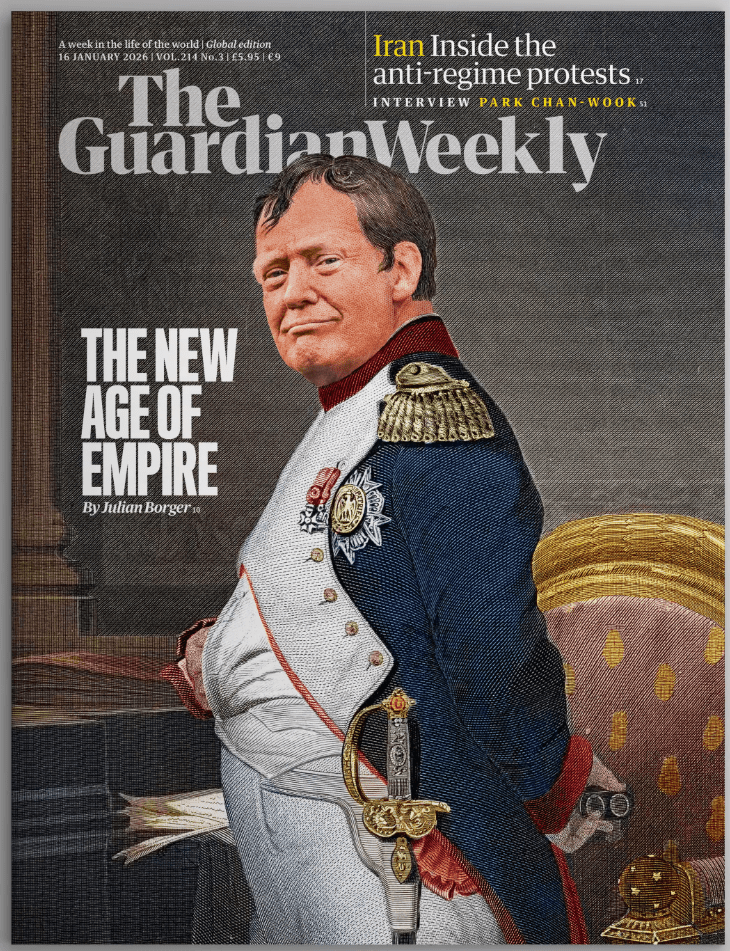
The killing of Charlie Kirk last week sent shock waves through America among both supporters and opponents of his views. Yet until last week, the young rightwing activist was relatively unheard of – by older generations anyway – outside the US.
As the ripples and implications of his death continue to spread across the US and beyond, our big story takes a step back. Washington bureau chief David Smith explains how the young activist rose to prominence and gained a place within Donald Trump’s inner circle, his provocative brand of populism and charisma playing an outsize role in the Republicans’ 2024 election victory. As Steve Bannon, the prominent rightwing commentator, told the Guardian, Kirk’s popularity with young voters “changed the ground game” for Trump and the Maga movement.
Spotlight | Why has England become festooned with flags? Chief reporter Daniel Boffey visits a Birmingham suburb to track down the genesis of a movement that wants to see the union jacks or the flag of St George displayed across the country
Special investigation | Boris Johnson’s pursuit of profit A cache of leaked documents show a blurring of lines in the former prime minister’s private business ventures and political role after leaving office, our investigations team reveals
Feature | The porn business stripped bare In Amsterdam, at Europe’s biggest pornography conference, Amelia Gentleman discovers the perils of a booming industry, from burnout to the advent of AI
Opinion | Trump is just a paper tiger While the US president likes to present himself as the biggest, baddest strongman, he crumples in the face of Benjamin Netanyahu or Vladimir Putin’s belligerence, says Simon Tisdall
Culture | The power of pure pop Famous for getting us through lockdowns with her kitchen disco and a stream of catchy hits, Sophie Ellis-Bextor tells Rebecca Nicholson about why the perimenopause is a gift to renewed creativity
After a shooting with obvious political resonance, news about the perpetrator’s motives rarely brings clarity. By Benjamin Wallace-Wells
How Jessica Reed Kraus Went from Mommy Blogger to MAHA Maven
The founder of “House Inhabit” has grown her audience during the second Trump Administration with political gossip and what she calls “quality conspiracy.” By Clare Malone
Is the Sagrada Família a Masterpiece or Kitsch?
In the century since Antoni Gaudí died, his wild design has been obsessively realized, creating the world’s tallest church—and an endlessly debated icon. By D. T. Max
THE NEW YORK TIMES MAGAZINE: The 9.14.25 Issue features David Enrich, Matthew Goldstein and Jessica Silver-Greenberg on how JPMorgan enabled the crimes of Jeffrey Epstein; Jonathan Mahler on how Trump shut down the war on cancer; Amy X. Wang on gold diggers; and more.
When most people think about Jeffrey Epstein, they think of a sexual-abuse scandal. But it’s also a financial scandal — one in which JPMorgan, the nation’s largest bank, not only enabled Epstein’s sex-trafficking operation but also enriched him while reaping profits for itself. Matthew Goldstein, and a team of other Times journalists, combed through 13,000 documents to explain why. By Matthew Goldstein, Gabriel Blanco and June Kim
The AI upheaval is unique in its ability to metabolize any number of dread-inducing transformations. The university is becoming more corporate, more politically oppressive, and all but hostile to the humanities? Yes — and every student gets their own personal chatbot. The second coming of the Trump Administration has exposed the civic sclerosis of the US body politic? Time to turn the Social Security Administration over to Grok. Climate apocalypse now feels less like a distant terror than a fact of life? In five years, more than a fifth of global energy demand will come from data centers alone.
Naturally there were lots of law enforcement types hanging around the convention — men with military fades, moisture-wicking shirts, and tattoos of the Bible and the Constitution and eagles and flags distended across their arms. But there were also a handful of women ICE applicants and a lot of men of color. The deportation officer applicant pool was, I felt, shockingly diverse — one might say it looked like America. The whole place looked and felt like America.
The challenge posed by this political crisis is how to take the stupidity seriously without reducing it to a wholly mental or psychiatric, let alone genetic, phenomenon. Stupidity can be understood as a problem of social systems rather than individuals, as André Spicer and Mats Alvesson explore in their book The Stupidity Paradox. Stupidity, they write, can become “functional,” a feature of how organizations operate on a daily basis, obstructing ideas and intelligence despite the palpable negative consequences. Yet it’s hard to identify anything functional about Trumpian stupidity, which is less a form of organizational inertia or disarray than a slash-and-burn assault on the very things — universities, public health, market data — that help make the world intelligible.
Xi Jinping had been waiting for the right moment to serve notice of China’s growing might and influence to the rest of the world, and the 80th anniversary of the end of the second world war provided the Mao-suited Chinese leader with the perfect opportunity.
Last week’s bombastic (or should that be bomb-tastic?) military parade in Beijing – in the presence of Vladimir Putin, Kim Jong-un and a host of other global strongmen – was intended as a show of force and stability to contrast sharply with the chaotic unpredictability of Donald Trump’s America. And, as the leaders of the world’s most notorious pariah states bear-hugged and strolled around Tiananmen Square like the cast of Reservoir Dogs, the optics did not disappoint.
But behind the scenes, how robust actually is the so-called “axis of upheaval”? As our big story this week explores, the illiberal alliance is riven by internal fractures and mistrust between China, Russia and North Korea that date back many years and cannot be discarded as quickly as Xi, or anyone else, might like.
Spotlight | France’s latest political crisis The fall this week of prime minister François Bayrou exposed a political malaise that is likely to sour French politics well beyond the 2027 presidential election, reports Paris correspondent Angelique Chrisafis
Interview | Leonard Barden, chairman of the chess board From honing his game in air raid shelters during the second world war to beating grand masters, our record-breaking chess columnist has lived an extraordinary life. Now aged 96, he chats to our chief sports reporter Sean Ingle
Feature | Syria’s cycle of sectarian violence Over a few brutal days in March, as sectarian violence and revenge killings tore through parts of the country, two friends from different communities tried to find a way to survive. By Ghaith Abdul-Ahad
Opinion | Angela Rayner’s exit is a bombshell for Keir Starmer The UK deputy prime minister’s fall will exacerbate all the doubts about the PM himself and his ability to keep Labour in power, writes Jonathan Freedland
Culture | Spinal Tap turn it up to 11, one last time More than 40 years since the film This Is Spinal Tap was mistaken for a comedy, its hard-rocking subjects are back for a legally obligated final gig. Our writer Michael Hann smells the glove
News, Views and Reviews For The Intellectually Curious