

Tag Archives: Cities
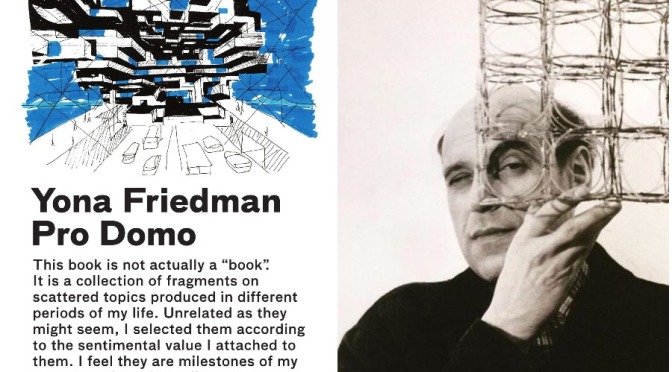
Tributes: French Planner, Architect Yona Friedman Dies At 96 – Founder Of “Mobile Architecture”
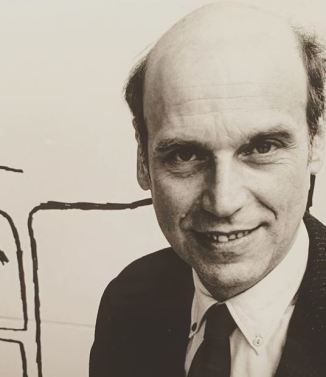
“After 96 years on this earth, Yona has moved up to build a Spatial City and install some Space Chains in the sky. The Fonds de Dotation Denise and Yona Friedman, which he founded last year, will continue his work.”
From an Instagram post (02/21/20)
Yona Friedman (5 June 1923 – 21 February 2020) was a Hungarian-born French architect, urban planner and designer. He was influential in the late 1950s and early 1960s, best known for his theory of mobile architecture.
In 1958, Yona Friedman published his first manifesto : “Mobile architecture”. It described a new kind of mobility not of the buildings, but for the inhabitants, who are given a new freedom.
Mobile architecture is the “dwelling decided on by the occupant” by way of “infrastructures that are neither determined nor determining”. Mobile architecture embodies an architecture available for a “mobile society”. To deal with it, the classical architect invented “the Average Man”. The projects of architects in the 1950s were undertaken, according to Friedman, to meet the needs of this make-believe entity, and not as an attempt to meet the needs of the actual members of this mobile society.
The teaching of architecture was largely responsible for the “classical” architect’s under-estimation of the role of the user. Furthermore, this teaching did not embrace any real theory of architecture. Friedman proposed then teaching manuals for the fundamentals of architecture for the general public.
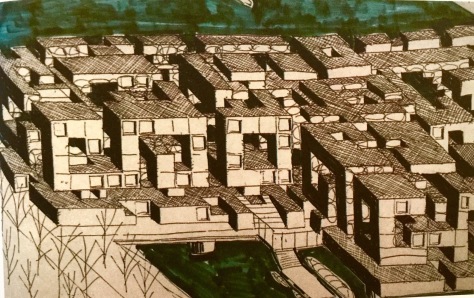
The spatial city, which is a materialization of this theory, makes it possible for everyone to develop his or her own hypothesis. This is why, in the mobile city, buildings should :
- touch the ground over a minimum area
- be capable of being dismantled and moved
- and be alterable as required by the individual occupant.
The Spatial City is the most significant application of “mobile architecture”. It is raised up on piles which contains inhabited volumes, fitted inside some of the “voids”, alternating with other unused volumes, making it look aesthetically pleasant. The basis of its design is that of trihedral elements which operate as “neighbourhoods” where dwellings are distributed without a price.
This structure introduces a kind of merger between countryside and city (compare to Paolo Soleri’s Arcology concept) and may span:
- certain unavailable sites,
- areas where building is not possible or permitted (expanses of water, marshland),
- areas that have already been built upon (an existing city),
- above farmland.
This spanning technique which includes container structures ushers in a new development in town-planning. Raised plans increase the original area of the city becoming three-dimensional. The tiering of the spatial city on several independent levels, one on top of the other, determines “spatial town-planning” both from the functional and from the aesthetic viewpoint. The lower level may be earmarked for public life and for premises designed for community services as well as pedestrian areas. The piles contain the vertical means of transport (lifts, staircases). The superposition of levels should make it possible to build a whole industrial city, or a residential or commercial city, on the same site. In this way, the Spatial City forms what Yona Friedman would call an “artificial topography”. This grid suspended in space outlines a new cartography of the terrain with the help of a continuous and indeterminate homogeneous network with a major positive outcome: this modular grid would authorize the limitless growth of the city.
The spaces in this grid are rectangular and habitable modular “voids”, with an average area of 25–35 square meters. Conversely, the form of the volumes included within the grid depends solely on the occupant, and their configuration set with a “Flatwriter” in the grid is completely free. Only one half of the spatial city would be occupied. The “fillings” which correspond to the dwellings only actually take up 50% of the three-dimensional lattice, permitting the light to spread freely in the spatial city. This introduction of elements on a three-dimensional grid with several levels on piles permits a changeable occupancy of the space by means of the convertibility of the forms and their adaptation to multiple uses.
In Yona Friedman’s own words “The city, as a mechanism, is thus nothing other than a labyrinth : a configuration of points of departure, and terminal points, separated by obstacles”.
From Wikipedia
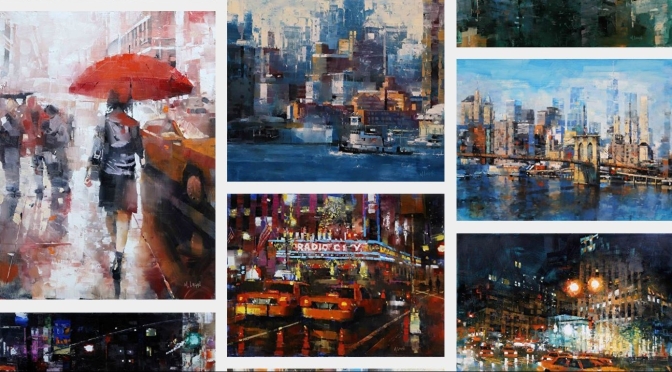
Profiles: 55-Year Old Canadian Artist Mark Laguë – “Painter Of Light”
Painter of Light
 Mark has developed an international reputation and has won numerous awards, both in his native Canada and in the United States. A dedicated painter, Mark Lague was born in Lachine Quebec in 1964 and he has had a fascination with drawing since childhood, a skill he practices constantly, even to this day.
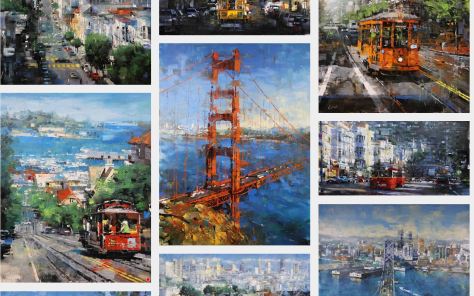
Upon graduation from Montreal’s Concordia University in Design, Mark embarked on a 13-year career in the animation industry, working primarily as a background designer and art director. During this time, despite working full time, he began receiving international acclaim for his watercolour paintings through competitions, juried shows, and solo exhibitions.
In 2000, Mark switched to oil as his primary medium, and in 2002 made the jump to full time painter. As an artist he is a realist, who is open to virtually all subject matter. What keeps him excited about painting is his endless quest to simplify and get to the essence of whatever he paints. Mark has been featured in numerous national art magazines, and continues to receive international recognition for his distinctive style of painting.
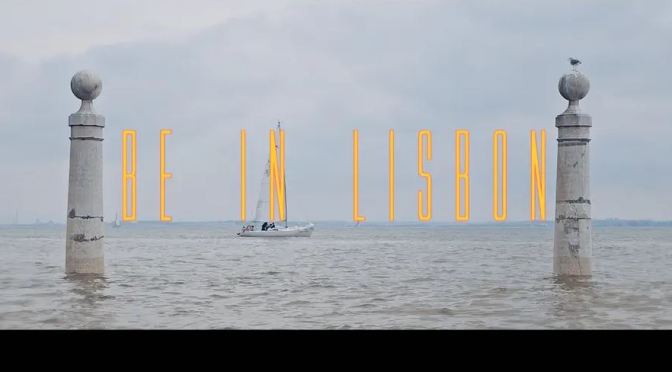
Top New Travel Videos: “Be In Lisbon” By Alex Soloviev
Filmed and Edited by: Alex Soloviev
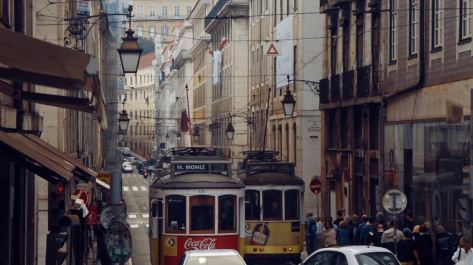
Another chapter about charming and vibrant capital of Portugal. Relaxed vibe of Lisbon, which is something you may don’t get in many other capital cities, makes you back there. Walk around, take the tram and be ready to find beauty in every corner. This is Lisboa.
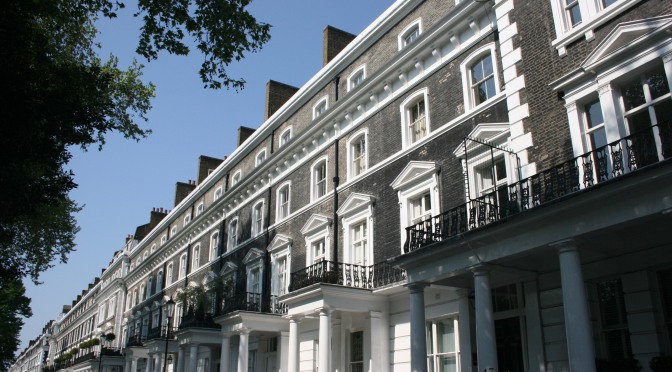
Design: The History Behind “Two-Up, Two-Down” London Row Houses
From a CityLab online article:
From the outside, London’s row houses have an eclectic variety of ornament, and they range in scale from palatial to boxy. But inside, they are pretty much all configured the same way. That’s because from the late 17th century up until the First World War, most residential buildings here cleaved very close to a model found across English cities: the terraced house, known in its most condensed, emblematic form as the “two-up, two-down.”
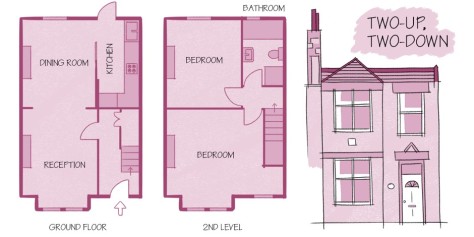
For a city that’s long been the repository of vast commercial, imperial, and industrial wealth, this might seem a very modest template. However, it is one that can be easily scaled up, points out Edward Denison, associate professor at the Bartlett School of Architecture and author of The Life of the British Home: An Architectural History.
“What’s extraordinary, in London in particular, is that you can find very grand houses in places such as Carlton House Terrace, with vast rooms and very high ceilings, that are still essentially two-up, two-downs with extra floors added,” says Denison. “Then you go to working-class terraced housing in places like Greenwich, and find a very different scale and quality of fittings, but essentially the same configuration.

New Photography Books: The Full-Day Panoramas Of “Day To Night” By Stephen Wilkes (Taschen)
From a Smithsonian Magazine online review:
 At first glance, Stephen Wilkes’ photographs look like a single moment in time. It is only upon closer inspection that viewers discover that each of his works is actually the result of shooting thousands of photographs from a stationary position over the course of a day and stitching them together digitally to create one cohesive panorama. The painstaking task of editing all of this information and whittling it down into one image can take months to complete, but the results capture a sense of place that can’t be expressed by a single frame alone.
Wilkes expands on this concept in his new book, Day to Night, which features panoramas of iconic places like New York’s Coney Island, Moscow’s Red Square and Arizona’s Grand Canyon seen over the course of a day. Time-lapse photos these are not, as Wilkes carefully selects the exact frames he’ll compile into the final image. (The book release coincides with “A Witness to Change,” a photographic exhibition to be held at Bryce Wolkowitz Gallery in New York City beginning September 12.)

Top Science Podcasts: Persistent Antibiotic Resistance And Modeling Hot Cities (Nature)
 Researchers have identified how Salmonella ‘persister’ cells can spread antibiotic resistance genes in mice intestines.
Cities are generally hotter than their surroundings, but what are the causes of these ‘heat islands’?
In this episode:
00:46 Antibiotic resistance reservoirs
Researchers have identified how Salmonella ‘persister’ cells can spread antibiotic resistance genes in mice intestines. Research article: Bakkeren et al.
08:12 Research Highlights
Bright barn owls stun prey, and the evolution of dog brains. Research Highlight: Zip-lining owls reveal what really scares their prey; Research Highlight: A dog’s breed is a window onto its brain
10:13 Urban heating
Cities are generally hotter than their surroundings, but what are the causes of these ‘heat islands’? Research Article: Manoli et al.
16:54 News Chat
A cryptic Russian radiation spike, and India’s moon mission gets closer to touchdown. News: How nuclear scientists are decoding Russia’s mystery explosion; News: ‘The most terrifying moments’: India counts down to risky Moon landing
 Boomers Daily