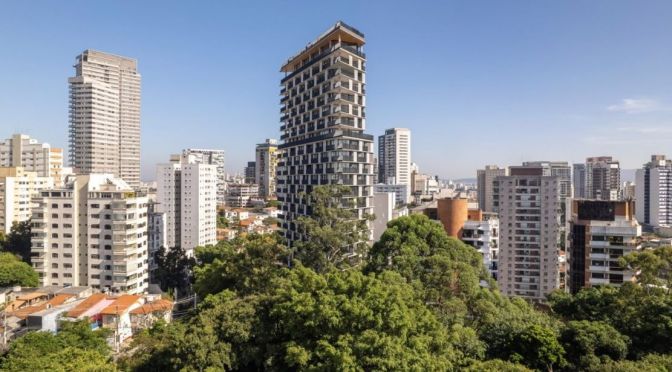

Onze22 consists of two towers, with the largest containing 24 storeys. Balconies wrap the building on three sides, allowing apartments to extend outdoors.
Read more on Dezeen: https://www.dezeen.com/?p=2022497

Onze22 consists of two towers, with the largest containing 24 storeys. Balconies wrap the building on three sides, allowing apartments to extend outdoors.
Read more on Dezeen: https://www.dezeen.com/?p=2022497



MVRDV is a globally based architectural firm established in 1993 by Winy Maas, Jacob van Rijs and Nathalie de Vries, with offices in Rotterdam, Shanghai, Paris, Berlin, and New York.

OMA is an internationally renowned architecture and urbanism practice led by eight partners, Rem Koolhas, Reinier de Graaf, Ellen van Loon, Shohei Shigematsu, Iyad Alsaka, Chris van Duijn, Jason Long, and Managing Partner-Architect David Gianotten. With offices in Rotterdam, New York, Hong Kong, Doha and Australia, the practice is currently working on several building projects, including the renovation of Kaufhaus des Westens in Berlin and the Simone Veil Bridge in Bordeaux.

UNStudio began as a vision of two young minds, Ben van Berkel and Caroline Bos, who started with a simple drawing board and a pen, sketching their designs for the future. Today, 30 years later, UNStudio operates in over 30 countries with six international offices and a team of over 200 architects and designers who focus on designing spaces that meet human needs.


Correspondent Rita Braver talks with Holl, whose recent works include the REACH at the John F. Kennedy Center for the Performing Arts, in Washington, D.C., and the Kinder Building at The Museum of Fine Arts, Houston – buildings in which Holl hopes to express “the joy from the creative act.”
Steven Holl is a tenured Professor of Architecture who has taught at Columbia GSAPP since 1981. After completing architecture studies in Rome in 1970, the University of Washington in 1971, and graduate studies at London’s Architectural Association in 1976, Holl founded Steven Holl Architects in 1977. Based in New York City, the forty person firm also has an office in Beijing.
Steven Holl has realized cultural, civic, academic and residential projects both in the United States and internationally including the Kiasma Museum of Contemporary Art in Helsinki, Finland (1998); the Chapel of St. Ignatius, Seattle, Washington (1997); Simmons Hall at the Massachusetts Institute of Technology in Cambridge, Massachusetts (2002); the Nelson-Atkins Museum of Art in Kansas City, Missouri (2007); the Horizontal Skyscraper in Shenzhen, China (2009); the Linked Hybrid mixed-use complex in Beijing, China (2009); Cité de l’Océan et du Surf in Biarritz, France (2011); the Reid Building at the Glasgow School of Art, Glasgow, Scotland (2014); the Arts Building West and the Visual Arts Building at the University of Iowa in Iowa City, Iowa (2006, 2016); the Ex of IN House (2016); the Lewis Arts Complex at Princeton University in Princeton, New Jersey (2017); Maggie’s Centre Barts in London (2017); the Institute for Contemporary Art at Virginia Commonwealth University (2018); and the Glassell School of Art at the Museum of Fine Arts, Houston (2018). Upcoming work includes the REACH expansion of the John F. Kennedy Center for Performing Arts in Washington, D.C. (2019); the Winter Visual Arts Center at Franklin & Marshall College (2019); Rubenstein Commons at the Institute for Advanced Study in Princeton, New Jersey (2019); and the expansion of the Museum of Fine Arts, Houston (2020).
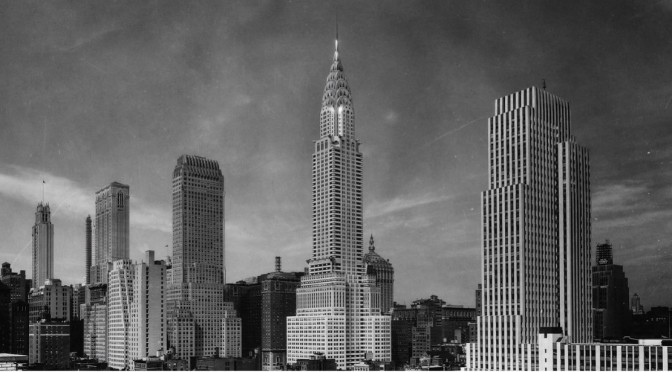
Today Michael Wyetzner of Michielli + Wyetzner Architects returns to Architectural Digest for a deep, detail-oriented break down of New York City’s singular Chrysler Building. From its unmistakable Art Deco design to the hidden details that echo its automotive inspiration, see why the Chrysler Building is an iconic staple of the Manhattan skyline.
The story of the Chrysler Building began in 1928, when automotive titan Walter P. Chrysler, founder of Chrysler Corporation, bought the property from Coney Island developer William H. Reynolds for $2 million. Chrysler hired architect William Van Alen, who had previously designed a skyscraper for Reynolds on the site, to create the world’s tallest tower. Construction on Chrysler’s project began in 1929 and was completed in 1930. Reaching a height of 1,048 feet, including its 125-foot steel spire, the Chrysler Building surpassed the Woolworth Building and 40 Wall Street in Lower Manhattan in a “Race to the Sky” to claim the tallest building in the world–a title it held until 1931. The Chrysler Building still reigns as the world’s most famous skyscraper, playing prominent roles in film and television from Godzilla and Spider-Man to Sex and the City.


Charles Jencks and Maggie Keswick | Anupama Kundoo | Margarete Schütte-Lihotzky | João Batista Vilanova Artigas | Laurie Simmons | Kochi Architects Studio | Ekar Architects | Atelier Tho.A | Chat Architects | Fernanda Canales Arquitectura | Brillhart Architecture
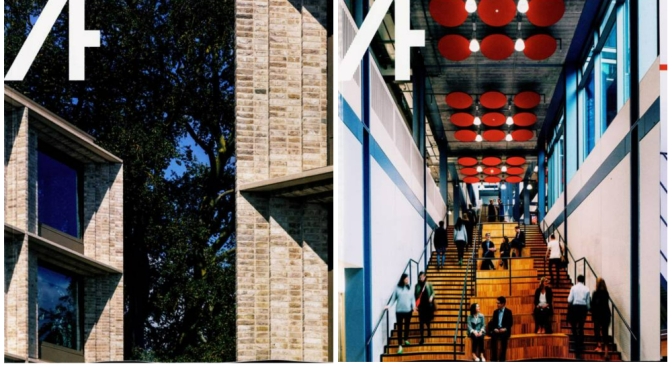
Very few people have the resources to realise the house of their dreams, yet the results can be extraordinary. From the London home of Charles Jencks and Maggie Keswick, which is a manifestation of their postmodern fantasies, to the local materials and construction techniques of Anupama Kundoo’s Wall House in Auroville, this issue revisits houses designed by architects for themselves, and sometimes their families. Also celebrated are the winning projects of the 2022 AR House Awards, featuring innovative and intriguing dwellings from Mexico, Japan, Thailand, Vietnam and the Bahamas.

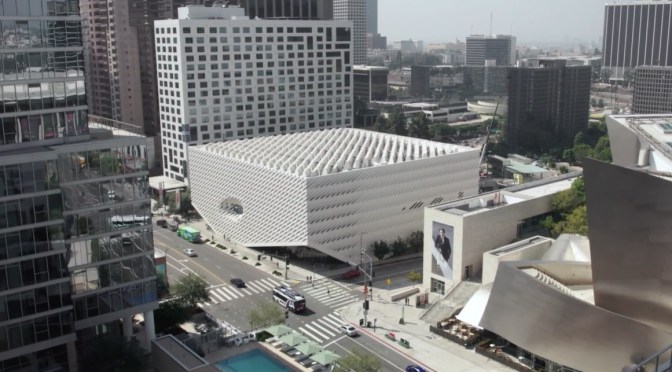
The video features The Broad in Los Angeles designed by Diller’s studio Diller Scofidio + Renfro, a three-storey museum that houses an expansive collection of contemporary and post-war artworks. Speaking to Dezeen in an exclusive video interview filmed at the Diller, Scofidio + Renfro office in New York City, Diller explained how the building was designed to feel inviting to visitors with a porous facade that allows light to be gently diffused into the gallery.
“It doesn’t really feel like a traditional museum,” Diller said. “There’s no sense of authority. When you step off the street, no one tells you where to go. There’s no information desk, there’s no admissions desk. You don’t pay, it’s free. It feels extremely welcoming.”


Isabel Allen’s Editorial for AT322 discusses how the Architecture Today Awards subverted the traditional role of the crit, transforming it into powerful tool for judging the merits and performance of buildings that already exist.

A sharp, trapezoidal marquee hoisted on spindly pilot is points the way towards the primary pedestrian entrance on the long eastern front.
Hey, batter batter! Michael Wyetzner of Michielli + Wyetzner Architects returns to AD, this time breaking down the architectural details found in baseball stadiums around North America. From some of the earliest homes of the national pastime to current multi-billion dollar behemoths, Michael offers up expert insight on what makes each of them distinct.
British bicycle manufacturer Brompton has unveiled plans to build a carbon-neutral headquarters and factory building designed by architects Hollaway Studio in Ashford, Kent. Envisioned by Brompton as a factory of the future, the facility will sit within an unused wetlands area that will be rewilded to become a nature reserve as part of the plans.




 Boomers Daily