

Video timeline: 00:00 – The World Ahead 2024 00:33 – Vital votes 03:34 – Taxis take off 07:10 – AI rules 10:19 – Industry cleans up? 13:48 – BRICS build

Video timeline: 00:00 – The World Ahead 2024 00:33 – Vital votes 03:34 – Taxis take off 07:10 – AI rules 10:19 – Industry cleans up? 13:48 – BRICS build
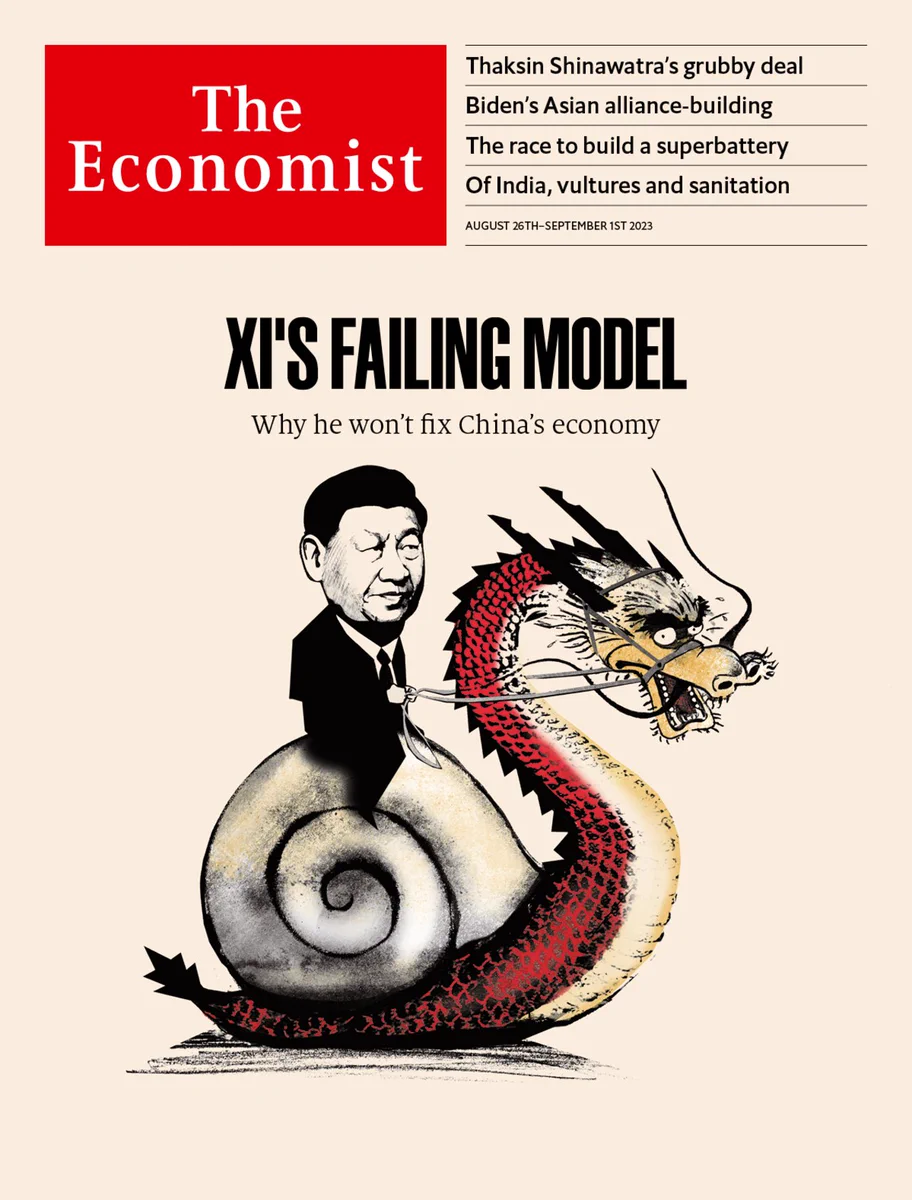

An increasingly autocratic government is making bad decisions

Whatever has gone wrong? After China rejoined the world economy in 1978, it became the most spectacular growth story in history. Farm reform, industrialisation and rising incomes lifted nearly 800m people out of extreme poverty. Having produced just a tenth as much as America in 1980, China’s economy is now about three-quarters the size. Yet instead of roaring back after the government abandoned its “zero-covid” policy at the end of 2022, it is lurching from one ditch to the next.
A healthy country uses justice to restore order. Mr Putin uses violence instead

As we published this editorial, it was not certain that Yevgeny Prigozhin’s private jet was shot down by Russian air-defences, or that the mutineer and mercenary boss was on board. But everyone believes that it was and that his death was a punishment of spectacular ruthlessness ordered by Russia’s president, Vladimir Putin. And that is the way Mr Putin likes it.
The Globalist Podcast, Tuesday, August 22: We discuss the Brics summit in Johannesburg, the US sale of Tomahawk missiles to Australia and why Georgians are frustrated with Russian business owners.
Also, the latest developments in technology, a round-up of the news from Zürich and the backlog of ships in the Panama Canal.

Xi Jinping wants them to focus on the party’s goals. Many cannot see why they should

The crowd did not seem excited to see George Michael and Andrew Ridgeley. When Wham! became the first Western pop group to perform in Communist China, the audience was instructed to stay in their seats. It was 1985 and, despite appearances, the young people in attendance were in fact joyous. The country around them was by no means free, but it was starting to reform and open up. Over the next three decades the economy would grow at a rapid pace, producing new opportunities.
Young Chinese have little hope for the future. Xi Jinping wants them to toughen up

In the southern city of Huizhou an electronics factory is hiring. The monthly salary on offer is between 4,500 and 6,000 yuan (or $620 and $830), enough to pay for food and essentials, but not much else. The advertisement says new employees are expected to “work hard and endure hardship”. The message might have resonated with Chinese of an older generation, many of whom worked long hours in poor conditions to give their children a brighter future. But many of those children now face similar drudgery—and are unwilling to endure it. “I can’t sit on an assembly line,” says Zhang, a 20-something barista with dyed-red hair at a local tea shop. He scoffs at the idea of making such sacrifices for so little gain. The job at the tea shop pays just 4,000 yuan a month, but he enjoys chatting up customers.
Turkey agrees to back Finland and Sweden’s bid to join Nato. Plus: Iran applies to join trading bloc Brics, plans for a second Scottish independence referendum and the latest art news.


 Boomers Daily