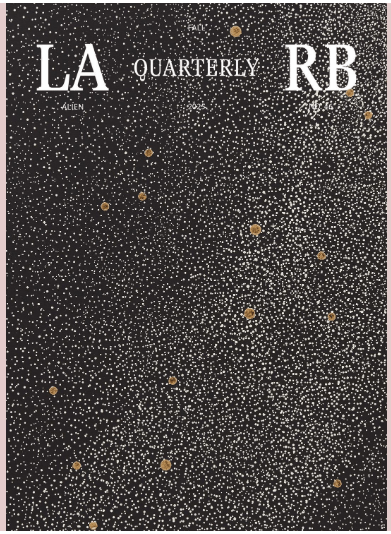
LOS ANGELES REVIEW OF BOOKS: The latest issue of LARB “Alien“,which wades into the unfamiliar. In Greta Rainbow’s “Tourists,” a woman travels to foggy Athens, where she confronts the unknowability of the city and her partner. In Sara Levine’s “Peter and the Women,” Peter (badly, ineptly, inappropriately, indecently) manages the women in his life: his hospice-bound mother and her nurse, as well as his girlfriends and one-night stands. And in Ari Braverman’s “Dogs of the Solar Steppe,” the narrator faces a decade-long punishment, performing domestic labor for a woman called Big Mother. Her former life assumes a “sheen of fantasy,” and the story warns us of “the easy slippage between one state and another.”
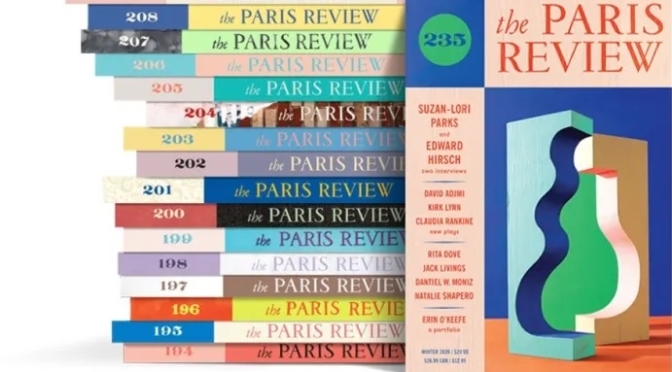
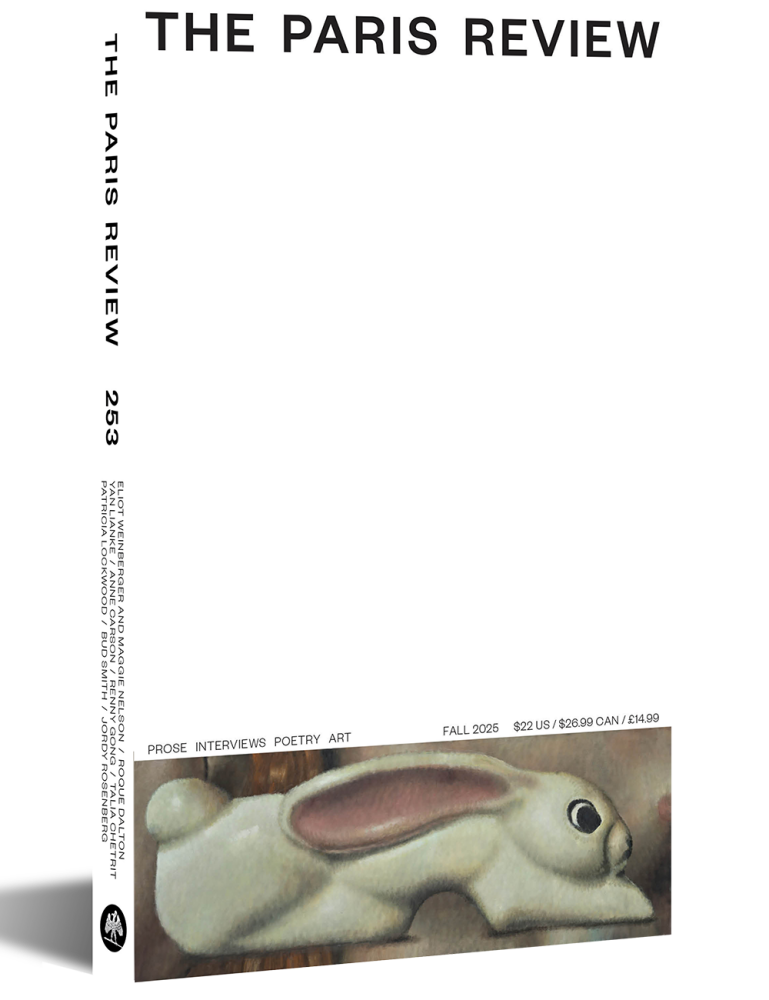
THE PARIS REVIEW : The latest issue features interviews with Maggie Nelson and Eliot Weinberger, prose by Bud Smith and Yan Lianke, poetry by Patricia Lockwood and Ishion Hutchinson, art by Martha Diamond and Talia Chetrit, a cover by Issy Wood, and more…
Eliot Weinberger on the Art of the Essay: “I have no interest in first-person investigation. Personally, I’ve never found myself an interesting person.”
Maggie Nelson on the Art of Nonfiction: “It’s important to notice when the spark of magic or curiosity is there and what snuffs it out, and being around too many writers, for me, snuffs it out.”
Prose by Anne Carson, Renny Gong, Aurora Huiza, Jordy Rosenberg, Bud Smith, and Yan Lianke.
Poetry by Roque Dalton, Ishion Hutchinson, Patricia Lockwood, Mariano Melgar, Eileen Myles, Katie Peterson, and authors unknown.
Art by Talia Chetrit, Martha Diamond, and Jamian Juliano-Villani; cover by Issy Wood.
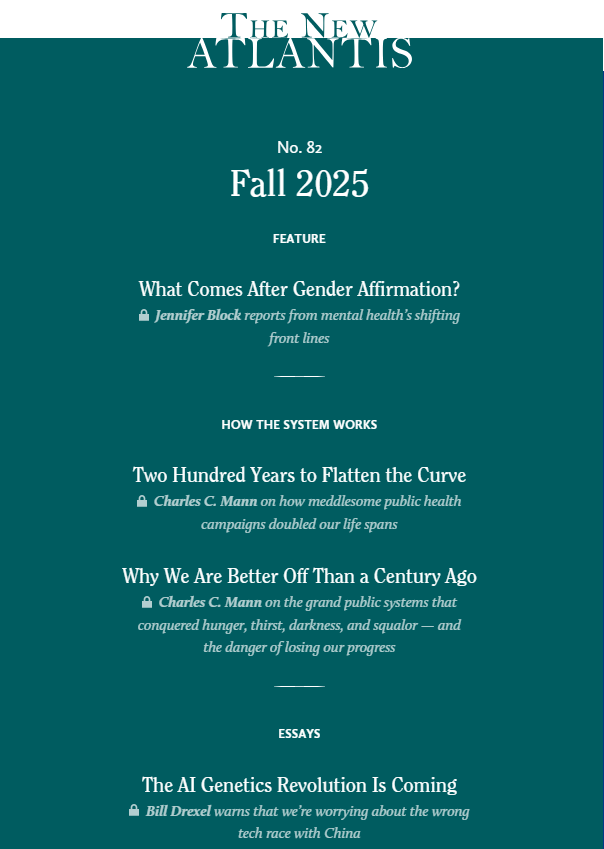
Making transition the first-line treatment for children was a mistake, many health agencies now say. A growing group of psychologists wants to restore the therapeutic relationship.
Two Hundred Years to Flatten the Curve
How generations of meddlesome public health campaigns changed everyday life — and made life twice as long as it used to be
Why We Are Better Off Than a Century Ago
Our ancestors built grand public systems to conquer hunger, thirst, darkness, and squalor. That progress can be lost if we forget it.
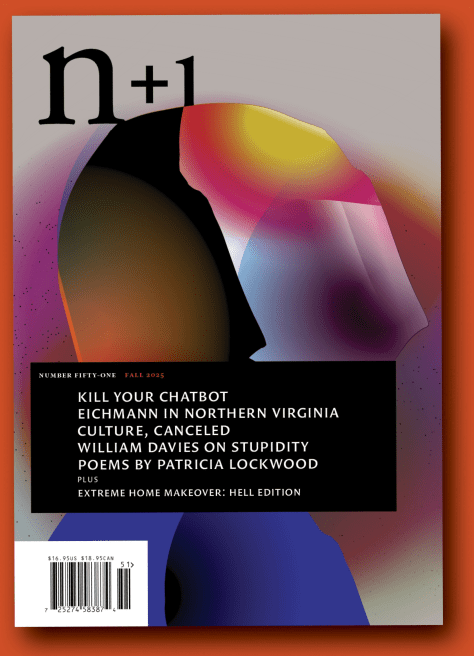
The AI upheaval is unique in its ability to metabolize any number of dread-inducing transformations. The university is becoming more corporate, more politically oppressive, and all but hostile to the humanities? Yes — and every student gets their own personal chatbot. The second coming of the Trump Administration has exposed the civic sclerosis of the US body politic? Time to turn the Social Security Administration over to Grok. Climate apocalypse now feels less like a distant terror than a fact of life? In five years, more than a fifth of global energy demand will come from data centers alone.
Naturally there were lots of law enforcement types hanging around the convention — men with military fades, moisture-wicking shirts, and tattoos of the Bible and the Constitution and eagles and flags distended across their arms. But there were also a handful of women ICE applicants and a lot of men of color. The deportation officer applicant pool was, I felt, shockingly diverse — one might say it looked like America. The whole place looked and felt like America.
The challenge posed by this political crisis is how to take the stupidity seriously without reducing it to a wholly mental or psychiatric, let alone genetic, phenomenon. Stupidity can be understood as a problem of social systems rather than individuals, as André Spicer and Mats Alvesson explore in their book The Stupidity Paradox. Stupidity, they write, can become “functional,” a feature of how organizations operate on a daily basis, obstructing ideas and intelligence despite the palpable negative consequences. Yet it’s hard to identify anything functional about Trumpian stupidity, which is less a form of organizational inertia or disarray than a slash-and-burn assault on the very things — universities, public health, market data — that help make the world intelligible.
In the latest edition of our “Voices” section, we ask five experts – from scientists to philosophers – how to protect space for the benefit of all of humanity.
“When people hear the term ‘space technology’, they tend to picture rocket launches, or maybe missions to the Moon … Other types of space activity with strong social impact tend to get less attention”
The satellite war
We speak to security expert Mark Hilborne about space warfare – and how it could be the deciding factor in the conflict between Russia and Ukraine.
“The public doesn’t understand how much we rely on space as a domain of warfare”
Sexism in space
When Nasa prepared a message to aliens with the Pioneer probes in the 1970s, sexism skewed how they represented humankind. Within the next decade, we may have another chance to send a message deep into space – and this time, we must do better, writes Jess Thomson.
“Only five objects we have crafted here on Earth are now drifting towards infinity, and four of them tell a lie about half of humankind”
American alien
The new Superman movie offers the vision of a kinder, more tolerant United States – saved by an immigrant, in this case a literal alien. But should we really pin our hopes on a superhero?
“Trump has even shared photoshopped images of himself as Superman. The idea that superheroes can save us all, if we just let them break all the rules, is one that the Maga followers find congenial”
News, Views and Reviews For The Intellectually Curious





 Boomers Daily