

 Fifty-five years after co-founding the rock band The Who, Pete Townshend is still at it. The lead lyricist and guitarist says he actually doesn’t enjoy performing but views it as an “easy” job necessary to finance his lifestyle and support his family and staff. Economics correspondent Paul Solman sits down with Townshend to discuss aging, surviving child abuse and art’s ability to inspire hope.
Tag Archives: Artists
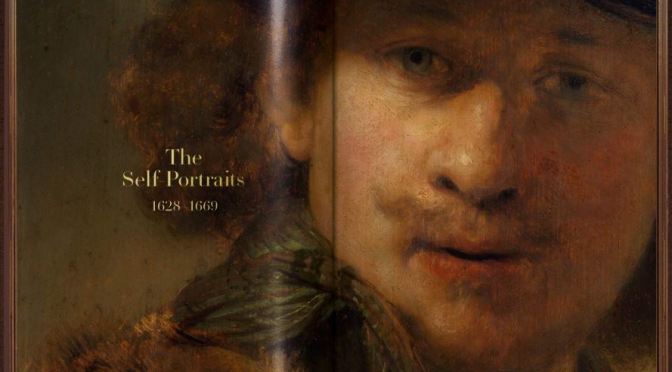
Art Books: “Rembrandt – The Self Portraits” By Volker Manuth, Marieke de Winkel (Taschen)
With more than 80 works spanning paintings, etchings, and drawings, the Dutchman’s lifelong practice of self-portraiture functions as a means of concretizing that which is fleeting, be it individual moments of development set against the inexorable passage of time, or the facial contortions of emotion that are gone, without a trace, as swiftly as they arrive.
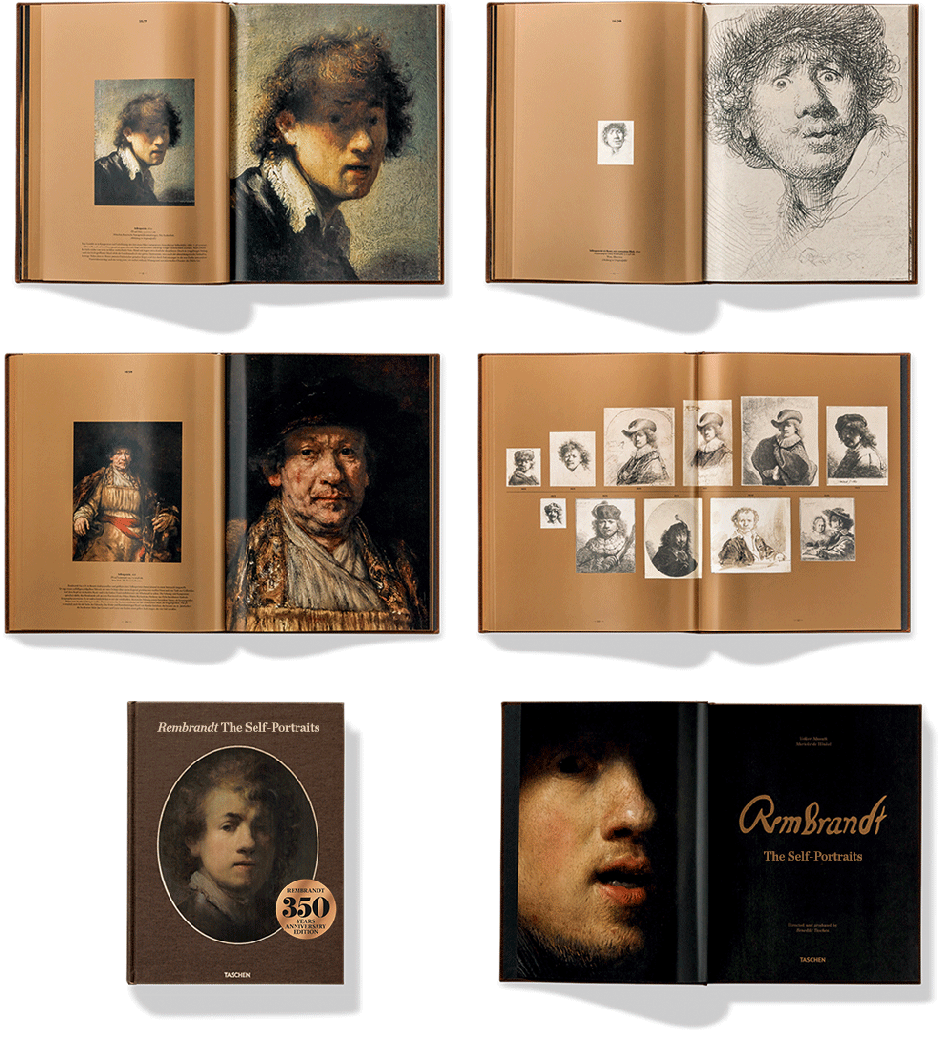
Across the four decades in which they were painted, one constant is particularly striking across media and styles―Rembrandt’s dedication to presenting himself from multiple perspectives, celebrating the multiplicity of the individual and championing the unfiltered portrayal of emotional expression.
To read more and order: https://www.taschen.com/pages/en/catalogue/art/all/04641/facts.rembrandt_the_self_portraits.htm?utm_campaign=2019_xmas4_davinci_rembrandt&utm_source=tas&utm_medium=nl
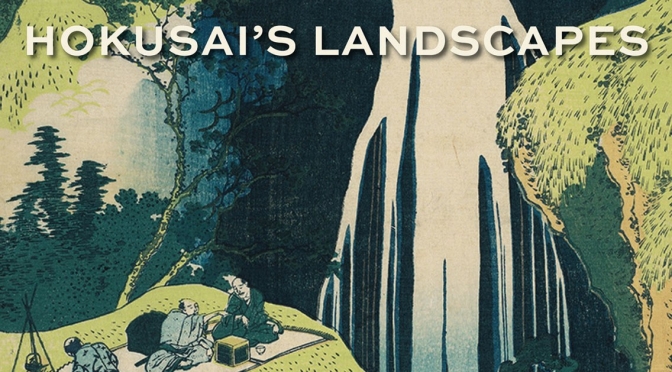
Best New Art Books: “Hokusai’s Landscapes – The Complete Series”
 Hokusai’s landscapes revolutionized Japanese printmaking and became icons of world art within a few decades of the artist’s death. Hokusai’s Landscapes focuses exclusively on this pivotal body of the artist’s work, the first book to do so. Featuring stunning color reproductions of works from the incomparable Japanese art collection at the Museum of Fine Arts, Boston (the largest collection of Japanese prints outside Japan), Hokusai’s Landscapes examines the magnetic appeal of Hokusai’s designs and the circumstances of their creation.
The best known of all Japanese artists, Katsushika Hokusai was active as a painter, book illustrator and print designer throughout his 90-year lifespan. Yet his most famous works―the color woodblock landscape prints issued in series―were produced within a relatively short time, in an amazing burst of creative energy that lasted from about 1830 to 1836.
To read more and order: https://www.amazon.com/Hokusais-Landscapes-Complete-Sarah-Thompson/dp/0878468668
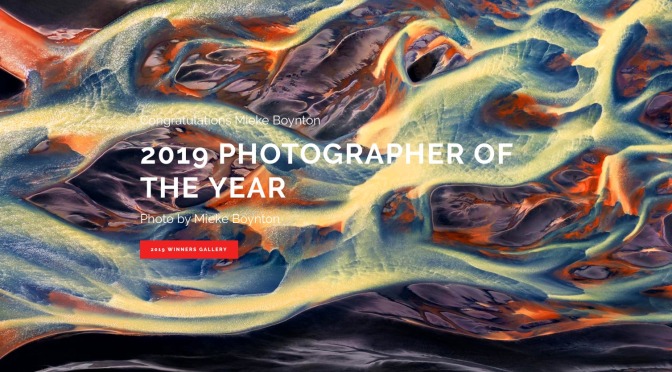
Photography Contests: “2019 Epson International Pano Awards” Winners
 The 10th EPSON International Pano Awards is dedicated to the craft and art of panoramic photography. Advances in digital photography and editing software have resulted in an ever-increasing rise in the popularity of image stitching, especially in the panoramic format. VR ‘immersive’ photography also continues to excite and develop at a rapid pace, and panoramic film photography remains alive and well.
The EPSON International Pano Awards showcases the work of panoramic photographers worldwide and is the largest competition for panoramic photography.
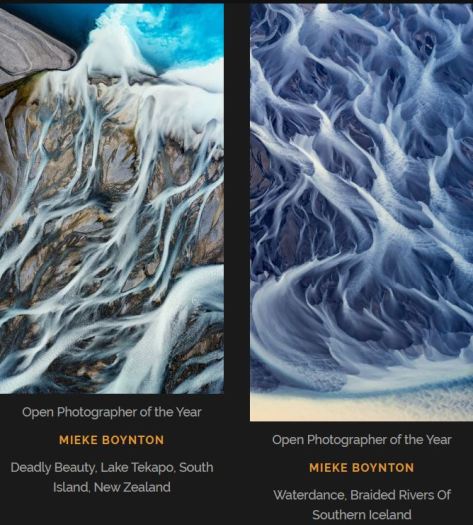

To read and see more: https://thepanoawards.com/2019-winners-gallery/
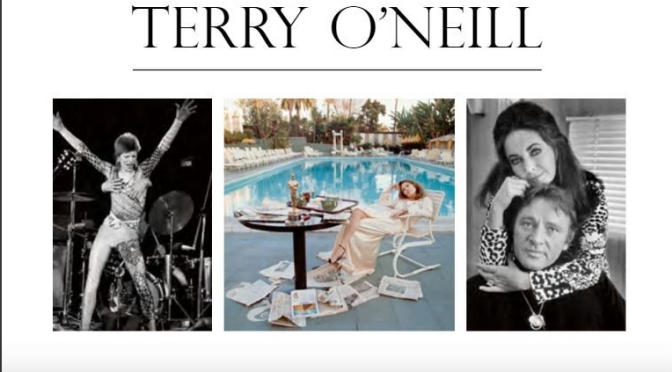
Artists: Remembering Photographer Terry O’Neill (1938 – 2019)
From an Apollo Magazine online article:

He shot the Beatles in a St John’s Wood back garden before they had even broken the Top 10 (‘I didn’t know how to work with a group, but because I was a musician myself and the youngest on staff by a decade, I was always the one they’d ask’), and within a few months was kitting out the Rolling Stones with suitcases to look like a travelling band in a series of candid street shots.
His portraits, in grainy 35mm black-and-white, are a veritable roll call of the 1960s youthquake – Michael Caine, Terence Stamp, David Hemmings, Marianne Faithfull, Jean Shrimpton (walking barefoot on a rain-slicked King’s Road, or posing with the porcelain inmates of a dolls’ hospital) – and of the other stars of the age, from the Rat Pack to Muhammad Ali. He photographed Churchill being carried from hospital in an armchair, a potentate on a palanquin; shot Peter Cook and Dudley Moore floating on lilos in raincoats; and extensively documented the early career of Elton John – including a remarkable shot where he plays an upright piano with his legs floating up towards the ceiling, as if performing on the International Space Station.
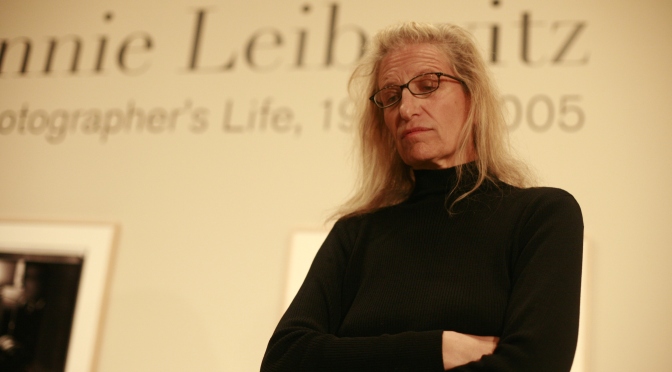
Photographers: Annie Leibovitz On Her Career, Andy Warhol, & Upcoming Show (Art Review)
From an Art Review online article:
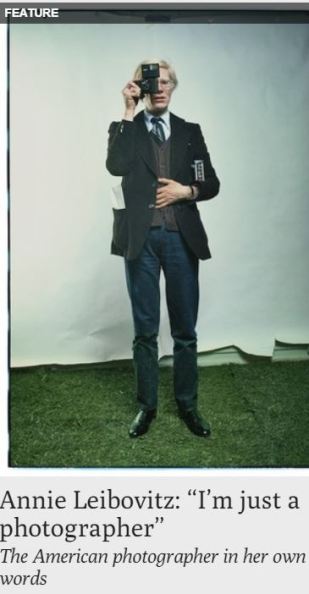 I chose to call myself a portrait photographer because labels were always being thrown on me. When I was at Rolling Stone I was a ‘rock-and-roll photographer’, at Vanity Fair I was a ‘celebrity photographer’. You know, I’m just a photographer. I realised I wasn’t really a journalist. I have a point of view and, while these photographs that I call portraits can be conceptual or illustrative, that keeps me on the straight and narrow. So I settled on this brand called ‘portraits’ because it had a lot of leeway. But I don’t think of myself that way now: I think of myself as a conceptual artist using photography.
 I remember going to the Factory in 1976 and watching Andy Warhol work. I’d been there before, earlier in the 70s, photographing Joe Dallesandro and Holly Woodlawn, and then Paul Morrissey. Warhol was a fixture of New York. It was just shocking when he died, because he was everywhere. I don’t know how he did it, but he was out at everything. You felt that if he was at a place you were at, then you were at the right place.
Warhol had things everywhere in the Factory – silkscreens all over the place, and tables of artwork – and things were always going on. I think Fran Lebowitz was there for Interview magazine, and [Warhol] was photographing the sisters from Grey Gardens [1975]. I was just a fly on the wall: there were people milling around doing all kinds of things, it was a pretty active place.
To read more: https://artreview.com/features/ara_winter_2019_annie_leibovitz/
Top Arts Podcasts: “The Lives Of Titian” (The Getty)
 One of the most successful artists of the Italian Renaissance, Titian was the master of the sixteenth-century Venetian school and admired by his royal patrons and fellow artists alike. Several of his contemporaries, including the authors and art theorists Giorgio Vasari, Francesco Priscianese, Pietro Aretino, and Ludovico Dolce, wrote accounts of Titian’s life and work.
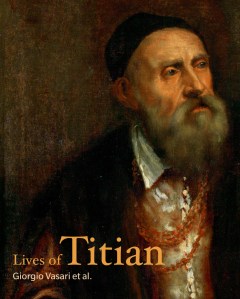 In this episode, Getty assistant curator of paintings Laura Llewellyn discusses what these “lives” teach us about Titian and the artistic debates and rivalries of his time. All of these biographies are gathered together in Lives of Titian, recently published by the Getty as part of our Lives of the Artists series.
Website: https://blogs.getty.edu/iris/podcast-the-lives-of-titian/
Artist Profiles: “Van Gogh & Gaughin” Controversy Anaylized By Author Bernadette Murphy (National Gallery Video)
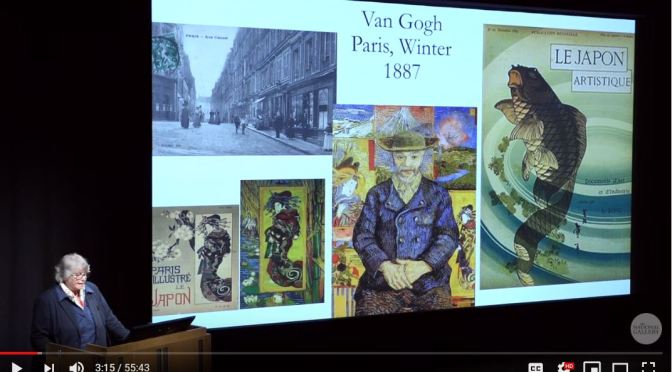
Gauguin’s stay at the Yellow House is mired in controversy. What really happened? Bernadette Murphy, author of ‘Van Gogh’s Ear: The True Story’, considers those fateful days from Gauguin’s point of view.
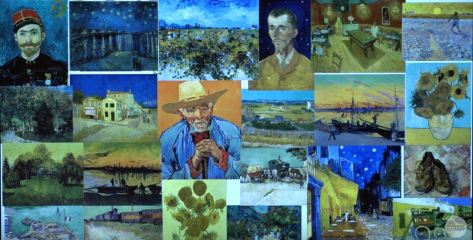
 The Credit Suisse Exhibition: Gauguin Portraits 7 October 2019 – 26 January 2020 Book tickets online and save, Members go free: https://bit.ly/2IspPWH
The first-ever exhibition devoted to the portraits of Paul Gauguin. Spanning his early years as an artist through to his later years spent in French Polynesia, the exhibition shows how the French artist revolutionised the portrait.
Exhibition organised by the National Gallery and the National Gallery of Canada, Ottawa.
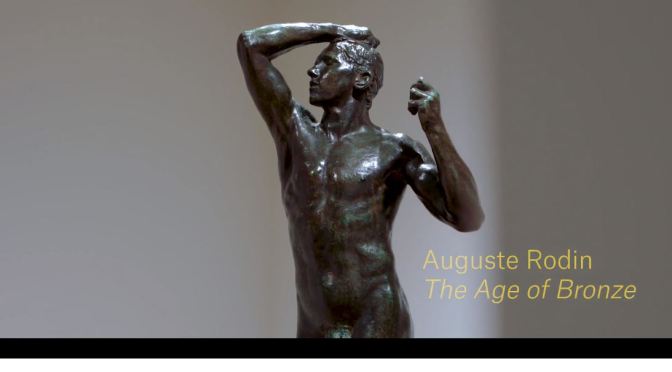
Artist Tales: Sculptor Auguste Rodin’s “The Age Of Bronze” – So Realistic It Caused A Scandal In 1877
From a Christie’s online article:
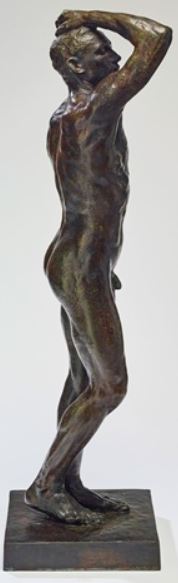 Rodin first exhibited a bronze and a plaster version of The Age of Bronze at the Cercle Artistique in Brussels in January 1877. A few months later, he exhibited the plaster at the Paris Salon, where it caused a scandal. ‘The vitality and naturalism of the sculpture was so extreme, the sense of modelling so observed, that he was accused of having cast the sculpture from the model himself,’ says the specialist.
Tudor Davies, Head of Impressionist & Modern Art in Paris, reveals why Rodin’s Salon ‘scandal’ marked a pivotal turning point in the artist’s career.
The Age of Bronze was originally conceived in 1877, and is widely considered Rodin’s first great work, ranking alongside his later masterpieces, including La Porte de l’Enfer, Le Penseur and Le Baiser. Its conception marked a decisive turning point in the sculptor’s career.


Retrofuturism: Past Visions Of The Future Are Now Very “Prescient”
From an Interesting Engineering online article:
Retrofuturism is the curious eye of the past upon us. This era’s rosy predictions about the future seem laughable from the perspective of the present; however, it seems that they got some things exceptionally right. Their ideas ranged from child-like and pridefully ambitious and inspired a movement upon the artists, designers, musicians, and filmmakers who channeled the technological fantasies of a lost age.
-
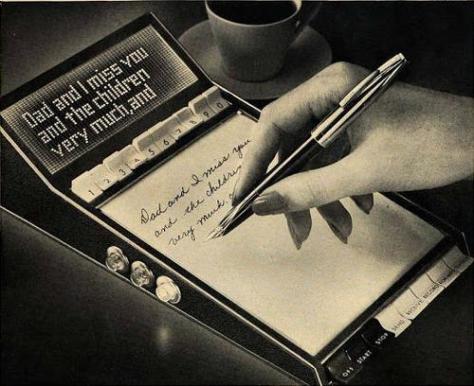
Instant Messaging (1964 Prediction)
-
This technology has actually become a reality. Many smartphones have this feature, or at least something similar to it. It doesn’t look like this of course, but the main idea is still there: you write it with your smartpen and the device makes your illegible handwriting into a text that is actually readable! However, it is not widely used; nobody could predict that typing would be superior to actual handwriting.
-
Personal Transportation (1950s Vision)
-
 It is unclear why people in the 1950s thought this was a practical way to travel; not only it looks like it is impossible to breathe in there, who would want to stand upright while driving? It would definitely ease the traffic; however, probably no one would want to use it.
The Smart-Cities of Future
 Towering transmitters in the city and private-jet traffic in the sky… This is a prediction that was made probably too early and it is definitely not so far from reality. Today, we paint a similar future for smart-cities and sci-fi movies depict the future cities in the same manner. It seems that older generations and we have a similar vision of the future look of the world.
 Boomers Daily