Tag Archives: Art Exhibitions

Art Exhibitions: The 58th Carnegie International

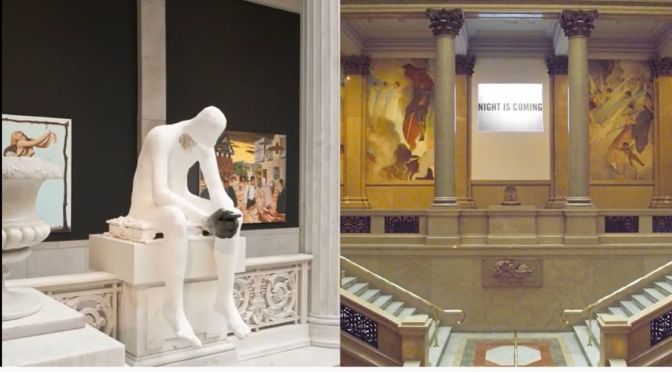
Established in 1896, the Carnegie International is the longest-running North American exhibition of international art. Organized every three to four years by Carnegie Museum of Art, the International presents an overview of how art and artists respond to the critical questions of our time.

Discover the history of this storied exhibition through archival footage and historical photographs, accompanied by the voices of curators and artists.

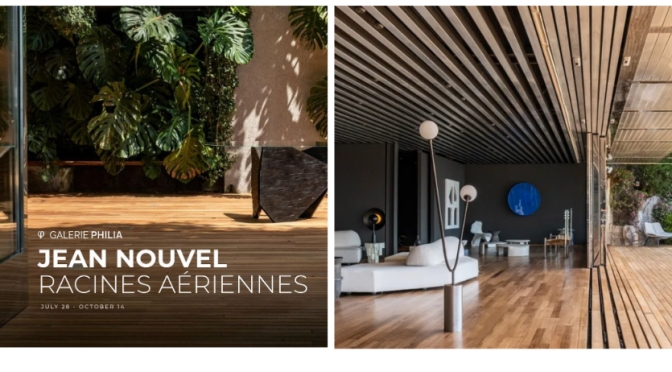
Art & Design: ‘Aerial Roots’ Galerie Philia, Cote d’Azur

Galerie Philia is proud to announce its summer exhibition taking place in two villas designed by Jean Nouvel and commissioned by Rivere Group on the luxurious Cote d’Azur. Villa Maeterlinck in Nice and villa in St Jean Cap Ferrat, both are perfectly integrated into the landscape and boast terrace gardens in front of wide private sea views on the Mediterranean.

Tillandsias in Saint Jean Cap Ferrat and Monsteras in Nice were planted by Jean Nouvel as an ode to their aerian roots. This specific fauna is in complete harmony with the asesthetic of the influential architect whose innovative aerian principle transforms buildings into dematerialized natural environments. Set in a mesmerizing atmosphere, between the breath-taking coast and the unassuming minimalism of Nouvel, Galerie Philia enhances this dialogue between the aesthetic of the architecture and its natural surroundings.

The concept of aerian roots is in the heart of the scenography of Galerie Philia as transcultural art and design works were selected for the plural and complex aesthetic and national identities they convey. Completed in 2015 and placed right by the famous Maeterlinck Palace, Villa Maeterlink is carved into the rock. Situated just by the waterfront, all of the rooms in the villa have a full view of the sea, with a living room spanning 40m2 without posts (cantilevered).

Set in a grand plot of 8600 m2, the entire house is made to measure including the stainless steel ceilings, light fixtures, and inox surfaces along with a multitude of special details that make this a truly unique place. The space breaths at all times thanks to the sliding partitions that were built in a studied way to dissipate the boundary between interior and exterior in this house that opens to the sea, and the stainless steel ceiling of the house allows one to see the sea at all times.

Blending with the unique and entirely customized architecture of Jean Nouvel, Galerie Philia’s elegant collection of sculptural design and art dresses these villas in a new look and create stunning vistas, transforming them into a living and breathing homes. The gardens and the interior of both villas are united by a harmonious scenography and become a reflection of the lightness of Nouvel’s aesthetic. The exhibition features unique pieces by Frederic Saulou, Andrés Monnier, Arno Declercq, Jojo Corväiá, Rick Owens, Elsa Foulon, Jan Ernst and many more designers represented by Galerie Philia.

The hand-carved stone firepit of Andres Monnier creates a radiant atmosphere in the patio with the ravishing views of plants as Gerard Kuijpers’ Dancing Stones move with the breeze from the mediterranean. Arno Declercq’s unique daybed accommodates a relaxing environment in the cozy living space and Jörg Pietschmann’s solid oak unique bench invites one to enjoy the monstera haven. The Revue Eclipse collaborated with Galerie Philia on the fine art selection, and internationally known artists will be exhibited such as Sam Szafran, Flora Temnouche, Edgar Sarin, Manuel Merida, Francisco Salazar, Jörg Kratz and Mateo Revillo.

Art Exhibtions: ‘Picasso & Braque – Radicals’ (2022)

Picasso & Braque: Radicals highlights significant work by the two pioneers of the Cubist art movement—Pablo Picasso and Georges Braque. Cubism, one of the most influential artistic developments of the twentieth century, challenged traditional perspectives of how we see the world. The movement is characterized by fractured viewpoints and abstracted forms and defies established notions of three-dimensionality. Cubism can be intellectually challenging but beautifully reflects the dynamism, rhythm, and innovation of the early 1900s.  

Although there is debate on who developed Cubism first, Picasso and Braque are credited with establishing this new visual language that presented infinite possibilities and catalyzed future developments in the visual arts. This exhibition features work by twentieth-century artists who took inspiration from these revolutionary ideas and practices, including American artists Fannie Hillsmith and John Marin, and Texas artist Bill Reily, among others. Paintings, drawings, sculptures, and prints demonstrate how Cubism transcended time and space.

Picasso & Braque: Radicals is organized for the McNay Art Museum by Lyle W. Williams, Curator of Prints and Drawings, Curator of Modern Art; and Rafael Fernando Gutierrez Jr., the inaugural Douglass Foundation Intern in Curatorial Studies.

Tours: 2022 Royal Academy Of Arts Summer Exhibition

With nearly 1,500 artworks on display, there is a lot to see at the Royal Academy of Arts (RA) Summer Exhibition 2022. If you want a taste of what’s on show then here is a quick tour. The theme chosen by the exhibition’s coordinator, Alison Wilding RA, is Climate. It begins outside, where a large-scale immersive installation by Spanish artist Cristina Iglesias brings nature and water to the courtyard. Inside, the artworks are spread over 11 rooms, including two galleries of prints selected by Grayson Perry RA.

Reviews: ‘The Week In Art’

On 29 June, Frieze announced the details of the first edition of its art fair in Seoul, South Korea. So for this last episode of the current season, we’re exploring the art scene and market in the Korean capital.

Ben Luke talks to the art historian and curator Jiyoon Lee about contemporary art in Seoul and beyond, and the origins of the current art scene in 1990s globalisation. The Art Newspaper’s associate editor, Kabir Jhala, speaks to two gallerists—Joorhee Kwon, deputy director at the Kukje Gallery and Emma Son, senior director at Lehmann Maupin, about the growing market and collector base, and the effect Frieze may have on the existing scene.

And this episode’s Work of the Week is Dahye Jeong’s A Time of Sincerity, a basket made with horsehair that this week won the Loewe Foundation Craft Prize. Kabir talks to the creative director at the fashion brand Loewe, Jonathan Anderson, about Jeong’s piece.

Frieze Seoul, COEX, Seoul, 2-5 September.

The Space Between: The Modern in Korean Art, Los Angeles County Museum of Art, 11 September-19 February 2023.

The 2022 Loewe Foundation Craft Prize, Seoul Museum of Craft Art, until 31 July.

Art Exhibits: ‘The Red Studio’ By Henri Matisse

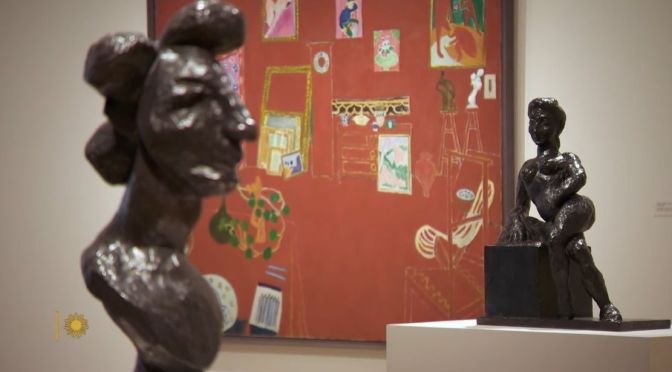
Henri Matisse’s landmark painting “The Red Studio” documented the artworks displayed in his workspace just outside Paris as it existed in 1911. For the first time since then, almost all the individual pieces depicted in his painting have been reunited for an installation at New York’s Museum of Modern Art. Correspondent Rita Braver reports.

Top Exhibition Tour: 19th Century Japanese Painter Kawanabe Kyōsai, London

The Japanese painter Kawanabe Kyōsai (1831–1889) was one of the most innovative artists of his day. He lived during a turbulent time, experiencing the downfall of the Tokugawa shogunate (the hereditary military government) and the new imperial regime’s reforms to modernise and Westernise the country. Kyōsai’s drive to capture the world with his brush earned him the nickname ‘demon of painting’ – which he lived by.

00:00 Room 1: From Tradition to Innovation

Kyōsai, as a highly trained painter, was proficient in traditional methods and subjects. He broke with convention by blurring the established boundary between ‘serious’ and comic pictures. Traditionally, complex painting techniques were reserved for literary classics, historical and legendary figures, auspicious themes and religious images. Comic pictures were typically produced in a lighter, more fluid style.

Kyōsai often saw humour in ‘serious’ subjects and introduced comic and everyday content in highly finished, detailed paintings. The selection in this room demonstrates Kyōsai’s range and skill across diverse genres. Subjects include animals, monsters, ghosts, protective deities and Buddhist icons. Some paintings display powerful Kano-style ink techniques, others depict humorous creatures – recalling works by his first teacher, Utagawa Kuniyoshi, and referencing medieval picture scrolls. He can be seen exploring Western techniques such as perspective, shading and the study of anatomy, which attests to his insatiable curiosity and desire to push beyond tradition.

04:17 Room 2: Laughing at Modernity

Kyōsai had a keen interest in society, and captured contemporary events in his pictures with humour and piquancy. His satirical prints from the 1860s, the period leading up to the collapse of the shogunate regime, reflect widespread anxiety about the political turmoil, economic instability and foreign presence. He channelled the febrile atmosphere into dynamic images of frog battles, monster parties and wildly dancing tengu (mischievous, semi-human creatures). Under the new Meiji government, the sudden influx of Western-style culture greatly shocked many Japanese, after over 260 years of relative isolation.

Kyōsai’s comic pictures express both the excitement of the new era, with modern technologies such as the telegraph and trains, and a certain scepticism towards those who blindly followed the new trends. The government’s policy of hiring European and American specialists to teach at new institutions in Japan brought the painter a personal benefit. The British architect Josiah Conder (1852–1920) became his pupil around 1881, and remained a student, patron and friend until Kyōsai’s death in 1889.

05:54 Room 3: The Artist Meets His Public

In nineteenth-century Japan, artists often produced works impromptu in front of an audience. The creative process was appreciated as a performance. At commercially organised calligraphy and painting parties called shogakai, attendees would pay for admission, and once inside, could ask the artists to create works for them at no extra charge. These gatherings were frequently a platform for collaboration. Multiple painters would complete a picture together or a calligrapher would inscribe a poem by the painter’s work. Kyōsai often depicted a scene of art viewing, and the artworks within the image would be painted by other artists.

Collaboration has always been an important part of the creative process in Japan, among artist friends or between teacher and pupils, sharing and marking the occasion. Event flyers, newspaper articles and anecdotes attest that Kyōsai was famous for his speedy, skilful and witty performances. The parties involved copious alcohol. Kyōsai loved saké and his brush became even more playful and expressive when intoxicated. Josiah Conder wrote in his master’s obituary: ‘under the influence of BACCHUS some of his strangest fancies, freshest conceptions and boldest touches were inspired.’

Art Exhibits: ‘Cezanne’

This video offers a look at Cezanne’s unique approach to color, form, and space through specialized imaging of a few of the artist’s most influential works in the Art Institute’s collection: The Basket of Apples, The Three Skulls, and The Vase of Tulips.

Cezanne May 15, 2022–Sep 5, 2022 https://www.artic.edu/exhibitions/928…

Reviews: ‘The Week In Art’

This week: is heritage in Ukraine being attacked and looted, and what can be done to protect it?

Ben Luke talks to The Art Newspaper’s museums and heritage editor, Tom Seymour, who has been to the Ukrainian-Polish border with the International Council of Museums (ICOM), to witness museum materials being sent into Ukraine to help institutions there. Then, Tom talks to Sophie Delepierre, the head of heritage protection at ICOM, about the organisation’s efforts in Ukraine and elsewhere.

As a major exhibition of the work of Paul Cezanne opens at The Art Institute of Chicago, ahead of its journey to Tate Modern later in the year, Ben talks to Gloria Groom and Caitlin Haskell, the curators of the Chicago exhibition. And for this episode’s Work of the Week, our acting digital editor, Aimee Dawson, asks Oliver Lanzenberg, the grandson of the artist Nicola L., about his grandmother’s work Gold Femme Commode (1969/1993). The piece is part of a show at Alison Jacques, one of a number of exhibitions opening to coincide with the second edition of London Gallery Weekend.

Tom’s full report into ICOM’s work for Ukraine is in the next print edition of The Art Newspaper and online soon.

The organisation Sophie mentions is NEMO, the Network of European Museum Organisations, ne-mo.org.

Cezanne, The Art Institute of Chicago, 15 May-5 September; Tate Modern, London, 5 October-12 March 2023.

Nicola L., Alison Jacques, London, until 23 July.

London Gallery Weekend, 13-15 May.

Reviews: ‘The Week In Art’

This week, Philip Guston Now is unveiled at the Museum of Fine Arts in Boston after its controversial postponement in 2020; Ben Luke talks to Kate Nesin and Megan Bernard, two of the four curators on the team assembled by the museum to revise the exhibition, which was postponed by four museums in the wake of George Floyd’s murder. 

We discuss how the show and its interpretation have changed in the last two years. As Queer Britain, the UK’s first national LGBTQ+ museum opens its doors, Gareth Harris, chief contributing editor at The Art Newspaper, speaks to Matthew Storey, the curator of the museum’s inaugural exhibition, Welcome to Queer Britain. And in this episode’s Work of the Week, our acting digital editor, Aimee Dawson, talks to Candida Lodovica de Angelis Corvi, global director at the Colnaghi gallery, about a rediscovered work by the 17th-century artist Caterina Angela Pierozzi, on display at Colnaghi in London.

Philip Guston Now, Museum of Fine Arts, Boston, until 11 September; Museum of Fine Arts, Houston, 23 October-15 January 2023; the National Gallery of Art, Washington, DC, 26 February-27 August 2023; and Tate Modern, London, 3 October 2023-25 February 2024. To hear an in-depth discussion about Philip Guston with the curator Robert Storr, author of the book Philip Guston: A Life Spent Painting, listen to the episode of this podcast from 18 September 2020.