Tag Archives: Architecture

Top Architectural Design: ‘Cabin ANNA’ In Eindhoven, Netherlands (Video)

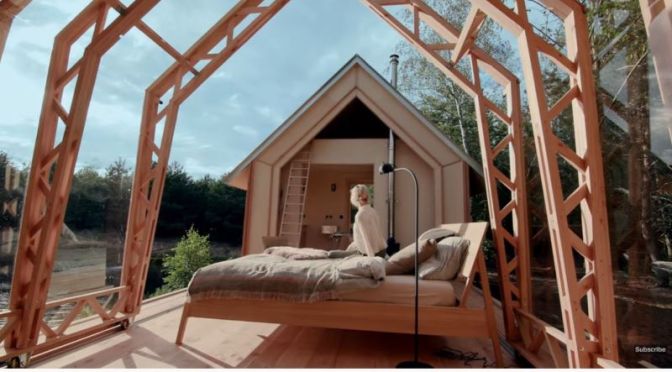
Architectural designer Caspar Schols is producing a flat-pack version of a garden shed with moving walls, which he built for his parents before he went to architecture school, as cabins for living and for working.

Schols drew on the Garden House pavilion he completed with no formal architecture training in Eindhoven in 2016 to develop two design: the ANNA Stay home and the ANNA Meet workplace. As with Garden House, the Cabin ANNA concepts have and inner beam-and-glass structure that is separated from the outer wooden walls and metal roof, and set on runners. This means they can be moved and outwards to create different layouts.

“A sellable, fully inhabitable house, a flat-pack that could be built and re-built anywhere in the world,” Schols said. “A dynamic home in the shape of an open platform to live with rather than against the elements, by playing with the configuration of the layers of the house – just like the way you dress yourself to suit different weather conditions, occasions and moods.”
Design: French Architect Jean Nouvel’s ‘Cave Resort’ In Saudi Arabia (Video)

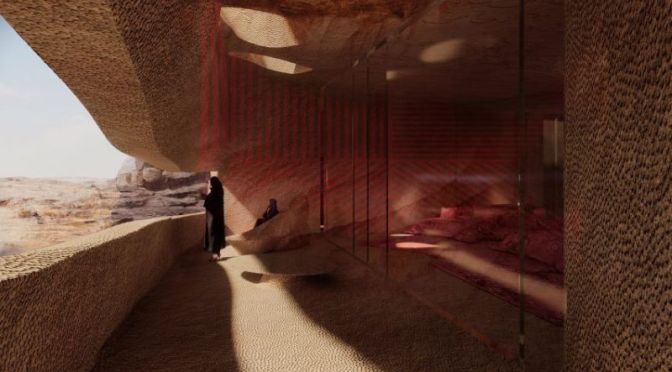
French architect Jean Nouvel has revealed plans for a  subterranean resort and hotel that would be hidden within the rock dwellings of AlUla, a natural region of north-west saudi arabia. located deep within the sharaan nature reserve, the project references the nearby hegra — a famous archaeological location that forms the country’s first UNESCO world heritage site. set to be completed by 2024, the development will include 40 guest suites and three villas. meanwhile, a retreat summit center nearby will feature 14 private pavilions.

Read more

Top Home Design Video: A ‘Storybook’, Converted Victorian Stable House In King’s Cross, London

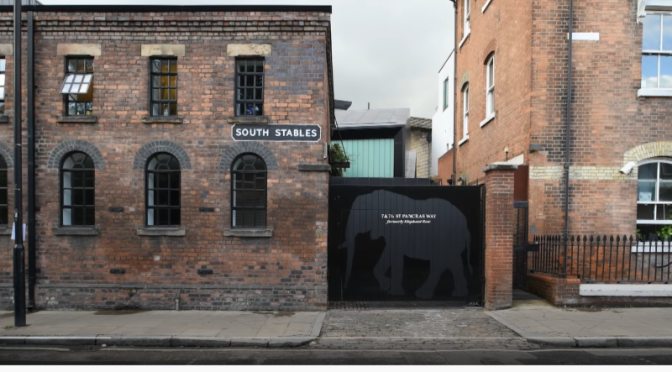
Step through the looking glass and into the story-book inspired house of architect Sally Mackereth in King’s Cross, a playful world of mystery, discovery and fun in a former Victorian stable.

As head of her architecture and design studio, Sally draws from her 25-year career working internationally to design residential and commercial projects with her signature style, defined by material rich spaces that play with colour, texture and detail. Recent projects have included the updating of a listed artist’s studio in Chelsea, London, once the workspace of James Whistler, Augustus John and John Singer Sargent; and the interiors of pied-a-terre for an art-loving couple in Tribeca, New York City. A sense of fun and glamour runs through the practice’s work, and Sally’s own living spaces are no exception.

Kings Cross is a district in Central London, England, 2.5 miles (4.8 km) north west of Charing Cross. It is served by London King’s Cross railway station, the terminus of one of the major rail routes between London and the North.[3]

The area has been regenerated since the mid-1990s with the terminus of the Eurostar rail service at St Pancras International opening in 2007 and the rebuilding of King’s Cross station, a major redevelopment in the north of the area.

Read more

Top Restorations: Church To Stunning Home-Studio In Basque Spain (Video)

When Tas Careaga first saw his 16th-century church it was advertised for sale as a “land plot with build-in ruins”. Abandoned for decades – the town has 6 other churches for a population of 2000 – it was being sold by the local bishopric for very little, but the new owner was required to rebuild it.

Careaga and friends spent 3 months just clearing the structure of debris before starting work to turn the relic into a home. With help from his architect friend Carlos Garmendia, Careaga preserved the open-feeling of the space by adding only one wall (for a bathroom on the 2nd floor). The cupola now houses a very high-ceilinged kitchen with art gallery walls. Most of the church celebrates the 10-meter (30-foot) ceilings created 5 centuries ago. In about a quarter of the space,

Careaga built a wooden frame to house two open-air floors for a 2nd-floor bedroom and 3rd-floor office. Instead of walls or banisters, the first floor relies on just three thin metal cables for the protection of occupants. The home is deeply personal, filled with furniture from Careaga’s family, religious art from his grandmother, and idiosyncrasies like a slackline to cross the thirty-foot-drop between the office and a secret bedroom above the cupola.

Careaga spent 3 years converting the church to his home with mostly his own labor and help from friends. He continues to add new touches, like converting the bell tower into a reading nook and bunk room for guests.

Carlos Garmendia (architect): https://www.garmendiacordero.com/ Tas Careaga’s projects: http://tascareaga.com/ Tas’ Instagram: https://www.instagram.com/tascareaga/ On *faircompanies: https://faircompanies.com/videos/anci…

Sustainable Architecture: ‘Woodnest Treehouses’ Above Fjord In Norway

Woodnest – Up in the air

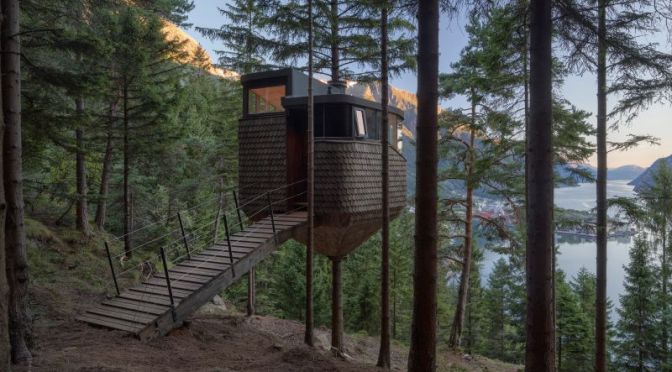
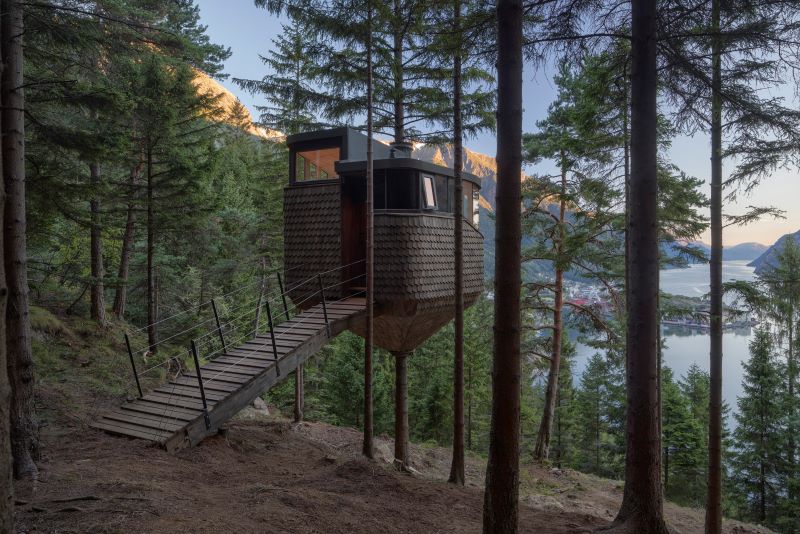
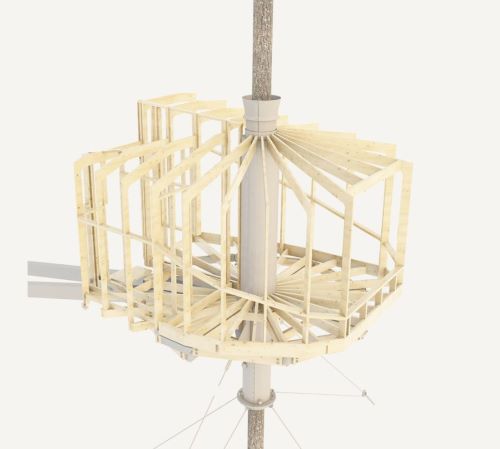
The steep forested hillsides around the Hardangerfjord above Odda, is the location of two Woodnest treehouses. The architecture is a specific response to the topography and conditions of the site itself. Inextricably crafted from nature, each treehouse is suspended 5-6m above the forest floor and fastened with a steel collar to the individual trunk of a living pine tree.

The journey to the site begins with the 20minute walk from the town of Odda, on the edge of the fjord and up through the forest via a steep winding path. Each treehouse is accessed via a small timber bridge, leading the visitor off the ground, into the structure and up in to the tree.

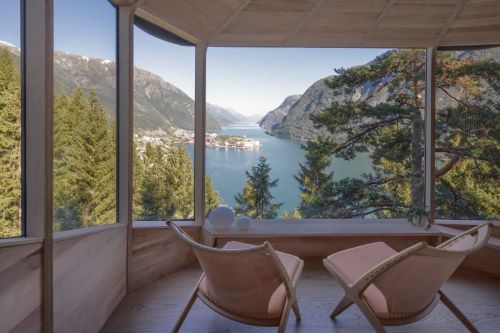
At just 15m2, carefully organized inside around the central tree trunk itself are four sleeping places, a bathroom, a kitchen area and a living space. From here one can lookout and experience the vast view out through the trees, down to the fjord below and across towards the mountains beyond.

At the very core of the project is the appreciation of timber as a building material. Inspired by the Norwegian cultural traditions of vernacular timber architecture, together with a desire to experiment with the material potential of wood, the architecture is structurally supported by the tree trunk itself, and formed from a series of radial glu-laminated timber ribs. The untreated natural timber shingles encase the volume creating a protective skin around the building, which will weather over time to merge and blend with the natural patina of the surrounding forest.

Website

Sustainable Architecture: ‘Anandaloy In Bangladesh’ – Made of Bamboo & Mud

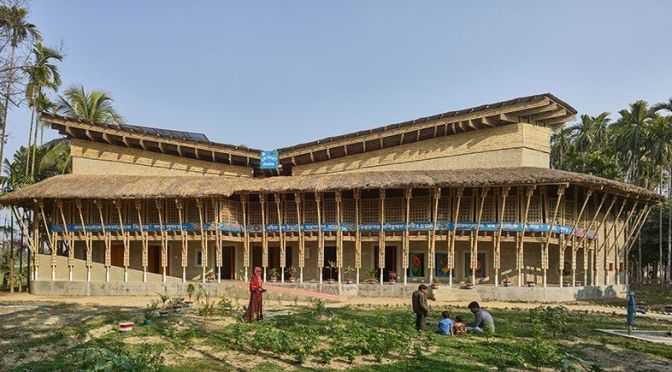
designed by german architect anna heringer, ‘anandaloy’ is a community center and workshop in bangladesh that is made from mud and bamboo. located in rudrapur, a village in the country’s dinajpur district, the two-storey building contains a therapy center for people with disabilities at ground level and a fair-trade textile manufacturing workshop for local women on the first floor. below a big ramp that connects the two levels, protective cave-like spaces provide settings for recreation or solitude.

Bangladesh, to the east of India on the Bay of Bengal, is a South Asian country marked by lush greenery and many waterways. Its Padma (Ganges), Meghna and Jamuna rivers create fertile plains, and travel by boat is common. On the southern coast, the Sundarbans, an enormous mangrove forest shared with Eastern India, is home to the royal Bengal tiger.

Dynamic Architecture: ‘Sylvan Rock’ – Designed By Aston Martin & S3Arc

The namesake rock ledge upon which the residence is sited reveals itself upon approach to the residence, the architectural form of the residence responding to the dramatic lines of the rock.

As you move around the residence, the form appears to fold down into the landscape – as if the architecture is born of and catapults from the natural landscape. A distinctly modern yet natural form, the residence is clad in blackened cedar and curtain walls of glazing.

SPECIFICATIONS

Residence | 5,983 SF
4 bedrooms, 4 bathrooms, 2 half baths
3 car garage
Pool and deck
Pool House | 873 SF
Three Guest House “Pods” | 1,574 SF
Treehouse – Architect designed
Food Garden and Trails
Total finished spaces in compound: 8,430 SF

As the residence comes into, the first glimpse offers a visual gasp with the distinctly modern architecture in counterpoint to the unspoiled natural beauty. Upon entering the dramatic garage carved from the earth, experience a subterranean lair and custom designed wine cellar.

After the journey, retreat to private quarters in the residence or beyond in the guest pods. Join other guests for dining and lively conversation at the communal table, enjoying fresh produce from the on-property Food Garden.

Interiors designed by Aston Martin — wood, leather and metals integrate into the architecture and furnishings for a seamless and luxurious experience.

Read and see more

Future Of Ocean Living: ‘Lillyana’ – A Hydrophytic Model For Urban Design

LILLYANA : Architecture & Innovation for the Sea

Author : Arthur Seibert and Clemens Lindner
Nationality : German
Year : 2019
Location : Shanghaï, China

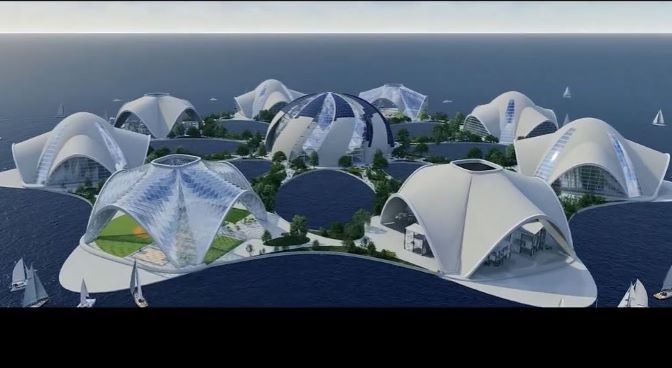
In the context of a rapidly increasing global population growth and the associated shortage of living space, alternative urban concepts in a marine environment are gaining importance under ecological and sustainable aspects. The concept- guideline “renaturation instead of soil sealing” is an effort to react on the challenges of current megatrends in the context of the sea. The underwater city structure is designed for up to 15,000 inhabitants in the vicinity of a large coastal city. “Lillyana” represents an ideal system that can be applied to various geographical and climatic conditions and their specific demands. The form is inspired by hydrophytes – plants that grow above and below the water and benefit from their environment. Through their biometric and biological mechanisms, the shape has been improved for energy efficiency, buoyancy and stability. Thus, the wind-, water- and solar energy production is directly embedded in the design language. The main challenge of this project was to develop a self-sufficient system that could also allow different forms of social life at the same time. To achieve this, we have tried to understand the factors that make an attractive city: “Living”, “working”, “mobility”, “supply” and “recreation” These fields of action provide the framework for our design: Therefore, a superior supply organ will be placed in the centre, from which radially arranged bridge systems will form connections to floating platforms. These are anchored beneath the seabed and represent the quarter centres. From the platforms, supply pipelines, on which various spheres are suspended, lead into the depths. They shift private, professional and social life below the water surface. High attractiveness, beneath as well as above the sea level, is achieved by providing well-located and spatially qualitative living and working areas with a recreation and leisure area, as well as an intelligent infrastructure via a pipeline network.

Descriptive of Author : Splendour of life beneath the surface: “Lillyana” – A hydrophytic model for urban design