APOLLO MAGAZINE – OCTOBER 2025 PREVIEW

October 2025

APOLLO MAGAZINE: The latest issue features Hew Locke and the Empire’s new clothes | Princeton University Art Museum reopens | William Hogarth’s bedside manner | the many faces of Nigerian modernism


Hew Locke and the Empire’s new clothes

On the eve of a major US survey, the artist talks to Apollo about decorating statues and the ornamental side of the British Empire

A compact history of the London mews

By turns picturesque and insalubrious, mews houses have a compellingly chequered past

Art Basel’s smallest fair has big ambitions

Eclectic art and innovative curation are helping Art Basel Paris fly the flag for the French art market

New frontiers for the Chinese art market

Work by late 20th-century and contemporary Chinese artists has been throwing up surprises recently

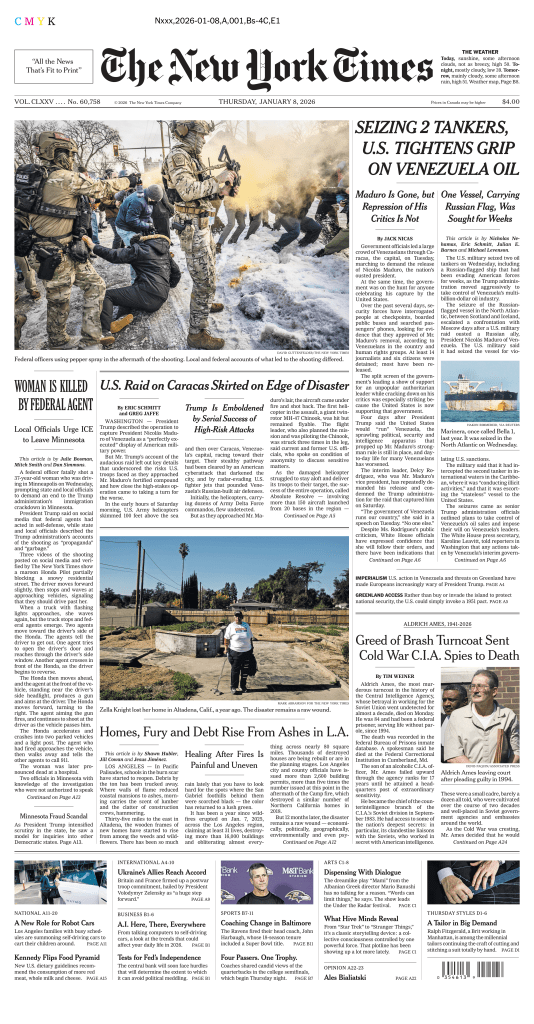
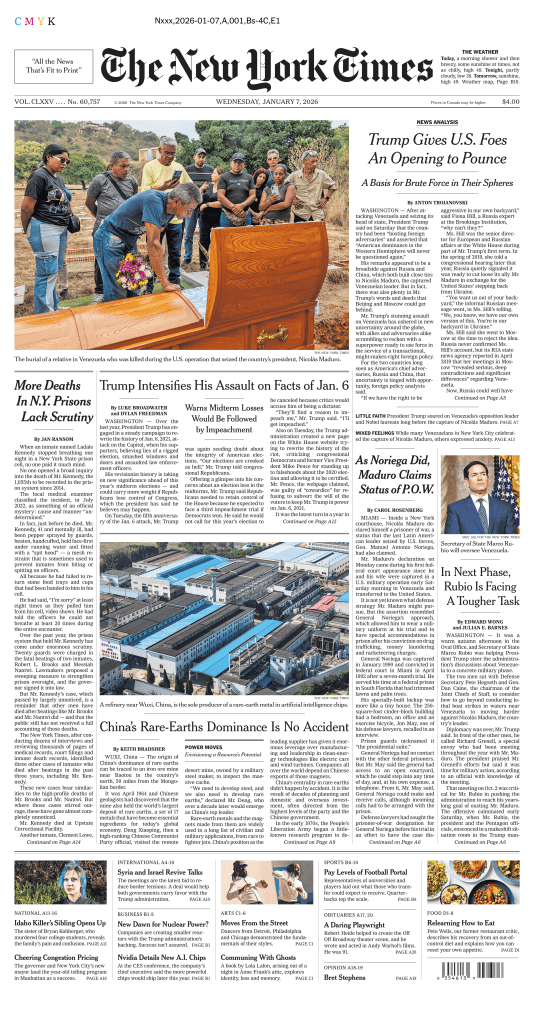
THE NEW YORK TIMES – THURSDAY, OCTOBER 2, 2025

Trump’s Language Upends Principle of a Nonpartisan Military

President Trump’s suggestion of cities as “training grounds for our military” is in tension with what the armed services have long sought to preserve.

Deadlock Over Shutdown Drags On With No Sign of Agreement

Democrats and Republicans were digging in as President Trump said he saw the shutdown as a tool to make lasting changes to the federal bureaucracy.

‘Enough Is Enough’: Many Palestinians Say Hamas Must Accept Cease-Fire Plan

Interviews in Gaza suggest wide support for a proposal that calls for an immediate end to a war that has brought immense civilian suffering.

Israel Said It Intercepted the Flotilla Headed to Gaza. Here’s What to Know.

LONDON REVIEW OF BOOKS – OCTOBER 9, 2025 PREVIEW

LONDON REVIEW OF BOOKS: The latest issue features Pico in Purgatory; Can cellos remember?; Britain’s Europe Problem

Pico in Purgatory

Pico’s Oration contravenes the very idea of human possibility that we think the Renaissance is about – yet we think of the Renaissance this way partly because of a centuries-long misreading of it. In which case, does Pico really belong to the Renaissance? Or is our whole idea of the Renaissance hopelessly flimsy, nothing but a collection of fantasies about what it means to be modern and human?

Britain’s Europe Problem

From Macmillan to Wilson to Heath to Thatcher to Major to Blair to Cameron, a succession of prime ministers persuaded themselves that their country was somehow different from the rest: it could pick and choose from the menu of European options in the way that suited it best. They were all mistaken. 

Computers that want things

For all the fluency and synthetic friendliness of public-facing AI chatbots like ChatGPT, it seems important to remember that existing iterations of AI can’t care. The chatbot doesn’t not care like a human not caring: it doesn’t care like a rock doesn’t care, or a glass of water. AI doesn’t want anything. But this is bound to change.

LITERARY REVIEW – OCTOBER 2025 ISSUE PREVIEW

LITERARY REVIEW : The latest issue features….Read All About It; Goethe’s Grand Ideas; The Basquiat Boom; Ministers & Monarchs; Operation Baku…

Strong Constitution: ‘Power and the Palace: The Inside Story of the Monarchy and 10 Downing Street’ By Valentine Low

Blood, Rage & Terror: ‘The Revolutionists: The Story of the Extremists Who Hijacked the 1970s’ By Jason Burke

Stocks & Scares: ‘1929: The Inside Story of the Greatest Crash in Wall Street History’ By  Andrew Ross Sorkin

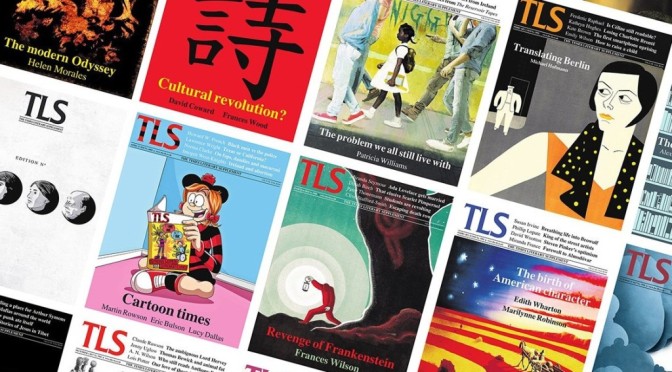
TIMES LITERARY SUPPLEMENT – OCTOBER 3, 2025 PREVIEW

TIMES LITERARY SUPPLEMENT: The latest issue features ‘Sylvia Plath’s Ariel at sixty; The case against progress; Patricial Lockwood’s bag of scraps…

Lioness of God    

The sixtieth anniversary ‘heritage’ edition of Ariel By Seamus Perry

The Puritan reflex

Thomas Pynchon’s haunted vision of history By James Marcus

A dashed clever fellow

The wisdom of Bertie Wooster By Tim Lake

Printed by herself

The precocious poetry of Charlotte Brontë By Samantha Ellis

THE NEW YORK TIMES – WEDNESDAY, OCT, 1, 2025

Shutdown Grinds Many Government Services to a Halt

A bitter deadlock between President Trump and Democrats in Congress over federal spending is expected to disrupt services and leave many workers furloughed, and possibly cause mass job losses.

Gaza City Exodus Is Overwhelming Relief Efforts, Aid Agencies Say

Hospitals are overflowing, water is low and diseases are spreading as hundreds of thousands of Palestinians flee south to escape Israel’s expanded ground offensive.

Moscow Indicates Retaliation if Europe Uses Russian Assets for Ukraine

Amid a plan to lend $165 billion to Ukraine using Russian state assets, European officials are mindful of the possibility of Russian blowback.

Trump Gave the Military’s Leaders a Rehashed Speech, Until Minute 44

Almost daily, thousands of words pour forth from President Trump’s mouth. Sometimes, he tucks in a revealing insight about the direction he is taking the U.S.

THE LONELINESS BET

How microgambling apps turn male solitude into profit.

By Michael Cummins, Editor, September 30, 2025

The slot machine has left the casino. Now, with AI precision, it waits in your pocket—timing its ping to the hour of your despair.

The ghost light of the television washes the room, a half-forgotten Japanese baseball game murmuring from the corner. Alex sits in the dark with his phone held at the angle of prayer, the glass an altar, an oracle, a mirror. A ping sounds, small and precise, like a tuning fork struck in his palm. Next pitch outcome—strikeout or walk? Odds updated live. Numbers flicker like minnows. The bet slip breathes. He leans forward. The silence is not merely the absence of sound, but the pressure of who isn’t there—a vacuum he has carried for years.

The fridge hums behind him, its light flickering like a faulty heartbeat. On the counter, unopened mail piles beside a half-eaten sandwich. His last real conversation was three days ago, a polite nod to the barista who remembered his name. At work, Zoom windows open and close, Slack messages ping and vanish. He is present, but not seen.

He is one of the nearly one in three American men who report regular loneliness. For him, the sportsbook app isn’t entertainment but companionship, the only thing that demands his attention consistently. The ping of the odds is the sound of synthetic connection. Tonight he is wagering on something absurdly small: a late-night table tennis serve in an Eastern European hall he’ll never see. Yet the stakes feel immense. Last year in Oregon, bettors wagered more than $100 million on table tennis alone, according to reporting by The New York Times. This is the new American pastime—no stadium, no friends, just a restless man and a glowing rectangle. The algorithm has found a way to commodify the quiet desperation of a Sunday evening.

This isn’t an evolution in gambling; it’s a fundamental violation of the natural pace of risk. Pregame wagers once demanded patience: a pick, a wait, a final score. Microbetting abolishes the pause. It slices sport into thousands of coin-sized moments and resolves them in seconds. Behavioral scientists call this variable-ratio reinforcement: rewards arriving unpredictably, the most potent engine of compulsion. Slot machines use it. Now sports apps do too. The prefrontal cortex, which might otherwise whisper caution, has no time to speak. Tap. Resolve. Tap again.

The shift is from the calculated risk of an investment to the pure reflex of a hammer hitting a knee. Fifty-two percent of online bettors admit to “chasing a bet”—the desperate reflex to wager more after losing. One in five confess to losing more than they could afford. The harm isn’t accidental; it’s engineered. Rachel Volberg, who has studied problem gambling for four decades, told The New York Times that live betting is “much more akin to a slot machine rather than a lottery ticket.” It bypasses deliberation, keeping the brain trapped in a continuous, chemical loop.

And it isn’t marginal to the industry. Live wagers already account for more than half of all money bet on DraftKings and FanDuel. The slot machine has left the casino. It is now in the pocket, always on, always glowing.

The uncanny efficiency of the app lies not in predicting what Alex will bet, but when he will be weakest. After midnight. After a loss. After a deposit he swore not to make. DraftKings’ $134 million purchase of Simplebet, as reported by The New York Times, wasn’t just a business deal; it was the acquisition of a behavioral engine. These models are trained not only on the game but on the gambler himself—how quickly he scrolls, when he logs on, whether his bets swell after defeat, whether his activity spikes on holidays.

DraftKings has gone further, partnering with Amazon Web Services to refine its predictive architecture. At a recent engineering summit in Sofia, engineers demonstrated how generative AI and AWS tools could enhance the personalization of wagers. The same anticipatory logic that once powered retail nudges—“this user is hovering over a product, send a discount”—is now recalibrated to detect emotional vulnerability. In betting apps, the purchase is a wager, the discount is a boost, and the timing is everything: late at night, after a loss, when silence settles heaviest.

The AI’s profile of Alex is more precise than any friend’s. It has categorized his distress. Recent surveys suggest men in the lowest income brackets report loneliness at twice the rate of wealthier peers—a demographic vulnerability the models can detect and exploit through the timing and size of his wagers. Loneliness among men overall has risen by more than thirty percent in the past decade. An algorithm that watches his patterns doesn’t need to imagine his state of mind. It times it.

The profile is not a dashboard; it’s a lever. It logs his loneliest hours as his most profitable. It recognizes reckless bets after a gut-punch loss and surfaces fast, high-variance markets promising a chemical reset. Then comes the nudge: “Yankees boost—tap now.” “Next serve: Djokovic by ace?” To Alex it feels like telepathy. In truth, the system has mapped and monetized his despair. As one DraftKings data scientist explained at a gambling conference, in remarks quoted by The New York Times: “If we know a user likes to bet Yankees games late, we can send the right notification at the right time.” The right time, of course, is often the loneliest time.

Microbetting doesn’t just gamify sport—it gamifies emotion. The app doesn’t care if Alex is bored, anxious, or heartbroken. It cares only that those states correlate with taps. In this system, volatility is value. The more erratic the mood, the more frequent the bets. In this economy of emotional liquidity, feelings themselves become tradable assets. A moment of heartbreak, a restless midnight, a twinge of boredom—all can be harvested. Dating apps convert longing into swipes. Fitness trackers translate guilt into streaks. Robinhood gamified trading with digital confetti. Sportsbooks are simply the most brazen: they turn solitude into wagers, despair into deposits.

Beneath the betting slips lies a hunger for competence. Only forty-one percent of men say they can confide in someone about personal problems. Men without college degrees report far fewer close friendships. Many describe themselves as not meaningfully part of any group or community. In that vacuum, the interface whispers: You are decisive. You are strategic. You can still win. Microbetting offers a synthetic agency: decisiveness on demand, mastery without witness. For men whose traditional roles—provider, protector, head of household—have been destabilized by economic precarity or cultural drift, the app provides the illusion of restored mastery.

The sheer volume of micro-choices acts as a placebo for real-world complexity. Where a career or relationship requires slow, uncertain effort, the app offers instant scenarios of risk and resolution. The system is perfectly aligned with the defense mechanism of isolation: self-soothing through hyper-focus and instant gratification. The product packages loneliness as raw material.

The genius of the app is its disguise. It feels less like a gambling tool than an unjudging confidant, always awake, always responsive, oddly tender. Welcome back. Boost unlocked. You might like… A digital shadow that knows your rhythms better than any friend.

“The clients I see gamble in the shower,” says counselor Harry Levant. “They gamble in bed in the morning.” The app has colonized spaces once reserved for intimacy or solitude. Men and women report similar levels of loneliness overall, but men are far less likely to seek help. That gap makes them uniquely susceptible to a companion that demands nothing but money.

FanDuel actively recruits engineers with backgrounds in personalization, behavioral analytics, and predictive modeling—the same skills that fine-tuned retail shopping and streaming recommendations. There is no direct pipeline from Amazon’s hover-prediction teams to the sportsbooks, but the resemblance is unmistakable. What began as an effort to predict which blender you might buy has evolved into predicting which late-inning pitch you’ll gamble on when you’re most alone.

Some apps already track how hard you press the screen, how fast you scroll, how long you hesitate before tapping. These aren’t quirks—they’re signals. A slower scroll after midnight? That’s loneliness. A rapid tap after a loss? That’s desperation. The app doesn’t need to ask how you feel. It knows. What looks like care is in fact surveillance masquerading as intimacy.

For Alex, the spiral accelerates. Fifty. Then a hundred. Then two-fifty. No pause, no friction. Deposits smooth through in seconds. His body answers the staccato pace like it’s sprinting—breath shallow, fingers hot. Loss is eclipsed instantly by the next chance to be right. This is not a malfunction. It is maximum efficiency.

In Phoenix, Chaz Donati, a gambler profiled by The New York Times, panicked over a $158,000 bet on his hometown team and tried to counter-bet his way back with another $256,000. Hundreds of thousands vanished in a single night. After online sportsbooks launched, help-seeking searches for gambling addiction surged by sixty percent in some states. The pattern is unmistakable: the faster the bets, the faster the collapse. The app smooths the path, designed to be faster than his conscience.

In Vancouver, Andrew Pace, a professional bettor described by The New York Times, sits before three monitors, scanning Finnish hockey odds with surgical calm. He bets sparingly, surgically, explaining edges to his livestream audience. For him, the app is a tool, not a companion. He treats it as a craft: discipline, spreadsheets, controlled risk. But he is the exception. Most users aren’t chasing edges—they’re chasing feelings. The sportsbook knows the difference, and the business model depends on the latter.

Meanwhile, the sport itself is shifting. Leagues like the NBA and NFL own equity in the data firms—Sportradar, Genius Sports—that provide the feeds fueling microbets. They are not neutral observers; they are partners. The integrity threat is no longer fixing a whole game but corrupting micro-moments. Major League Baseball has already investigated pitchers for suspicious wagers tied to individual pitches. When financial value is assigned to the smallest, most uncertain unit of the game, every human error becomes suspect. The roar of the crowd is drowned out by the private vibration of phones.

Lawmakers have begun to stir. In New Jersey, legislators have proposed banning microbets outright, citing research from Australia showing nearly eighty percent of micro-bettors meet the criteria for problem gambling. Representative Paul Tonko has pushed for national standards: deposit caps, affordability checks, mandatory cool-off periods. “We regulate tobacco and alcohol,” he said. “Why not emotional risk?” Public health advocates echo him, warning of “a silent epidemic of digital compulsion.” The industry resists. Guardrails, they insist, would ruin the experience—which, of course, is the point.

The deeper question is not consumer choice; it is algorithmic ethics. Loneliness is already a recognized risk factor for cardiovascular disease and dementia. What happens when the same predictive infrastructure used to ship packages anticipatorily or recommend movies is redeployed to time despair? The failure to regulate is a failure to acknowledge that algorithmic harm can be as corrosive as any toxin.

At 2:03 a.m., Alex finally closes the app. The screen goes dark. The room exhales. The silence returns—not as peace, but as pressure. The television murmurs on, but the game is long over. What remains is residue: the phantom buzz of a notification that hasn’t arrived, the muscle memory of a finger poised to tap, the echo of odds that promised redemption.

He tells himself he’s done for the night. But the algorithm doesn’t need urgency. It waits. It knows his hours, his teams, the emotional dip that comes after a loss. It will tap him again, softly, precisely, when the silence grows too loud.

One in four young men will feel this same loneliness tomorrow night. The casino will be waiting in their pockets, dressed as a companion, coded for their cravings. Outside, dawn edges the blinds. Somewhere a stadium will fill tomorrow, a crowd roaring in unison. But in apartments like Alex’s, the roar has been replaced by a private buzz, a vibration against the skin. The app is patient. The silence is temporary. The house never sleeps.

Because in this new emotional economy, silence is never a stop. It is only a pause. And the algorithm waits for the ping.

THIS ESSAY WAS WRITTEN AND EDITED UTILIZING AI

THE NEW YORK TIMES – TUESDAY, SEPT. 30, 2025

Government Shutdown Could Delay Economic Data at a Critical Moment

“Flying blind amidst heavy fog is a dangerous proposition,” one economist said about the risks of a lapse in official statistics.

Trump’s Meeting With Democrats Yields No Progress, With Shutdown a Day Away

U.S. Deports Planeload of Iranians After Deal With Tehran, Officials Say

The deportation flight to Iran is the most stark push yet by the Trump administration to deport migrants even to places with harsh human rights records.

With New U.S. Deal to End Gaza War, a Rare Moment of Triumph for Netanyahu

Prime Minister Benjamin Netanyahu of Israel got almost everything he hoped for, despite mounting international isolation.

After Volatile Summer, Trump’s Approval Remains Low but Stable, Poll Finds

THE NEW YORKER MAGAZINE – OCTOBER 6, 2025 PREVIEW

The illustrated cover for the October 6 2025 issue of The New Yorker in which two dishevelled parents lovingly watch a...

THE NEW YORKER MAGAZINE: The latest cover features R. Kikuo Johnson’s “Free Play” – The overwhelming delights of parenting.

Grace and Disgrace

Hope lies not in expecting a late-in-life conversion experience in the Oval Office but in carrying out the ordinary work of civic life. By David Remnick

Tim Berners-Lee Invented the World Wide Web. Now He Wants to Save It

In 1989, Sir Tim revolutionized the online world. Today, in the era of misinformation, addictive algorithms, and extractive monopolies, he thinks he can do it again. By Julian Lucas

Carol Burnett Plays On

The ninety-two-year-old comedy legend has influenced generations of performers. In a string of recent TV roles, she has been co-starring with some of her closest comedic heirs. By Rachel Syme

Where the Battle Over Free Speech Is Leading Us

Doxing, deplatforming, defunding, persecuting, firing, and sometimes killing—all are part of an escalating war over words. What happens next? By Louis Menand

THE NEW YORK TIMES – MONDAY, SEPT. 29, 2025

Trump and Netanyahu to Discuss Plans for Postwar Gaza

President Trump and Prime Minister Benjamin Netanyahu are set to meet today in Washington after a week in which Israel grew more isolated internationally.

New Ideas Emerge to End Gaza Conflict and Govern After War

The Man Behind the All-Powerful Presidency

Russell Vought spent years drawing up plans for a “unitary executive” with ultimate authority over the government. He is on the brink of making it happen.

The Rise and Fall of Eric Adams

Mr. Adams has suspended his re-election campaign, becoming the first mayor of New York City to fail to win a second term since David Dinkins.

At Least 4 Dead in Attack on Michigan Church

The police said they believed the attacker opened fire on the congregation and intentionally set fire to the church near Flint, Michigan.

News, Views and Reviews For The Intellectually Curious