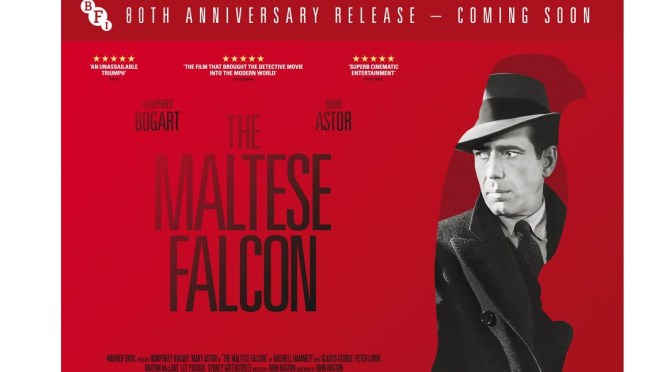
The new trailer for the landmark film noir starring Humphrey Bogart and directed by John Huston – back in cinemas UK-wide from 17 September to celebrate its 80th anniversary.
John Huston’s directorial debut, this year celebrating its 80th anniversary, turned Bogart into a major star. Adapted from Dashiell Hammett’s novel about a San Francisco detective’s investigations into the murder of his business partner, Huston’s snappily witty script retains the plot’s labyrinthine complexity while revelling in colourful characterisations of the villains Sam Spade encounters during his quest. Inspired casting includes Lorre as volatile Joel Cairo, Greenstreet as menacingly amiable Kasper Gutman, and Cook as his gunman. But it’s the fraught, febrile relationship between Bogart’s Spade and Mary Astor’s femme fatale – who persuaded his partner to take on her case – that shapes the deep, dark core of desire, doubt and duplicity pervading the film from beginning to memorable end.
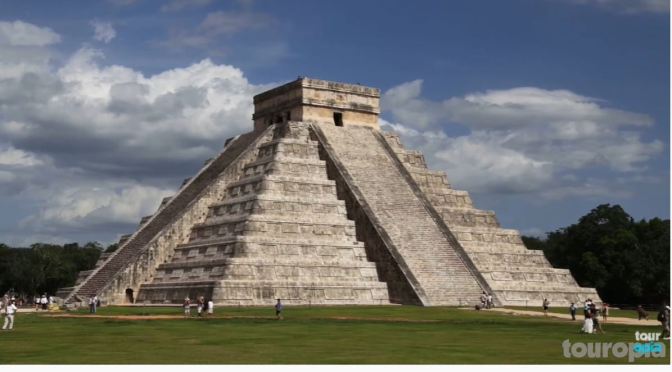
For almost a millennium, the ancient ruins of great architecture lay buried beneath the jungle vegetation on the Yucatan Peninsula. Abandoned by their creators these ancient temples and pyramids are a stunning reminder of a powerful civilization that once ruled the people of Central America. Although the accomplishments of the ancient Mayans are astonishing, no city would escape the inevitable collapse. One by one they were swallowed by the rainforest leaving the amazing Mayan ruins hidden, waiting to be discovered.
The Maya civilization was a Mesoamerican civilization developed by the Maya peoples, and noted for its logosyllabic script—the most sophisticated and highly developed writing system in pre-Columbian Americas—as well as for its art, architecture, mathematics, calendar, and astronomical system.
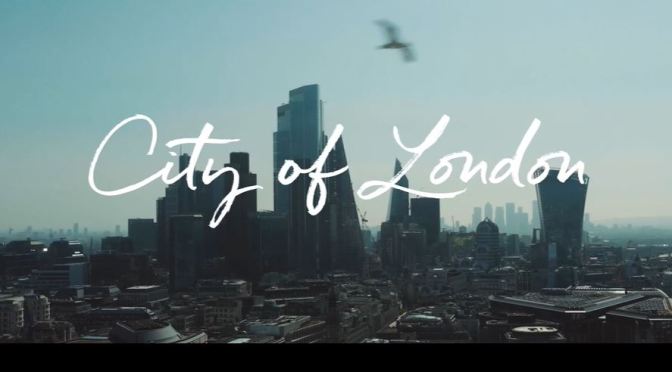
Condé Nast Traveller takes a one-day tour of the City of London. Join our photographic director Matthew Buck and chief sub-editor Gráinne McBride as they plan their itinerary around a completely empty St Paul’s Cathedral, a legendary brutalist building, a café selling the UK’s first compostable coffee pods and an excellent chophouse. The pair discover a new perspective of the capital’s City-within-a-city.
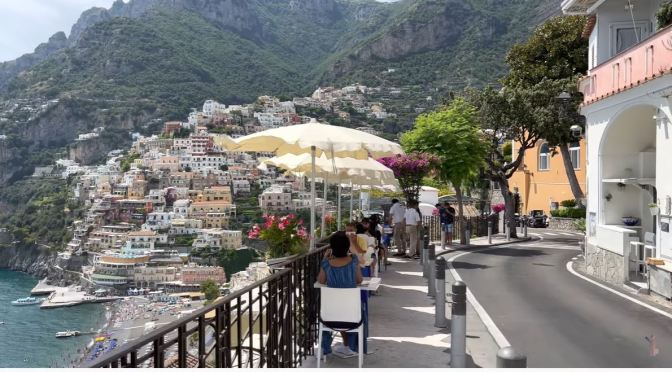
Positano is a cliffside village on southern Italy’s Amalfi Coast. It’s a well-known holiday destination with a pebble beachfront and steep, narrow streets lined with boutiques and cafes. Its Chiesa di Santa Maria Assunta features a majolica-tiled dome and a 13th-century Byzantine icon of the Virgin Mary. The Sentiero degli Dei hiking trail links Positano to other coastal towns.
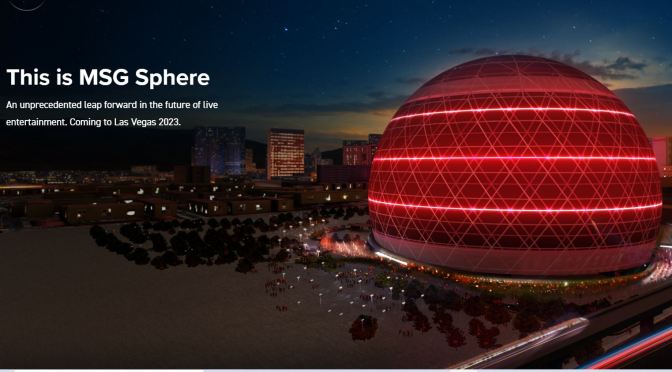
The world-first spherical structure, containing the world’s largest and highest resolution LED screen that will not only transform the Las Vegas skyline, but quite literally reshape the live entertainment industry.
Since the days of Dean Martin and the Rat Pack in the 1960’s Las Vegas has been renowned for live entertainment and between showcase fights and residencies from Lady Gaga, Celine Dion, Britney Spears and Magic Mike the city is constantly raising the bar with what it has to offer.
Its latest offering, developed by Madison Square Garden Entertainment and located just off the strip behind the Venetian, is unlike anything anywhere else on Earth.
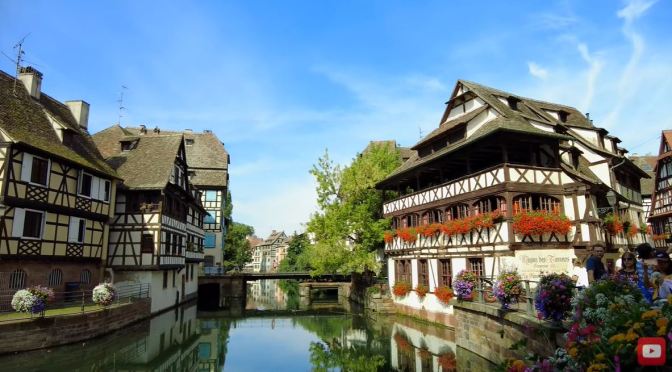
Petite France is the city’s lively tourist hub, known for cobblestone streets, canals, and well-preserved half-timbered homes like the Tanners’ House, built in 1572. A terrace atop the 17th-century Barrage Vauban, a covered bridge and dam, offers panoramic views. Alsatian eateries dot the area, while shops on and around Grand’Rue sell clothing and souvenirs such as crockery, wine, and specialty teas.
Strasbourg is the capital city of the Grand Est region, formerly Alsace, in northeastern France. It’s also the formal seat of the European Parliament and sits near the German border, with culture and architecture blending German and French influences. Its Gothic Cathédrale Notre-Dame features daily shows from its astronomical clock and sweeping views of the Rhine River from partway up its 142m spire.
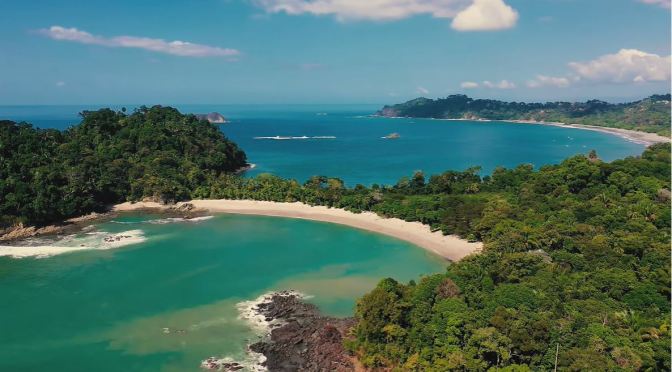
Costa Rica is a rugged, rainforested Central American country with coastlines on the Caribbean and Pacific. Though its capital, San Jose, is home to cultural institutions like the Pre-Columbian Gold Museum, Costa Rica is known for its beaches, volcanoes, and biodiversity. Roughly a quarter of its area is made up of protected jungle, teeming with wildlife including spider monkeys and quetzal birds.
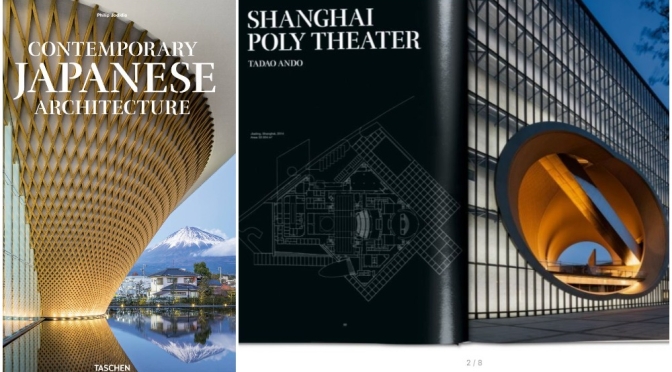
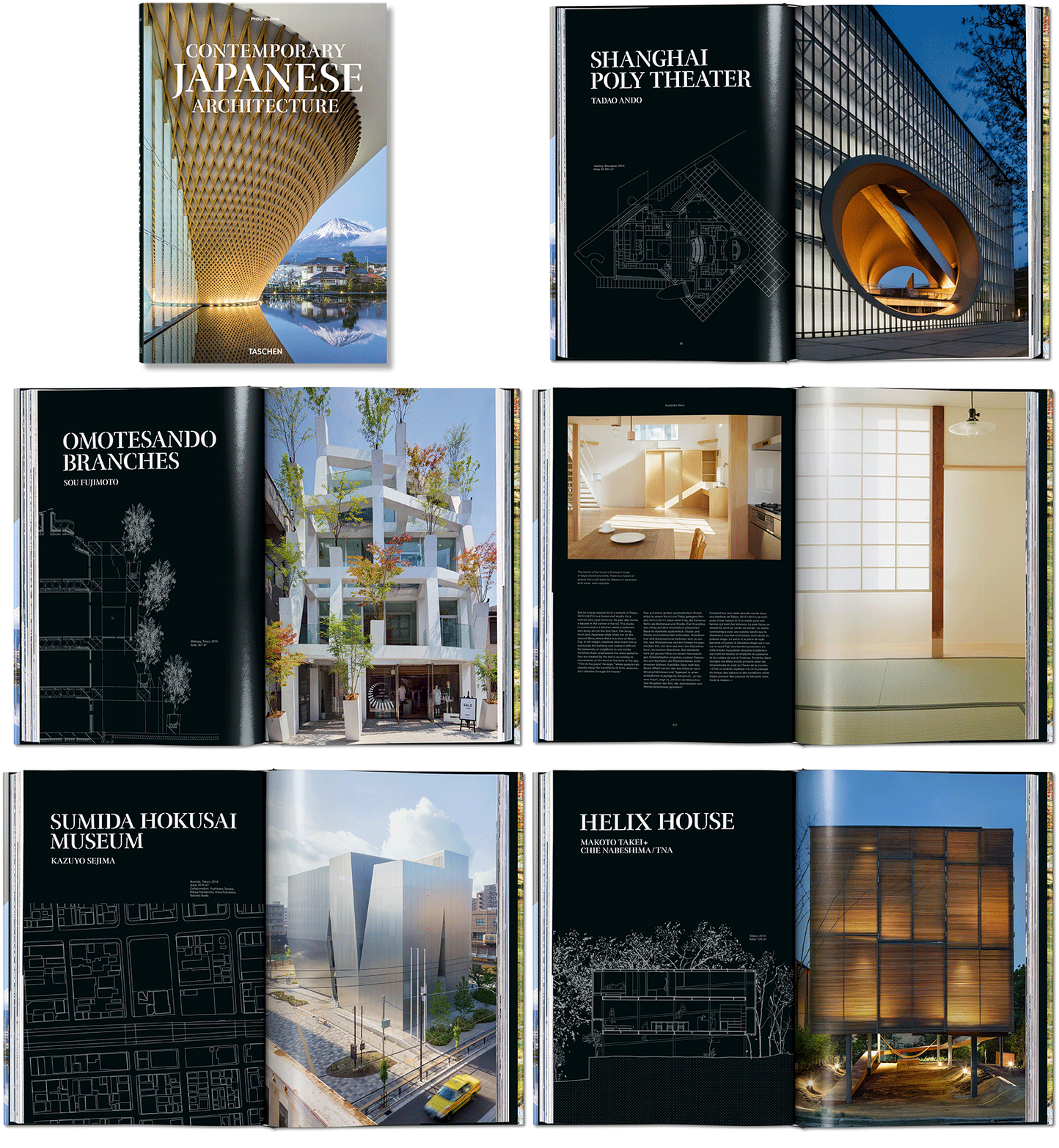
The contemporary architecture of Japan has long been among the most inventive in the world, recognized for sustainability and infinite creativity. No fewer than seven Japanese architects have won the Pritzker Prize.
Since Osaka World Expo ’70 brought contemporary forms center stage, Japan has been a key player in global architecture. With his intentionally limited vocabulary of geometric forms, Tadao Ando has since then put Japanese building on the world’s cultural map, establishing a bridge between East and West. In the wake of Ando’s mostly concrete buildings, figures like Kengo Kuma (Japan National Stadium intended for the Olympic Games, originally planned for 2020), Shigeru Ban (Mount Fuji World Heritage Center), and Kazuyo Sejima (Kanazawa Museum of 21st Century Art of Contemporary Art) pioneered a more sustainable approach. Younger generations have successfully developed new directions in Japanese architecture that are in harmony with nature and connected to traditional building. Rather than planning on the drawing board, the architects presented in this collection stand out for their endless search for forms, truly reacting on their environment.
Presenting the latest in Japanese building, this book reveals how this unique creativity is a fruit of Japan’s very particular situation that includes high population density, a modern, efficient economy, a long history, and the continual presence of disasters in the form of earthquakes. Accepting ambiguity, as seen in the evanescent reflections of Sejima’s Kanazawa Museum, or constant change and the threat of catastrophe is a key to understanding what makes Japanese architecture different from that of Europe or America.
This XL-sized book highlights 39 architects and 55 exceptional projects by Japanese masters—from Tadao Ando’s Shanghai Poly Theater, Shigeru Ban’s concert hall La Seine Musical, SANAA’S Grace Farms, Fumihiko Maki’s 4 World Trade Center, to Takashi Suo’s much smaller sustainable dental clinic. Each project is introduced with photos, original floor plans and technical drawings, as well as insightful descriptions and brief biographies. An elaborate essay traces the country’s building scene from the Metabolists to today and shows how the interaction of past, present, and future has earned contemporary Japanese architecture worldwide recognition.



 Boomers Daily