Category Archives: Technology

SCIENCE & TECH: DISCOVER MAGAZINE – JULY/AUG 2024

Discover Magazine Subscription [6 issues]

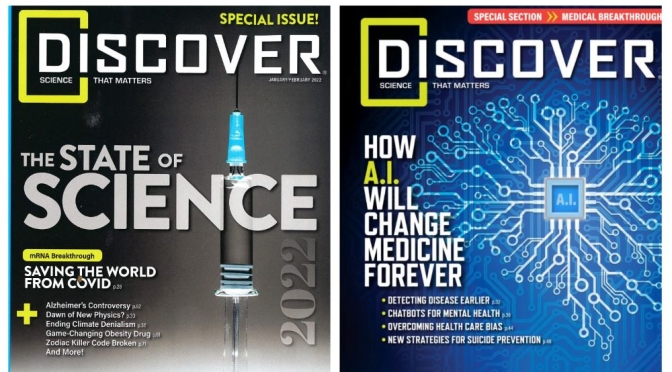
Discover Magazine (June 30, 2024): The latest issue features ‘Next-Gen Medicine’ – Recreating human organs on microchips; Inside the new Opioid Crisis; History’s strangest sleep study and Prehistoric Family Secrets…

The Future of Organ-Chip Technology Is Bright

From rendering animal testing obsolete to reducing HIV and preterm birth, Donald Ingber is making the future a reality.

The Opioid Crisis Is Not Over

Organizations Work to Reduce Animal Deaths With Relegated Passageways

Man Experiences His Own Spine-Tingling Tale

Mapping the Darkness Excerpt: Sleep Spelunking

Preview: MIT Technology Review – July/August 2024

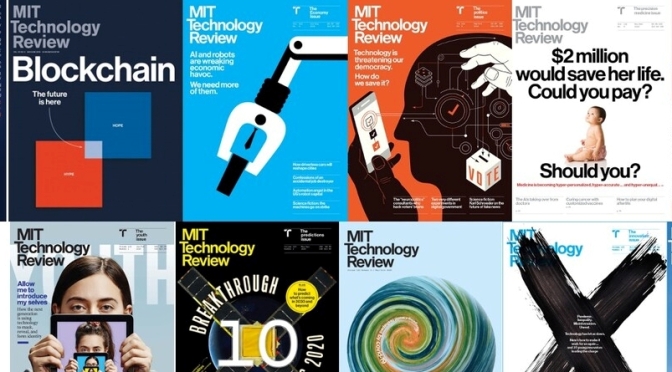
MIT Technology Review (June 26, 2024): The new issue features The Play issue – Did you know you could surf in the desert? New pools make it possible–but at what cost? Learn how AI is bringing an unprecedented expansiveness to computer and video games and how high-tech supershoes are helping athletes run faster and more safely. Plus: Gamification was always a dubious concept–so how did it take over the world?

How gamification took over the world

Gamification was always just behaviorism dressed up in pixels and point systems. Why did we fall for it?

Supershoes are reshaping distance running

Kenyan runners, like many others, are grappling with the impact of expensive, high-performance shoes.

How generative AI could reinvent what it means to play

AI-powered NPCs that don’t need a script could make games—and other worlds—deeply immersive.

Harvard Business Review – July/August 2024 Issue

July–August 2024

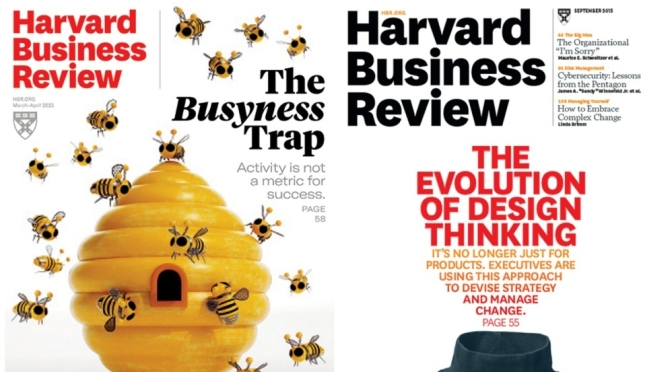
Harvard Business Review (June 15, 2024) –

Why Entrepreneurs Should Think Like Scientists

Founders of start-ups who question and test their theories are more successful than their overly confident peers.

How to Assess True Macroeconomic Risk

Models and forecasts can be seductive, but it’s time for executives to reclaim their economic judgment.

The Middle Path to Innovation

Forget disruption and incrementalism. Here’s how to develop high-growth products in slow-growth companies.

World Economic Forum: Top Stories – June 15, 2024

World Economic Forum (June 15, 2024) – The top stories of the week include:

0:15 Mini-factories in space – Space Forge says its technology could revolutionize manufacturing. The satellites contain miniature manufacturing systems. They take advantage of the conditions in low-Earth orbit such as microgravity, extreme temperatures and a contaminant-free environment to forge materials that would be impossible to manufacture here on Earth.

1:53 Biodiversity credits explained – Nature is under unprecedented threat. Around 2 million plant and animal species could go extinct in the next few decades as climate change and habitat loss push ecosystems towards irreversible tipping points. To fight this crisis, experts are coming up with new ways to protect life on Earth by assigning value to the ecosystems around us. These innovations include biodiversity credits.

6:58 Nairobi switches to electric buses – Private minibuses called matatus are the main mode of public transport in Nairobi. Most matatus are old, diesel-powered and inefficient and 60% of the city’s population rely on them to get around. Electric mobility start-up BasiGo has built an all-electric alternative. The first bus rolled off its Nairobi production line in early 2024. Nairobi bus operators have already ordered 500 more. More than 90% of Kenya’s electricity is generated renewably, which means BasiGo’s buses are virtually emission-free.

8:40 How to build healthier cities – This architect designs buildings that bring communities together – Sumayya Vally grew up in post-Apartheid Pretoria, South Africa in what had been an Indian-only township and saw how division kept communities apart. Vally founded the Johannesburg-based architecture practice Counterspace to fight the built legacies of colonization and highlight the peaceful coexistence between communities.

World Economic Forum: Top Stories – May 13, 2024

World Economic Forum (May 13, 2024) – The top stories of the week include:

0:15 Banking uplifts women in Pakistan – Pakistan has a large gender gap in financial inclusion. 47% of men have at least one registered financial account but just 13% of women. Even for those with an account, banking can be prohibitively time-consuming, especially for women who are running a business alongside a household. Now a new kind of digital banking service is helping to close this gap.

2:23 World’s busiest airports revealed – The world’s busiest airports in 2023 were dominated by the United States, with five airports cracking the top 10. Overall, global airports saw a significant rebound in 2023, handling a total of 8.5 billion trips.

4:39 WMO: Asia hardest hit by climate – In 2023, Asia saw a wave of extreme weather events from floods to cyclones. World Economic Forum Head of Climate Adaptation Eric White explains why climate change is making extreme weather more likely.

7:07 Saving Earth with space science – Simonetta Di Pippo says that space is already helping tackle the greatest challenges on Earth. Satellite connectivity is improving our management of disasters and powering digital transformation. Which is revolutionizing sectors from healthcare to education, retail and communication.

Preview: MIT Technology Review – May/June 2024

MIT Technology Review (April 29, 2024): The new issue features ‘The Robots Are Coming’ – And they’re here to help; A brief, weird history of brainwashing; Office space in space; AI comes for bodycams…

The Build issue

Who says we can’t still build things? In this issue: a look at the robots we’ve always wanted; a new model for space exploration; and efforts to flood-proof Louisiana’s coastline. Plus a wild, weird history of brainwashing; designing cheese with AI; and glow-in-the dark petunias.

Is robotics about to have its own ChatGPT moment?

Researchers are using generative AI and other techniques to teach robots new skills—including tasks they could perform in homes.Stretch Robot Presents Rose in its gripper

Technology Quarterly: ‘Health And AI’ (April 2024)

Technology Quarterly: A new prescription

The Economist (April 1, 2024): The latest issue of THE ECONOMIST TECHNOLOGY QUARTERLY is focused on:

A new prescription

AIs will make health care safer and better, reports Natasha Loder. It may even get cheaper too

AIs will make health care safer and better

Artificial intelligence has long been improving diagnoses

Medical AIs with human faces are on their way

Artificial intelligence is taking over drug development

Can artificial intelligence make health care more efficient?

Read full report

Preview: MIT Technology Review – March/April 2024

Image

MIT Technology Review (February 29, 2024): The new issue features ‘The Hidden Worlds Issue’ – Is Anybody Out There? Using technology to explore and expose hidden worlds, from enabling deeper dives into ocean depths to journeying to one of Jupiter’s orbiting bodies to pushing the boundaries of particle physics. Plus: wearables for wildlife, Wi-Fi sensing, and a reconsideration of Luddites.

The search for extraterrestrial life is targeting Jupiter’s icy moon Europa

NASA’s Europa Clipper mission will travel to one of Jupiter’s largest moons to look for evidence of conditions that could support life.

Inside the hunt for new physics at the world’s largest particle collider

The Large Hadron Collider hasn’t seen any new particles since the discovery of the Higgs boson in 2012. Here’s what researchers are trying to do about it.

Meet the divers trying to figure out how deep humans can go

Figuring out how the human body can withstand underwater pressure has been a problem for over a century, but a ragtag band of divers is experimenting with hydrogen to find out.

Previews: New Humanist Magazine – Spring 2024

Image

NEW HUMANIST MAGAZINE – SPRING 2024 ISSUE: The new issue features Emma Park on how the culture wars are damaging the sciences, theoretical physicist Tasneem Zehra Husain on why the imagination is key to decoding the universe, and Alom Shaha on what can be gained by thinking like a scientist

Beyond the two cultures

Amid a polarised debate, science and art seem further apart than ever. Emma Park, editor of The Freethinker, explores what humanism has to teach us about the apparent conflict between these ways of thinking and how to bridge the divide.

“While humanities scholars are often (not without justification) accused of being Luddites, those on the science and technology side could also benefit from the knowledge that the humanities have accumulated over the centuries … [And] no intellectual activity worth the name can flourish in a politically repressive environment: freedom of expression and enquiry should be an issue to unite artists, scholars and scientists.”

The poetry of science

Metaphors are key to unlocking the secrets of the universe – scientists should do more to harness their power, writes acclaimed physicist Tasneem Zehra Husain.

“Metaphors aren’t only a means of description, they can also lead to revelations. Centuries ago, Newton was able to calculate the gravitational attraction between two objects … [but] would ‘feign no hypothesis’ as to why it was so. He had the equation, but he did not understand gravitation … With Einstein, we finally have a metaphor. When we picture space-time as a dynamic ‘fabric’ … we begin to understand what gravity means.”