The Wall Street Journal (October 15, 2024): In Ukraine and the Red Sea, low-tech drones are changing the way wars are fought. The U.S. and other countries are investing in a new and inexpensive way to retaliate: lasers.
Chapters: 0:00 Laser weapon systems 1:03 The LOCUST 2:57 Targets 3:40 Weaknesses 4:56 Future challenges and deployment
Compared with traditional weapons, lasers present some key challenges: they have a shorter range, limited power and can be harder to fix when issues arise. WSJ explains how the BlueHalo LOCUST laser weapon system works and why the tech is so difficult to perfect.
The Wall Street Journal (October 14, 2024): “Darwin” is one of Ukraine’s deadliest drone pilots in its war against Russia.
Chapters: 0:00 A race to adapt 1:38 “Darwin” 2:48 Artillery strikes 4:01 Personal evolution 6:37 In the bunker 8:32 Drone strike 12:20 Just the beginning
But the 20-year-old must contend with his own personal evolution after hundreds of successful missions in a modern survival of the fittest.
Massachusetts is one of the richest states in the country — because it’s pricing out its own middle class. Why did the state stop building enough to house them?
0:15 What’s next for urgent climate action? – At the Sustainable Development Impact Meetings in New York, leaders discussed how to curb carbon emissions while building an inclusive economy. Regulations can be a lever for systemic change but local innovation is crucial, too.
3:09 Solar stoves reduce air pollution deaths – It cooks food while emitting hardly any smoke. It uses a hybrid system, powered by energy from solar panels and from fuel such as small sticks or crop waste. The ACE One was created by African Clean Energy which is a part of the World Economic Forum’s Equitable Transition Initiative.
5:08 Chief economists’ outlook for the rest of 2024 – Many chief economists polled by the World Economic Forum are optimistic about 2025. In the United States, nearly nine in ten chief economists anticipate moderate or strong growth in the coming year. Similarly, in South Asia, 71% predict strong or very strong growth.
9:33 Earth exceeds 6 of 9 planetary boundaries – In 2009, a team of scientists identified the 9 natural processes that regulate Earth’s biosphere and keep it stable. These include climate change, biodiversity, ocean acidification and freshwater. The team also defined the safe planetary boundary for each process. A safe and sustainable future for humanity lies within these boundaries.
CNBC (October 2, 2024): For a decade, Elon Musk has championed the idea that one day Tesla cars will drive themselves as robotaxis. On October 10, the company plans to reveal a “dedicated robotaxi” design at an invitation-only event in Los Angeles.
Chapters: 3:18 Ch 1 – Tesla’s vision for autonomy 6:33 Ch 2 – Full self-driving 10:13 Ch 3 – Realizing the robotaxi 15:34 Ch 4 – Sizing up the robotaxi competition
Despite years of bold predictions and missed deadlines, fans of the company are holding out hope that Musk will finally deliver. Regardless of what the company showcases at its robotaxi day, experts are skeptical of the company’s strategy, citing its Auotpilot and Full Self-Driving technology as a barometer for Tesla’s progress, or lack thereof.
While Tesla has been developing its autonomous vehicles, competitors like Google-owned Waymo and Chinese companies like Pony.ai and Baidu have already launched commercial robotaxi services. With U.S. EV sales growth slowing, there’s a lot riding on Tesla’s potential pivot to autonomy. CNBC explores whether the company is ready for robotaxis and if Musk’s vision for driverless Teslas will become a reality anytime soon.
World Economic Forum (September 28, 2024) – The top stories of the week include:
0:15 How investment advice is changing – ‘The film is a rollercoaster ride into the last few years of how technology is changing our relationship to money’, says Chris Temple, director of This Is Not Financial Advice, a documentary that follows four online investors, including one who made – and lost – millions in crypto.
5:56 New tech reveals the impacts of climate change – Using AI, we can process Earth Observation (EO) data faster. Helping us monitor disaster impact in hours, not days. AI is also improving climate and weather forecast models. Through AR and VR, engineers are transforming these complex datasets into interactive, intuitive experiences that can help leaders make climate decisions.
7:39 This debt plan can save coral reefs – The deal reduces Indonesia’s debt repayments to the US by $35 million over the next 9 years and redirects those payments towards reef conservation instead. Indonesia is home to 16% of the world’s coral reefs and around 60% of the world’s coral species. Its reefs generate around $1.6 billion in value every year through fisheries, coastline protection and tourism. But Indonesia’s reefs face a range of threats.
9:21 Ray Dalio on funding climate action – By 2050, climate damage could cost between $1.7 trillion and $3.1 trillion per year. However, the costs of inaction could be even greater, says Ray Dalio, the founder of the world’s largest hedge fund, Bridgewater Associates. Right now, climate action is hugely under-financed.
CNBC (September 17, 2024): For decades, Amazon has set the standard for fast package delivery. When Prime launched in 2005, two-day shipping was virtually unheard of. By March 2024, 60% of Prime items were delivered same or next day. Now Amazon wants to push that number even higher, using generative AI, despite concerns about energy and cost.
Chapters: 2:14 Two-day to same-day 5:51 Robot revolution 9:18 Predicting orders 12:11 Routes and personalization
CNBC got an exclusive look at Amazon’s use of generative AI to optimize delivery routes, make more intelligent warehouse robots, and better predict where to stock new items.
Climate change is putting parasites — the unseen pests running our planet — in peril, but a small band of scientists is fighting to save them from extinction. By Kate Golembiewski
What Goes On Inside the Mind of a Dog?
Help researchers understand the underpinnings of dog personality and behavior with these Citizen Science projects.
MIT Technology Review (August 17, 2024): The 125th Anniversary issue features ‘Greetings from the Future’ – Personalized AI, Genetically-Engineered Immunity and Digital Immortaility. We’ll see it all in the next century.
News, Views and Reviews For The Intellectually Curious











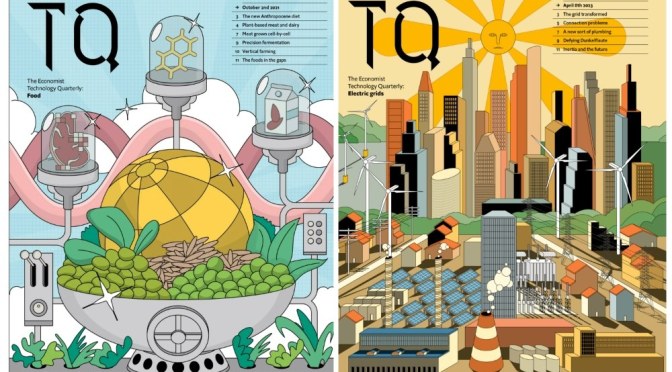

 The Economist





 Boomers Daily