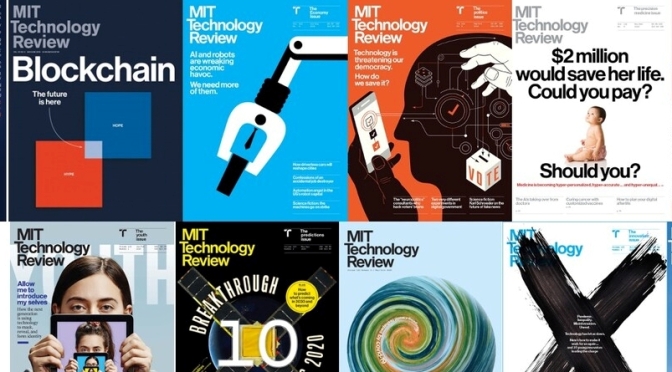
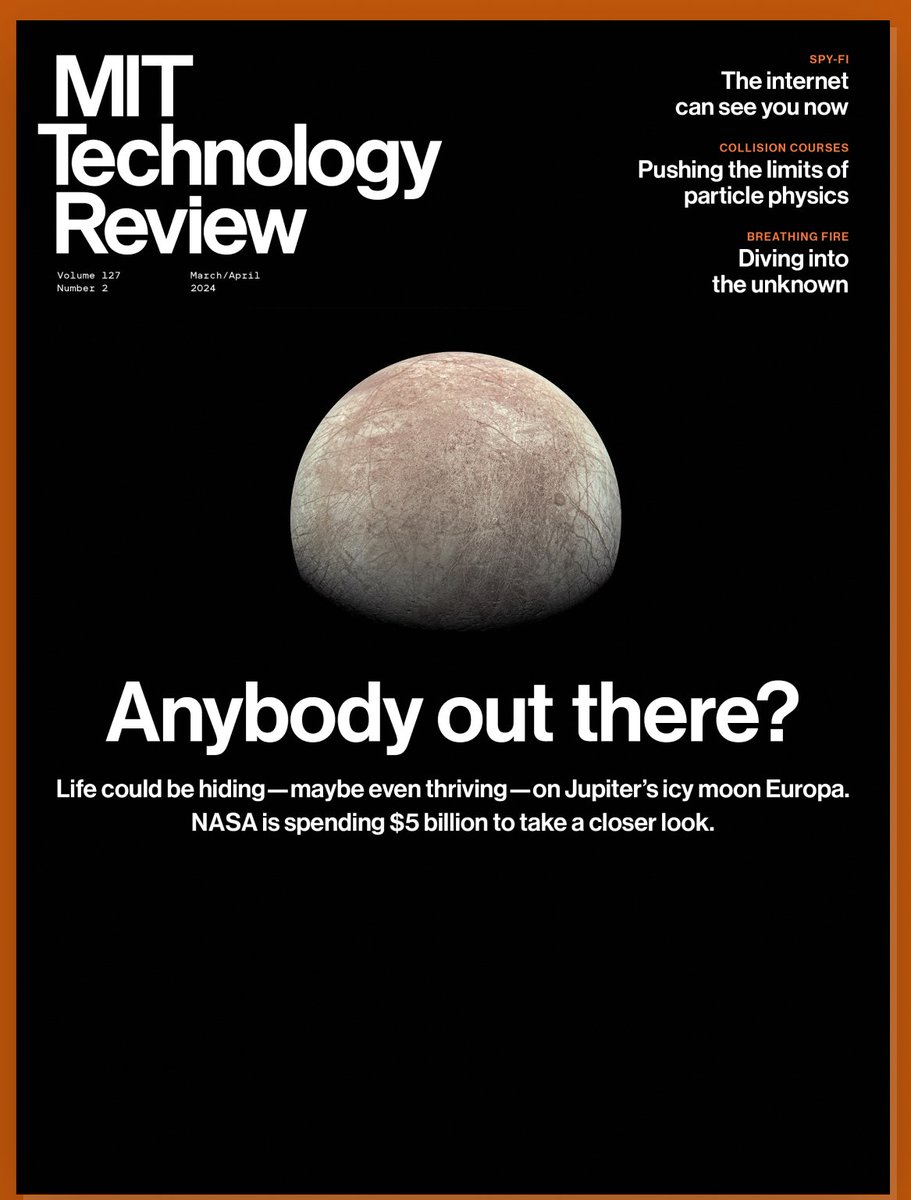
MIT Technology Review (February 29, 2024): The new issue features ‘The Hidden Worlds Issue’ – Is Anybody Out There? Using technology to explore and expose hidden worlds, from enabling deeper dives into ocean depths to journeying to one of Jupiter’s orbiting bodies to pushing the boundaries of particle physics. Plus: wearables for wildlife, Wi-Fi sensing, and a reconsideration of Luddites.
The Large Hadron Collider hasn’t seen any new particles since the discovery of the Higgs boson in 2012. Here’s what researchers are trying to do about it.
Figuring out how the human body can withstand underwater pressure has been a problem for over a century, but a ragtag band of divers is experimenting with hydrogen to find out.
BBC News (February 24, 2024): What was the technology that made photography possible? From Polaroid to the instant tap of your smartphone – here is a rundown on the history of the camera.
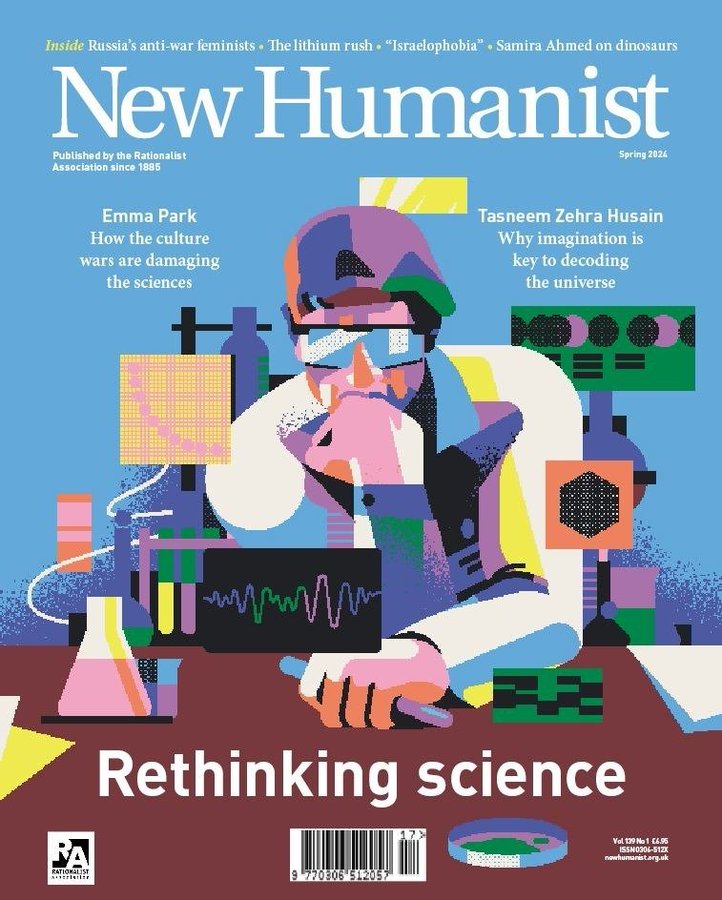
NEW HUMANIST MAGAZINE – SPRING 2024 ISSUE: The new issue features Emma Park on how the culture wars are damaging the sciences, theoretical physicist Tasneem Zehra Husain on why the imagination is key to decoding the universe, and Alom Shaha on what can be gained by thinking like a scientist…
Beyond the two cultures
Amid a polarised debate, science and art seem further apart than ever. Emma Park, editor of The Freethinker, explores what humanism has to teach us about the apparent conflict between these ways of thinking and how to bridge the divide.
“While humanities scholars are often (not without justification) accused of being Luddites, those on the science and technology side could also benefit from the knowledge that the humanities have accumulated over the centuries … [And] no intellectual activity worth the name can flourish in a politically repressive environment: freedom of expression and enquiry should be an issue to unite artists, scholars and scientists.”
The poetry of science
Metaphors are key to unlocking the secrets of the universe – scientists should do more to harness their power, writes acclaimed physicist Tasneem Zehra Husain.
“Metaphors aren’t only a means of description, they can also lead to revelations. Centuries ago, Newton was able to calculate the gravitational attraction between two objects … [but] would ‘feign no hypothesis’ as to why it was so. He had the equation, but he did not understand gravitation … With Einstein, we finally have a metaphor. When we picture space-time as a dynamic ‘fabric’ … we begin to understand what gravity means.”
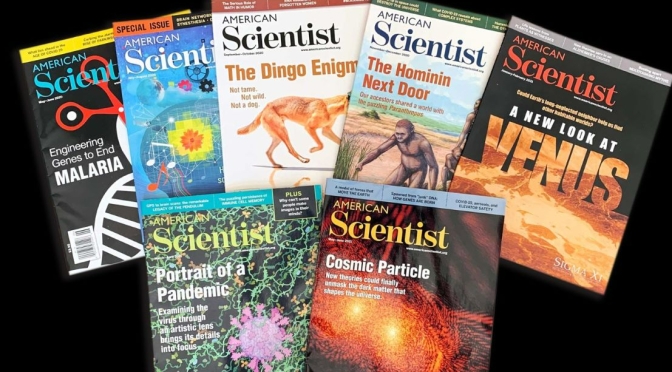
American Scientist (February 15, 2024): The latest issue features “Deconstructing DNA Beyond the Helix” – science educator and artist Caryn Babaian explores through illustration the molecular details and interactions that can affect DNA’s structure. She contends that for people to fully understand DNA, it must be shown in relationship to water.
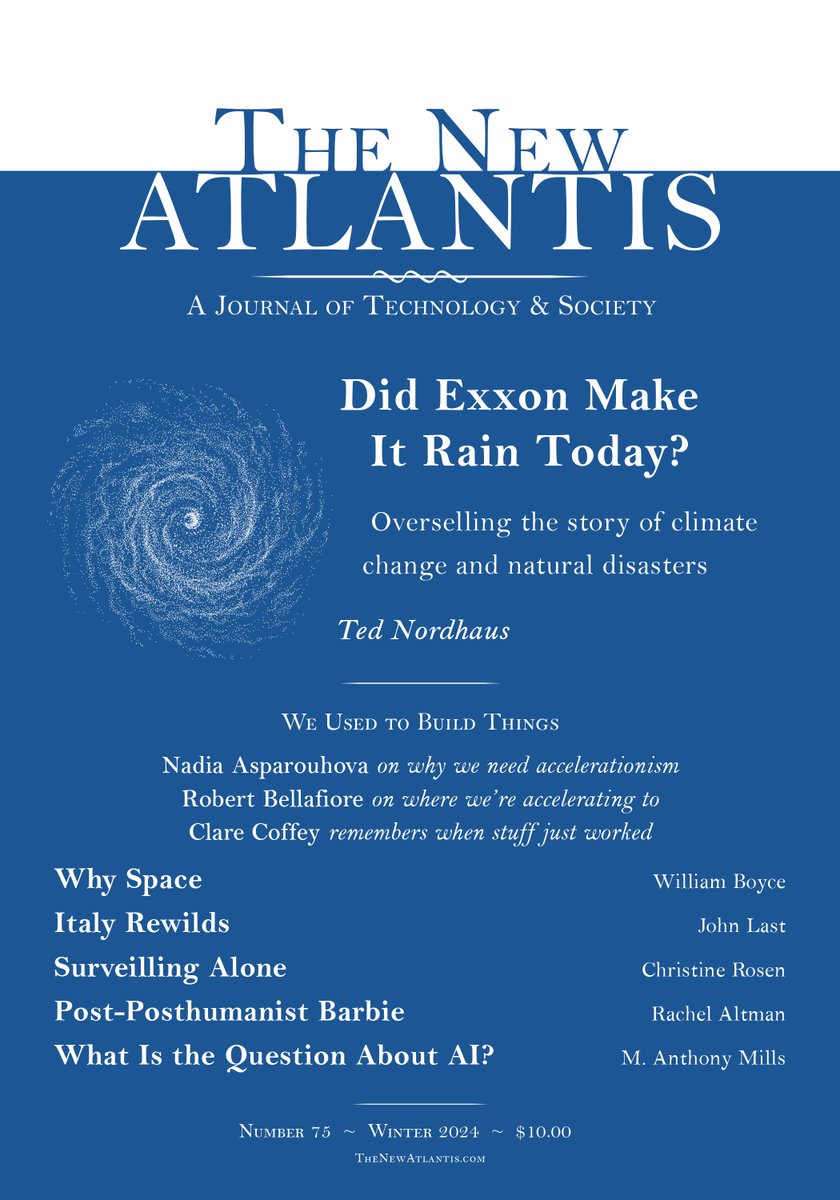
The New Atlantis Magazine (February 8, 2024) : The latest issue features ‘Did Exxon Make It Rain Today? – Overselling the story of climate change and natural disasters; Bears in the Villa – On whether Italians are ready for the return of wilderness; What Is Space For? – On Why gaze and why we should go…
Why headlines blaming extreme weather on climate change don’t hold up, the peril of catastrophism, and the case that we’re actually safer than ever before
Users of the internet can ignore its physical underpinnings. But for technologies like artificial intelligence and the metaverse to work, others need to pay attention, argues Abby Bertics
Every year, we look for promising technologies poised to have a real impact on the world. Here are the advances that we think matter most right now.
AI for everything
We now live in the age of AI. Hundreds of millions of people have interacted directly with generative tools like ChatGPT that produce text, images, videos, and more from prompts. Their popularity has reshaped the tech industry, making OpenAI a household name and compelling Google, Meta, and Microsoft to invest heavily in the technology.
Super-efficient solar cells
Solar power is being rapidly deployed around the world, and it’s key to global efforts to reduce carbon emissions. But most of the sunlight that hits today’s panels isn’t being converted into electricity. Adding a layer of tiny crystals could make solar panels more efficient. WHY IT MATTERS
Apple Vision Pro
Apple will start shipping its first mixed-reality headset, the Vision Pro, this year. Its killer feature is the highest-resolution display ever made for such a device. Will there be a killer app? It’s early, but the world’s most valuable company has made a bold bet that the answer is yes. WHY IT MATTERS
Weight-loss drugs
The global rise in obesity has been called an epidemic by the World Health Organization. Medications like Mounjaro and Wegovy are now among the most powerful tools that patients and physicians have to treat it. Evidence suggests they can even protect against heart attacks and strokes. WHY IT MATTERS
The Economist (January 4, 2024) – A new wave of artificial intelligence is starting to transform the way the entertainment industry operates. Who will be the winners and losers?
Video timeline: 01:07 AI is changing the music business 04:09 How big data revolutionised entertainment industries 05:20 Can AI predict a film’s success? 09:26 How generative AI is creating new opportunities 12:36 What are the risks of generative AI?
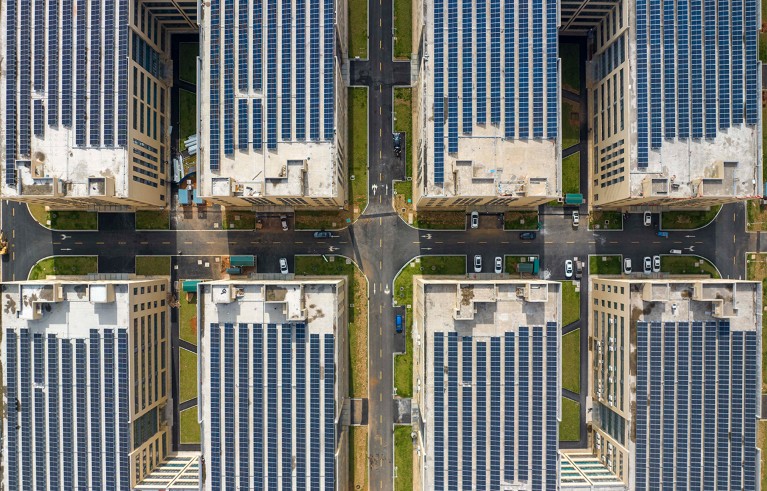
nature podcasts (December 29, 2023) – A new kind of solar cell is coming: is it the future of green energy? Firms commercializing perovskite–silicon ‘tandem’ photovoltaics say that the panels will be more efficient and could lead to cheaper electricity.
On the outskirts of Brandenburg an der Havel, Germany, nestled among car dealerships and hardware shops, sits a two-storey factory stuffed with solar-power secrets. It’s here where UK firm Oxford PV is producing commercial solar cells using perovskites: cheap, abundant photovoltaic (PV) materials that some have hailed as the future of green energy. Surrounded by unkempt grass and a weed-strewn car park, the factory is a modest cradle for such a potentially transformative technology, but the firm’s chief technology officer Chris Case is clearly in love with the place. “This is the culmination of my dreams,” he says.
The Economist (December 28, 2023) – What are the stories set to shape 2024? From the biggest election year in history, to how to control AI and even taxis that fly, The Economist offers its annual look at the world ahead.
Video timeline: 00:00 – The World Ahead 2024 00:33 – Vital votes 03:34 – Taxis take off 07:10 – AI rules 10:19 – Industry cleans up? 13:48 – BRICS build
News, Views and Reviews For The Intellectually Curious


 BBC News (February 24, 2024): What was the technology that made photography possible? From Polaroid to the instant tap of your smartphone – here is a rundown on the history of the camera.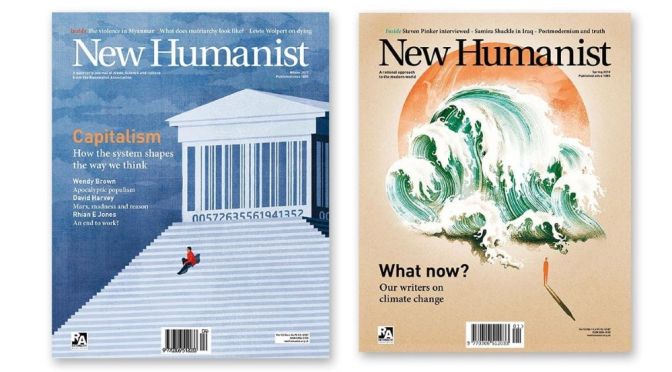

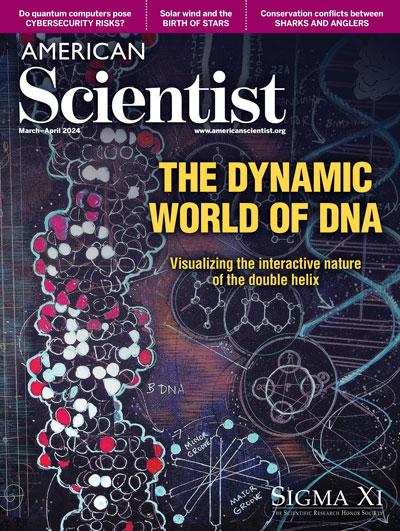
 American Scientist (February 15, 2024): The latest issue features “Deconstructing DNA Beyond the Helix” – science educator and artist Caryn Babaian explores through illustration the molecular details and interactions that can affect DNA’s structure. She contends that for people to fully understand DNA, it must be shown in relationship to water.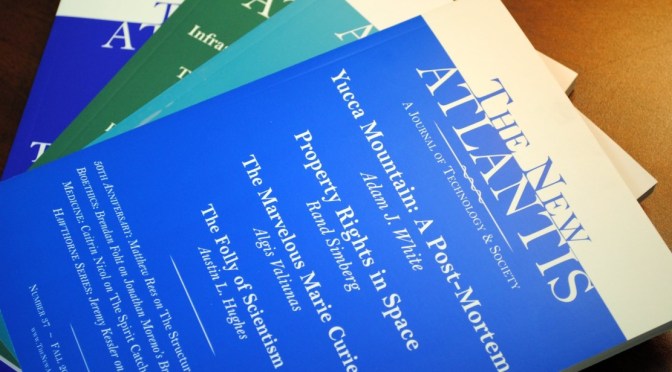


 The Economist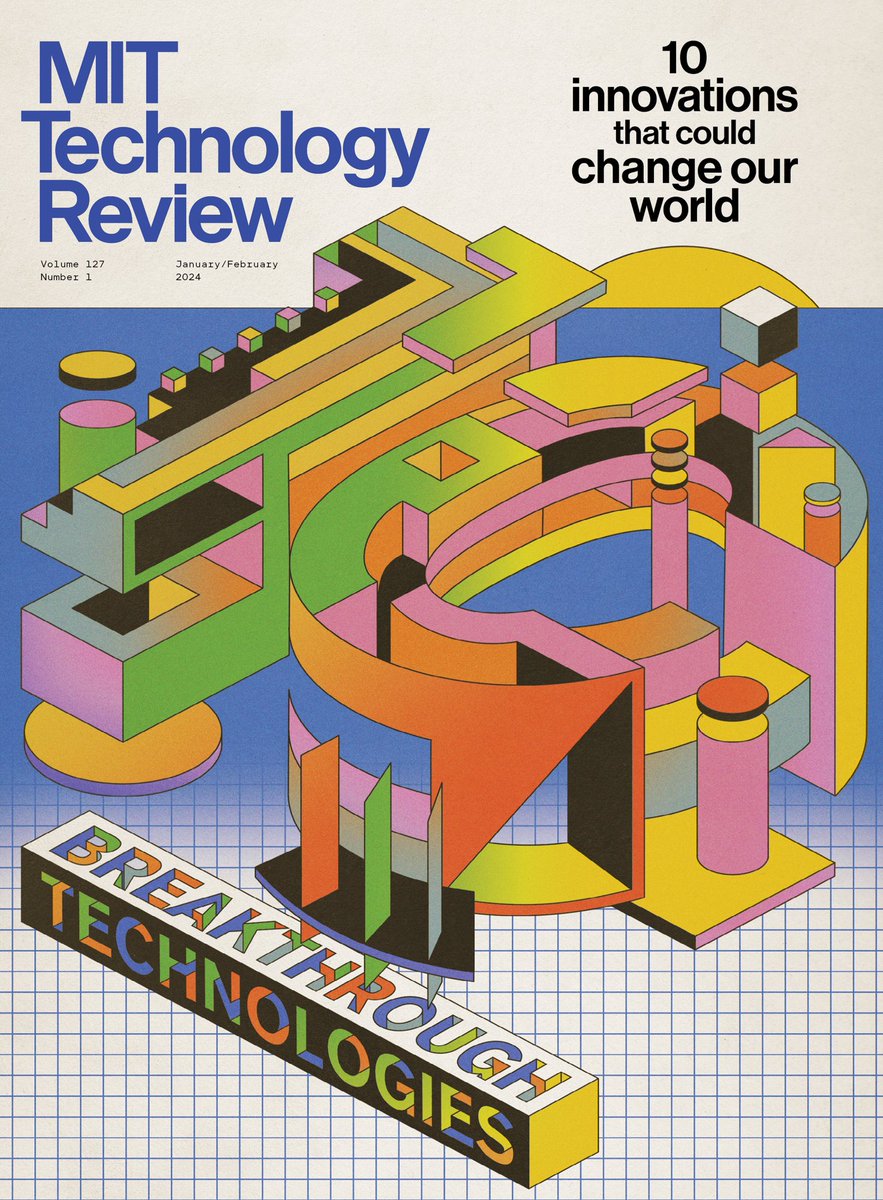



 Boomers Daily