
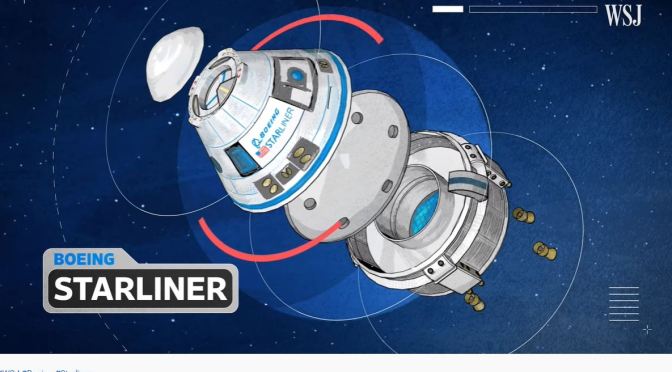
After years of cost overruns, errors and delays, Boeing’s space program is facing a major test: Later this year it will likely make its second attempt to launch its Starliner crew capsule to the International Space Station. WSJ looks at the company’s path to this crucial moment, and what’s riding on the test flight’s success. Illustration: Alex Kuzoian/WSJ
Category Archives: Technology
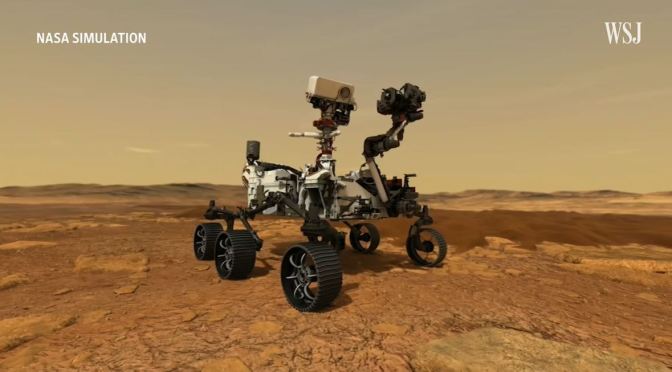
Space Missions: How Mars Rover Searches For Life
NASA’s Perseverance rover landed on Mars more than two weeks ago. Jennifer Trosper from NASA’s Jet Propulsion Laboratory explains how the rover will explore the Martian landscape and search for signs of life. Photo: NASA

Top Innovation & Design: ‘Sunne’ – Indoor Window Solar Lamp (Video)
Dutch designer Marjan van Aubel has developed a solar lamp that is designed to be hung in front of windows so it can generate its own energy.
Called Sunne, the light is equipped with photovoltaic cells and an integrated battery, allowing it to harvest and store enough energy throughout the day to light up a room at night. Van Aubel designed the lamp as part of an ongoing project to normalise solar technology by bringing it inside homes.
“To facilitate a shift in our perception towards solar, it also needs to be more accessible to a larger group of people,” she told Dezeen. “People need to be able to familiarise themselves with it and have it in their surroundings. Sunne is a first step to integrating solar energy into our everyday life.”
Read more on Dezeen: https://www.dezeen.com/?p=1619138
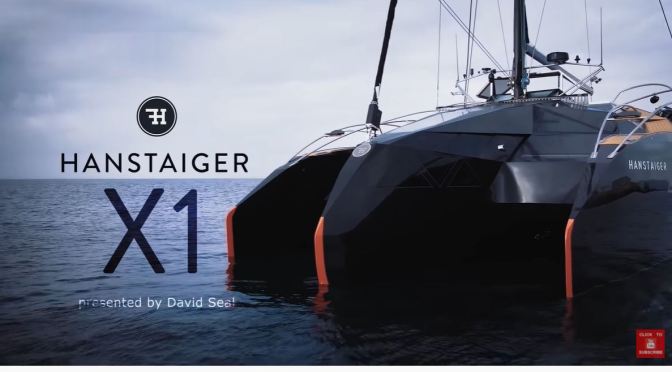
Future Of Sailing: The ‘Carbon Fibre Trimaran – Hanstaiger X1’ (Video)
The X1 is an exceptionally well designed trimaran, with all the hydrodynamic advantageous that brings. The sailboat version can reach speeds of 20 knots. The powerboat version can achieve speeds of 30 knots thanks to more powerful engines.
The interior of the X1 is not designed to feel you are in a boat; its designed to feel like you are in luxury home. Natural light fills all areas of boat, thanks to the glass roof structure and oversized lateral windows. There are no narrow corridors or maze like internal structures; the layout is designed to feel open and easy to move around in. The toilets are proper sized, with all the space, functionality and finishings you would come to expect from a 5 star hotel.

Space Ventures: Asteroids As Source Of Precious Metals & Elements (Video)
Mining on asteroids sounds like the stuff of science fiction, but it could soon become a reality. Nations and powerful corporations already have plans for such ventures and are hard at work staking their claim to resources from space. How can economic growth continue unfettered once all the earth’s resources have been consumed?
Major companies and governments have long been working on plans to exploit the resources to be found in the vastness of space. How far are humans from achieving this? This documentary examines the technological requirements of space mining. It also assesses how great the desire is to find new sources of raw materials. The film touches on scientific and fundamental societal issues – including humanity’s craving for new territories and our degradation of the Earth as we attempt to exploit all our planet has to offer.
Technology: ‘How Covid Is Boosting Innovation’
Covid-19 has accelerated the adoption of technologies and pushed the world faster into the future. As businesses and organisations look towards the post-pandemic era, what lessons can be learned about innovation?
Read more here: https://econ.st/3t6T7yM
Chapters 00:00 – How has covid-19 boosted innovation? 01:20 – Drone deliveries 04:20 – How crises lead to innovation 06:47 – How restaurants have innovated 09:29 – Inequality between companies 10:48 – Some start-ups have thrived 12:57 – Working from home 14:15 – E-learning: benefits and challenges

Analysis: ‘NFT’s And The Digital Art Boom’ (Video)
Non-fungible tokens, or NFTs, have exploded onto the digital art scene this past year. Proponents say they are a way to make digital assets scarce, and therefore more valuable. WSJ explains how they work, and why skeptics question whether they’re built to last. Photo Illustration: Jacob Reynolds/WSJ
A non-fungible token is a special type of cryptographic token which represents something unique. NFTs are called non-fungible because they are not mutually interchangeable, since they contain unique information, although it is possible to mint any number of NFTs representing the same object.

Documentary: ‘Fukushima – The Age Of Radioactivity’
The USS Ronald Reagan cruised into a radioactive cloud from the Fukushima nuclear power plant in March 2011. Sailors on the aircraft carrier were exposed to radiation. This documentary looks at the event and what came before it. The discovery of the atom and radioactivity are among the most important advances in 20th Century science. This film provides a comprehensive, historical examination of a century of radioactivity. At the same time it remembers the victims – from the Curies to Fukushima.
The film-makers visit Japanese families who sued Tepco, the operator of the Fukushima reactor, after their children developed thyroid cancer following the tsunami and subsequent nuclear disaster. Sent to help tsunami victims, sailors from the USS Ronald Reagan give detailed accounts of what happened on board the carrier. Radiation victims on both sides of the Pacific recount their difficulties in getting information. The film also introduces others harmed by industrial and military secrecy over the issue. Among them are fishermen and veterans exposed to radiation during the nuclear bomb tests on Bikini Atoll, Hiroshima survivors and young women who worked with radium in US factories in the 1920s. Radioactivity is invisible and odorless, yet very harmful to life. A Japanese doctor tells viewers how radioactivity affects the human body, why it causes cancer, and what can be done to shield people against it.

Analysis: ‘The Rise Of Wind Power In The U.S.’ (Video)
In the past decade, wind power capacity has tripled, and it’s projected to double in the decades to come. Wind is now America’s top renewable source of electricity generation, and the domestic offshore industry is finally taking off, as major manufacturers debut ever larger and more powerful turbines. While the industry faces some challenges with permitting, public opposition from various interest groups, and the obvious intermittency issues, there’s no doubt that wind is poised to play a major role in the energy transition. The question is just how fast it will grow.
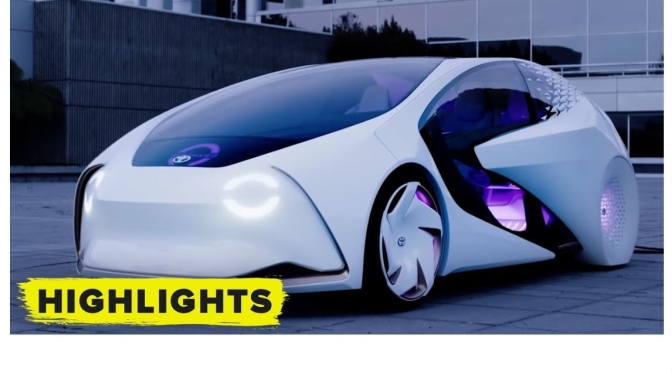
Future Transportation: Top ‘Self-Driving Concept Cars’ Of 2021 (Video)
Fully autonomous cars are the future of transportation. And car makers have been releasing what they believe that future will look like one day. Here is a compilation of some of those visionary concepts.
Video timeline: 00:00 Honda Augmented Driving Concept 00:23 Toyota Concept-I 00:52 Audi Aicon 01:28 Volvo 360C 02:22 Jaguar Future-Type 03:15 Jaguar I Waymo I-Pace 03:45 Zoox 04:28 Nissan Intelligent Mobility 05:27 BMW Next Vision 100 06:09 Mercedes F 015 08:46 Renault EZ-Ultimo 09:37 Renault Float 11:00 Volkswagen Sedric 12:09 Nio Eve 13:16 Hyundai Project Elevate 14:00 Chrysler Portal Concept 16:36 Tesla Full Self Driving Demo 18:28 GM eVTOL
 Boomers Daily