Creative agency wolfgang LA has unveiled the thundertruck, an electric offroader with futuristic looks. Although just a proposal for now, the multipurpose EV promises ‘superior on and off-road performance’ and ‘an entirely new level of versatility and functionality’, all with zero emissions.
2021 was the busiest year yet for NASA in low-Earth orbit, we also made progress preparing for a flight test around the Moon, and had a very active year exploring space, studying Earth, testing technologies for next generation aircraft, and much more. Here’s a look back at those and other things we did this year at NASA. Download Link: https://go.nasa.gov/3yM3so2
Meanwhile, the Institute announced that it would remove the names of known eugenics proponents from its buildings, honors, and assets.
February saw the historic landing of NASA’s Mars rover Perseverance on the Red Planet. The 2,263-pound rover, designed and operated by JPL, which Caltech manages for NASA, will spend two years investigating Mars’s Jezero crater, and will collect and cache samples of rocks and sediment for recovery by a subsequent mission.
The wide gap in development between rich and poor children could be closed with the help of neuroscience. Might a controversial focus on genetics also help? Film supported by @Mishcon de Reya LLP
Video timeline: 00:00– The achievement gap between rich and poor kids 00:55 – Words matter in childhood development 03:16 – Conversation can combat childhood inequality 05:09 – Can genetics help close the achievement gap? 07:30 – Genetics can be controversial
Situated along the coast of Hong Kong, SmartZendo apartment was designed to bring Zen ideas into a small home. In redesigning the home, architect Patrick Lam converted a chaotic, awkward space into a mindful experience of modern living, using Zen’s focus to draw the scenery outside into the home.
Creating an open living area allowed the addition of a raised floor, containing additional storage hidden by hatches, as well as a raisable coffee table embedded in the floor. This also allowed the relocation of the kitchen from an irregularly shaped room into the living area, and the addition of a series of timber panels that can divide the living space into a sleeping area.
Smart hardware and appliances complete the home, reducing clutter and encouraging dual purpose use of furniture and cabinetry throughout.
Hong Kong will develop a new metropolis in its northern part to accommodate 2.5 million people and better integrate itself into the overall development of the country, according to the annual policy address delivered Wednesday by Chief Executive of China’s Hong Kong Special Administrative Region Carrie Lam.
Hong Kong, officially the Hong Kong Special Administrative Region of the People’s Republic of China, is a city and special administrative region of China on the eastern Pearl River Delta in South China.
Sports betting in the U.S. is booming. During the 2021 NFL season an estimated 45 million Americans are expected to wager at least $12 billion. Since a 2018 Supreme Court ruling, sports betting is now legal in more than 30 states.
A flood of new customers eager for risk and excitement has made DraftKings one of the nation’s biggest sportsbooks. In the third quarter of 2021 DraftKings revenue rose 60% from the year prior to $213 million. During that same period with mobile betting launching in several states the number of its monthly unique paying customers rose 31% to 1.3 million.
And the online sports betting and gaming industry in the U.S. is just starting to grow. As of 2021 only 4% of gross gaming revenue in the U.S. was generated online compared with 45% in a more mature market like the UK. The online sports betting market in the U.S. is expected to be worth nearly $40 billion by 2033. So what does the future look like for legal sports betting in America and what challenges lie ahead for sports betting providers like BetMGM, FanDuel and DraftKings?
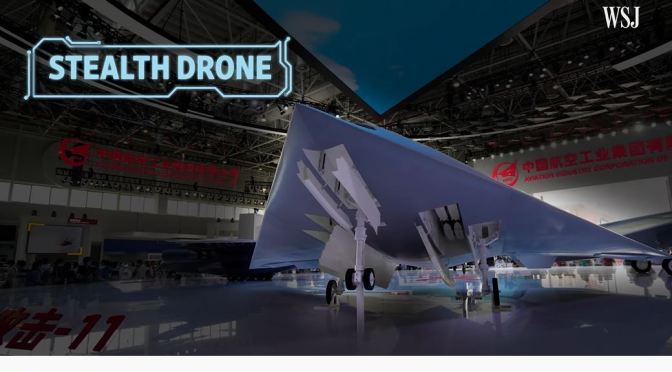
China is expanding its military arsenal with new drones, including stealth versions and those that can swarm and drop bombs. WSJ compares the tech and design of these drones with their U.S. counterparts to see how Beijing is equipping its military for possible future conflict. Photo composite: Sharon Shi
News, Views and Reviews For The Intellectually Curious















 Boomers Daily