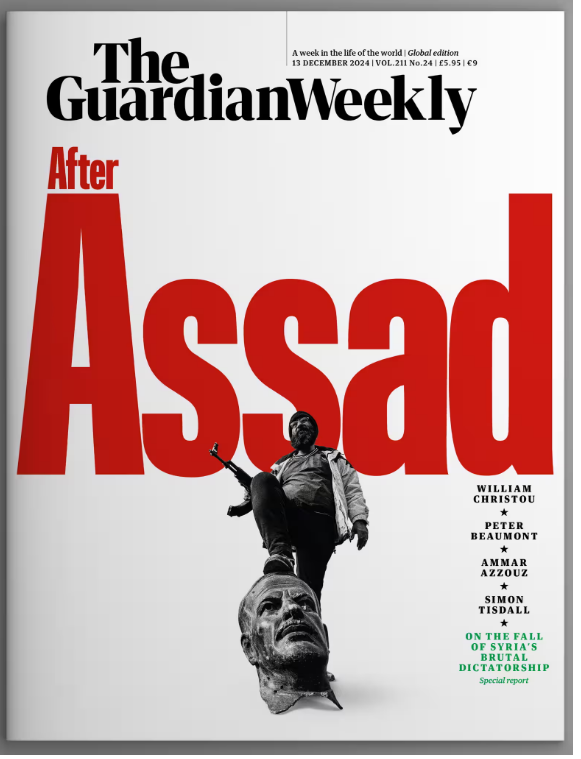
Not even the most optimistic of rebels could have predicted the rapid collapse, last weekend, of the Assad dynasty that ruled Syria with an iron fist for more than 50 years. Yet while there was relief and joy both inside Syria and among the nation’s vast displaced diaspora, it was also accompanied by apprehension over what might come next.
1
Spotlight | Russia and Ukraine wait warily for Trump transition The idea of the US president-election as a saviour for Ukraine, as unlikely as it may seem, holds an appeal for an exhausted nation without a clear path to victory. Shaun Walker and Pjotr Sauer report
2
Environment | The jailed anti-whaler defiant in face of extradition threat Capt Paul Watson talks to Daniel Boffey about his arrest on behalf of the Japanese government, his ‘interesting’ Greenland prison, and separation from his children
3
Feature | The growing threat of firearms that can be made at home One far-right cell wanted to use 3D-printed guns to cause ‘maximum confusion and fear’ on the streets of Finland. Could the police intercept them in time? By Samira Shackle
4
Opinion | Farage is lying in wait. Britain can’t afford for Starmer to fail It is not enough for the Labour leader’s ‘milestones’ to be achieved. Voters must feel the improvement in their daily lives, says Guardian columnist Jonathan Freedland
5
Culture | The best books of 2024 From a radical retelling of Huckleberry Finn to Al Pacino’s autobiography, our critics round up their favourite reads of the year
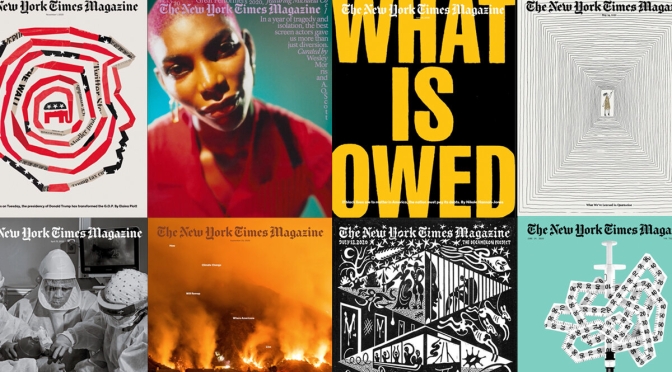
THE NEW YORK TIMES MAGAZINE (December 7 2024): The 12.8.24 Issue features William Langewiesche on the secret Pentagon war game how nuclear escalation spirals out of control; Daniel Bergner on a mysterious gap in psychosis rates; Alexis Okeowo on an endless war in Ethiopia; and more.
Black Americans experience schizophrenia and related disorders at twice the rate of white Americans. It’s a disparity that has parallels in other cultures. By Daniel Bergner
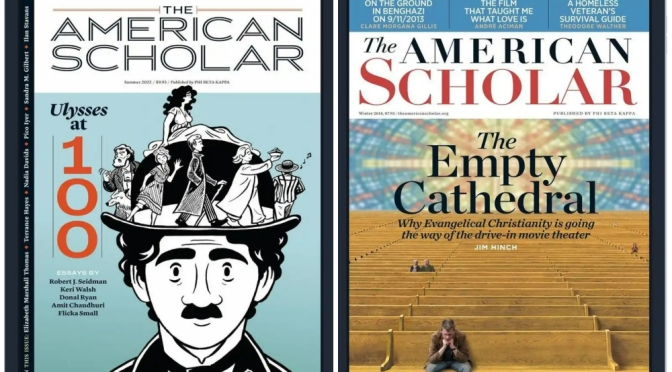
THE AMERICAN SCHOLAR (December 2, 2024): The latest issue features ‘From Atop The Magic Mountain’ – One-Hundred years later, Thomas Mann’s epic remains as prophetic as ever.
Only rarely did the outside world intrude on an idyllic Connecticut childhood, but in the tumultuous 1960s, that intrusion included an encounter with evil
THE NEW YORK TIMES MAGAZINE (November 30, 2024): The 12.1.24 Issue features Susan Dominus on an I.V.F. mix-up; Amir Ahmadi Arian on the director Mohammad Rasoulof; Francesca Mari on deadly superbugs bred by modern warfare; and more.
An I.V.F. Mix-Up, a Shocking Discovery and an Unbearable Choice
Two couples in California discovered they were raising each other’s genetic children. Should they switch their girls?
Modern Warfare Is Breeding Deadly Superbugs. Why?
Researchers are trying to understand why resistant pathogens are so prevalent in the war-torn nations of the Middle East.
The Guardian Weekly (November 28, 2024): The new issue features last week’s escalation of Nato ballistic missile activity, in which UK and US-made missiles were launched into Russia for the first time, brought a predictably cold response from Vladimir Putin – who loosened Moscow’s nuclear doctrines and promised more attacks with a new, experimental ballistic missile.
1
Spotlight | Does lame duck Biden have time to Trump-proof democracy? The outgoing US president may only have weeks left in the White House, but activists say he can secure civil liberties, accelerate spending on climate and healthcare, and spare death row prisoners. David Smith reports
2
Science | My weird, emotional week with an AI pet Casio says Moflin can develop its own personality and build a rapport with its owner – and it doesn’t need food, exercise or a litter tray. But is it essentially comforting or alienating? Justin McCurry finds out
3
Feature | Are we right to strive to save the world’s tiniest babies? Doctors are pushing the limits of science and human biology to save more extremely premature babies than ever before. But when so few survive, are we putting them through needless suffering? By Sophie McBain
4
Opinion | A social media ban is in everyone’s interests – not just kids under 16 Van Badham on why she resents being excluded from protection against monetised fear, anger and toxicity
5
Culture | A road trip like no other: an epic drive on the Autobahn Fifty years after electronic pioneers Kraftwerk released a 23-minute song about a road – and changed pop music for ever – Tim Jonze hits the highways of Düsseldorf and Hamburg in search of its futuristic brilliance
THE NEW YORK TIMES MAGAZINE (November 2, 2024): The 11.24.24 Issue features Philip Montgomery on two weeks in the life of Pennsylvania’s Luzerne County before, during and after the election; Emily Bazelon on how the abortion rights movement won in many states in the election; Tomas Weber on how Ozempic is turning people off from eating junk food; and more.
Facing an eight-year prison sentence, Mohammad Rasoulof had to make the most difficult decision of his life. We spent two weeks there before and after the election to understand what’s driving these changes.
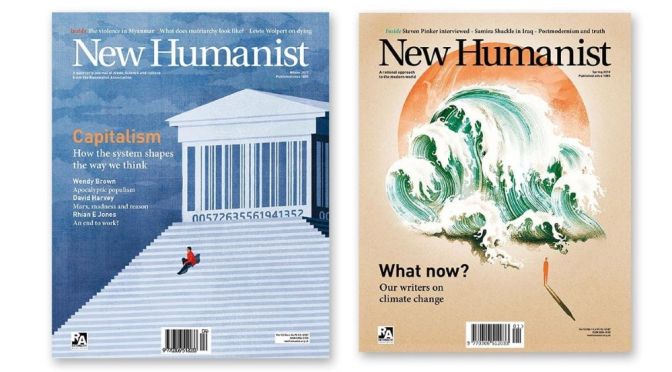
NEW HUMANIST MAGAZINE – WINTER 2024/2025 ISSUE: The new issue features ‘Our Cyborg Future?’
The new age of the cyborg?
Neurobiologist and journalist Moheb Costandi explores the rapidly-developing world of brain-computer interfaces. For some people, these devices are already transforming lives – but the technology is quickly overtaking the ethics.
A dangerous calculation
Peter Ward unpicks the dark philosophy of the tech billionaires and how it is infiltrating some of our most powerful organisations.
There’s a product for that
A recent film, The Substance, explored the growing pressure on all of us – particularly women – to modify our bodies, not only through make-up and cosmetic procedures but also through digital filters. Clare Chambers, professor of political philosophy at the University of Cambridge, talks to us about the power of resistance and allowing our bodies to be “good enough”.
New life in the veins
Peter Salmon recounts the bizarre history of blood transfusion – and why the super-rich remain fascinated by its possibilities.
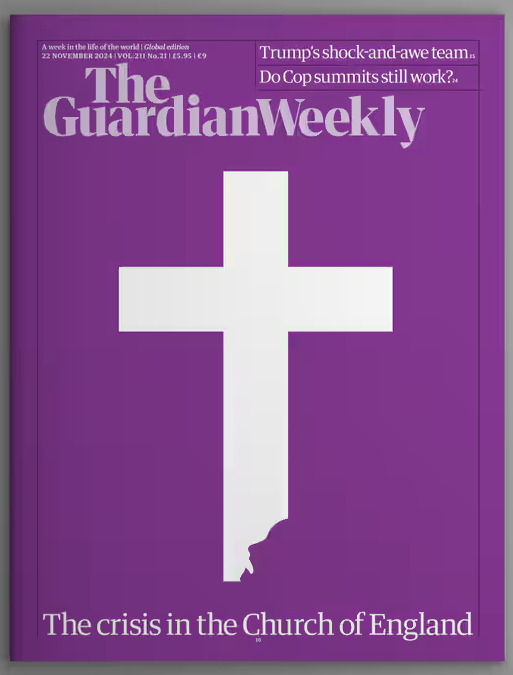
Existentialist crises might more commonly be associated with some who seek out religion, rather than with those religions themselves, but that’s where the Church of England has found itself in recent days.
The resignation of Justin Welby, the archbishop of Canterbury, followed a damning report into the church’s shameful failures over the serial child abuser John Smyth, which detailed even more disturbing details of cover-ups by some senior clergy.
1
Spotlight | Trump’s shock-and-awe team A flurry of controversial and extremist picks for Trump’s administration has provoked criticism and made heads spin. David Smith reports from Washington
2
Science | The inverse link between cancer and dementia Scientists have long been aware of a curious connection between these common and feared diseases. At last, a clearer picture is emerging, writes Theres Lüthi
3
Feature | Kernels of hope During the siege of Leningrad, botanists in charge of an irreplaceable seed collection, the first of its kind, had to protect it from fire, rodents – and hunger. By Simon Parkin
4
Opinion | Seven lessons from a long-serving economics editor From Thatcher to Trump and Brexit, the Guardian’s outgoing economics editor, Larry Elliott, reflects on his 28 years in the role.
5
Culture | Faking history Film and TV have a slippery relationship with the truth when it comes to historical epics. Simon Usborne meets the experts whose advice goes unheeded
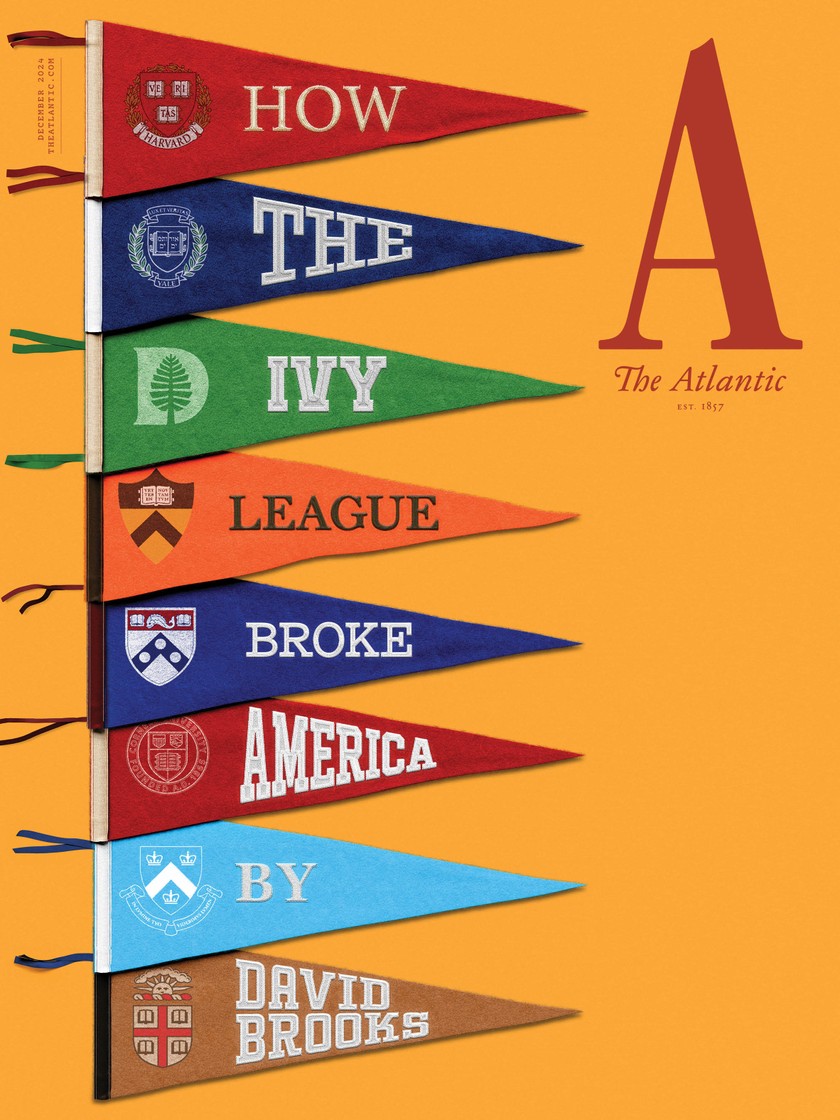
The Atlantic Magazine – November 20, 2024: The latest issue features ‘How the Ivy League Broke America’ – The meritocracy isn’t working. We need something new.












 Boomers Daily