Arizona has what researchers call “the climate of tomorrow, today.” Scientists are using a 30-ton robotic field scanner in the state to study plant genetics and hopefully develop stress-resilient crops.
This week’s Nature Podcast looks at: Triggering swarming behaviour in locusts, antibody therapies as a bridge to Covid-19 vaccine, and new insights into how humans synchronize.
In this episode:
01:56 Understanding swarming behaviour
Swarms of migratory locusts regularly devastate crops across the world, but why these swarms form has been a mystery. Now, a team of researchers have identified a compound that causes solitary locusts to come together in their billions – a finding that could have practical applications for preventing this behaviour. Research article: Guo et al.;News & Views: Catching plague locusts with their own scent
A satellite’s fecal find reveals that Antarctica’s emperor penguin population is much larger than previously thought, and changing how genes are named to avoid Excel’s autocorrect. Research Highlight: Satellites find penguins by following the poo; Research article: Bruford et al.
17:49 An out-of-sync arts project
A collaborative art-science project featuring a network of connected violinists has given new insights into how humans synchronize. Research article: Shahal et al.
23:51 Briefing Chat
We take a look at some highlights from the Nature Briefing. This time we find out about the odd immune system of the anglerfish, and the beetle that can pass through a frog’s digestive system without coming to harm. Wired: The Anglerfish Deleted Its Immune System to Fuse With Its Mate; Research paper: Sugiura
In 2015, after a nine-and-a-half-year journey, NASA’s New Horizons spacecraft raced past Pluto, beaming images of the dwarf planet back to Earth.
Five years after the mission, researchers are poring over images of Pluto’s far-side, which was shrouded in shadow during New Horizon’s flypast. They hope that these images will help give a better understanding of how Pluto was born and even whether a hidden ocean resides beneath the world’s icy crust.
Are we alone in the Universe, or are there other life-forms ‘out there’? Recent discoveries of planets beyond the solar system (more than 4000 of them) suggest that the question is not ‘whether?’ but ‘where?’. This book enables general readers to understand current endeavours to answer this question and the related one of ‘what kind?’
Wallace Arthur is an evolutionary biologist and science writer. He is Emeritus Professor of Zoology at the National University of Ireland, Galway. His most recent book is The Biological Universe: Life in the Milky Way and Beyond, published by Cambridge University Press in 2020.
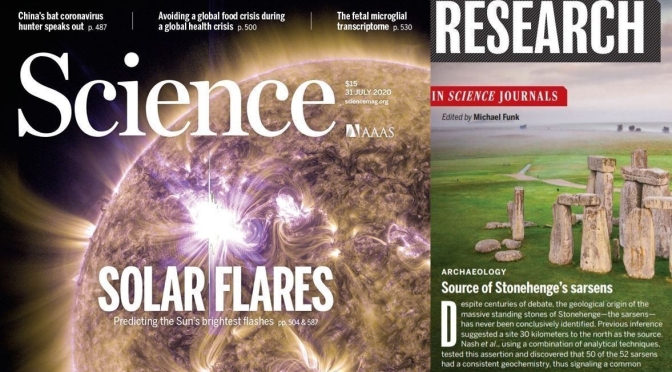
Staff Writer Meredith Wadman joins host Sarah Crespi to discuss the risk of the novel coronavirus infection to pregnant women. Early data suggest expectant women are more likely to get severe forms of the infection and require hospitalization. Meredith describes how the biology of pregnancy—such as changes to the maternal immune system and added stress on the heart and lungs—might explain the harsher effects of the virus.
Also this week, Sarah talks with Gianluca Roscioli about his experiments with commercial razor blades and real human hair. By using a scanning electron microscope, he was able to show how something relatively soft like hair is able to damage something 50 times harder like stainless steel.
Science Editor-in-Chief Holden Thorp joins host Sarah Crespi to discuss his editorial on preventing vaccine hesitancy during the coronavirus pandemic. Even before the current crisis, fear of vaccines had become a global problem, with the World Health Organization naming it as one of the top 10 worldwide health threats in 2019. Now, it seems increasingly possible that many people will refuse to get vaccinated. What can public health officials and researchers do to get ahead of this issue?
Also this week, Sarah talks with Science Senior Correspondent Jon Cohen about his story on Chinese scientist Shi Zhengli, the bat researcher at the center of the COVID-19 origins controversy—and why she thinks President Donald Trump owes her an apology.
Finally, Geert Van der Snickt, a professor in the conservation-restoration department at the University of Antwerp, talks with Sarah about his Science Advances paper on a new process for peering into the past of paintings. His team used a combination of techniques to look beneath an overpainting on the Ghent Altarpiece by Hubert and Jan Van Eyck—a pivotal piece that showed the potential of oil paints and even included an early example of painting from an aerial view.
This week’s Nature podcast looks at how skin’s unusual response to stretching is finally explained, a coronavirus update and the latest in a huge effort to map DNA.
In this episode:
01:06 Stretching skin
For decades it’s been known that stretching skin causes more skin to grow, but the reasons why have been a mystery. Now, researchers have uncovered a mechanism to explain the phenomenon. Research Article: Aragona et al.; News and Views: Stretch exercises for stem cells expand the skin
The ENCODE project aims to identify all the regions in the human genome involved in gene regulation. This week, data from its third iteration has been published and we examine the highlights. Research Article: Snyder; News and Views: Expanded ENCODE delivers invaluable genomic encyclopaedia
28:50 Briefing Chat
We take a look at some highlights from the Nature Briefing. This time we look at how smallpox may be much older than previously thought, and how the Earth’s atmosphere rings like a bell. Nature News: Smallpox and other viruses plagued humans much earlier than suspected; Physics World:
News, Views and Reviews For The Intellectually Curious


 This week’s Nature Podcast looks at: Triggering swarming behaviour in locusts, antibody therapies as a bridge to Covid-19 vaccine, and new insights into how humans synchronize.

 In 2015, after a nine-and-a-half-year journey, NASA’s New Horizons spacecraft raced past Pluto, beaming images of the dwarf planet back to Earth.

 Staff Writer Meredith Wadman joins host Sarah Crespi to discuss the




 This week’s Nature podcast looks at how skin’s unusual response to stretching is finally explained, a coronavirus update and the latest in a huge effort to map DNA.
  Boomers Daily