The Globalist Podcast (January 8, 2024) –Antony Blinken’s latest multi-stop tour of the Middle East, Iraq prepares US-led troop exit and Ecuadorean president Daniel Noboa’s plan to hold a referendum on security measures.
Also, the business news and the winners of the Golden Globe Awards.
Monocle on Sunday, January 7, 2024– Monocle’s editorial director, Tyler Brûlé, is joined by Juliet Linley and Chandra Kurt to discuss the weekend’s hottest topics.
We also speak to our editor in chief, Andrew Tuck, our deputy head of radio, Tom Webb, and Monocle’s Istanbul correspondent Hannah Lucinda Smith.
Monocle on Saturday, January 6, 2024: What lasting effect has the Capitol Hill riot had on the US over the past three years? Monocle’s Christopher Chermak discusses how views and memories of that day have changed. How will Asia’s elections this month impact the rest of the world?
Monocle’s Naomi Xu Elegant looks ahead. And is ‘Saltburn’ a perfect satire or does it fall flat? Join journalist Vincent McAviney and Georgina Godwin for a review of the week’s news and culture.
The Wall Street Journal (January 5, 2024) – Iran-backed groups connect to form a land bridge across the Middle East and form an alliance that Tehran calls the ‘Axis of Resistance.’ This land bridge can be used to transport equipment and personnel, but also allows for positions in Iraq and Syria to attack U.S. interests or threaten Israel closer to its borders.
Video timeline: 0:00 ‘Axis of Resistance’ 0:37 Iran’s allies 1:44 Iran’s history 3:22 U.S. in the Middle East 4:14 Attacks since Oct. 7
WSJ explains what to know about the alliance that includes Hamas in Gaza, Hezbollah in Lebanon and the Houthis in Yemen.
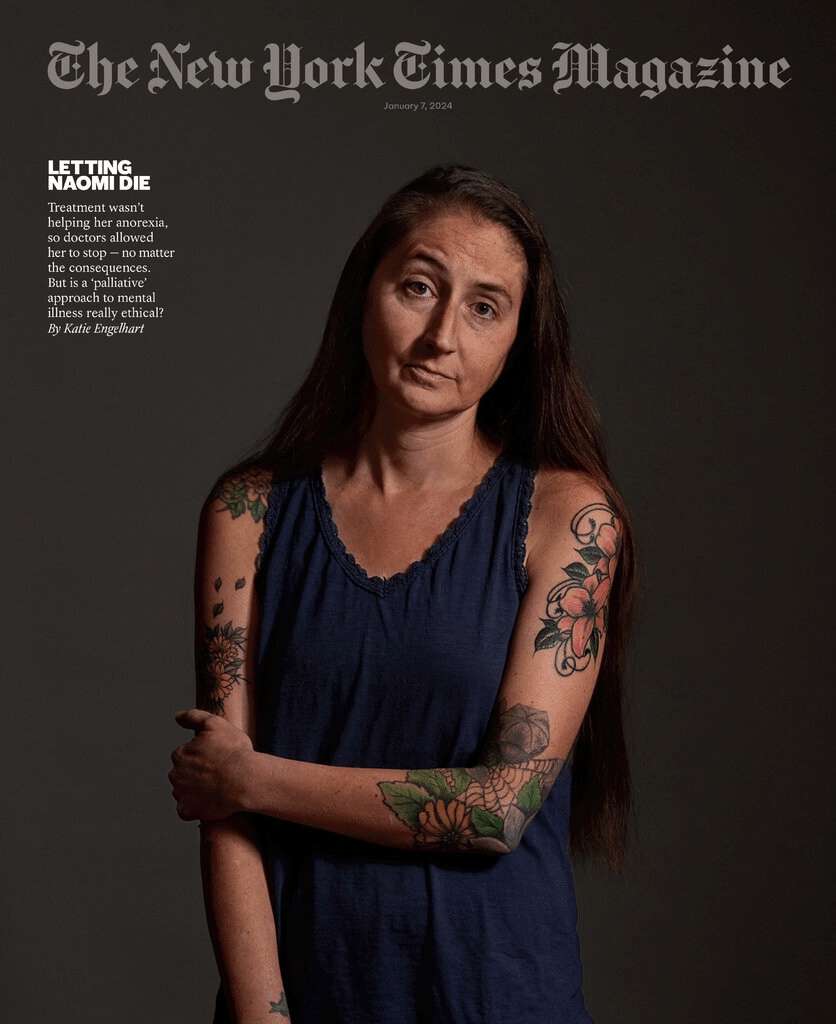
THE NEW YORK TIMES MAGAZINE (January 5, 2024): The new issue features “Letting Naomi Die” – Treatment wasn’t helping her anorexia, so doctors allowed her to stop, no matter the consequences. But is a ‘palliative’ approach to mental illness really ethical?
Treatment wasn’t helping her anorexia, so doctors allowed her to stop — no matter the consequences. But is a “palliative” approach to mental illness really ethical?
By Katie Engelhart
The doctors told Naomi that she could not leave the hospital. She was lying in a narrow bed at Denver Health Medical Center. Someone said something about a judge and a court order. Someone used the phrase “gravely disabled.” Naomi did not think she was gravely disabled. Still, she decided not to fight it. She could deny that she was mentally incompetent — but this would probably just be taken as proof of her mental incompetence. Of her lack of insight. She would, instead, “succumb to it.”
What If People Don’t Need to Care About Climate Change to Fix It?
By David Marchese
“It seems like we’ve been battling climate change for decades and made no progress,” Dr. Hannah Ritchie says. “I want to push back on that.” Ritchie, a senior researcher in the Program on Global Development at the University of Oxford and deputy editor at the online publication Our World in Data, is the author of the upcoming book, “Not the End of the World.” In it, she argues that the flood of doom-laden stats and stories about climate change is obscuring our ability to imagine solutions to the crisis and envision a sustainable, livable future.
The Globalist Podcast (January 5, 2024) – A discussion of the effect of the Israel-Gaza war on Lebanon and the potential for a broader fallout after a series of Israeli strikes on Hezbollah.
Also, the latest on Russia’s war in Ukraine, following the biggest prisoner swap since the beginning of the invasion. Plus: Louis Vuitton’s first luxury hotel, film news and Helsinki’s annual light-art festival.
The Economist Magazine (January 4, 2024): The latest issue features‘The man supposed to stop Donald Trump is an unpopular 81-year-old; Israel-Hizbullah – Can war be avoided?; The stakes in Taiwan’s election; An interview with Volodymyr Zelensky; The surge in AI nationalism…
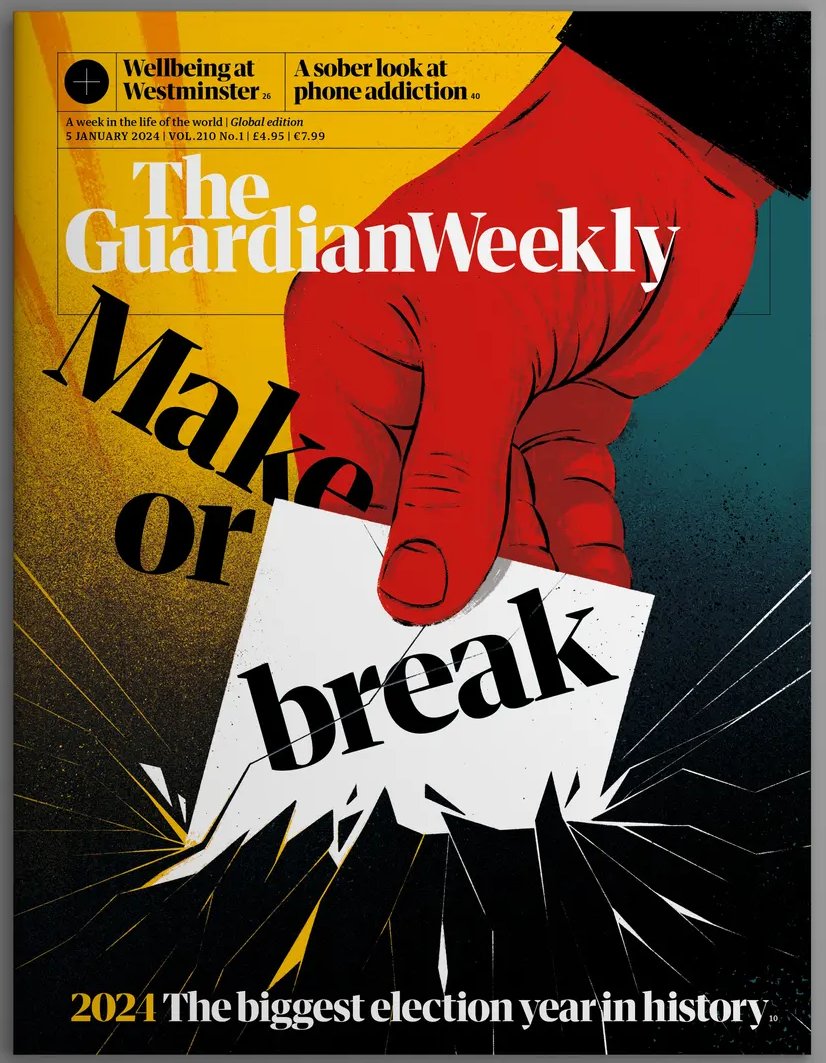
About 2 billion people have the opportunity to cast their ballots in polls that span the globe from the United States to Taiwan, and India to Mexico in 2024. The outcomes, as our analysts and correspondents explain in our big story, have implications for us all.
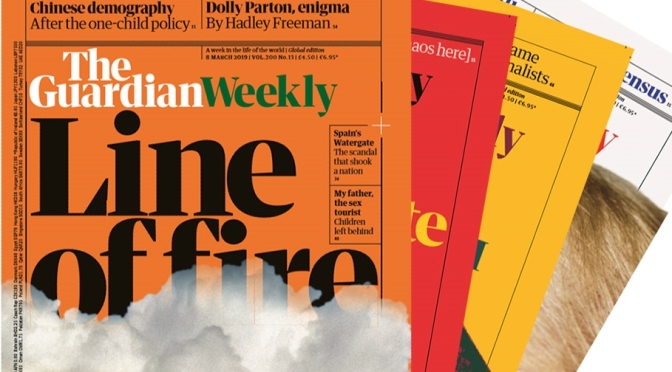
Washington bureau chief David Smith looks at the likely rerun of 2020’s Biden v Trump contest in November and explores what has changed and what has not in the US as the old adversaries square up. It is an almost foregone conclusion that Narendra Modi will be back for a third term as Indian prime minster, reports Hannah Ellis-Petersen from Delhi where analysts fear his victory will further imperil the country’s Muslim minority. And while Vladimir Putin will certainly continue as president in Russia, Pjotr Sauer explains why the man about to become fifth-time president might allow other candidates onto the ballot list. From Taiwan’s poll on 13 January to the 27-state European elections in June, how citizens vote will influence the geopolitical landscape for us all, while the conduct of campaigns will reveal how vulnerable democracies now are to misinformation and cyber interference from malign actors.
The Globalist Podcast (January 4, 2024) – The latest on Iran following the cancellation of president Ebrahim Raisi’s trip to Turkey and discuss the US decision to reopen border crossings with Mexico.
Plus: the release of the explosive Epstein papers and business news with economist Vicky Pryce.





 The Wall Street Journal







 Boomers Daily