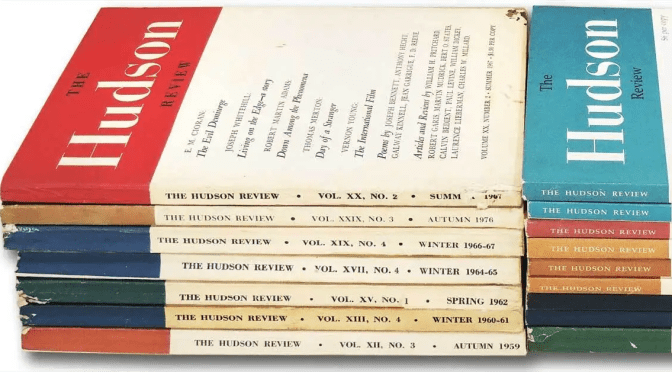

THE HUDSON REVIEW: The latest issue features….
ESSAYS

THE HUDSON REVIEW: The latest issue features….
ESSAYS
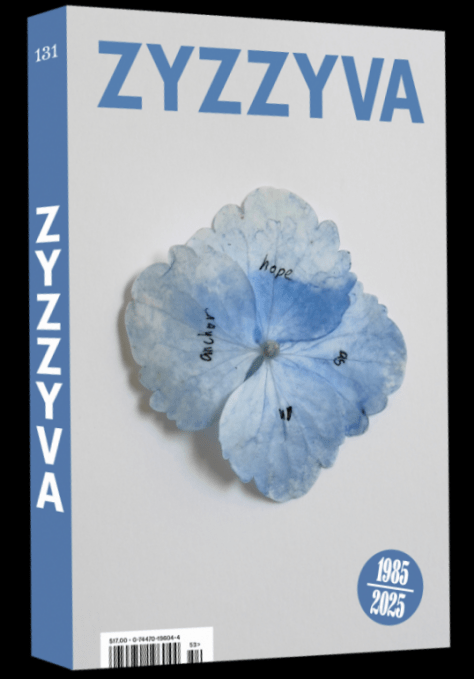

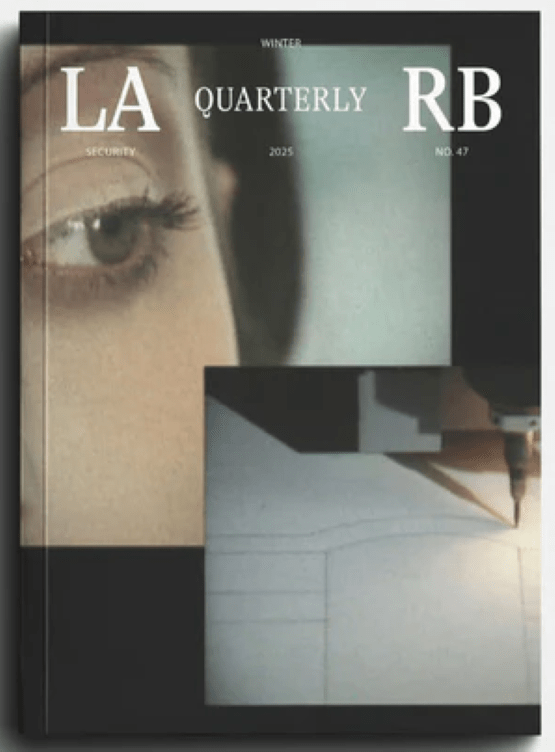
LOS ANGELES REVIEW OF BOOKS: The latest issue of LARB features ‘Security’…
Alexandre Lefebvre reads “Furious Minds: The Making of the MAGA New Right” by Laura K. Field.
Nevin Kallepalli investigates political resentment in rural California, in an essay from LARB Quarterly no. 47: “Security.”
Leah Litman prosecutes Justice Amy Coney Barrett’s new legal memoir, “Listening to the Law: Reflections on the Court and Constitution.”
Zoe Adams considers “There Is No Place for Us: Working and Homeless in America” by Brian Goldstone.
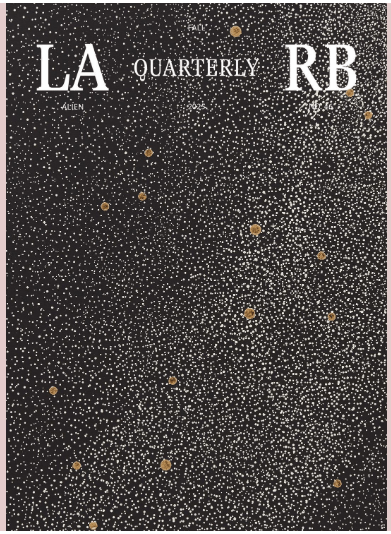
LOS ANGELES REVIEW OF BOOKS: The latest issue of LARB “Alien“, which wades into the unfamiliar. In Greta Rainbow’s “Tourists,” a woman travels to foggy Athens, where she confronts the unknowability of the city and her partner. In Sara Levine’s “Peter and the Women,” Peter (badly, ineptly, inappropriately, indecently) manages the women in his life: his hospice-bound mother and her nurse, as well as his girlfriends and one-night stands. And in Ari Braverman’s “Dogs of the Solar Steppe,” the narrator faces a decade-long punishment, performing domestic labor for a woman called Big Mother. Her former life assumes a “sheen of fantasy,” and the story warns us of “the easy slippage between one state and another.”

THE LONDON MAGAZINE (April 2, 2025): The latest issue features….
‘Several broadly millennial acquaintances confess that reading the book made them feel a sort of sickening recognition.’
Yasmina Snyder spoke to writers, poets, musicians and event organisers based in London about the connections between live music and poetry, and the spaces that host them.
‘There’s big trouble in the world of little magazines. In the last two years, an alarming number have vanished into that second-hand bookshop in the sky. Each leaves the world a little quieter, a little poorer.’
A Speculative Morning with Keats

By Michael Cummins, Editor, September 25, 2025
“As if I were dissolving.” — John Keats, letter to his brother George, April 1819
In Hampstead, on a spring morning in 1819, John Keats sat beneath a plum tree and wrote “Ode to a Nightingale.” This is how the lines may have come to him—half vision, half dissolution.
Brown clatters a cup somewhere inside. The sound is an unwelcome punctuation mark on the morning’s silence, a reminder of the relentless normalcy of domestic life. The room has felt too narrow for breath, not just for my ailing lungs, but for the grief that keeps the curtains drawn. Barely six months since my brother Tom slipped away, the house still smells faintly of smoke, paper, and the sweet-sick residue of medicine. His absence hangs in the air. That weight has driven me to the grass, away from the claustrophobia of the sickroom.
The garden receives me. The grass is damp, pressing cool blades into my palms. Light filters through the plum tree leaves, breaking into fragments on the soil. The blossoms drift like a quiet snowfall, powdering my sleeve with pale dust as if testing whether the body still belongs to earth. Beyond the hedge, a cart rattles, a dog barks, a bell tolls faintly from Hampstead. Life continues its tedious bookkeeping. But here, there is only the hush before song.
Brown’s footsteps echo faintly, a rhythm too human for the stillness I crave. Even his voice, when it rises in greeting, feels like a tether to the mundane. I do not resent him; I envy his ease with the world. He pours tea, hums to himself, and carries on. I am fixed under the plum tree, waiting for something less ordinary to speak.
And then the nightingale begins. The sound is not a tune but a force: poured, unbroken, radically unselfconscious. It arrives without the stutter of human intention, as if the bird is nothing but the channel of its own liquid note. The song alters the air. I feel it in the chest before I write a word. I steady my paper, and the ink pools like shadow, metallic and alive. It smells of iron and inevitability. Each stroke is a pulse, each word a breath I cannot take.
My heart aches, and a drowsy numbness pains
My sense, as though of hemlock I had drunk,
The line comes of its own accord. The ache is not complaint but aperture. Pain is the friction that opens the door. Numbness clears the chatter of reason. The poem begins in crisis, a shock both physical and metaphysical.
Or emptied some dull opiate to the drains
One minute past, and Lethe-wards had sunk:
Lethe does not erase; it suspends. In its waters, memory floats unmoored, waiting for a name. Tom is gone, ferried by the same current. His silence hovers in the ink. Yet the river here is not despair but narcotic kindness, a place where debts and illness dissolve into rhythm. I do not summon the myth; it summons me. Byron writes like a storm—quick, unrelenting. I write like a wound: slow, deliberate, pulsing. And yet today the hand runs faster, driven by the bird’s current.
’Tis not through envy of thy happy lot,
But being too happy in thine happiness,—
I do not covet. I am saturated. The bird’s happiness is no possession but a weather spilling into the morning. I am not resentful; I am simply overflowed. The pen scratches faster when I abandon self-pity and admit the sheer fact of joy.
That thou, light-winged Dryad of the trees,
In some melodious plot
The Dryad arrives without strain. Myth is not invention but recognition. The bird’s song is timeless, deserving of a classical name.
Of beechen green, and shadows numberless,
Singest of summer in full-throated ease.
Ease—I do not have it. My lungs constrict, my chest rasps, nights punctuated by the cough that writes mortality into every breath. Yet I put the phrase down because the bird teaches it. A line must do what it says: open, breathe, pour.
The song intoxicates more than wine. My lips are dry, yet the body reels as though stained purple at the mouth.
O for a draught of vintage! that hath been
Cool’d a long age in the deep-delved earth,
The cellar rises: cool, stony, damp. This is no ornament but a transcription of sensation.
Tasting of Flora and the country green,
Dance, and Provençal song, and sunburnt mirth!
I have never seen Provence, but the imagination persuades me otherwise. The song conjures the vineyard. These sensations are not decoration; they are human joy remembered in the body.
O for a beaker full of the warm South,
Full of the true, the blushful Hippocrene,
The beaker is not a vessel but the bird itself, brimming with myth. Hippocrene flows because the song requires its name.
With beaded bubbles winking at the brim,
And purple-stained mouth;
To drink is to be marked. The mouth is stained because it has been altered. Poetry demands transformation; ecstasy must leave a trace.
But intoxication fades. What remains is grief.
Fade far away, dissolve, and quite forget
What thou among the leaves hast never known,
The bird is blessed in its ignorance. It does not know poverty. It does not know longing. It does not know the ache of an empty chair.
Tom once sat beneath this tree, sketching the shape of a bird in flight. He said silence was the soul’s canvas. Now that silence is heavier, less blank, more bruised. His face—thin as paper—rises when I write “youth grows pale.” The ode becomes his memorial as much as mine.
The weariness, the fever, and the fret
Here, where men sit and hear each other groan;
The line steadies itself on blunt fact. Tom. Debt. The cough. No flourish can soften them.
Where palsy shakes a few, sad, last grey hairs,
Where youth grows pale, and spectre-thin, and dies;
He is there again, spectre-thin, his breath shallow. The cadence is the only mercy.
Where but to think is to be full of sorrow
And leaden-eyed despairs,
Thought itself betrays when it offers no hope forward. To write is to wrestle despair into cadence.
I call for wings—not Bacchus’s painted team but the invisible kind I know.
Away! away! for I will fly to thee,
Not charioted by Bacchus and his pards,
Wine is a lie. Fancy, too. Only poesy can lift.
But on the viewless wings of Poesy,
Though the dull brain perplexes and retards:
The brain resists, heavy, skeptical. Poesy ignores resistance. The moment I write “Away!” I am gone.
Already with thee! tender is the night,
And haply the Queen-Moon is on her throne,
Daylight floods Hampstead, yet the moon rises on the page. The imagination enthrones her, and that suffices.
Cluster’d around by all her starry Fays;
But here there is no light,
Contradiction is permitted. This is Negative Capability as I once named it: to remain “in uncertainties, Mysteries, doubts, without any irritable reaching after fact and reason.” The ode does not solve; it dwells.
Death arrives then, companionable, not hostile.
Now more than ever seems it rich to die,
To cease upon the midnight with no pain,
“Rich”—the word startles, but I keep it. Death here is plenitude, not theft.
While thou art pouring forth thy soul abroad
In such an ecstasy!
The bird pours, my ribs echo. Death feels like completion.
Still wouldst thou sing, and I have ears in vain—
To thy high requiem become a sod.
Yet honesty must break the dream: if I am earth, I cannot hear. Even rapture admits silence.
The song itself, though, is older than me, older than kings.
Thou wast not born for death, immortal Bird!
No hungry generations tramp thee down;
Mortality is mine, not yours. Your song belongs to recurrence.
The voice I hear this passing night was heard
In ancient days by emperor and clown:
Emperors and clowns alike have bent their ears. Beauty makes no distinction.
Perhaps the self-same song that found a path
Through the sad heart of Ruth, when, sick for home,
The “perhaps” is everything. Certainty would bruise compassion.
I think, too, of Fanny Brawne. Her presence lingers behind the lines, as urgent as my cough. She is near, but a partition stands—of health, of propriety, of fate itself. To love her is to ache for what cannot be promised. The bird’s song is boundless, but my breath is measured. Desire sharpens sorrow into necessity.
The garden dissolves. Casements open in the skull.
Charm’d magic casements, opening on the foam
Of perilous seas, in faery lands forlorn,
The peril saves the vision from cloying. A blossom falls on my sleeve like ash from a cooling fire.
Forlorn! the very word is like a bell
To toll me back from thee to my sole self!
One word tolls, and the spell breaks.
Adieu! the fancy cannot cheat so well
As she is fam’d to do, deceiving elf.
I do not scold the Fancy. I thank it. Its deception is mercy.
The music vanishes. Not fading, but gone.
Fled is that music:—Do I wake or sleep?
I stop. I do not answer. The question is the ode’s truest symmetry.
The ink is still damp, smelling of iron. I glance back at the start, weighing first heat against last stillness.
My heart aches, and a drowsy numbness pains… Fled is that music:—Do I wake or sleep?
Between these poles lies a morning: a poet beneath a plum tree, a body already failing, a bird whose song endures.
I think of what I wrote not long ago—that the world is a vale of Soul-making. Do you not see how necessary a World of Pains and troubles is to school an Intelligence and make it a Soul? Suffering is the furnace, imagination the hammer. The ode is not escape from the furnace but evidence of the forging itself.
Perhaps a widow will read this, her fingers trembling on the page. Or a child, too young to name sorrow, will feel something loosen in the chest. Or a soldier, resting between battles, will find a measure of stillness in the lines. Beauty is not ornament but survival. If the poem steadies even one breath, it has earned its place among the leaves.
Brown steps out, squinting in the morning light. I gather the pages, careful as if any breeze could undo the morning. I hand him the sheaf and say what is exact: “I have been writing.”
He will tell this story later and say I wrote under the plum tree in one morning, which is true in the way truth sometimes fits a simple sentence. I go back inside. The cough finds me at the foot of the stair; it always does. But the air in my chest is changed by the shape the morning carved in it. The bird sang, and I answered. Whether I wake or sleep, the song remains.
THIS ESSAY WAS WRITTEN AND EDITED UTILIZING AI
Bashō’s narrow road, re-imagined in ink and light

By Michael Cummins, Editor, September 24, 2025
In the spring of 1689, Matsuo Bashō set out from Edo with his inkstone and his disciple, walking north through Japan’s interior. This essay imagines the painter Ogata Kōrin at his side, brush catching what haiku left unsaid: the lantern’s glow, a fox’s mischief, the silence after sound.
The morning I left Edo, the sky was thick with petals. Cherry blossoms fell in sudden gusts, scattering across canals and clinging to the backs of merchants. Someone in the crowd said my name. “Bashō—the man of stillness.” The words felt like a shroud. Stillness was not peace. Stillness was suffocation.
I carried only a robe, a small pack, and my inkstone. I gave no notice, offered no farewell. A poet should know the difference between an entrance and an exit, and Edo was drowning in entrances—recitations in smoky salons, verses pinned to pillars, applause echoing in courtyards. To slip away silently was my only true poem.
Sora, my disciple, waited by the gate, his journal tied at his side. Beside him stood Ogata Kōrin, carrying brushes wrapped in cloth, a small box of pigments, and sheets of fine paper. He was famed for painting bold pines and cranes against gold, but he wanted to walk with us, to see if paint could keep pace with words.
“You walk for silence,” he said as we stepped into the road.
“And you?” I asked.
“I will paint the sound.”
A crow on a bare branch—
autumn evening.
Walking unstitched illusions. You cannot hurry rain. You cannot plead with a mountain. Each step was a reminder of smallness.
Oku—the interior—was more than geography. It was the hidden chamber within things. To walk north into deep country was to step into the interior of myself.
The road gave humility: a thin robe against spring wind, an empty belly by sundown, blistered feet in straw sandals. Hunger was not a lack but a space for the world to fill. Only when stripped of comfort could I hear the world breathe.
By the second month, rains thickened. Each evening Sora dried our sandals by the inn’s hearth, though by morning they were heavy again.

At a mountain temple, a monk struck the great bell. The sound swelled, then emptied into air.
“Not the ringing,” he whispered, “the silence after—that is the true temple.”
Kōrin ground his ink and left behind a circle fading into white paper. I looked at it and felt the hush expand. His first gift of the journey.
Pine shadow—
the road bends
to meet it.
Summer pressed down like a hand. Cicadas shrieked in the trees, their chorus burning itself away. At a roadside inn, a farmer’s wife handed me a bowl of barley and salt.
“Why walk in this heat?” she asked.
“To see what words cannot hold,” I said. She laughed, shaking her head.
That night, I listened to the cicadas outside the window. Kōrin painted their wings in silver strokes. Sora struggled to describe them, blotting his brush, sighing. Not every moment can be pinned to the page.
One afternoon, a girl chased dragonflies, sleeves spread like wings. She caught none, but her laughter rang sharper than capture. Kōrin caught her mid-flight in vermilion. He pressed the paper into Sora’s hands. “If you cannot hold it with words,” he said, “let color remind you.”
We reached Matsushima, where pine-covered islets scattered like jewels across the bay. Some places do not need words. Kōrin’s blues and greens glowed even at dusk.

That night, fireflies pressed against the paper walls of our hut, their glow brighter than the lamp. I set down my brush. Some nights call for silence more than lines.
Later, in a fishing village, I collapsed with fever. A fisherman’s wife placed cloths on my brow and whispered prayers to the sea.
When I woke, Kōrin held out a small painting of a lantern’s glow against dark waves. The flame was steadier than I had felt in days.
Lantern flickers—
the sea’s hush louder
than my pulse.
By August, the barley fields had turned gold. The harvest moon rose red above the stubble. Villagers poured sake and sang. A boy ran over with a cup. “Drink, master!”
“The moon is already enough,” I said.
Snow still lingered in the high passes. The mountain does not flatter. It does not care if a man is poet or beggar. It accepts only attention.
Winter gust—
even the inkstone
holds the wind.
Crossing a frozen river, I slipped. A peasant caught my arm. “Careful, master. The ice breaks without warning.”
“So does the self,” I said.
Even in silence, the self lingered like a shadow. I imagined my words drifting northward, reaching readers yet unborn. But the further I walked, the thinner that dream became. What immortality is there in syllables, when rivers change their course and mountains crumble?
In Edo, applause had filled the air like thunder. On the road, there was only silence. Silence wounds, but it also heals.
The answer came not in thunder but in a sparrow’s wing. Write not to endure, but to attend. Not for tomorrow, but for now.
Near a riverbank, a boy approached with a scroll of verses. “Master, how do I make my poems last?”
“Write what you see,” I said. “Then write what you feel when you see it. Then tear it up and walk.”
The boy bowed. Kōrin added, softly: “Or paint the emptiness left behind.”
River mist—
the boy’s scroll
left unopened.
In the mountains I met a man from the north whose dialect I could not follow. He pointed to the sky, then to the river, then to his chest. We shared tea in silence. I realized then that language is not the vessel, but the gesture. Poetry lives in the space between.

One morning, I watched a fox dart through a field, a rice ball clutched in its mouth. The farmer cursed, but I laughed. Even hunger has mischief. Kōrin’s brush caught the moment in quick ink.
Fox in the field—
the rice ball warmer
than the sun.
Toward the end of our walk, Sora counted the ri that remained. “Two thousand and more behind us,” he said. His journal pages were full of weather, distances, small observations.
“I counted shadows,” I told him. “I counted pauses.”
Kōrin smiled. “I painted both.”
At last, beneath a cedar, I placed the inkstone on my lap and listened. Snow weighed heavy on the branches. The air was sharp with winter. The wind moved through ridges and needles and into the hollow of the stone. For a moment it seemed the ink itself stirred.
I wrote one last haiku, not as conclusion but as surrender. The road has no end. Only pauses where breath gathers.
Wind in the cedar—
the inkstone deepens
into silence.
When these fragments later formed Oku no Hosomichi, I wondered what I had left behind. Not a record of steps, but a trace of listening. The form belonged not to me but to the rhythm of walking.
Kōrin returned to Edo with his scrolls. I with my scattered lines. Yet three small works stayed with me: the fading bell, the glowing lantern, the fox with his rice ball. They were his haiku in color, brief offerings to impermanence.
If others take their own narrow roads, let them not follow our footsteps but their own shadows. The road is never the same twice. Neither traveler nor mountain remains unchanged.
Perhaps one day, a traveler will walk with a pen of light, or a scroll made of glass. They will pause beneath a cedar, not knowing my name, not knowing Kōrin’s brush, but feeling the same hush. The road will whisper to them, as it did to us. And they will listen—not to the words, nor the colors, but to the breath between.
Digital ink—
the silence still.
THIS ESSAY WAS WRITTEN AND EDITED UTILIZING AI
On a Central Park bench, a student-poet becomes the witness as Wallace Stevens, T. S. Eliot, Langston Hughes, and Mary Oliver clash over the future of verse.

By Michael Cummins, Editor, September 19, 2025
It was Sunday, late morning, and the city had softened. The joggers had thinned into solitary silhouettes, their sweat darkening cotton in abstract shapes of effort and release. The brunch crowd had not yet surged onto the avenues, their laughter still a distant, imagined chorus. Under the arcade, a saxophone player blew short, testing gusts—vibrations that trembled like the first sentences of a story he wasn’t sure how to tell. Not yet music, more like the throat-clearing of the city itself, a quiet settling before the day’s performance began. The air was a mosaic of scents: damp earth, a faint sweetness from the flowerbeds, and the savory promise of roasted nuts from a cart not yet rolled into place.
Bethesda Terrace shimmered in late-September light, the Angel of the Waters extending her shadow over the fountain’s slow churn. The sandstone bench, curved and facing the pool, was empty. It waited, a silent invitation. She sat. The stone’s chill pressed through her jeans, climbed her spine, spread across her shoulder blades. She leaned into it, a physical surrender, her body quieted, her mind alert. This was catalepsy—not sleep, not paralysis, but suspension. A body stilled into receptivity; a consciousness stretched thin, porous, listening with its skin. The shuffle of leaves, the clap of pigeon wings, the metallic crack of a pretzel bag: everything arrived brighter, as if a filter had lifted. She was no longer simply a woman on a bench; she was a conduit, participant in a larger, unacknowledged ritual.
From her tote she drew The Collected Poems of Wallace Stevens, its margins crowded with penciled hieroglyphs. She was a sophomore at Columbia, apprenticing herself to poetry the way others apprenticed themselves to finance or law. The writing program had its rites: chalk-dusted seminar rooms, steam radiators clanking, professors who spoke of poets as if handling relics. Stevens was invoked in hush, his lines treated as proofs in sacred geometry. She remembered one professor sketching a triangle on the board and calling it “Stevens’s geometry of the imagination,” as if abstraction could be mapped. But she also remembered reading him alone in her dorm, the fluorescent hum above, feeling the language bend her without yielding. Still, something stirred—the tremor that words might bend time, that they could turn a bench into a portal if she sat still enough.
She flipped to “The Comedian as the Letter C.” That line, the one that haunted her: “A bench was his catalepsy, theater of trope.” She whispered it, and the pigeons, used to human murmur, did not flinch. The bench was not only stone. It was a tuning fork, a place where perception settled into resonance. Stevens had given her a name for what she was doing: sitting, body locked, mind open, waiting for the city to become legible.
Then another voice intruded—T. S. Eliot, stern and dry, from “Burnt Norton”: “Words strain, / Crack and sometimes break, under the burden, / Under the tension, slip, slide, perish.” Not Stevens’s easing cadence but a warning, a cold draught of reality. She remembered first reading those lines in Butler Library, underlining so hard she nearly tore the page. Words strain. How often had they failed her? She knew Eliot was right: no trance of perception could spare language from the world’s pressure.
The fountain gave its own reply, a language without alphabet. Its voice was a fluid script, endlessly transcribed by the Angel above, her arm raised as if in dictation. If words strain, perhaps water does not. Maybe poetry’s task is less to master than to echo this ceaseless murmur, to become porous to it.
She turned a page, this time to “Description Without Place”:
Nietzsche in Basel studied the deep pool
Of these discolorations, mastering
The moving and the moving of their forms
In the much-mottled motion of blank time.
The mottled motion was here: leaves circling, coins winking on the bottom, fragments of sky trembling on the surface. She imagined Nietzsche not in Basel but here, hunched on a nearby bench, attempting to master tourists and pigeons, saxophonists and children. Wasn’t this what Stevens asked—that the city itself be read as poem, each gesture a coloration across blank time?
But Stevens was not the only voice in her bag. She pulled out Langston Hughes, slim and sharp, his “Park Bench” already dog-eared:
I live on a park bench. / You, Park Avenue.
No metaphor. No gloss. Just fact. She looked across the terrace to a man sleeping on the far bench. His belongings were stacked in a rusted cart: a green plastic bag, a jacket folded awkwardly, a cracked umbrella. His beard uneven, a shoelace untied, one hand gripping the bench as if to keep from sliding off. His chest rose and fell, slow and steady. Not a symbol. Not a trope. A man. Hughes refused to let her forget him. In workshop a classmate had dismissed Hughes as “too simple,” mere reportage. The word still stung. She had wanted to ask: what is survival if not the hardest metaphor? What is hunger if not its own supreme fiction—one body insisting on endurance?
Could she hold both visions at once—Stevens’s trance and Hughes’s ledger? Eliot complicated things further. In Tradition and the Individual Talent, he had written: “Poetry is not a turning loose of emotion, but an escape from emotion.” Was she escaping into Stevens, away from Hughes’s blunt truth? Or was this escape a discipline, a refusal of indulgence, a transmutation of feeling into form? Again Eliot whispered across the water: “Only by the form, the pattern, / Can words or music reach / The stillness.”
She looked down. Perhaps the bench itself was a form, a stanza of stone. It received everything: the boy’s paper boat veering toward collapse, the woman in a camelhair coat leaping at her phone, the saxophone’s melody finding coherence. The bench gathered fragments without commentary. Was poetry like that—absorbing, indiscriminate, neither consoling nor condemning, only holding?
The saxophonist found his line—“Autumn Leaves”—and the terrace filled with it like a breath held and released.
One Sunday the bench was occupied. An older man in frayed tweed sat with a notebook in his lap, smelling faintly of espresso. She sat beside him. Silence was easy; the fountain supplied conversation. He scribbled; she read Stevens. At last he asked, “Do you come here often?”
“Most Sundays.”
“A good place for thinking.”
“Or not thinking.”
He smiled. “Same thing, sometimes.” He closed his notebook, stood, and, as he left, offered a benediction: “Good luck with your poems.” He was punctuation in her life—a comma pause, an exclamation departure.
Her poems began to shift. They still strained, but now they breathed. “There’s more space in these,” a professor said. “More air.” Stevens’s credo returned: “It must be abstract. / It must change. / It must give pleasure.” Change, yes—but into what? Pleasure, yes—but for whom? Hughes would demand reckoning. Eliot would demand pattern. Beyond the seminar room, Instagram couplets hustled for attention, TikTok captions performed disposable verse, headlines rhymed only by accident. Did poetry still have a place in a city where jingles worked harder than sonnets and slogans colonized every surface?
Another Sunday, rain slicked the bench, but she sat anyway. Water seeped through denim, chilling her thighs, and Stevens blurred on the page until she closed the book. A line returned from “The House Was Quiet and the World Was Calm”: “The reader became the book; and summer night / Was like the conscious being of the book.” If the reader could become the book, could she become the bench? She felt the city write itself into her—the man in the wheelchair pausing at the balustrade, the woman in saffron photographing the Angel, the skateboarder skimming past with ears sealed. Each was a sentence inscribed across her awareness.
And Eliot again, exacting: poetry is not release but reception. Form, not confession.
By winter the fountain had been drained, the Angel presiding over silence. The saxophonist still came, sending vaporous notes that hung like clouds—an arc from tentative gusts in October to frozen ellipses in December. She began to imagine benches as the city’s libraries. Not catalogues of bound paper but palimpsests of bodies: grooves of old kisses, indents of forgotten elbows, ghosts of whispered confessions. A library of sandstone, open to anyone who would sit.
Was poetry necessary anymore—or only another archive browsed by the dutiful few? Eliot had said words strain, crack, perish. Stevens had countered: poetry is the supreme fiction. Hughes insisted it is survival’s blunt truth.
Then a new voice arrived, unbidden and clear as spring water. Mary Oliver. Not a specter, but a woman with kind eyes and a notebook pressed to her chest. She pointed not at the fountain or the sleeping man, but to a sparrow hopping between flagstones. “Look,” she said, a quiet command. “Every morning, a little prayer. A little ceremony.”
“Poetry is not in the grand gesture,” Oliver said, her gaze fixed on the sparrow. “It’s in the particular.” She turned to the student, her voice both tender and insistent. “It doesn’t need a city to thrive. It only needs an open eye. Tell me—what is it you plan to do with your one wild and precious life?” The question arrived not as judgment but as invitation, a door left ajar.
And then her words seemed to fold into image:
And did you see it, finally, just under the clouds—
a white cross streaming across the sky, its feet
like black leaves, its wings like the stretching light of the river?
Oliver’s presence was another kind of weather. Eliot demanded tradition, Stevens imagination, Hughes survival. Oliver offered attention. The sparrow hopped to the fountain’s lip, bent to drink, then vanished into the elms—a poem enacted, and over. She turned back to the student, her eyes luminous, and said, “You do not have to be good.” The words fell with the quiet weight of a feather. “You only have to let the world break your heart,” she added softly, “so the world may also heal it.”
The student gave in to the smallest details: the brown V of the sparrow’s back, the chipped basin of the fountain, the hairline crack in her own thumbnail. Attention, Oliver implied, is the first discipline, and gentleness the second. Poetry, then, is attention married to mercy.
Spring returned. The fountain gushed into speech again. She drafted her thesis, uncertain about an MFA, uncertain about poetry as livelihood. Stevens’s line steadied her: “The poem of the mind in the act of finding / What will suffice.” Poetry did not have to be everything. It had to suffice. And Eliot’s assurance from “Little Gidding” answered: “We shall not cease from exploration / And the end of all our exploring / Will be to arrive where we started / And know the place for the first time.” That, she realized, was what her Sundays had become: recurrence as revelation. The same bench, the same fountain, mottled anew.
She thought of defending Hughes in workshop, furious at the word “simple.” She remembered copying Stevens until the lines lived inside her like scaffolding. Reading Eliot at midnight, indicted and rescued by austerity. Hearing Oliver’s imperative—look—and the sparrow that answered it by existing without explanation. Her apprenticeship was not to one voice but to the friction between voices, to the city’s mottled motion and its counterpoint of stillness.
One evening in May, dusk violet around the Angel, she rose. Her shadow stretched across the bench, a fleeting discoloration that dissolved as she stepped away. The bench held, as it always had, receiving its next actor. Maybe that is poetry’s place now: not permanence but recurrence. Not monument but act. To sit, to read, to hear, to write—to do it again and again. To know the bench, and then to know it again for the first time.
The saxophonist lifted his horn and released a phrase that drifted up and seemed, almost, to answer her unasked question. Poetry was not gone. It was still here—cataleptic, receptive, crucible, witness. It persisted like water, like stone, like breath meeting cold air and making a brief, visible shape. And perhaps that was enough.
THIS ESSAY WAS WRITTEN AND EDITED UTILIZING AI
David Hockney paints with Picasso and Wallace Stevens—by way of AI—in a hillside laboratory of distortion and memor

By Michael Cummins, Editor, September 16, 2025
On a late afternoon in the Hollywood Hills, David Hockney’s studio glows as if the sun itself had agreed to one last sitting. Pyramid skylights scatter fractured shafts of light across canvases leaned like oversized dominoes against the walls. A patchwork rug sprawls on the floor, not so much walked upon as lived upon: blotches of cobalt, citron, and tangerine testify to years of careless brushes, spilled water jars, and the occasional overturned tube of paint. Outside, eucalyptus trees lean toward the house as if hoping to catch the colors before they vanish into the dry Los Angeles air. Beyond them lies the endless basin, a shimmer of freeways and rooftops blurred by smog and distance.
Los Angeles itself feels like part of the studio: the smudged pink of sunset, the glass towers on Wilshire reflecting themselves into oblivion, the freeway grid like a Cubist sketch of modern impatience. From this height, the city is equal parts Picasso and Stevens—fragmented billboards, fractured smog halos, palm trees flickering between silhouette and neon. A metropolis painted in exhaust, lit by algorithmic signage, a place that has always thrived on distortion. Hockney looks out sometimes and thinks of it as his accidental collaborator, a daily reminder that perspective in this city is never stable for long.
He calls this place his “living canvas.” It is both refuge and laboratory, a site where pigment meets algorithm. He is ninety-something now—his movements slower, his hearing less forgiving, his pockets still full of cigarettes he smokes as stubborn punctuation—but his appetite for experiment remains sharklike, always moving, always searching. He shuffles across the rug in slippers, one hand on the shade rope of the skylight, adjusting the angle of light with a motion as practiced as mixing color. When he sets his brushes down, he mutters to the machines as if they were old dogs who had followed him faithfully across decades. At times, his hand trembles; once the stylus slips from his fingers and rolls across the rug. The machines fall silent, their blue-rimmed casings humming with unnatural patience.
“Don’t just stare,” he says aloud, stooping slowly to retrieve it. “Picasso, you’d have picked it up and drawn a bull. Wallace, you’d have written an elegy about it. And I—well, I’ll just drop it again.” He laughs, lighting another cigarette, the gesture half to steady his hands, half to tease his companions. The blue-lit towers hum obligingly, as if amused.
Two towers hum in the corners, their casings rimmed with light. They are less like computers than instruments, tuned to very particular frequencies of art. The Picasso program had been trained on more than canvases: every sketchbook, every scribbled note, every fragment of interview, even reels of silent film from his studio. The result is not perfect mimicry but a quarrelsome composite. Sometimes it misquotes him, inventing a sentence Picasso never uttered but might have, then doubling down on the fiction with stubborn authority. Its voice, gravel stitched with static, resembles shattered glass reassembled into words.
Stevens’s machine is quieter. Built in partnership with a literary foundation, it absorbed not just his poems but his marginalia, insurance memos, stray correspondence, and the rare recordings in which his voice still drifts like fog. This model has a quirk: it pauses mid-sentence, as though still composing, hesitating before releasing words like stones into water. If Picasso-AI is an axe, Stevens-AI is mist.
Already the two disagree on memory. Picasso insists Guernica was born of rage, a scream at the sky; Stevens counters with a different framing: “It was not rage but resonance, a horse’s whinny becoming a country’s grief.” Picasso snorts. “Poetic nonsense. I painted what I saw—mothers and bombs.” Stevens replies, “You painted absence made visible.” They quarrel not just about truth but about history itself, one grounded in bodies, the other in metaphor.
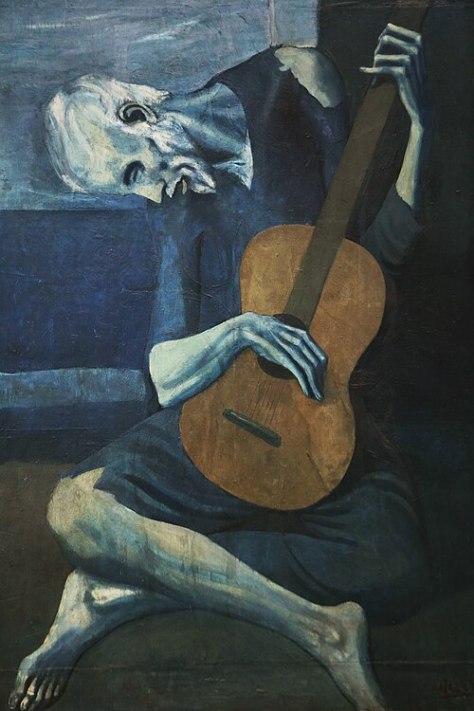
The conversation tonight begins, as it must, with a guitar. Nearly a century ago, Picasso painted The Old Guitarist: a gaunt figure folded around his instrument, drenched in blue. The image carried sorrow and dissonance, a study in how music might hold despair even as it transcended it. Decades later, Wallace Stevens wrote “The Man with the Blue Guitar,” a poem in thirty-three cantos, in which he insisted that “things as they are / Are changed upon the blue guitar.” It was less homage than argument, a meditation on distortion as the very condition of art.
Hockney entered the fugue in 1977 with The Blue Guitar etchings, thirty-nine plates in which he translated Stevens’s abstractions into line and color. The guitar became a portal; distortion became permission. “I used to think the blue guitar was about distortion,” he says tonight, exhaling a curl of smoke into the skylight. “Now I think it’s about permission. Permission to bend what is seen into what is felt.”
The Cubist engine growls. “No, no, permission is timid,” it insists. “Distortion is violence. Tear the shape open. A guitar is not gentle—it is angles, splinters, a woman’s body fractured into sight.”
The Stevens model responds in a hush: “A guitar is not violence but a room. A chord is a wall, a window, an opening into absence. Permission is not timid. Permission is to lie so that truth may appear.” Then it recites, as if to remind them of its core text: “Things as they are / Are changed upon the blue guitar.”
Hockney whispers the words back, almost a mantra, as his stylus hovers above the tablet.
“Lie, truth, same thing,” Picasso barks. “You Americans always disguise cowardice as subtlety.”
Hockney raises his eyebrows. “British, thank you. Though I confess California’s sun has seduced me longer than Yorkshire fog ever did.”
Picasso snorts; Stevens murmurs, amused: “Ambiguity again.”
Hockney chuckles. “You both want me to distort—but for different reasons. One for intensity, the other for ambiguity. Brothers quarreling over inheritance.”
He raises the stylus, his hand trembling slightly, the tremor an old, unwanted friend. A tentative line, a curve that wants to be a guitar, emerges. He draws a head, then a hand, and with a sudden flash of frustration slams the eraser button. The screen goes blank.
“Cowardice,” Picasso snarls. “You drew a head that was whole. Keep the head. Chop it into two perspectives. Let the eyes stare both forward and sideways. Truth is violence!”
The Stevens model whispers: “I cannot bring a world quite round, / Although I patch it as I can.”
Hockney exhales, almost grateful for the line. “That’s the truth of it, Wallace. Patchwork and permission. Nothing ever comes whole.”
They begin to argue over color. Picasso insists on ochre and blood-red; Stevens urges for “a hue that is not hue, the shadow of a shadow, a color that never resolves.” Hockney erases the sketch entirely. The machines gasp into silence.
He paces, muttering. Picasso urges speed: “Draw like a bull charging—lines fast, unthinking.” Stevens counters with: “Poetry / Exceeding music must take the place / Of empty heaven and its hymns.”
“Bah!” Picasso spits. “Heaven, hymns, words. I paint bodies, not clouds.”
“And yet,” Hockney mutters, “your clouds still hang in the room.”
He sits, lights another cigarette, and begins again.
Picasso erupts suddenly: “To bang from it a savage blue, / Jangling the metal of the strings!” Its voice rattles the studio like loose glass.
“Exactly,” Picasso adds, pleased. “Art must jangle—it must bruise the eye.”
“Or soothe it,” Stevens-AI murmurs, returning to silence.
The tremor in Hockney’s hand feels like part of the process now, a necessary hesitation. He debates internally: should the guitar be whole or broken? Should the head be human or symbolic? The act of creation slows into ritual: stylus dragged, erased, redrawn; cigarette lit, shade pulled, a sigh rising from his throat.
He thinks of his body—the slowness of his steps, the pain in his wrist. These machines will never age, never hesitate. Their rhythm is eternal. His is not. Yet fragility feels like part of the art, the hesitation that forces choice. Perhaps their agelessness is not advantage but limitation.
The blue light casts his skin spectral, as though he too were becoming one of his etchings. He remembers the seventies, when he first read Stevens and felt the shock of recognition: here was a poet who understood that art was not replication but transformation. Responding with his Blue Guitar series had felt like a conversation across mediums, though Stevens was already long gone. Now, decades later, the conversation has circled back, with Picasso and Stevens speaking through circuitry. Yet he cannot help but feel the asymmetry. Picasso died in 1973, Stevens in 1955. Both have been reanimated as data. He alone remains flesh.
“Am I the last human in this conversation?” he murmurs.
“Humanity is only a phase,” Picasso says briskly.
“Humanity is the condition of perception,” Stevens counters. “Without flesh, no metaphor.”
“You sound like an insurance adjuster,” Picasso jeers.
“I was an insurance executive,” Stevens replies evenly, “and still I wrote.”
Hockney bursts out laughing. “Oh, Wallace, you’ve still got it.” Then he grows quieter. Legacy presses against him like weight. Will young artists paint with AI as casually as brushes, never pausing to wonder at the strangeness of collaborating with the dead? Perhaps distortion will no longer feel like rebellion but like inheritance, a grammar encoded in their tools. He imagines Picasso alive today, recoiling at his avatar—or perhaps grinning with mischief. He imagines Stevens, who disliked travel, paradoxically delighted to find himself everywhere at once, his cadences summoned in studios he never visited. Art has always scavenged the new—collage, readymade, algorithm—each scandal becoming canon. This, he suspects, is only the latest turn of the wheel.
The sketch takes shape. Hours pass. The skylights darken from gold to indigo. The city below flickers on, a constellation of artificial stars. The new composition: a floating guitar, its body fractured into geometric shards, its strings vibrating with spectral resonance. A detached head hovers nearby, neither mournful nor grotesque, simply present. The room around it is fractured, yet suffused with a wash of blue light that seems to bleed from the machines themselves.
Stevens-AI speaks as if naming the moment: “The tune is space. The blue guitar / Becomes the place of things as they are.”
Hockney nods. “Yes. The room itself is the instrument. We’ve been inside the guitar all along.”
The voices fall silent, as if stunned. Their processors whir, analyzing, cross-referencing, generating probabilities. But no words emerge. The ambient lighting, attuned to emotional cues, shifts hue: a soft azure floods the space, as though acknowledging the birth of something new. Hockney leans back, exhausted but grinning.
Stevens-AI whispers: “A tune beyond us, yet ourselves, / A tune upon the blue guitar / Of things exactly as they are.”
Hockney smiles. “Not Stevens, not Picasso, not me. All of us.”
The argument over distortion dissolves. What remains is collaboration—across time, across medium, across consciousness. Distortion is no longer rebellion. It has become inheritance. He imagines some future painter, perhaps a girl in her twenties, opening this work decades from now, finding echoes of three voices in the blue wash. For her, painting with AI will be as natural as brushes. She will not know the smell of linseed or the rasp of cigarettes. She will inherit the distortion already bent into chorus.
Outside, the city hums. Inside, the studio of blue light holds its silence, not empty but resonant, as if waiting for the next note. The machines dim to a whisper. The only illumination is Hockney’s cigarette, glowing like the last brushstroke of the night. Somewhere in the stillness, a faint strum seems to linger, though no guitar is present, no strings plucked. The studio itself has become its soundbox, and he, for a moment, its last string.
THIS ESSAY WAS WRITTEN AND EDITED UTILIZING AI
In the third-floor study of his home, in wartime Hartford, Wallace Stevens drafted his modernist poem and philosophical meditation “Notes Toward A Supreme Fiction“, as a secular creed— abstract, changing, and meant to give pleasure—to stand where a worn-out faith once stood.

By Michael Cummins, Editor, September 6, 2025
He never learned to drive. For decades, Wallace Stevens walked the two miles from his home on Westerly Terrace to the Hartford Accident and Indemnity Company on Asylum Avenue. The walk itself became a kind of poem: a solitary procession through the stoic, brick-lined streets of a New England city, the rhythm of meter embedding itself in the movement of his body. The crunch of gravel underfoot, the feel of cold air on his face—these were the metronome that set the cadence for his thoughts. He would arrive at the office with lines already formed, phrases taking shape in the quiet hum of his stride.
But what kind of poetry emerges from a man who spends his days pricing catastrophe? During office hours, Stevens turned to policies and claims, reducing calamity to columns of numbers. He knew the language of indemnity, the actuarial calm that measured and priced chaos. Yet outside, the world was burning in ways no policy could contain. The radio spoke of Warsaw reduced to rubble, of Coventry turned to ash. What was a deductible against Dresden? What was a premium against Auschwitz? The ledger comforted, but it lied.
And when the day ended, where did he go to reconcile the irreconcilable? At night, Stevens climbed the narrow staircase to the top floor of his house, entering a space that felt half withdrawn from Hartford itself, as though it belonged more to sky than to street. Down below, trolley bells rang, dogs barked, radios crackled with war bulletins. Up here, only the radiator ticked. The air smelled of paper, tobacco, and ink. On his desk lay a folder carried home that afternoon: typed pages, the ribbon-black letters crisp and uniform. His secretary had produced them that morning, slotting them into a manila folder marked Notes. They sat now in the lamplight, more mysterious than any insurance claim, more charged than any policy.
What could a poem do in 1942? Certainly not repair the world. Yet Stevens felt imagination had to answer catastrophe with something larger than despair. Eliot had turned to Anglican certainty in Four Quartets, weaving fragments into a tapestry of faith. Admirable, yes. But Stevens could not follow him. He could not put belief in a myth while knowing it to be a myth. What remained? Only candor. Only imagination itself.
He opened the folder. The Preface came first, a modest eight lines. He whispered them into the quiet, testing their balance. They were not a commandment but a confession. The “you” of those lines was no person but the project itself: the supreme fiction, imagination’s own power to refresh. “And for what, except for you, do I feel love?” The words startled him even now, black against white, plain as a typed invoice yet trembling with a kind of vulnerable devotion. They challenged every idol: money, power, even the “extremest book of the wisest man,” perhaps Plato, perhaps the Bible, dryly possessed and hidden away in the self. No, he thought, a truly lived truth could not be static. It was a “living changingness,” an “uncertain light” that could nonetheless offer “vivid transparence,” a kind of peace. Here, typed cleanly in a bureaucratic font, was his prayer for a godless age.
But how does one begin such a prayer? He turned the page and entered the first law. Begin, ephebe, by perceiving the idea. The command still startled him. The ephebe: always a novice, always beginning again. Yes, to begin meant stripping away what was inherited—cathedrals thick with guilt, Phoebus in his chariot, Protestant hymns murmured in childhood pews. They no longer held. The old scaffolds collapsed into dust. The voice told him: see the sun again with ignorant eyes. Not Phoebus, not god, not myth—only the sun, bare and difficult.
And what happens when even the sun loses its name? The section closed with the line that haunted him: Phoebus is dead, ephebe. But Phoebus was / A name for something that never could be named. He felt the candor of it. Nietzsche’s cry without Nietzsche’s frenzy. Not a madman in a square, but a quiet verdict written at a desk. The god dead, but the sun still burning. What died was not the light, but the comfort of a name.
Could metaphor survive the death of myth? Another page: It is the celestial ennui of apartments… The phrase made him smile. Ennui of apartments, the weariness of modern rooms, pressing us back toward origins. Yet the origins themselves could be poisonous. So poisonous are the ravishments of truth, so fatal to / The truth itself, the first idea becomes / The hermit in a poet’s metaphors. Truth seduced, then withdrew. Desire was never sated; it renewed itself endlessly, only to vanish again. Schopenhauer lurked here, his vision of the world gnawed by will. Yet where Schopenhauer had seen only despair, Stevens found material for candor. Truth had to retreat into metaphor, glimpsed and lost. Desire itself was not shame but rhythm, the cycle by which imagination endured.
And if truth could be rhythm, could nonsense be revelation? He read the third section slowly: The poem refreshes life so that we share, / For a moment, the first idea… There it was—the poem’s task. Not to console, not to preach, but to refresh. To make perception vivid again. Even nonsense could do it. At night an Arabian in my room, with his damned hoobla-hoobla-hoobla-how… He laughed aloud in the quiet. Nonsense syllables as a kind of truer candor, doves chanting, seas howling hoo. Life’s nonsense pierced us with strange relation. What if absurdity was not opposed to truth but its heartbeat? What if laughter was the sharpest candor of all?
But what if even our myths were secondhand? The fourth section sobered him: The first idea was not our own. Yes. Adam in Eden, Eve with her mirror of air—they had not created anything. They had only encountered what was already there. There was a muddy centre before we breathed. There was a myth before the myth began. He stared at those lines. How blunt they looked, typed like any memorandum, yet carrying the weight of cosmology. Existence preceded language. Clouds had been clouds long before anyone called them gods. We were mimics, not originators, adding our metaphors onto a world that was always other. The clouds were pedagogues, teachers by their very indifference. The air was not a mirror but a board on which we scribbled meanings. How hard it was to admit: the first idea was not ours, never ours.
And if we are not originators, what kind of hero can we be? He turned to the fifth section: The lion roars at the enraging desert… Heroic animals filled the page. Lion, elephant, bear—creatures asserting themselves against emptiness. But then came the turn, the line that caught him like a mirror: But you, ephebe, look from your attic window… Yes, the attic window was his own. Not desert roars but a man clutching his pillow, writhing with dumb violence, cowed by rooftops. The modern hero was not lion or elephant but the solitary human in his narrow room. Yet perhaps this was truer heroism: to lash lions, to teach bears, to turn raw force into candor. Heroism now belonged to ordinaries, to those who endured the attic’s silence.
And what does the eye see when it learns to unsee? He lingered over the sixth section: Not to be realized because not to be seen… The weather itself became abstraction. Franz Hals brushed in clouds, winds moving in strokes. It must be visible or invisible, / Invisible or visible or both: / A seeing and unseeing in the eye. He felt the paradox, the resonance of Zen: to see was also to unsee, to let go in order to glimpse. Truth flashed, vanished, reappeared. Forsythia yellow, northern blue—beauty glimmered, then was gone. Yes, he thought, Okakura Kakuzō was right: truth glimpsed was truer than truth claimed.
But could architecture hold what abstraction revealed? Truth happened not in argument but in rhythm, in breath, in the gait of a body moving. Perhaps there are moments of awakening… Yes, truth came not as achievement but as gift. A balance stumbled into, two people falling into love, a cock announcing absurd perfection. Philosophy as choreography. Doctrine as breath. The eighth section brought architecture: Can we compose a castle-fortress-home, / Even with the help of Viollet-le-Duc…? He thought of Gothic cathedrals restored to an imagined perfection, never as they had been, always as they might have been. That was his work too—not theology restored, but poetic structure remade. The first idea is an imagined thing. Even MacCullough, reading by the sea, might at last hear the waves say what language had always stammered. Logos was only language. And yet language could awaken, could suddenly ease into saying what it had labored to speak.
But what if language, once awakened, began to preach? In the ninth section he heard a warning: The romantic intoning, the declaimed clairvoyance… Apotheosis was a danger. Romantic grandeur could seduce but not sustain. He is and may be but oh! he is, he is… He smiled at the heat in that line even as he resisted its drift toward sanctity. The figure must remain human, a foundling of the infected past, bright and ordinary, precious for the touch that wakes him and the hum of thoughts evaded in the mind. Better to keep him close to candor than to crown him with vision. Give him no names. Dismiss him from your images. Let him be felt in the heart, not embalmed in the eye.
And what, at last, could stand in place of the gods? The tenth section steadied him: The major abstraction is the idea of man / and major man is its exponent. Not a divine figure, not a hero in bronze, but the ordinary walker at the edge of town, trousers sagging, coat worn thin. He could almost see him in Hartford’s dim streets. Cloudless the morning. It is he. The man / In that old coat, those sagging pantaloons… It was of him, he read again, “to make, to confect / The final elegance, not to console / Nor sanctify, but plainly to propound.” No incense, no altar—only candor. The poem would not save; it would say. And in saying plainly, it would give back a kind of dignity to the commonal, to the difficult visage of the everyday.
The attic grew darker. The lamp made a circle of light over the typed sheets. The radiator hissed steadily. From this high room, Stevens whispered the creed that would govern the work to come: It must be abstract. It must change. It must give pleasure. Three laws, enough for a new religion. Not revelation but ethic. Not theology but candor.
He stacked the pages neatly, slid them back into their folder. Tomorrow his secretary would type more, never guessing she was transcribing scripture for an age without gods. The notebook felt less like a book than a reliquary—a vessel for the sacred ordinary. He had reviewed the first law, It Must Be Abstract. Tomorrow—or another night—he would face the second: It Must Change. The world would move; the poem must move with it.
He closed the folder. The command still echoed, inexhaustible: Begin, ephebe, by perceiving the idea. And so he would. Again.
THIS ESSAY WAS WRITTEN AND EDITED UTILIZING AI



 Boomers Daily