
A selection of three essential articles read aloud from the latest issue of The Economist. This week, riding high in a workers’ world, the Amazon effect on live sport (9:45) and even transience is mutating (17:35).
Category Archives: Poetry
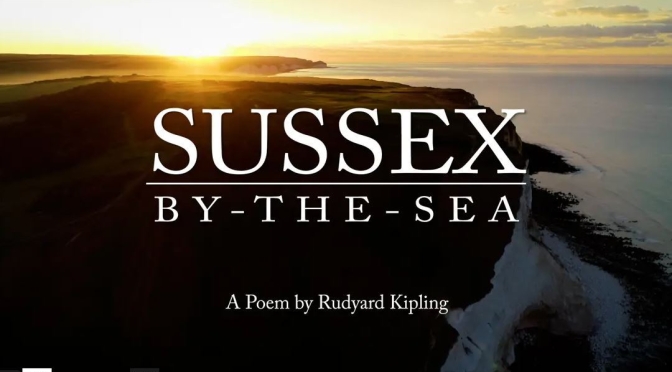
Poetic Travel: ‘Sussex By-The-Sea’, England (Video)
“Sussex by-the-Sea” is a 4K drone film is based on the words of the famous author and Sussex resident Rudyard Kipling’s 1902 poem “Sussex” and explores the East Sussex coastline between Roedean and Beachy Head.
Kipling, author of the “Jungle Book,” first lived in the village of Rottingdean and in 1902 bought 17th-century house “Batemans” in Burwash, East Sussex, where he lived until he died. His poem explored his love of the area, such as the wonders of the coastline and specific landmarks including the Longman of Wilmington and Beachy Head. Locations seen in the film include Roedean, Ovingdean, Rottingdean, Saltdean, Telscombe Cliffs, Peacehaven, Newhaven, Piddinghoe, Tide Mills, Seaford, Seven Sisters and Beachy Head, as well as landmarks such as the Meridian Monument, Litlington White Horse, The Long Man of Wilmington as well as the Newhaven Ferry.
“Sussex” (1902) Poem written by Rudyard Kipling
Narrated by Howard Ellison (howardellison.net/)
Filmed and edited by Dan Parkes (danthecameraman.co.uk/)
Music track: “Carried by the Wind” (licensed)
Music composed by Florian Seraul (tiny-music.com/)
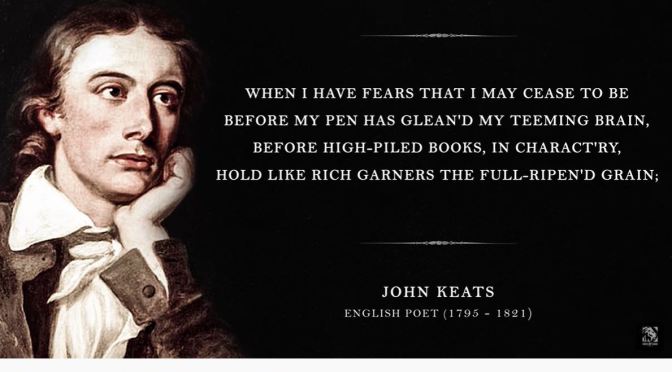
Poetry: ‘When I Have Fears’ – John Keats (1795-1821)
Read by James Smillie – John Keats was a revered English poet who devoted his short life to the perfection of poetry.
John Keats was an English Romantic poet. He was one of the main figures of the second generation of Romantic poets, along with Lord Byron and Percy Bysshe Shelley, despite his works having been in publication for only four years before his death from tuberculosis at the age of 25.
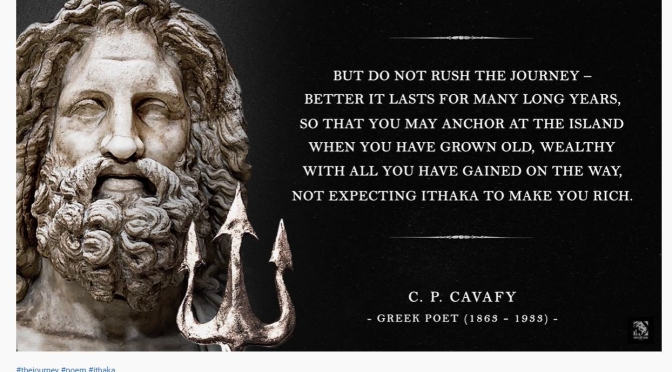
Greatest Poetry: ‘Ithaka’ By C.P. Cavafy (1863-1933)
Constantine Peter Cavafy was an Egyptiot Greek poet, journalist and civil servant. His consciously individual style earned him a place among the most important figures not only in Greek poetry, but in Western poetry as well. Cavafy wrote 155 poems, while dozens more remained incomplete or in sketch form.
Ithaka
BY C. P. CAVAFYTRANSLATED BY EDMUND KEELEY
As you set out for Ithaka
hope your road is a long one,
full of adventure, full of discovery.
Laistrygonians, Cyclops,
angry Poseidon—don’t be afraid of them:
you’ll never find things like that on your way
as long as you keep your thoughts raised high,
as long as a rare excitement
stirs your spirit and your body.
Laistrygonians, Cyclops,
wild Poseidon—you won’t encounter them
unless you bring them along inside your soul,
unless your soul sets them up in front of you.
Hope your road is a long one.
May there be many summer mornings when,
with what pleasure, what joy,
you enter harbors you’re seeing for the first time;
may you stop at Phoenician trading stations
to buy fine things,
mother of pearl and coral, amber and ebony,
sensual perfume of every kind—
as many sensual perfumes as you can;
and may you visit many Egyptian cities
to learn and go on learning from their scholars.
Keep Ithaka always in your mind.
Arriving there is what you’re destined for.
But don’t hurry the journey at all.
Better if it lasts for years,
so you’re old by the time you reach the island,
wealthy with all you’ve gained on the way,
not expecting Ithaka to make you rich.
Ithaka gave you the marvelous journey.
Without her you wouldn’t have set out.
She has nothing left to give you now.
And if you find her poor, Ithaka won’t have fooled you.
Wise as you will have become, so full of experience,
you’ll have understood by then what these Ithakas mean.
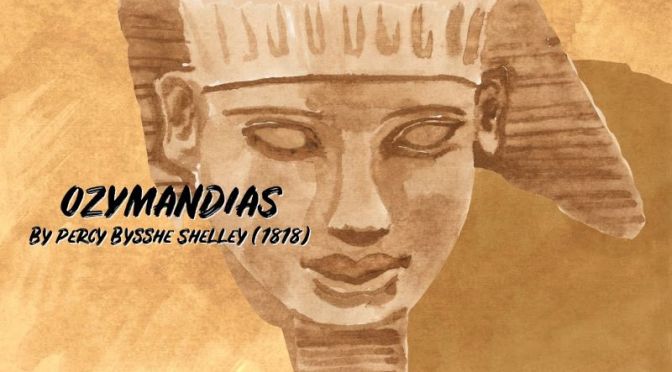
Animated Short Films: ‘Ozymandias’ – A Poem By Percy Bysshe Shelley
Directed and animated by Alvaro Lamarche-Toloza
“OZYMANDIAS” is the animated 3D adaptation of a poem written by English poet Percy Bysshe Shelley in December 1817. It was created with a series of wash paintings animated with the Unreal Engine and EbSynth to test an experimental 3D animation pipeline.
Additional info:
Using EbSynth, a texture synthesis / transfer tool created by Secret Weapon, we applied wash paintings to 3D scenes created in real-time with the Unreal Engine. The result is a unique look and a promising experimental pipeline which dramatically speeds up the production of 3D animation stylized with traditional 2D art.
About the poem:
Written in 1817 by Percy Shelley, “Ozymandias” refers to pharaoh Ramesses II and was perhaps inspired by the acquisition of a large Ramesses statue by the British Museum the same year. References to this poem have often appeared in pop culture, though Shelley himself might not have considered it to be one of his major works.
It was first published in the 11 January 1818 issue of The Examiner of London.
Credits:
Directed and animated by Alvaro Lamarche-Toloza
Wash paintings by Estelle Chauvard
Voice by Bryan Cranston, taken from the Breaking Bad Teaser Trailer
“Menkaure colossal statue base” model by Zhejiang University
“Ramses II” model by Taoetsia
“Horse Skeleton” model by Diego Luján García
‘OZYMANDIAS’ By Percy Bysshe Shelley
I met a traveller from an antique land,
Who said—“Two vast and trunkless legs of stone
Stand in the desert. . . . Near them, on the sand,
Half sunk a shattered visage lies, whose frown,
And wrinkled lip, and sneer of cold command,
Tell that its sculptor well those passions read
Which yet survive, stamped on these lifeless things,
The hand that mocked them, and the heart that fed;
And on the pedestal, these words appear:
My name is Ozymandias, King of Kings;
Look on my Works, ye Mighty, and despair!
Nothing beside remains. Round the decay
Of that colossal Wreck, boundless and bare
The lone and level sands stretch far away.”
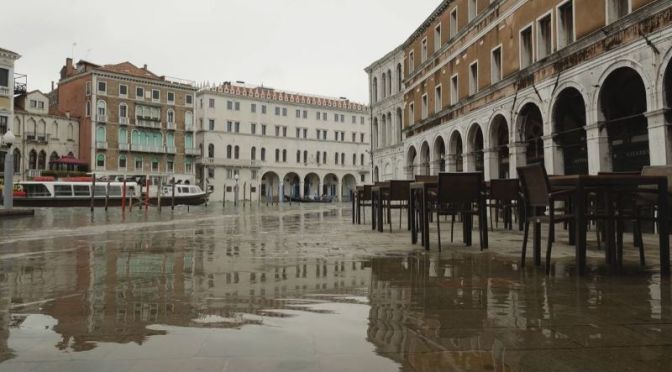
Poetic Short Films: ‘NELLA MIA CITTÀ (In my city)’ – A Tribute To Venice (Video)
Filmed, Edited and Directed by: Milton Kam
NELLA MIA CITTÀ (In my city) is my visual ode to Venice. The film observes the lagoon city and its residents during the relative scarcity of tourists in its streets. From the lustre of its famous spots to the anonymity of its quiet alleys, Venice feels as if ‘the future did not come,’ to borrow a line from the poem, which the film is based on.
Nella mia città is written by Anna Toscano and was taken from her book Doso la polvere, Milan, La Vita Felice, 2012
With music by Federico Toffano (cello), Liesl Odenweller (soprano), and Ivano Zanenghi (lute).
IN MY CITY by Anna Toscano
The future does not exist
the future does not come
in my city:
however long my step is
however much you have the favor of the wind
the number 2 does not go more than 22 km per hour.
How to get beyond the past
how not to look back
(at this speed)
with your neck always at three quarters:
time stops in piazzale Roma
so we live entangled
in the stories of peoples.
We stand, happy,
in a rearview mirror.

Poetry: Robert Frost’s ‘Stopping By Woods On A Snowy Evening’ (Video)
A short poem told from the perspective of a traveler who stops to watch the snow fall, and, in doing so, reflects on the conflict between man and nature and the wishes and obligations we face in our lives.
Written by Robert Frost, 1922.
Read by Shane Morris.
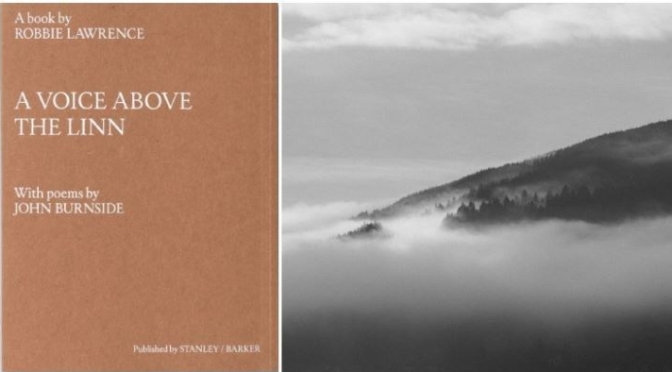
New Photography Books: ‘A Voice Above The Linn’ By Robbie Lawrence (2020)
In ‘A Voice Above The Linn’ Lawrence collaborated with the renowned poet John Burnside, who contributed four beautiful new poems to segment its chapters.
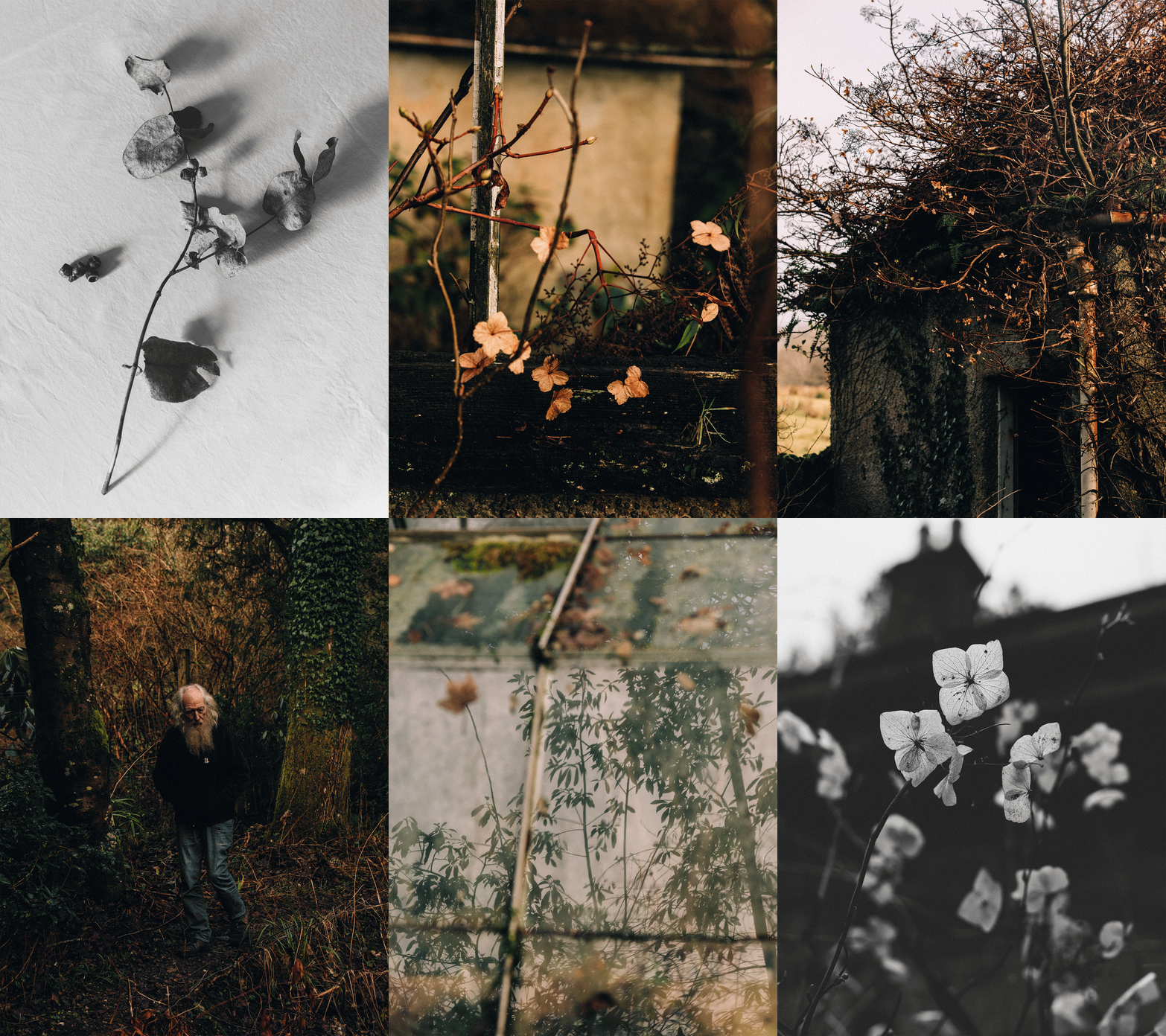
In 2016 Robbie Lawrence first travelled to a remote stretch of coastline in the west coast of Scotland, to Linn Gardens, which lies at the head of Cove Bay on the west side of Rosneath peninsula. The gardens had been run for fifty years by Jim Taggart, an avid botanist and gardener.
Jim discovered that the region’s subtropical climate allowed him to grow plants and flowers from all over the world. His endeavours led to the estate being covered in an intricately plotted web of ferns, bamboos, Magnolias and Rhododendrons. As Jim got older, his son Jamie took over the more physical elements of maintaining the garden, including travelling abroad to research and gather new plants. On one such journey, to the northern mountainous region of Vietnam, Jamie disappeared. His body was found years later, he had evidently fallen in one of the mountain’s higher passes.
“When I first met Jim, who by this point was well into his 80s, he told me that he decided to keep the garden going as a memorial to his son. Over the past few years, I went back to visit Jim and document the garden as it passed through the seasons. Despite his age, Jim would bound around the garden, occasionally stopping to provide a lengthy anecdote about a particular fern or tree. Last summer, Jim passed away at the age of 84.” – Robbie Lawrence
Travel Videos: ‘Je Viens’ – Hiking The Trails In Tignes, Southeastern France
“Je Viens” is a Cinematic Poem Short Film In Tignes, France Directed by Franck Pinel.
Filmed, Edited and Directed by: Franck Pinel (FKY)
Music by: Steven Gutheinz
Written by: Samuel Revol
Narrated by: Siméon Revol & Laure Revol
English Translation by: Madeleine Barter
“Between the desert peaks and the wild plains, Itinerary of the man alone; poisoned, in love, alive.”
I invite you on the trails of Tignes in Savoie, under the August sun, to breathe the fresh air! A little vastness, horizons blurred to forget for a few moments our confined lives.
A first FKY / Srevol collaboration, with a text written for the film, and read by a young Simeon with a rocky voice.
I Approach
Tightrope walking earthling
Lying heavily on rock
I look for your softness
Your suspended caresses
In my solitude, I approach
My bones follow your tracks
Along smoke-filled banks,
Burns under your sun
My masterful soul
In my solitude, I approach
My wings poisoned
by oily molecules
accept my sorrow
my ghostly pardon
In my solitude, I approach
Tightrope walking earthling
With smoky soul, I approach
I burn in your softness
Masterful earth
—————————————
Je viens
Funambule terrien,
Aimanté à la roche,
Je cherche tes douceurs,
Tes caresses suspendues.
Dans ma solitude, je viens
Mes os suivent ta piste,
Aux rivages enfumés
Je brûle sous ton soleil
Mon âme de capitaine
Dans ma solitude, je viens
mes ailes empoisonnées
de molécules pétroliennes
accepte mon désolé
mon pardon fumigène
Dans ma solitude, je viens
Funambule terrien,
A l’âme enfumée je viens
Je brûle dans ta douceur,
Terre capitaine
Tignes is a group of villages that form a high-altitude ski resort in the French Alps, near the Italian border. With nearby Val d’Isère, it’s part of the Espace Killy ski area, linked by a network of lifts. Val Claret and Tignes Le Lac villages are lively hubs, with restaurants and shops. In summer, the area offers trails, golf and a bike park, plus ski runs on the Grande Motte glacier.
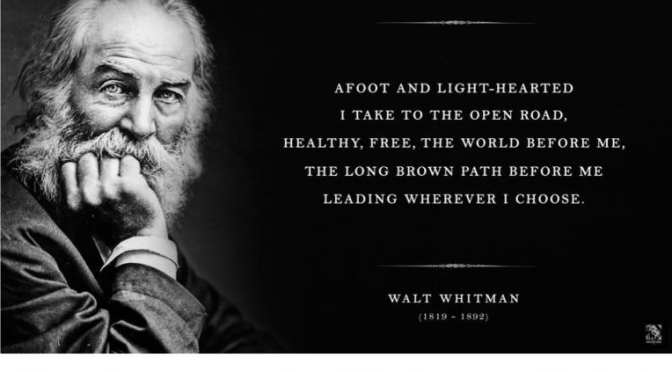
Poetry: ‘Song Of The Open Road’ By Walt Whitman
Read by Dave Luukkonen and Music by Tony Anderson
Walt Whitman is America’s world poet – a latter-day successor to Homer, Virgil, Dante, and Shakespeare, whose verse collection ‘Leaves of Grass’ marked a new era in the history of American literature.
Within Leaves of Grass, Whitman’s ‘Song of the Open Road’ engages with important themes of freedom, the self and nature. The poem begins with the speaker setting out on a long brown path “Afoot and light-hearted,” for he is done with the routines, customs, and safe behaviours of his previous life, “done with indoor complaints, libraries, querulous criticisms.”
Here, Whitman renounces a life devoted to the conventional pursuit of material success and embarks on the open road, the world before him. –
If you’d like to read the full poem, go here: https://www.poetryfoundation.org/poem…
 Boomers Daily