
Category Archives: Finance

Technology Report: “Spycraft” – July 6, 2024

Technology Quarterly: Watching the watchers

The Economist SPECIAL REPORTS (July 2, 2024): The ‘Watching The Watchers’ issue features Tools of the spy trade have changed and so has the world in which they are used, says Shashank Joshi

The tools of global spycraft have changed

Illustration of two magnifying glasses with eyes inside on a background of digital files and pointing cursors.
illustration: claire merchlinsky

And so has the world in which they are used, says Shashank Joshi

Afew years ago intelligence analysts observed that internet-connected cctv cameras in Taiwan and South Korea were inexplicably talking to vital parts of the Indian power grid. The strange connection turned out to be a deliberately circuitous route by which Chinese spies were communicating with malware they had previously buried deep inside crucial parts of the Indian grid (presumably to enable future sabotage). The analysts spotted it because they were scanning the internet to look for “command and control” (c2) nodes—such as cameras—that hackers use as stepping stones to their victims.

Ubiquitous technical surveillance has made spying more difficult

Signals intelligence has become a cyber-activity

Sometimes the old ways of espionage are the best

Artificial intelligence can speed-sort satellite photos

Private firms and open sources are giving spies a run for their money

Report: “Deglobalization Of Finance” – May 11, 2024

Special reports: Worlds apart

The Economist SPECIAL REPORTS (May 8, 2024): The ‘Deglobalization of Finance’ issue features

Worlds apart

The American-led financial order is giving way to a more divided one

Ten years ago your correspondent was fidgeting nervously in a meeting room at vtb Capital, the investment-banking arm of Russia’s second-biggest bank, just across the road from the Bank of England. During the recruitment process for a graduate job, things had taken a worrying turn. A Russian missile had shot down mh17, a passenger flight from Amsterdam to Kuala Lumpur, while it was passing over Ukraine. Plenty of Russian firms were already under Western sanctions owing to the annexation of Crimea earlier that year. Now sanctions were being ramped up, and vtb Capital’s parent bank was a prime target. Hence the fidgeting: how to ask the slightly alarming man across the table whether there would even be a vtb in a few months’ time?

The global financial system is in danger of fragmenting

How crises reshaped the world financial system

The movement of capital globally is in decline

National payment systems are proliferating

The fight to dethrone the dollar

How the financial system would respond to a superpower war

Sources and acknowledgments

Special Report: ‘Homeland Economics’ (October 2023)

Special reports: Homeland Economics

The Economist SPECIAL REPORTS (OCTOBER 7TH 2023):

Homeland Economics

Governments across the world are rediscovering industrial policy. They are making a big mistake, argues Callum Williams

Analysis: Argentina’s Dysfunctional Economy

The Economist (September 7, 2023) – Rampant inflation, a booming black market for US dollars and crippling debt – welcome to Argentina, one of the world’s most dysfunctional economies. How did it end up like this?

Video timeline: 00:00 – Argentina’s economy is in crisis 01:21 – What is happening now? 04:16 – Why is this happening? 05:52 – Overspending 07:00 – Printing money 08:03 – Borrowing money 08:51 – Trade controls 11:06 – What are the solutions?

Analysis: Meta, PayPal & X Race To Build A ‘Super App’

Wall Street Journal (September 7, 2023) – Meta. PayPal. X. All of these tech companies have made attempts at a “super app” in the U.S., following the success of WeChat in China, but have yet to get one off the ground. Tech leaders have struggled to combine elements like social media, messaging, payment and more into one place.

Video timeline: 0:00 App efficiency 0:37 The appeal 2:18 U.S. issues 4:03 Regulation 4:48 What’s next?

So what’s holding the U.S. back from having a super app available? WSJ explains why, despite challenges, companies still see it as their holy grail product.

#Superapp#WeChat#WSJ

Money: Non-Cash Payment Option In US, India & China

The Economist (August 10, 2023) – Non-cash payments are on the rise all over the world. Our writers explain how digital technology has changed the way consumers shop in three important markets: America, China and India.

Video timeline: 00:00 Cashless transactions are on the rise 00:18 America: account and card 02:01 India: Unified Payment Interface 04:06 China: App payments

Special Report: ‘Digital Finance’ – The Economist

Image

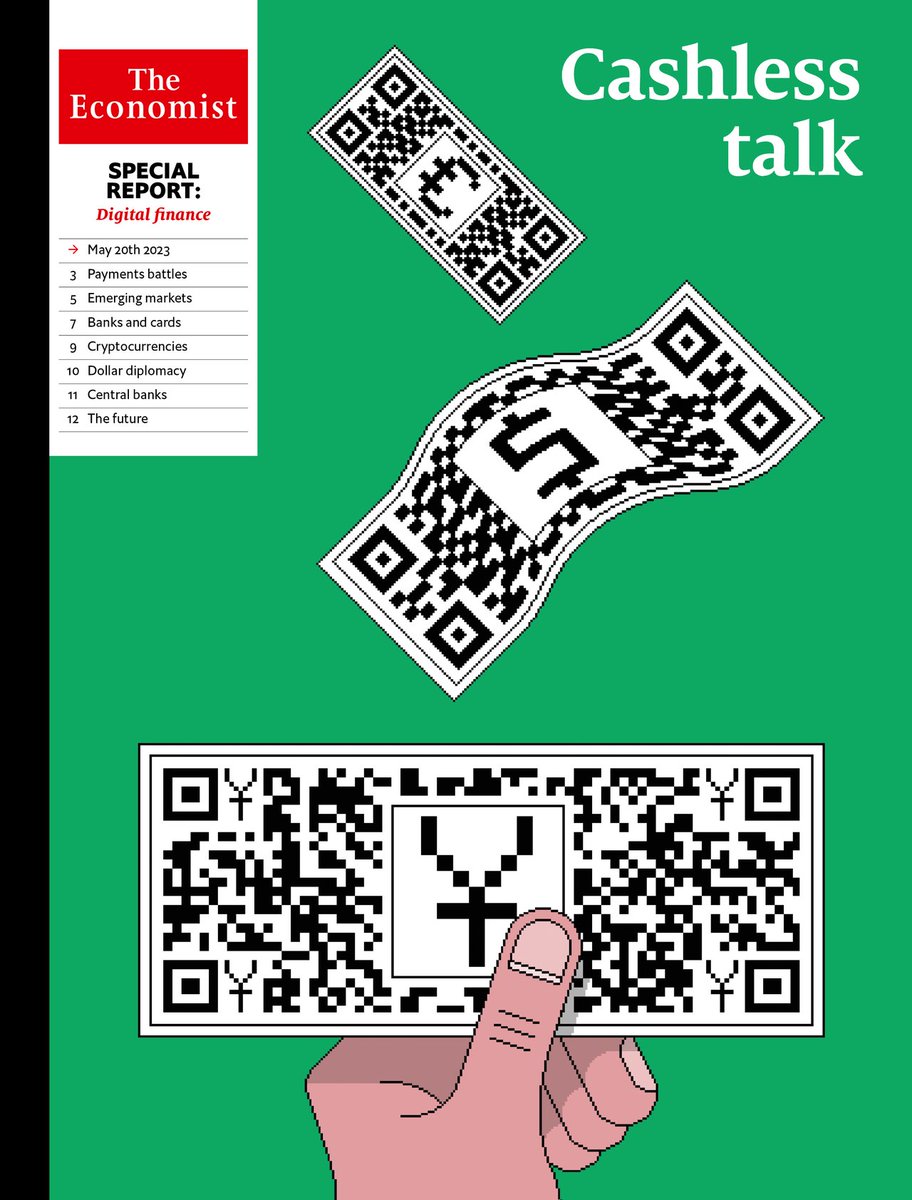
The Economist – Special Reports (May 20, 2023): The fight over payments systems is hotting up around the world. There may be surprising winners, says Arjun Ramani.

As payments systems go digital, they are changing global finance

The fight over payments systems is hotting up around the world. There may be surprising winners, says Arjun Ramani

Payment is one of the most fundamental economic activities. To buy anything, you need something the seller wants. One option is barter, but that is beset by friction (what are the chances of having something your counterparty wants at any exact moment?). Early forms of money, from cowrie shells to beads to metal coins, offered a solution: they were always in demand to settle transactions.

Finance: Why Do U.S. Banks Keep Going Bankrupt?

CNBC (April 3, 2023) – The collapse of Silicon Valley Bank, Signature Bank and Credit Suisse were a harsh reminder of how quickly a trusted institution could fail, putting billions of dollars at risk.

Over 550 banks have collapsed since 2001, according to the FDIC. So what exactly causes a bank to fail? And what implications does it have on the U.S. economy?

Chapters: 00:00 — Introduction 01:41 — Chapter 1 05:28 — Chapter 2 08:55 — Chapter 3

Preview: The Economist Magazine – Nov 26, 2022

Frozen out

The Economist – November 26, 2022 issue:

Europe faces an enduring crisis of energy and geopolitics

This will weaken it and threaten its global position

Disney brings back a star of the past. But its real problem is the script

Hollywood is suffering from the brutal economics of streaming

Russian “offshore journalists” need help, not hindrance

Europe should let them do their jobs

Qatar 2022 World Cup: Why It Spent $300 Billion

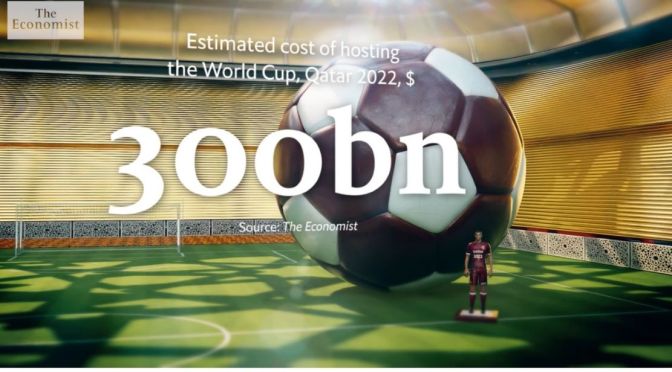
The Economist – Qatar is about to host the most expensive World Cup ever, costing as much as $300bn. Why has this small, gas-rich kingdom chosen to host football’s most prestigious event, and how does it fit into its broader plans for economic transformation?

Video timeline: 00:00 – Why is Qatar hosting the World Cup? 00:57 – World Cups are expensive competitions 01:56 – Qatar’s human rights violations 02:36 – Qatar’s place in the Gulf 04:43 – Qatar distinguishes itself from its neighbours 05:50 – Qatar bids to host the World Cup 07:18 – Qatar’s neighbours issue a blockade 10:12 – What might happen after the World Cup?

Read our defence of Qatar’s hosting of the World Cup: https://econ.st/3XcOC5A