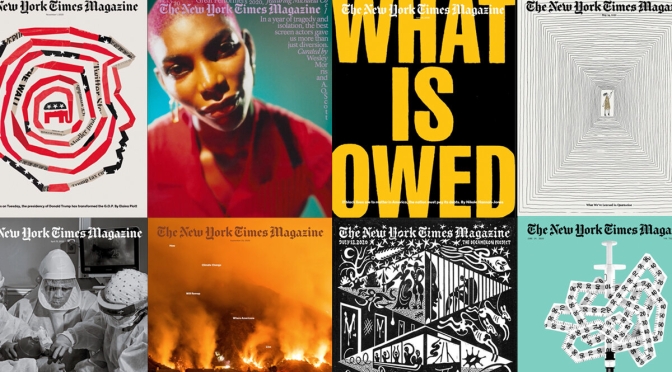
THE NEW YORK TIMES MAGAZINE:The 1.18.26 Issue features Robert Draper on Marjorie Taylor Greene; Ferris Jabr on a science experiment to help make the oceans less acidic; Jonathan Mahler on Christian Zionism and MAGA; and more.
Imagine yourself on an isolated mountain pass. The wind is whipping, the air is thin, there is nothing around you except the sky and the sound of your feet hitting the craggy ground. Many of us have experienced the wonder and exertion that comes with a great hike in a wild landscape. These are places we may love to visit, but for Kílian Jornet, this is where he is most at home.
We’re just a couple of weeks into 2026 and already it feels like an eternity has passed.
From Venezuela to Greenland, a blitz of revanchist US foreign policy moves by Donald Trump has thrown the world into turmoil. Domestically, it’s little better: in Minneapolis, the killing last week of Renee Nicole Good by an Immigration and Customs Enforcement agent – who was defended aggressively by Trump – prompted shock and fury across America.
While some argue that recent events simply represent a more honest, open approach towards US policy goals than in the recent past, others believe such brazen expansionism profoundly threatens the world order.
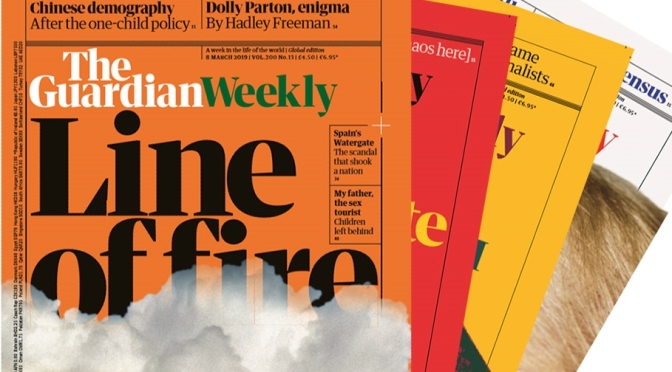
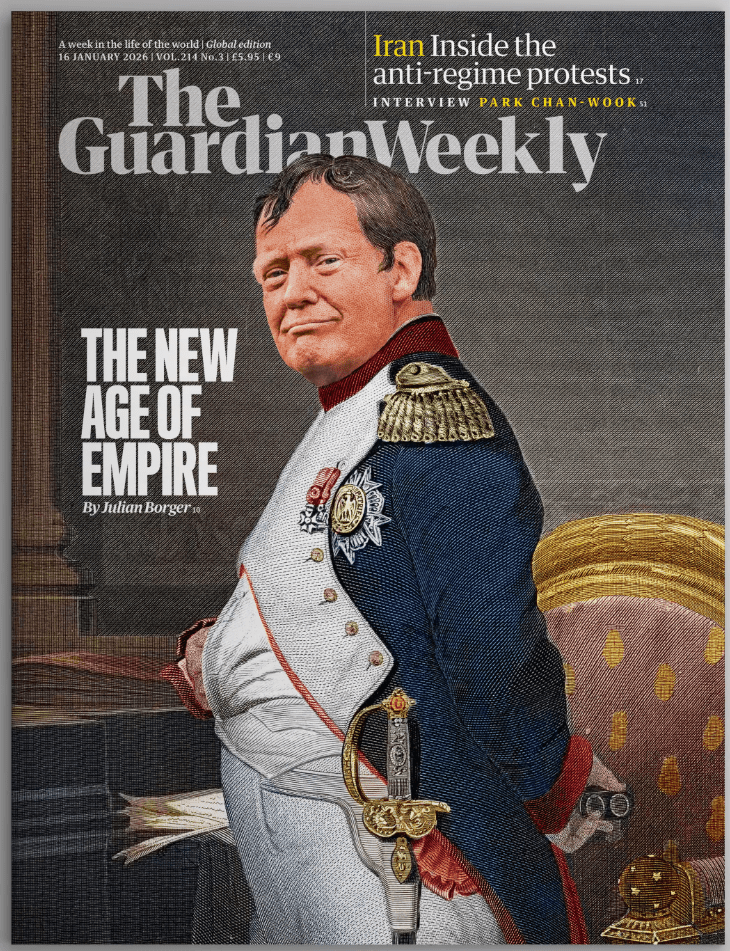
In a terrific essay this week, our senior international correspondent Julian Borger argues that these events signal a shift away from the postwar rules-based order and into a new age of global imperialism where, alongside Vladimir Putin’s Russia and Xi Jinping’s China, powerful nations use overtly brute force to achieve their objectives.
Spotlight | Iran protests: ‘The streets are full of blood’ After several days of protests amid an information blackout and a brutal crackdown, demonstrators recount their experiences on the frontlines to Deepa Parent and William Christou
Technology | Elon Musk’s pervert chatbot ‘Add blood, forced smile’: Amelia Gentleman and Helena Horton investigate how Grok’s AI nudification tool went viral
Feature | Trump’s assault on the Smithsonian The US president has vowed to kill off ‘woke’ in his second term in office, and the venerable cultural institution a few blocks from the White House is in his sights. Charlotte Higgins reports
Opinion | As the bombs fell, my family planted hope in a garden in Gaza Amid constant danger, Taqwa Ahmed al-Wawi’sseed-planting was a tiny act of resistance, offering food – and a sense of achievement among the devastation
Culture | Interview with Park Chan-wook The South Korean film director talks to Steve Rose about cultural dominance, the capitalist endgame and why we can’t beat AI
Donald Trump’s destruction of the civil service is a tragedy not just for the roughly 300,000 workers who have been discarded, but for an entire nation.
An Act of Cosmic Sabotage
How Donald Trump tried to ground NASA’s science missions
I Tried to Be the Government. It Did Not Go Well.
My five-month quest to monitor the weather, track inflation, and inspect milk for harmful microorganisms
He once defied the G.O.P. by blasting military interventions. But what looked like anti-interventionism is really a preference for power freed from the pretense of principle. By Daniel Immerwahr
Denmark Is Sick of Being Bullied by Trump
The U.S., once Denmark’s closest ally, is threatening to steal Greenland and attacking the country’s wind-power industry. Is this a permanent breakup? By Margaret Talbot
How Marco Rubio Went from “Little Marco” to Trump’s Foreign-Policy Enabler
As Secretary of State, the President’s onetime foe now offers him lavish displays of public praise—and will execute his agenda in Venezuela and around the globe. By Dexter Filkins
They were developed during the civil rights movement to reduce harm, but their rampant use during anti-ICE protests has led to a new kind of violence. By Clayton Dalton
After his son was repeatedly attacked, Rick Kuehner reached out to his suburban school, to the police and to other parents. The violence only got worse. By Matthew Shaer
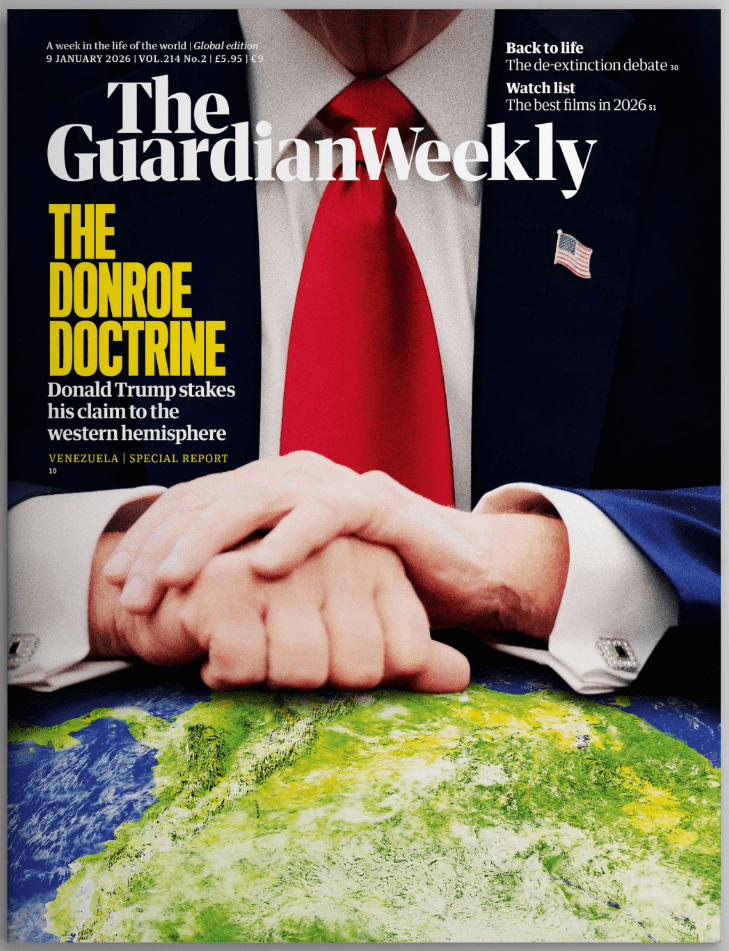
Donald Trump consigned the remnants of the rules-based international order to the bottom of the Caribbean Sea as US forces extracted Nicolás Maduro to face trial in the US. With allies and adversaries of Washington still adjusting to last weekend’s audacious assault on Caracas, Trump and his inner circle are thinking about their next steps to secure US interests in what they regard as “our hemisphere”.
Our reporting team, led by Latin American correspondent Tom Phillips, gauges the reaction to Maduro’s abduction on the ground in Caracas and among Venezuela’s closest neighbours, while Dan Sabbagh explains how the US military had planned and executed the operation.
Since the start of the US military buildup and blockade of Venezuela, Trump had claimed that Maduro needed to be “brought to justice” for his alleged role in drug trafficking, which Trump claimed had caused thousands of deaths in the US. But, as international commentators Julian Borger and Nesrine Malik explain, that has proved the thinnest of justifications and already by last Saturday it was clear that Venezuela’s huge oil reserves were uppermost on his mind.
Spotlight | Iran in turmoil An ailing economy and plummeting exchange rate have prompted the biggest street protests in many years, report Deepa Parent and William Christou
Science | Is de-extinction really possible? Bringing woolly mammoths and dire wolves back to life captured the public’s imagination last year but, Patrick Greenfield reports, there are questions around what can actually be achieved
Feature | The power and purpose of guilt Psychologist Chris Moore saw first-hand how powerful and complex an emotion it is, as he explains to Emine Saner
Opinion | Adieu to the French art of lunch Paul Taylor mourns the demise of a convivial lunch at a bistro serving freshly prepared food and the end of an unpretentious part of working culture
Culture | Is the crisis in masculinty just a joke? It’s a ridiculous time to be male – and that’s good news for a new genre of social media comedy poking fun at the manosphere, finds Matthew Cantor
Kathryn Ferry salutes the fore-sight of Clough Williams-Ellis a century on from the opening of his Picturesque confection at Portmeirion in Gwynedd
Pour show
The winter ritual of wassailing is an ancient plea for abundant apple harvests that is indulged in to this day, finds Laura Parker
Shoot for the stars
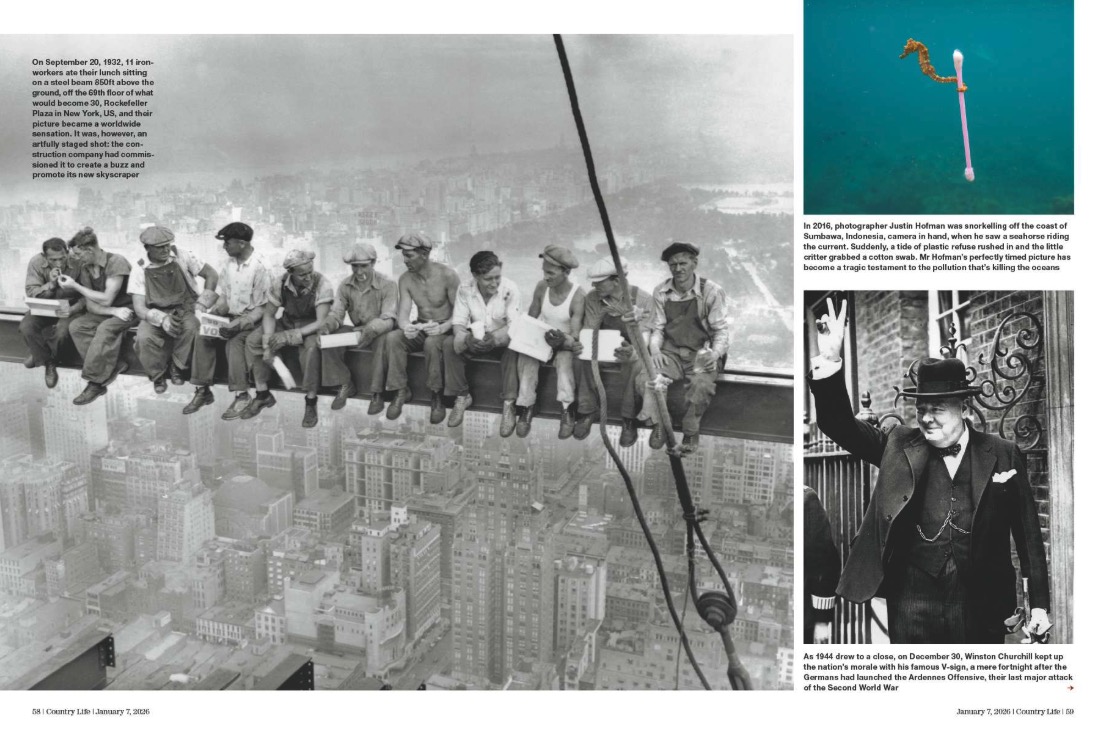
Relive the most memorable moments of the past 100 years with 22 incredible images chosen by Lucy Ford, Emily Anderson and Carla Passino
London Life
Will Hosie considers how water defines and divides Londoners and ponders the possible renewal of a rivalry between the National Gallery and Tate Modern, plus our writers have all you need to know this month
In the garden
Grow ground nuts, says Mark Diacono, and enjoy tubers with a taste of nutty new potatoes
Helen Allen’s favourite painting
The executive director of the US Winter Show picks an intriguing portrait sporting a quizzical look
Country-house treasure
John Goodall is captivated by the fighting cats in a 17th-century mosaic above the Long Library fireplace at Holkham Hall, Norfolk
The legacy: Agatha Christie
Kate Green acclaims murder-mystery-writing maestro Agatha Christie, whose 66 detective novels have sold more than two billion copies worldwide
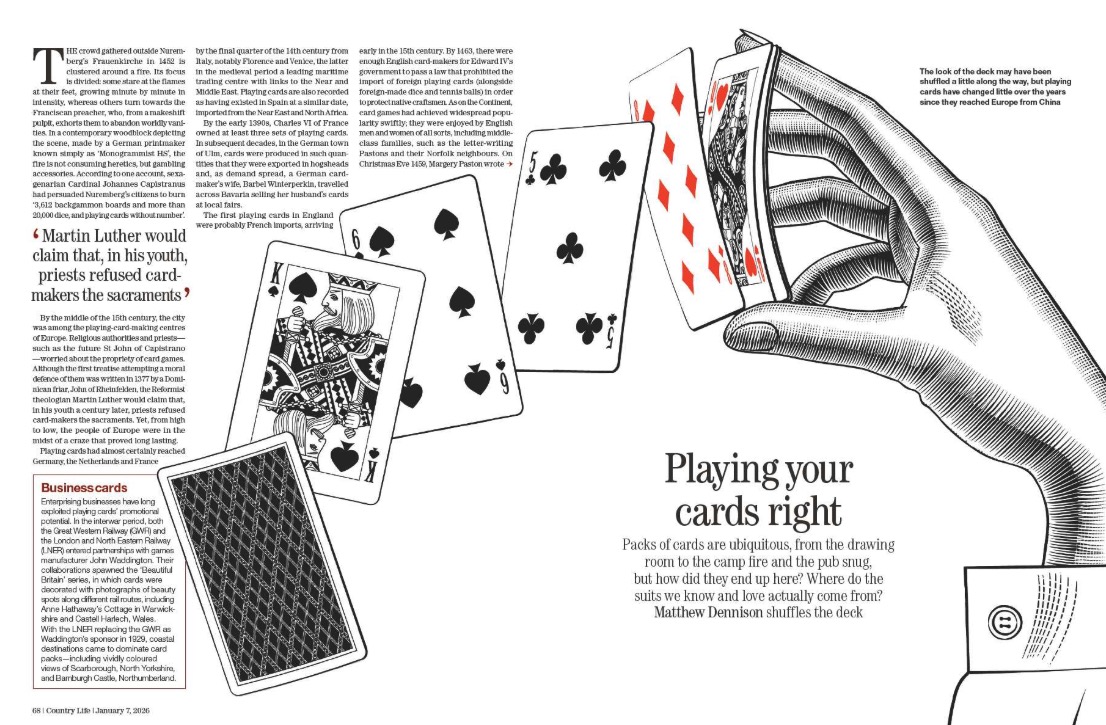
Playing your cards right
Matthew Dennison is holding all the aces as he traces the history of playing cards right back to 9th-century China
The good stuff
Glide seamlessly into 2026 with Amie Elizabeth White’s stylish selections for the ski slopes
Interiors
Giles Kime welcomes the world of possibilities offered by free-standing kitchens and Arabella Youens admires the boot room of a house in Gloucestershire
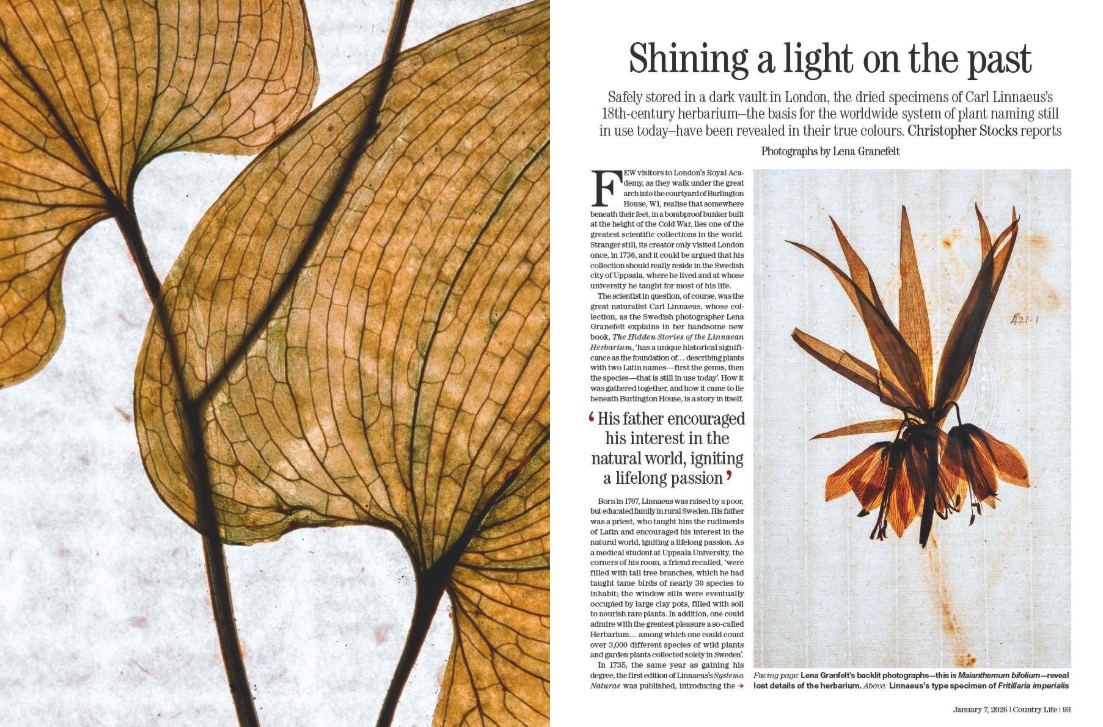
Shining a light on the past
Carl Linnaeus’s glorious 18th-century herbarium is showcased in a new collection of exquisite photographs by Lena Granefel, discovers Christopher Stocks
Travel
Pamela Goodman takes in peerless Himalayan panoramas from a remote luxury lodge in India and, in her monthly column, wonders what the Normans did for us
Arts & antiques
Actor and poet Leigh Lawson tells Carla Passino why he will never part with memorabilia dedicated to music-hall queen Marie Lloyd, his great-aunt
Scale model
Abundant mackerel was once greeted with garlands thrown into the sea. David Profumo profiles Scomber scombrus
Voters voted for it, even if they weren’t sure what it was. But maps are the ideal metaphor for our models of what the world might be. By Adam Gopnik
Marjorie Taylor Greene’s Big Breakup
The congresswoman split with the President over the Epstein files, then she quit. Where will she go from here? By Charles Bethea
The Making of the First American Pope
Will Pope Leo XIV follow the progressive example of his predecessor or chart a more moderate course? His work in Chicago and Peru may shed light on his approach. By Paul Elie
THE NEW YORK TIMES MAGAZINE:The 1.4.26 Issue features the untold story of how Jeffrey Epstein got rich; the Rhinelander v. Rhinelander trial, one of the most scandalous trials of the Jazz Age; Supreme Court lawyer Thomas Goldstein’s double life as a high-stakes gambler; and more.
For 40 years, Christian Zionism was a powerful force in American politics. A new generation on the right is taking cues from elsewhere. By Jonathan Mahler
News, Views and Reviews For The Intellectually Curious











 Boomers Daily