Category Archives: Architecture

Travel & Architecture Video: New Zealand Eco-Lodge “Te Arai” (2020)

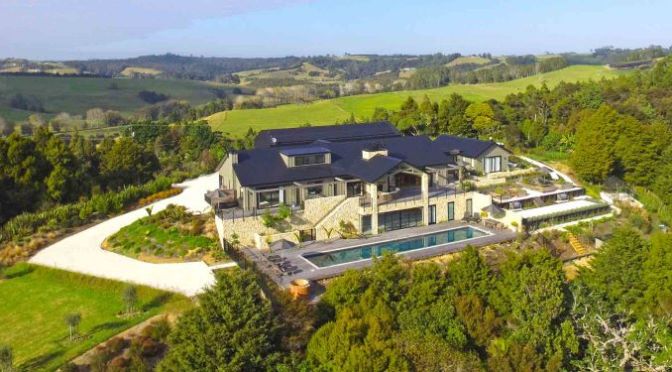
Grand Designs New Zealand – Te Arai: Tuscan Lodge Cathy and Vince Moores strive to create a sumptuous Italian style villa surrounded by beautiful mature gardens, but their budget takes on a life of its own, threatening to turn their long awaited dream into a nightmare.

Te Arai Lodge is an eco-friendly oasis offering boutique luxury and warm hospitality, only 1 hour 15 minutes north of the Auckland harbour bridge. Surrounded by over 20 acres of ancient podocarp forest and native bush, Te Arai Lodge sits on an elevated ridge with panoramic views across the rolling hills of the Brynderwyn Ranges out to the stunning beaches and surrounding islands of the Mangawhai coast.

We welcome our guests to experience a homestay boutique luxury lodge like no other. One that is inspired by the beauty of the surrounding native flora and bird life, our passion for sustainability and organic garden-to-table dining, and our love of hospitality and meeting people from all over the world.

With authentic personal service from the owners Vince & Kathy Moores, their family and a team of carefully chosen staff, Te Arai Lodge creates a special escape for those seeking the finest comforts without compromising the environment.
Website

Top Architectural Design: “Hedonistic House” On Aegina Island, Greece

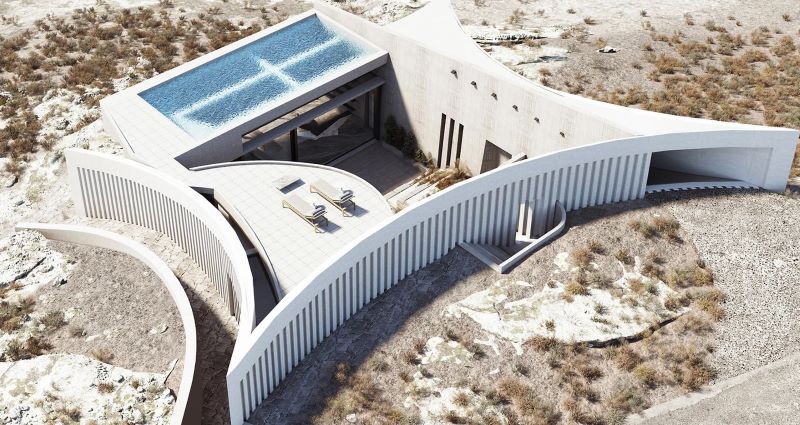
The holiday home located in the area of ​​Agioi Apostoloi in Aegina is organized around a central patio. The dialogue with the natural terrain of the plot as well as the unobstructed visual views of the land were elements crucial to the design.

​The visitor enters from the highest point of the patio from where the movements are distributed around the three living areas of the house – the master bedroom, the guest rooms and the lounge area – and the swimming pool. The morphology of the patio follows the outer sloping terrain and as it gradually descends through a path of terraces and outdoor seating areas leads the visitor to the view.

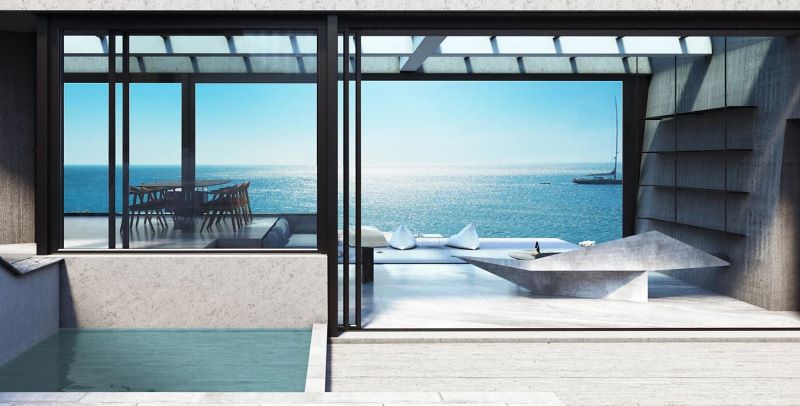
Its final level, in combination with the airy living room, constitutes an expanded covered balcony to the sea. Its transparent roof bears the pool-observatory. The patio functions as a vital living space of the residence and so does the rooftop swimming pool.

The bedrooms maintain their privacy while at the same time referring to the heart of the whole – the patio and the sea view. The section of the house levels creates an internal microcosm of spaces and movements, constituting a path that can bypass the enclosed spaces and end up outside the plot around the side of the daily activities volume.

The morphology of the complex expresses the function of each individual space housed under it while the selected rough materials set up a direct dialogue with the island’s topos. The individual volumes are embraced by a dynamic curved, unifying outer skin that holds the whole together and forms a characteristically acute, yet silent gesture of a human intervention on the natural landscape.  

Aegina_Ayli_UP-Sunset_FINAL.jpg

Website

Top Home Tour Videos: “Glass House On Stony Lake” In Canada (2020)

Filmed and Edited by: Kirsten Dirksen

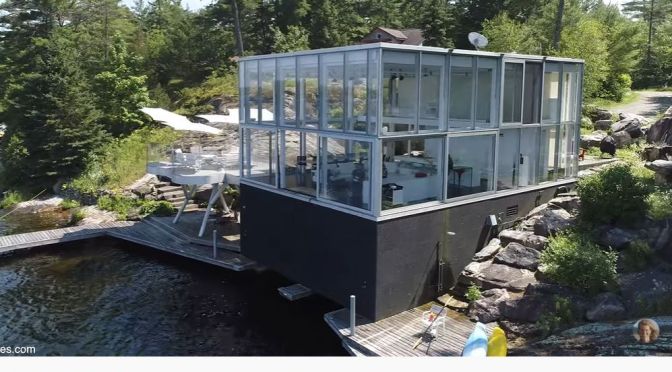
To create a photography studio with maximum daylight, Larry Williams built a glasshouse. Doubling as a boat garage (the lower floor), it hugs the lake’s edge. Viewed from the inside, the outside world tumbles in: the wake of a powerboat ripples up to the window, kayakers wave as they pass, a child jumps from the dock. Toward the back of the house, granite invades the view: the home is built on top of the Canadian Shield- a swath of ancient rock stretching across half of Canada.

Williams speaks proudly of the 300 million-year-old limestone and 3 billion-year-old granite outside his door. To heat and cool the home, architect Pat Hanson relied on a geothermal system: tubes of water snake into the lake to benefit from the lake floor’s nearly constant year-round temperature. In summer, the water in the closed-loop system is cooled by the lake and in winter it is warmed. The granite floor acts as a heat sink to slowly radiate the sun’s energy through the house during the evening. The white roof reflects light and heat to keep the place cool during summer.

To create a home inside four walls of glass, Hanson placed the domestic functions inside a floating cube supported by steel beams so as not to touch the walls. Downstairs, it houses the kitchen and guest bath and upstairs, an open bedroom. The stairway is bathed in Corian which continues upstairs with a Corian bathtub and bed structure doubling as sculpture. Large sliding fritted glass doors close to provide privacy for the mezzanine bedroom, though are typically left open to allow for natural ventilation.

Website: https://www.gh3.ca/work/boathouse-studio

Top Historic Home Video Tours: Santa Barbara’s “Villa Solana”, Built In 1914

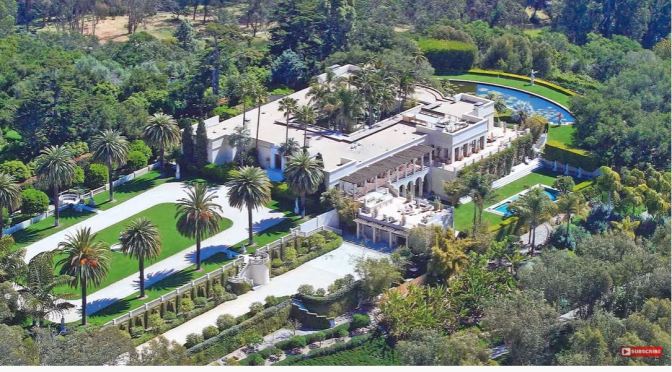
Set Privately on a Lush Knoll Top Boasting Sweeping 360 Views of the Pacific. Built in 1914 by Prominent Santa Barbara Native Frederick Forrest Peabody and Designed by Architect Francis T. Underhill, the 22,000-square-foot Estate at 256 Eucalyptus Hill Drive, Which is Known as Solana, Was a Precursor to Other Sprawling West Coast Properties Such as Hearst Castle and the Getty Villa. Located on an 11.2-acre Knoll-top Property, the Castle-like Compound Offers 360-degree Views of the Pacific Ocean and Santa Ynez Mountains. From 1958 to 1978, the Estate Served as the Site of a Prominent American Think Tank, and Revered Guests Ranging From John F. Kennedy to Martin Luther King Jr. Visited to Discuss Pressing Policy Issues.

Top Small Home Design: “LEWISHAM POD” – 430 SF Of “Pure Tasmania” (Video)

Perched on the side of a hill in the seaside town of Lewisham, 40 minutes’ drive from Hobart, is a new little house that’s getting a lot of attention. A wealth of high-end design and curated materials deliver warmth, and an outside-in philosophy brings the rugged beauty of Tasmania’s seascape into the palette. It’s no wonder it features in this year’s TV Series Grand Designs.  

Owner Alice Hansen wanted to create a home that was small and beautiful – a celebration of what Tassie is.

“I wanted the house to let Tassie do the talking. I wanted simple lines with not too much going on so that nature could be drawn in. I wanted the house to be a shelter more than anything else. To cocoon me from the outside, but not detract from the external environment,” says Alice. “I also wanted an outdoor bath, and to be able to see the stars from my bed at night.” 

Website

The Future Of Cities: “BiodiverCity” In Malaysia – “Urban Lilypad Islands”

BiodiverCity is conceived as an Urban Mosaic of three diverse islands, and a set of urban design guidelines for mixing programs, addressing pedestrian and mobility networks, building sustainably and harvesting resources. The three islands bring together mixed-use districts, establishing habitat connectivity and supporting edge ecologies in reserves, parks, corridors and urban plazas.

The Channels, BiodiverCity’s first island, is constructed in three complementary phases: in Phase 1, Active Destinations include a wave pool and technology park; in Phase 2, a Civic Heart establishes governance and research institutions in the area; and in Phase 3, a Cultural Coast builds upon the heritage and vibrant creative energy of Penang’s George Town to create a regional and international draw.

As the heart of the district, the Channels’ 500-acre digital park includes spaces for research, development and local business opportunities. The Mangroves, BiodiverCity’s second and central island dedicated to businesses, is organized around a network of sheltered urban wetlands, creating suitable environments for its namesake Mangrove forests—an important natural infrastructure that doubles as effective powerhouses for sequestering more than four times as much carbon as a typical forest.

At the center of the Mangroves, the Bamboo Beacon hosts meetings, conferences and major events—broadcasting the knowledge developed in BiodiverCity out to the world. The buildings in BiodiverCity will be designed to perform efficiently and will to a large extent be constructed by low-carbon materials such as bamboo and Malaysian timber in combination with green concrete, a sustainable alternative comprised of industrial waste and recycled materials. By encouraging green roofs, facades, public and private open spaces, the islands can form a nearly continuous habitat mosaic feeding back into the forests, beaches, riparian zones and estuaries at the island’s edges.

The Laguna, BiodiverCity’s westernmost island, is an oasis for ecological living, organized around a central marina. Eight smaller islands form a miniature archipelago, where floating, stilted and terraced housing takes advantage of the natural setting of Tanjung Gertak Sanggul.

Source by BIG – Bjarke Ingels Group.

English Country Houses: “Another Country” CEO Paul de Zwart’s ‘Hideaway’ Home In Dorset (Video)

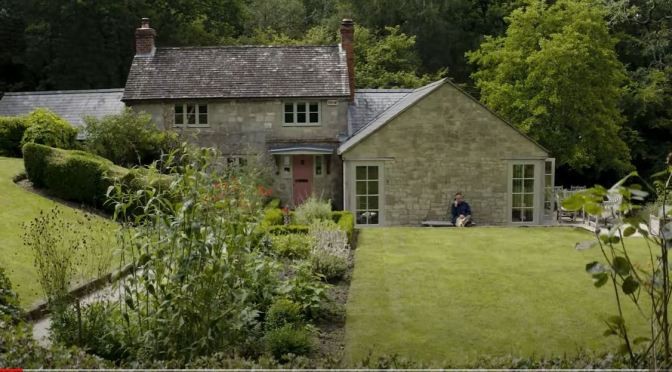
See how since buying the house with his wife, managing director of creative agency Winkreative, Ariel Childs, 20 years ago, Paul de Zwart has transformed a 17th-century cottage into a refined take on the English country house idiom, with interiors that bear the mark of the couple’s desire for contemporary country living, where wellies are as at home as a cocktail shaker.

 London-based entrepreneur Paul de Zwart crystallized the concept for his fledgling furniture company, Another Country, while searching for some simple bedside tables and stools for his country house. “I realized there was a dearth of well-made, well-priced design with a modern craft heritage,” he says. His solution? An affordable line of pared-down pieces that are handmade in England from sustainable woods. “We’re going for timeless over trendy.”

Website

Future Housing: “Mars Habitat” By Hassell Studio

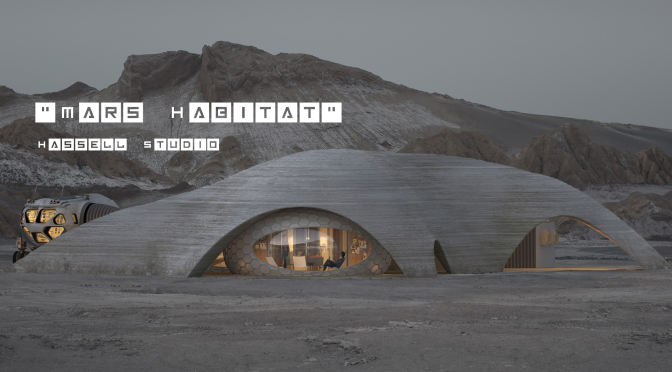
We set out to design the perfect habitat for space explorers on the red planet as part of NASA’s international 3D Printed Habitat Challenge.

Our team, in collaboration with structural engineers Eckersley O’Callaghan (EOC), was shortlisted to design the world’s first human home on Mars. In our design, an external shell made from local Martian regolith would be built in advance by autonomous robots before exploration teams arrived to construct the interior – a series of inflatable ​‘pods’ containing everything for work and life on Mars.

Our aim was to bring a more human element to space design, typically all about maximum efficiency and performance. Our habitat goes far beyond just ticking the boxes for safety and survival. It’s a home away from home where astronauts can carry out the most important work in the history of space exploration.

Website

Urban Design: Shipping Container Turned Into Rustic Cafe In Taiwan

Imagination of walking towards nature——

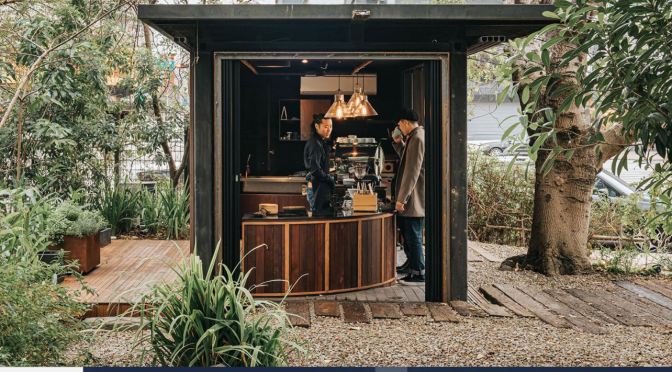
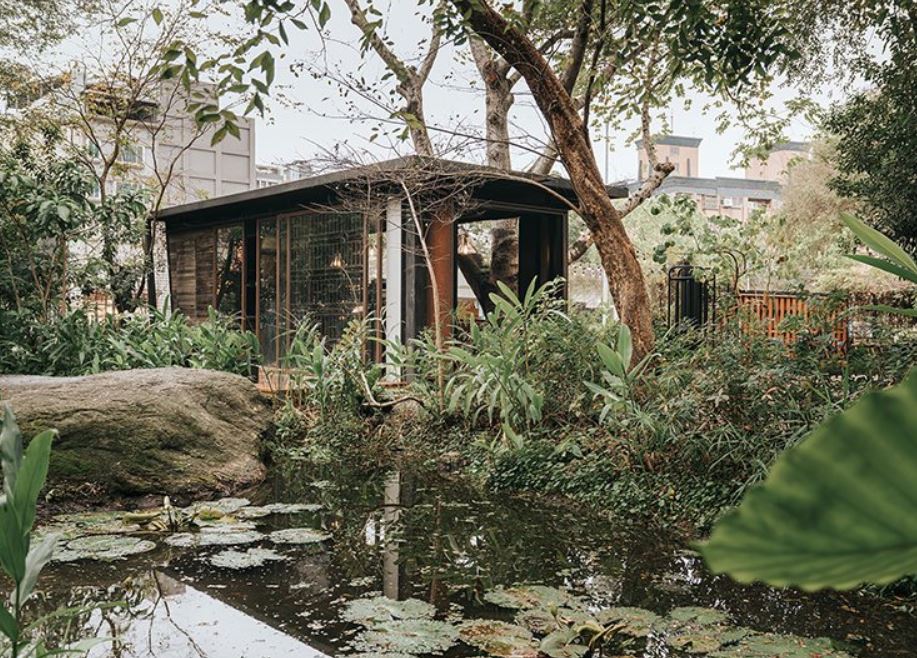
From the edge of the city as a starting point, an invisible path is created that stretches to the forest, along the sleepers, passing by the trees, and winding in freely in accordance with the original terrain, because of the old container buildings opened by this path The body, the ambiguity of the boundary instantly permeates with the surrounding environment, and people, sunlight and air flow in the natural place like this.

This is a single but not monotonous space. The coffee shop is converted from old containers. It uses rusty iron that echoes the original material as a contrast. The logs that change the quality of the space are used as sections to provide a coffee shop. Representing the soul, the continuously extending bar fully presents the barista’s posture, and the linear free flow also gives this store its exclusive posture and appearance.

Through the formation of individual terrain and the creation of tiny corners, it produces freedom like walking in nature, and develops a rich and diverse space experience. In this rare urban corner, take a breather, take your own way, or Stop or go and find your own place.

Website