Preview: New York Times Magazine – June 4, 2023

Image

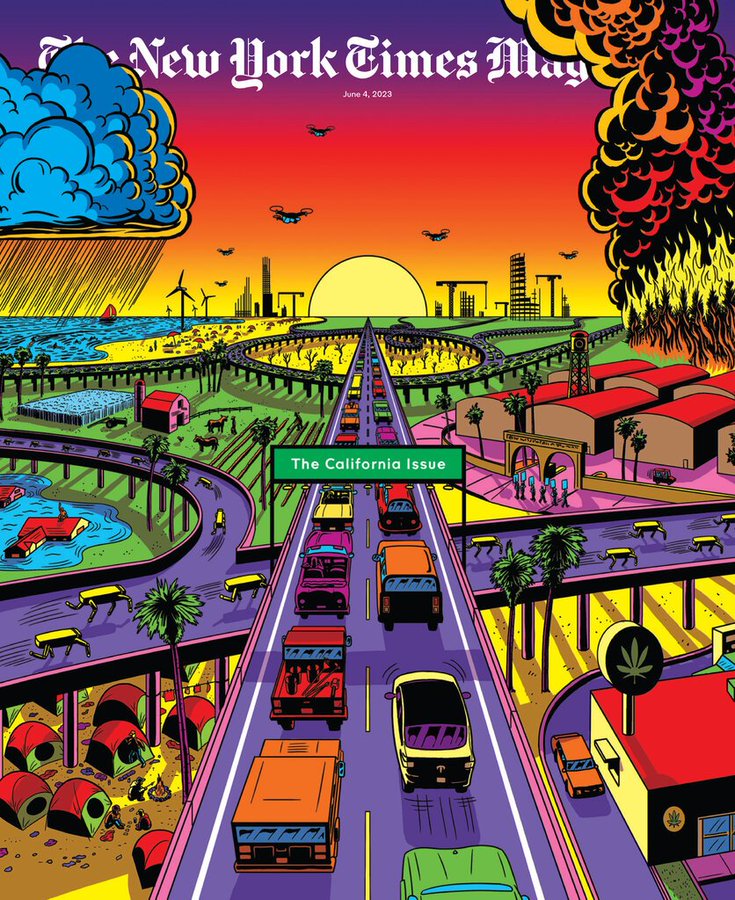
THE NEW YORK TIMES MAGAZINE (June 4, 2023) – California is the place where the future happens, for good and ill. That’s part of its magic. Read our first-ever California Issue to find out what roads the state will take us down next.

Inside: A fight over a parking lot that explains the housing crisis; the future of California’s power to shape national policy; how the state is adapting to a warming world — and more.

California Builds the Future, for Good and Bad. What’s Next?

An illustration of a California-inspired scene: wildfires, cars on a highway, the writer’s strike in Hollywood, a tent city, drones in the sky, flooding and a marijuana dispensary.

From reparations to tax revolts, the Golden State tries out new ideas all the time. What roads will its latest experiments send us down?

By Laila Lalami

I remember my first glimpse into the future. In August 1992, when I arrived in California as a student, I discovered during orientation that the university required all incoming students to have something called an email account. To access it, I had to call up a text-based mail client on Unix, using a series of line commands. If I needed a file that sat on a university computer in New York, I could use file transfer protocol to download it in Los Angeles, the whole process taking no more than a few minutes. That’s brilliant, I remember thinking.

Can the ‘California Effect’ Survive in a Hyperpartisan America?

A collage illustration showing the California capitol, the Golden Gate Bridge and a surfer hitting the waves, among other California motifs.

For decades the state has been setting policy for the whole nation. Now red states are pushing back.

By Conor Dougherty

For a while this winter, seemingly every text message that Buffy Wicks received asked if she was running for Congress. Representative Barbara Lee, of California’s 12th District, which includes Oakland, had announced that she would enter the race for Dianne Feinstein’s soon-to-be-vacated Senate seat. This decision by Lee, who is 76, created a rare opportunity for the next generation of California Democrats to vie for federal office. And Wicks — a 45-year-old State Assembly member who lives in Lee’s district and was last re-elected with 85 percent of the vote — seemed like a natural candidate.
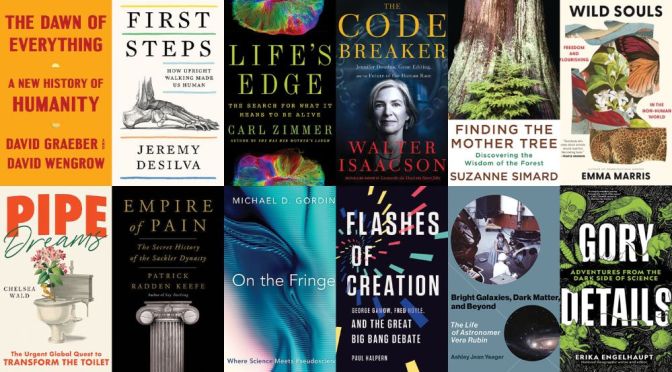
Reviews: Top New Science Books For Summer 2023

First page of PDF

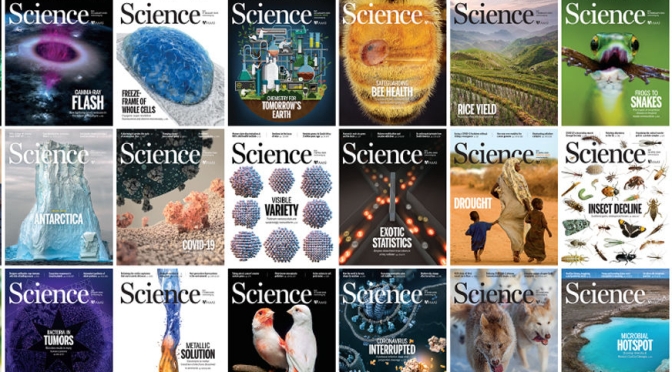
SCIENCE MAGAZINE – JUNE 1, 2023:

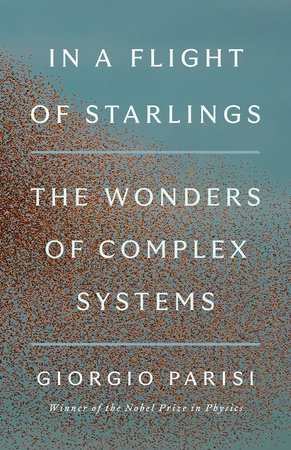
In a Flight of Starlings by Giorgio Parisi

In a Flight of Starlings: The Wonders of Complex Systems by Giorgio Parisi

From the 2021 Nobel Prize winner in Physics, an enlightening and personal journey into the practice of groundbreaking science

With In a Flight of Starlings, celebrated physicist Giorgio Parisi guides us through his unorthodox yet exhilarating work, starting with investigating the principles of physics by observing the flight of flocks of birds. Studying the movements of these communities, he has realized, proves an illuminating way into understanding complex systems of all kinds—collections of everything from atoms and planets to other animals, such as ourselves.

product image

I Feel Love: MDMA and the Quest for Connection in a Fractured World by Rachel Nuwer

 In I Feel Love, science journalist Rachel Nuwer separates fact from fantasy, hope from hype, in the drug’s contested history and still-evolving future. Evidence from scientific trials suggests MDMA, properly administered, can be startlingly effective at relieving the effects of trauma. Results from other studies point to its usefulness for individual and couples therapy, for treating depression, alcohol addiction, and eating disorders, and for cultivating personal growth. Yet scientists are still racing to discover how MDMA achieves these outcomes, a mystery that is taking them into the inner recesses of the brain and the deep history of evolution.

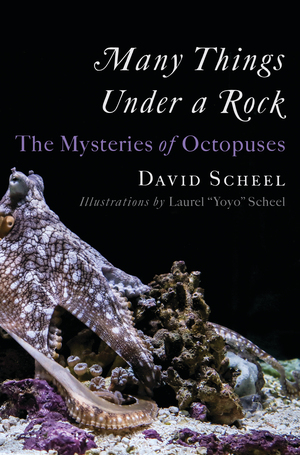
Many Things Under a Rock: The Mysteries of Octopuses by David Scheel

A behavioral ecologist’s riveting account of his decades-long obsession with octopuses: his discoveries, adventures, and new scientific understanding of their behaviors.

Of all the creatures of the deep blue, none is as captivating as the octopus. In Many Things Under a Rock, marine biologist David Scheel investigates four major mysteries about these elusive beings. How can we study an animal with perfect camouflage and secretive habitats? How does a soft and boneless creature defeat sharks and eels, while thriving as a predator of the most heavily armored animals in the sea? How do octopus bodies work? And how does a solitary animal form friendships, entice mates, and outwit rivals?

The Hidden History of Code-Breaking

The Hidden History of Code-Breaking: The Secret World of Cyphers, Uncrackable Codes, and Elusive Encryptions  by Sinclair McKay

A fascinating exploration of the uncrackable codes and secret cyphers that helped win wars, spark revolutions and change the faces of nations.

There have been secret codes since before the Old Testament, and there were secret codes in the Old Testament, too. Almost as soon as writing was invented, so too were the devious means to hide messages and keep them under the wraps of secrecy

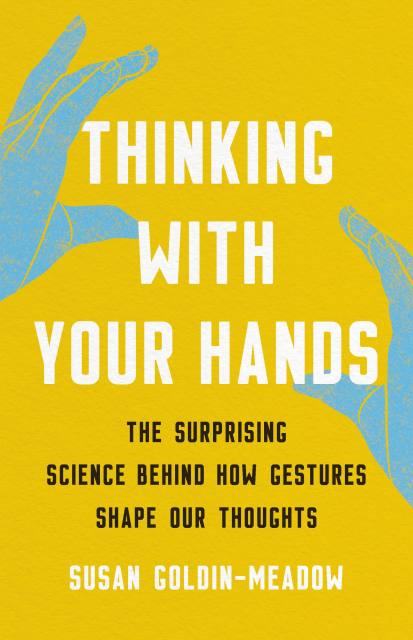
Thinking with Your Hands

Thinking with Your Hands: The Surprising Science Behind How Gestures Shape Our Thoughts by Susan Goldin

An astounding account of how gesture, long overlooked, is essential to how we learn and interact, which “changes the way you think about yourself and the people around you.” (Ethan Kross, bestselling author of Chatter)

In Thinking with Your Hands, esteemed cognitive psychologist Susan Goldin-Meadow argues that gesture is vital to how we think, learn, and communicate. She shows us, for instance, how the height of our gestures can reveal unconscious bias, or how the shape of a student’s gestures can track their mastery of a new concept—even when they’re still giving wrong answers. She compels us to rethink everything from how we set child development milestones, to what’s admissible in a court of law, to whether Zoom is an adequate substitute for in-person conversation.   

READ MORE ONLINE

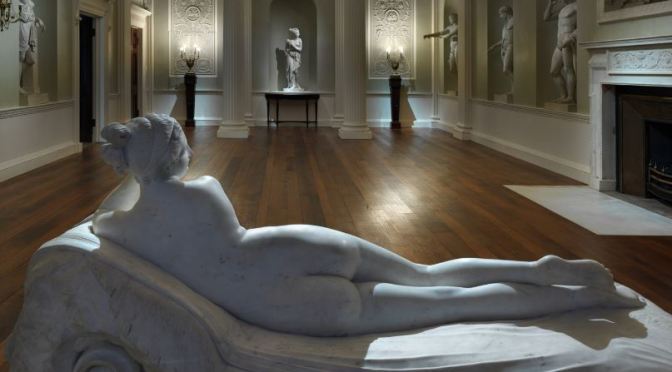
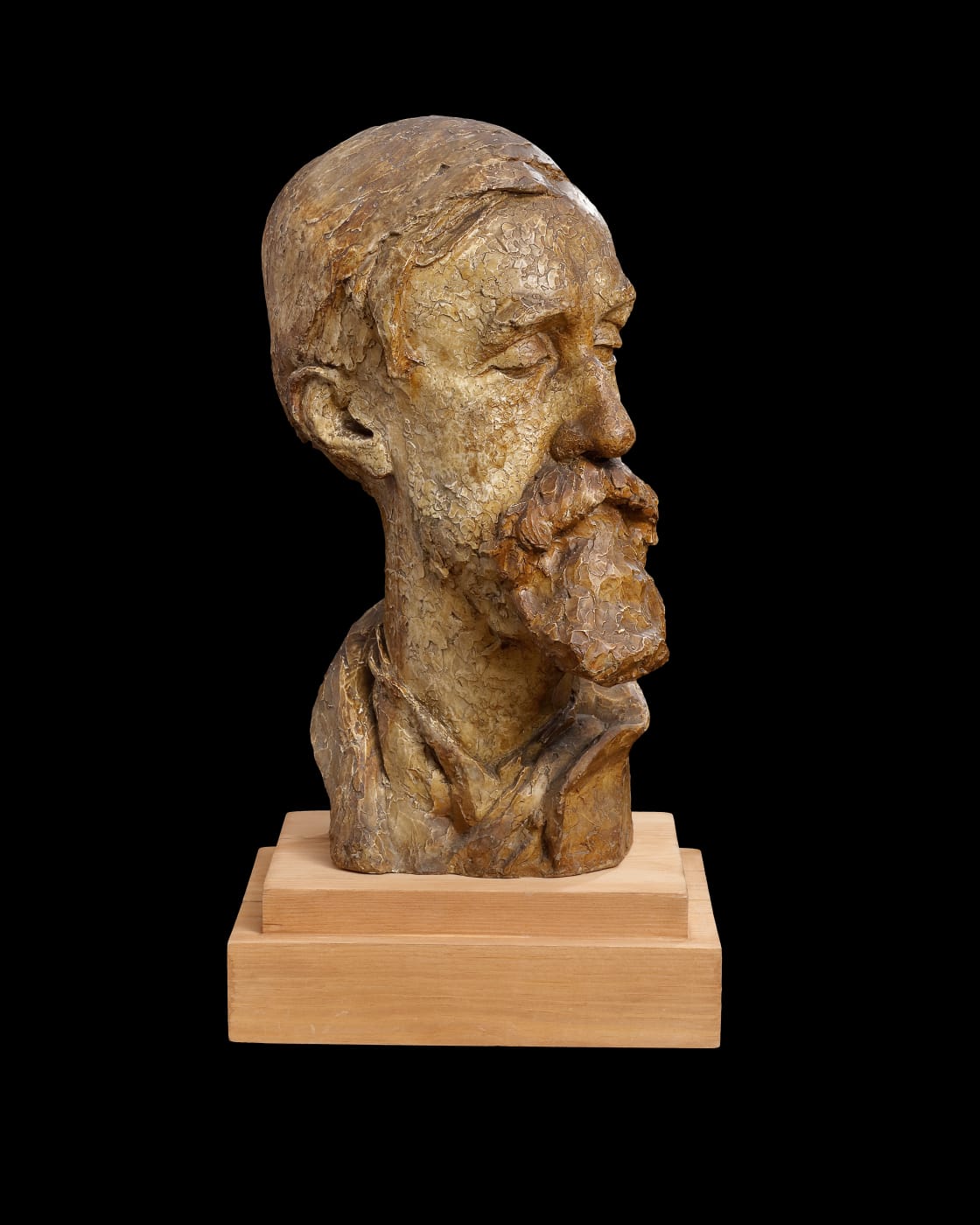
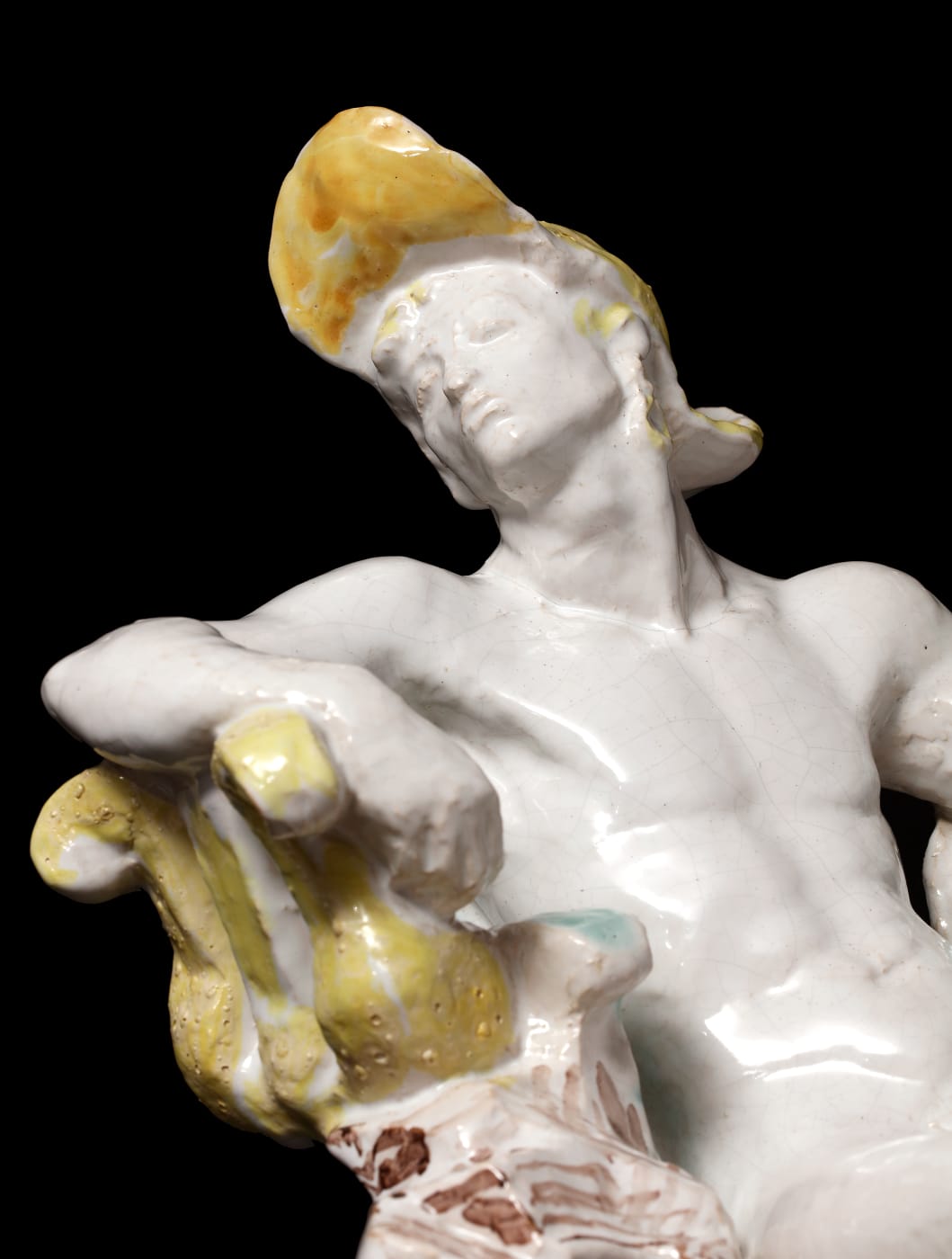
Sculpture Exhibitions: ‘Bloomsbury Stud: The Art Of Stephen Tomlin’ (2023)

Philip Mould & Co Films (June 2, 2023) – Starting off at Charleston House, where Stephen Tomlin’s friends, lovers, and sitters came together, this exhibition film traces Tomlin’s life and career, revealing the stories behind the artworks on display in ‘Bloomsbury Stud: The Art of Stephen Tomlin’, on view at the Philip Mould Gallery from 5th June until 11th August 2023.

Bloomsbury Stud The Art of Stephen Tomlin


Stephen Tomlin, the Bloomsbury group’s primary sculptor, immortalised the faces of Bloomsbury’s best-known characters, including Duncan Grant, Lytton Strachey and Virginia Woolf. With inexhaustible charisma, disarming good looks and undeniable talent, Tomlin captivated his contemporaries, and references to Stephen ‘Tommy’ Tomlin pepper countless biographies of 20th century figures.

However, until recently, that was where his story remained. Now, this exhibition aims to return Tomlin to the artistic spotlight where he belongs.

Previews: The Economist Magazine – June 3, 2023

Image

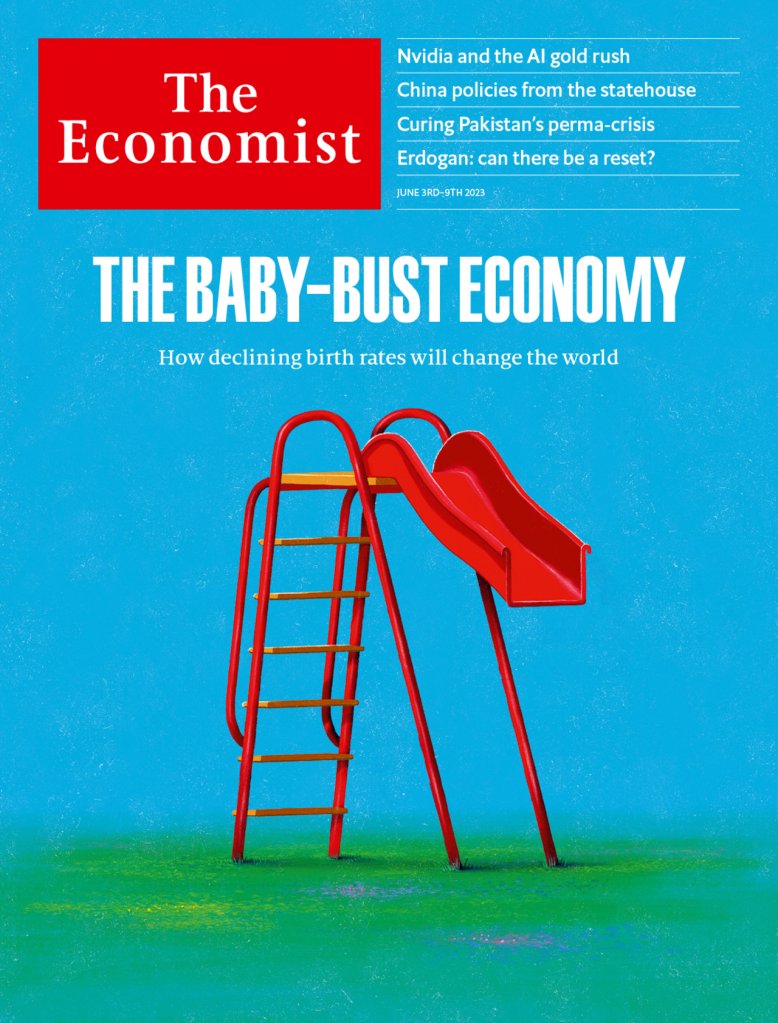
The Economist Magazine– June 3, 2023 issue: The baby-bust economy: How declining birth rates will change the world.

Global fertility has collapsed, with profound economic consequences

What might change the world’s dire demographic trajectory?

In the roughly 250 years since the Industrial Revolution the world’s population, like its wealth, has exploded. Before the end of this century, however, the number of people on the planet could shrink for the first time since the Black Death. The root cause is not a surge in deaths, but a slump in births. Across much of the world the fertility rate, the average number of births per woman, is collapsing. Although the trend may be familiar, its extent and its consequences are not. Even as artificial intelligence (ai) leads to surging optimism in some quarters, the baby bust hangs over the future of the world economy.

How to make the re-election of Recep Tayyip Erdogan less bad news

Turkish President and People's Alliance's presidential candidate Recep Tayyip Erdogan gestures to supporters at the presidential palace, in Ankara, Turkey, Sunday, May 28, 2023. Turkey President Recep Tayyip Erdogan won reelection Sunday, extending his increasingly authoritarian rule into a third decade as the country reels from high inflation and the aftermath of an earthquake that leveled entire cities. (AP Photo/Ali Unal)

There is a chance for a partial reset

It certainly wasn’t fair. Nor was it entirely free. But, like it or not, the victory on May 28th of Recep Tayyip Erdogan in Turkey’s presidential election is a fact. For the next five years Turkey, Europe and the wider world will have to deal with a prickly and authoritarian populist. That is bad news on many fronts: economically, democratically and regionally. And yet pragmatists have a duty to search for chinks of light in the gloom.

It’s not just a fiscal fiasco: greying economies also innovate less

That compounds the problems of shrinking workforces and rising bills for health care and pensions

“Adam is a special child,” says the voice-over, as the camera pans across abandoned classrooms and deserted maternity wards. “He’s the last child born in Italy.” The short film made for Plasmon, an Italian brand of baby food owned by Kraft-Heinz, a giant American firm, is set in 2050. It imagines an Italy where babies are a thing of the past. It is exaggerating for effect, of course, but not by as much as you might imagine. The number of births in Italy peaked at 1m in 1964; by 2050, the un projects, it will have shrunk by almost two-thirds, to 346,000.

News: Asia Defense Summit, China-U.S. Tensions, OPEC Meeting, Nigeria President

The Globalist Podcast, Friday, June 2, 2023: Asia’s top security meeting, IISS Shangri-La Dialogue kicks off but China refuses to talk to the US on the sidelines.

Plus: several media groups are banned from Opec’s production meeting this weekend; we check in on how Nigeria’s new president is faring and we ask, “What is lake cow bacon?” 

The New York Times Front Page – Friday, June 2, 2023

Image

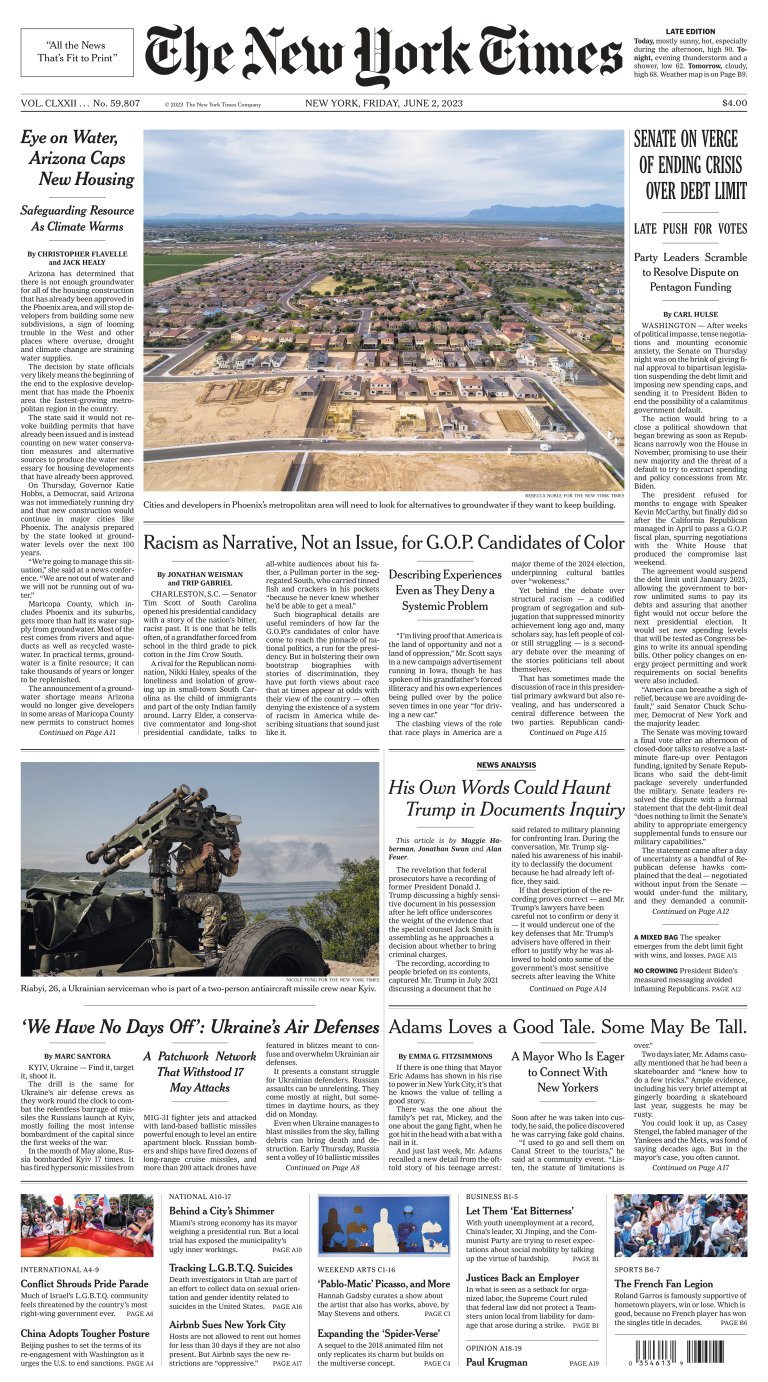
Arizona Limits Construction Around Phoenix as Its Water Supply Dwindles

Queen Creek, Ariz., a suburb of Phoenix, is projected to grow to 175,000 people from its current 75,000 — if it can find enough water.

In what could be a glimpse of the future as climate change batters the West, officials ruled there’s not enough groundwater for projects already approved.

NEWS ANALYSIS

McCarthy Emerges From the Debt Limit Fight With Victories, and Some Wounds

The deal that Speaker Kevin McCarthy negotiated met his goal of cutting spending from current levels.

The speaker defied expectations and delivered a debt limit agreement that few thought he could manage, but left some of his Republican colleagues feeling betrayed.

Talk of Racism Proves Thorny for G.O.P. Candidates of Color

As candidates like Tim Scott and Nikki Haley bolster their biographies with stories of discrimination, they have often denied the existence of systemic racism in America while describing situations that sound just like it.

Mayor Adams Loves a Good Tale. Some of Them May Be Tall.

The New York City mayor has made an art form of telling stories about himself that are nearly impossible to verify, adding fresh details to often-told anecdotes.

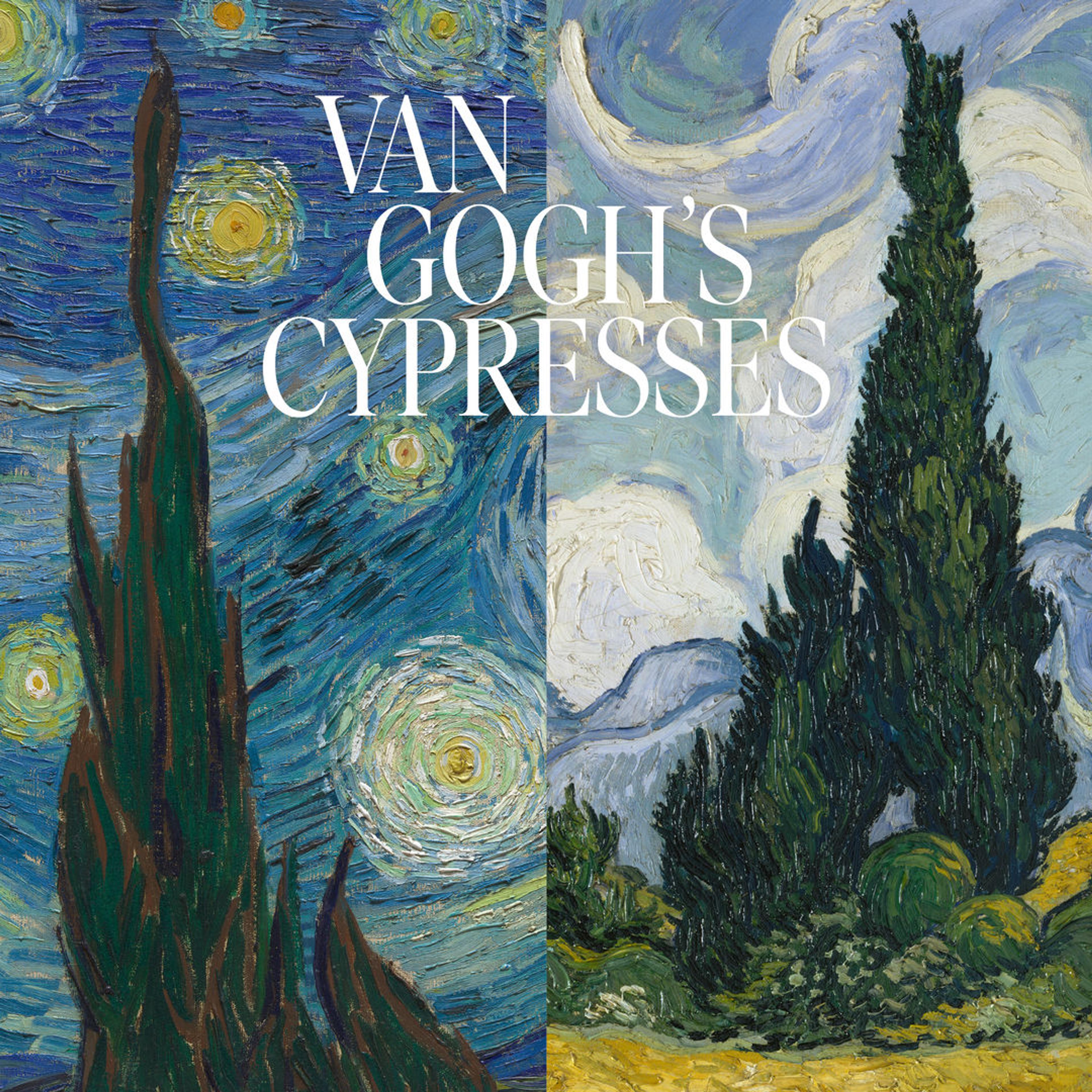
Museum Exhibition Tour: ‘Van Gogh’s Cypresses’

The Metropolitan Museum of Art Join Susan Alyson Stein, Engelhard Curator of Nineteenth-Century European Painting, to virtually explore Van Gogh’s Cypresses, the first exhibition to focus on the trees—among the most famous in the history of art—immortalized in signature images by Vincent van Gogh (1853–1890).

Van Gogh’s Cypresses

May 22nd – August 27th, 2023

Such iconic pictures as Wheat Field with Cypresses and The Starry Night take their place as the centerpiece in a presentation that affords an unprecedented perspective on a motif virtually synonymous with the Dutch artist’s fiercely original power of expression. Some 40 works illuminate the extent of his fascination with the region’s distinctive flamelike evergreens as they successively sparked, fueled, and stoked his imagination over the course of two years in the South of France: from his initial sightings of the “tall and dark” trees in Arles to realizing their full, evocative potential (“as I see them”) at the asylum in Saint-Rémy.

Juxtaposing landmark paintings with precious drawings and illustrated letters—many rarely, if ever, lent or exhibited together—this tightly conceived thematic exhibition offers an extraordinary opportunity to appreciate anew some of Van Gogh’s most celebrated works in a context that reveals the backstory of their invention for the first time.

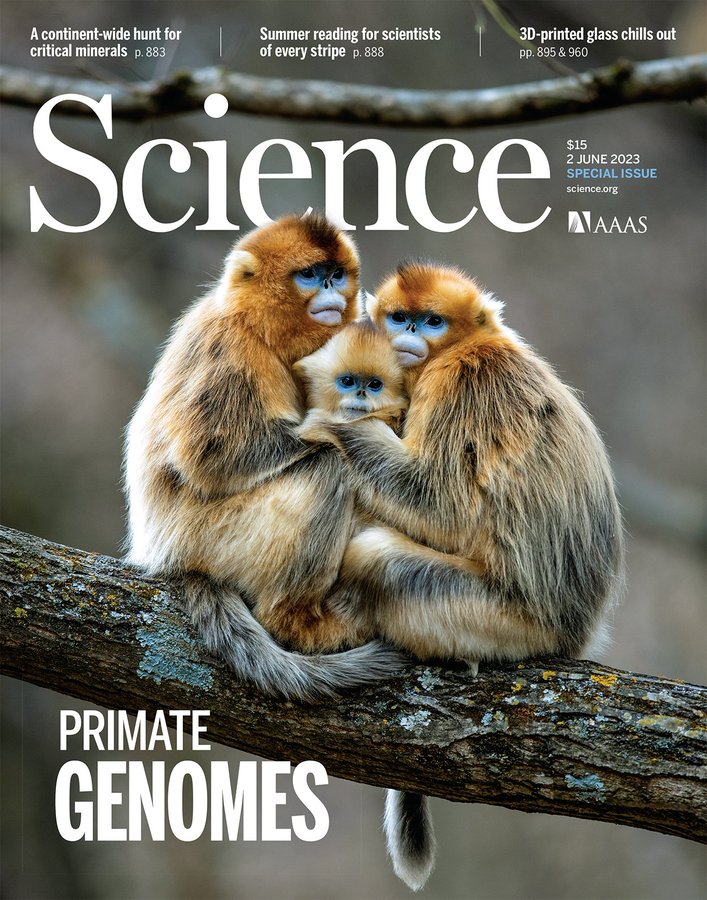
Research Preview: Science Magazine – June 2, 2023

Image

Science Magazine – June 2, 2023 issue: The snub-nosed monkey genus Rhinopithecus comprises five allopatric and morphologically differentiated species, the black-white snub-nosed monkey, the black snub-nosed monkey , the golden snub-nosed monkey, the gray snub-nosed monkey, and the Tonkin snub-nosed monkey. 

Understanding our own order

Humans are primates. If we weren’t able to do things like write poetry and drive cars, we would likely be classified as another species of great ape, along with our closest cousins—chimpanzees, bonobos, gorillas, and orangutans. Thus, understanding the genomes, evolutionary history, sociality, and, some might argue, even ecology of modern primates greatly informs our understanding of ourselves.

A cool path for making glass

Brent Grocholski

Printing glass with additive manufacturing techniques could provide access to new materials and structures for many applications. However, one key limitation to this is the high temperature usually required to cure glass. Bauer et al. used a hybrid organic-inorganic polymer resin as a feedstock material that requires a much lower temperature for curing (see the Perspective by Colombo and Franchin).

A super Sonic circadian synchronizer

Sonic Hedgehog signaling and primary cilia control the core mammalian circadian clock

Virtually all mammalian physiological functions fall under the control of an internal circadian rhythm, or body clock. This circadian rhythm is governed by master neural networks in the hypothalamus that synchronize the activity of peripheral clocks in cells throughout the body.

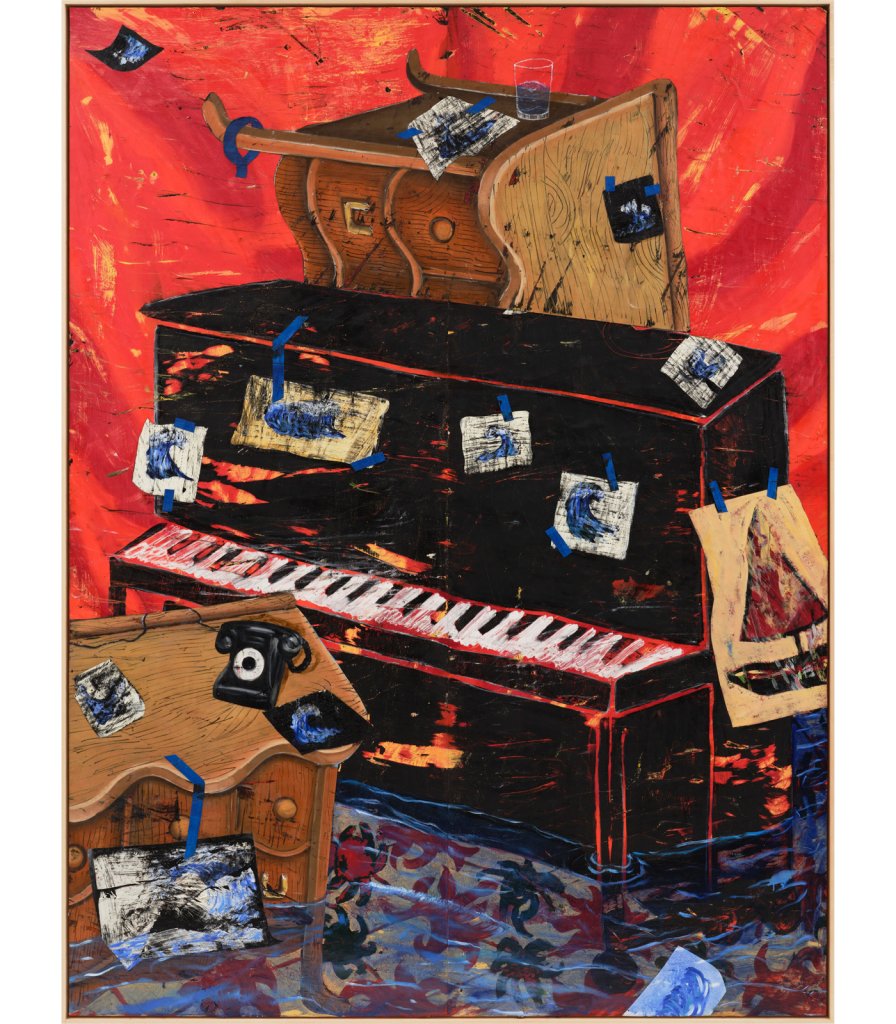
Art: ‘Angel Otero – The Sea Remembers’ In Hong Kong

Hauser & Wirth Hong Kong (June 1, 2023) – Angel Otero is known for his signature approach to visual storytelling, synthesizing magical realism and abstraction, the observed and the imagined, and the past and the present.

ANGEL OTERO – THE SEA REMEMBERS

1 JUN – 29 JUL 2023

Beginning 1 June, Hauser & Wirth Hong Kong presents ‘The Sea Remembers,’ Otero’s first solo exhibition in Asia since he joined the gallery in 2022. Through a labor-intensive process of laying down, scrapping and collaging oil paint, Angel Otero’s works are rooted in abstract image making and engage with the idea of memory through addressing art history, as well as his own lived experience.

The New York Review Of Books – June 22, 2023

Image

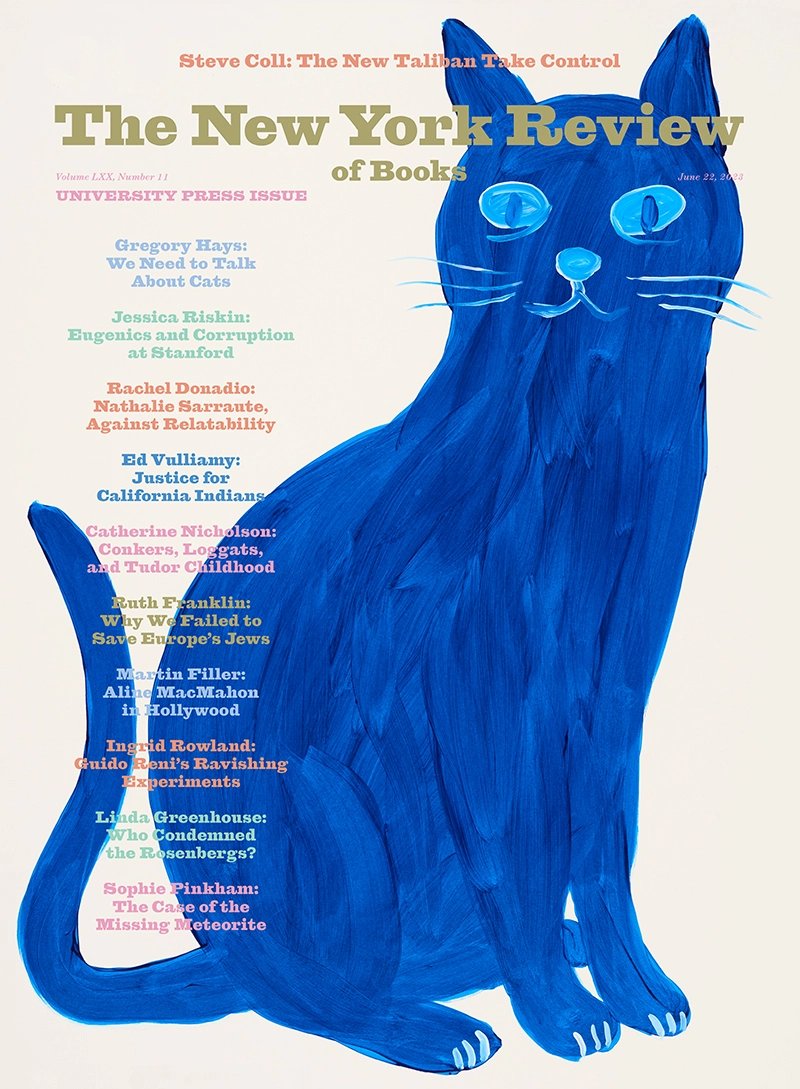
The New York Review of Books – June 22, 2023 issue: Fara Dabhoiwala on the ingenious index, Ingrid D. Rowland on Guido Reni’s questing soul, Rachel Donadio on Nathalie Sarraute’s sensual eviscerations, Steve Coll on the Taliban’s second emirate, Jessica Riskin on the poisoning of Jane Stanford, Ruth Franklin on Ken Burns’s The US and the Holocaust, Gary Saul Morson on Tolstoy’s conversion, Ed Vulliamy on the Native Americans of California, Linda Greenhouse on judging the Rosenbergs, Gregory Hays on our feline friends, poems by Shane McCrae and Fernando Pessoa, and much more.

Life Is Short. Indexes Are Necessary.

By Fara Dabhoiwala

Index, A History of the: A Bookish Adventure from Medieval Manuscripts to the Digital Age by Dennis Duncan

In his new history of the index, Dennis Duncan traces its evolution through the constantly changing character of reading itself.

In 1941 an ambitious Philadelphia pediatrician, the wonderfully named Waldo Emerson Nelson, became the editor of America’s leading textbook of pediatrics. For the next half-century the compilation of successive editions of this large volume advanced his career, consumed his weekends, and encroached heavily on his domestic life. 

Who Are the Taliban Now?

By Steve Coll

Taliban members walking past a mural on the former US embassy, Kabul

The Return of the Taliban: Afghanistan After the Americans Left by Hassan Abbas

Hassan Abbas’s book surveys the second Islamic Emirate’s ideology and leading personalities and probes its internal tensions.

Nearly two years after the Taliban’s return to power in Kabul, the UN refers to the regime only as “the de facto authorities,” to avoid any hint of formal recognition of the Islamic Emirate of Afghanistan, as the Taliban call their government. By any name, the Taliban today control Afghanistan’s territory, as well as federal ministries and local administrations. They also preside over a nation in severe crisis. Food insecurity haunts at least half of the population; a country shattered by more than four decades of war again faces the shadow of famine.