
Audio

 In a WTOP-FM interview, Health Affairs Editor-In-Chief Alan Weil assesses how consumers may (or may not) benefit from two long-anticipated rules, recently unveiled by the Trump Administration, that increase price transparency for both hospitals and insurers.
Sleep Podcasts: Older Adults Are More Likely To Suffer From Chronic (Long-Term) Insomnia
 Beyond the constant tossing and turning of a sleepless night, it might surprise you to know that insomnia is affecting a fair hunk of the Australian population. A recent study released by the Sleep Health Foundation found that 15 per cent of us suffer from chronic insomnia disorder, and very few people are choosing to access help.
Guests:
Professor Robert Adams, Professor in Respiratory and Sleep Medicine for Flinders University, and lead researcher for Chronic Insomnia Disorder in Australia study for Sleep Health Foundation
Dr Moira Junge, health psychologist specialising in treating sleep disorders, board member for Sleep Health Foundation

Podcasts: “LabGenius” CEO James Field On AI/Machine Learning Discovering New Medicines (Babbage)
 Researchers are using artificial intelligence techniques to invent medicines and materials—but in the process are they upending the scientific method itself? The AI approach is a form of trial-and-error at scale, or “radical empiricism”. But does AI-driven science uncover new answers that humans cannot understand? Host Kenneth Cukier finds out with James Field of LabGenius…
Website: https://www.economist.com/podcasts/2019/11/27/the-end-of-the-scientific-method

Health Diagnosis Podcasts: Dysautonomia (Invisible Illness) Affects Up To 3 Million Americans
From a Milwaukee Journal Sentinel online article:

“Dysautonomia is probably significantly more common than we realize,” says Jeremy Cutsforth-Gregory, a neurologist at Mayo Clinic in Rochester, Minnesota. “I think it’s significantly underdiagnosed.” In about half of POTS cases, he adds, the patient’s disease grows out of the immune response to an infection.
Ryan Cooley, a doctor and co-director of the Dysautonomia Center at Aurora Medical Center in Grafton, says detecting the disorder is especially challenging because “typically there isn’t a dominant symptom or physical finding.”
Perhaps the most common clue to the disorder is that patients find that when they stand up from a chair their heart races and they feel light-headed.
To read more: https://www.jsonline.com/story/news/2019/11/14/invisible-illness-leaves-millions-undiagnosed-barely-functioning/2507547001/
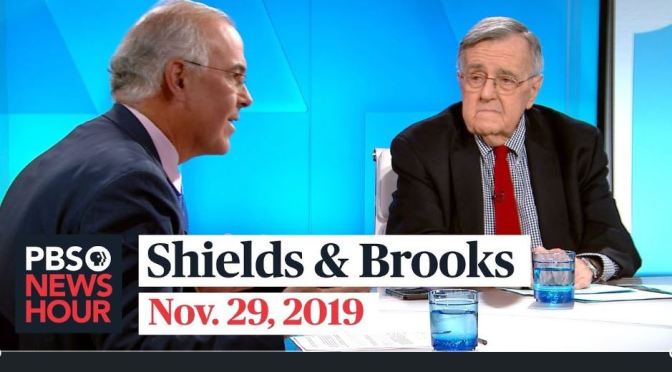
Top Political Podcasts: Mark Shields And David Brooks On The Latest In Washington (PBS)
 Syndicated columnist Mark Shields and New York Times columnist David Brooks join Judy Woodruff to discuss the week in politics, including public opinion and legal debate in the impeachment inquiry into President Trump, the shifting race among 2020 Democrats and what we’re thankful for during this holiday week.
Top Political Podcasts The Economist Asks: “What’s The Future Of The Republican Party?”
 AHEAD OF the 2020 American presidential election, John Prideaux, The Economist‘s US editor, talks to Bill Weld, a former governor of Massachusetts, Joe Walsh, a talk radio host and former Illinois congressman, and Mark Sanford, a former governor of South Carolina. While Donald Trump enjoys near 90% approval ratings among his party, can anyone challenge him for the Republican presidential nomination? And how has he changed what it means to be a Republican?
Anne McElvoy hosts. Runtime: 32 min
Website: https://www.economist.com/podcasts/2019/11/29/whats-the-future-of-the-republican-party

Online Shopping: “Amazon, Target, Walmart – The One-Day Shipping Battle” (WSJ Podcast)
 Wall Street Journal corporate bureau chief Marcelo Prince explains the competition between retailers Amazon, Target and Walmart to provide one-day shipping to customers during the holiday season.

Science Podcasts: NIH Scientist Loan Repayment Conflicts, Undersea Cables As Seismic Sensors
The National Institu tes of Health’s largest loan repayment program was conceived to help scientists pay off school debts without relying on industry funding. But a close examination of the program by investigative correspondent Charles Piller has revealed that many participants are taking money from the government to repay their loans, while at the same time taking payments from pharmaceutical companies. Piller joins Host Sarah Crespi to talk about the steps he took to uncover this double dipping and why ethicists say this a conflict of interest.
Sarah also talks with Nate Lindsey, a Ph.D. candidate at the University of California, Berkeley, about turning a 50-meter undersea fiber optic cable designed to move data into a sensor for activity in the ocean and the land underneath. During a 4-day test in Monterey Bay, California, the cable detected earthquakes, faults, waves, and even ocean-going storms.
For this month’s books segment, Kiki Sandford talks with Dan Hooper about his book At the Edge of Time: Exploring the Mysteries of Our Universe’s First Seconds.

Health Podcasts: Which Drug Prices Should Medicare Negotiate? (NE Journal Of Medicine)
From a New England Journal of Medicine article:
 Medicare negotiation of prescription-drug prices would bring U.S. government policies in line with those of other high-income countries, and the idea is popular with both the public and policy analysts. But it would represent a sea change for pharmaceutical firms, which will maintain that any threat to their pricing power will slow innovation.
Negotiating prices of 10 too-little drugs and 10 too-late drugs to levels currently paid in the United Kingdom would produce about $26.8 billion in savings in 2019 alone, most of which ($25.9 billion) would come from savings on drugs in the latter category. Over time, the drugs included could change. For instance, in 2020 this category might include Revlimid (lenalidomide), which generated $6.5 billion in 2018 U.S. sales; its price in the United Kingdom is 32% of that in the United States.
Americans all along the political spectrum favor allowing Medicare to negotiate the prices it pays for prescription drugs.1 In September, House Speaker Nancy Pelosi (D-CA) introduced what is now called the Elijah E. Cummings Lower Drug Costs Now Act of 2019 (H.R. 3), and the bill would have Medicare do just that.
Although there are draft pieces of legislation and regulation that take aim at the rising cost of drugs, H.R. 3 is the legislative tip of the spear for price negotiation. If it became law, Medicare would target drugs that claim the largest share of the health care budget and that face limited competition from generics or biosimilars. I propose an alternative set of drugs for price negotiation: those that have too little evidence to support full approval or are too late in their life cycle to justify continued high prices.
To read more: https://www.nejm.org/doi/full/10.1056/NEJMp1912736?query=recirc_inIssue_bottom_article

Top Political Podcasts: Mike Bloomberg Enters Crowded, And Skeptical Field (The Economist)
 MICHAEL BLOOMBERG, the billionaire former mayor of New York, has announced he is running for president. But he is late to join the race and not very popular with Democratic primary voters. We also look at TikTok, a wildly successful video-sharing app that some see as a threat to security in the Western world. And much of Switzerland is up in arms—about the reliability of the country’s coffee supply. Runtime: 20 min
 Boomers Daily