Tag Archives: The Local Project Videos

Tours: Fairweather House In Sydney, Australia (4K)

Stemming from an inside-out design approach, Fairweather House sees a 1940s Federation-era home reimagined with a modern kitchen. While extending the home, Pohio Adams Architects designs in careful consideration of its heritage and current use.

Video timeline: 00:00 – Introduction to the Home 00:56 – The Client Brief 01:18 – Reinvigorating the Original Home 02:28 – Outside-Inside Planning Approach 03:56 – The Glass Pavilion 04:29 – Landscape Architecture 05:04 – The Heart of the Home 05:35 – Materiality 06:13 – What the Architect is Most Proud Of

Set amongst the equally grand residences of Sydney’s Bellevue Hill, Fairweather House brings together the old and the new through a considered lens. Pohio Adams Architects elevates the interior design and architecture of the Federation-style home with refined, contemporary insertions such as a modern kitchen, creating a sense of stylistic coherence.

Architecturally, Pohio Adams Architects respects the heritage of the building whilst steering the design towards functionality and grandeur. The original front façade is retained, as well as three formal rooms towards the entrance of the property. Throughout the house, alterations are well-considered and benefit the home. The inserted modern kitchen accommodates the homeowners’ love of entertaining, whilst an added glass and steel pavilion offers an externally focused alternative to the original dark structure.

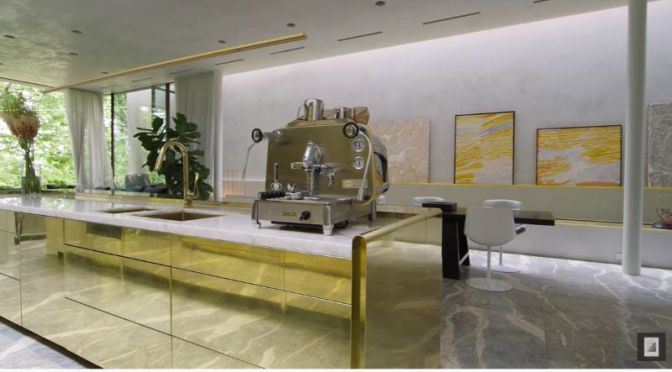
Pohio Adams Architects designs the modern kitchen to be the hero piece of the interior design. Over four metres long, the kitchen feeds into a sense of openness permeating Fairweather House, allowing residents and guests to circulate with ease around the marble island bench. Located in the rear pavilion, the modern kitchen proposes the ideal space for guests to gather, with seating provided for six people.

Focusing on the relationship between inside and out, Pohio Adams Architects crafts a compelling interiority that actively refers to the external landscape. Fairweather House exemplifies the inside-out methodology, with the boundary between the rear spaces and the garden successfully blurred.
Architecture: Hopetoun In Melbourne, Australia

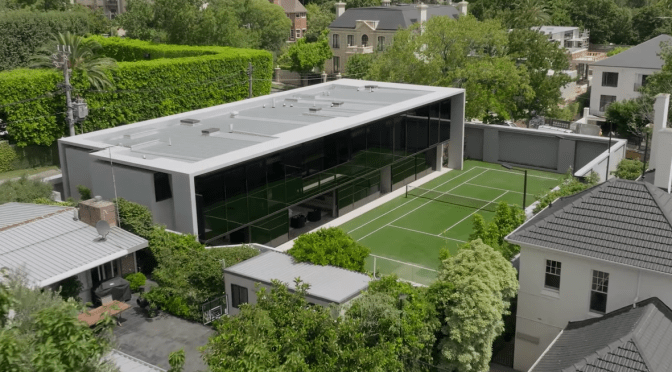
A solid concrete dwelling, The Hopetoun is a luxury super house, complete with a tennis court and sleek garage. Meticulously designed by FGR Architects, the new build combines architecture, lighting and textural detail to reveal internal spaces of surprising delicacy.

Video Timeline: 00:27 – Entering the Super House 01:21 – Minimalist Architecture 01:57 – Connection Between Spaces 02:19 – Positioning the House 02:59 – Lighting in the House 03:40 – Concrete Architecture 04:37 – Utilising Stone and Timber 04:54 – Breaking Tradition

Located in the leafy Melbourne suburb of Toorak, The Hopetoun is a super house designed to accommodate a large family. Situated on the corner of a road, the house is crafted to dramatically embrace the breadth of its site, presenting a broad and expansive façade to the street. A house tour of the property sheds light on the layout of the super house, carefully planned by the architect.

FGR Architects configures the home to maximise solar penetration via the northern aspect, fitting the sunlit side of the house with ample glazing and arranging the internal spaces to reflect the need for natural light. Whilst the southern orientation houses utilities and services, the northern counterpart is occupied by the most frequently habited rooms. A sculptural set of stairs forms the highlight of the interior design. FGR Architects uses lighting to express the structural prowess of the concrete super house, including the implemented overhangs within the architecture.

The delicate interaction between the undulating texture of the concrete walls and the warm wash of artificial light presents lighting almost as a material in itself, equal amongst the concrete, glass, stone and timber. Utilising the refined nature of concrete in relation to light, FGR Architects is able to create a sophisticated super house that possesses the robust material character to age elegantly through time. 00:00 – Introduction to the Super House

Architecture: Otsu House In Casuarina, Australia

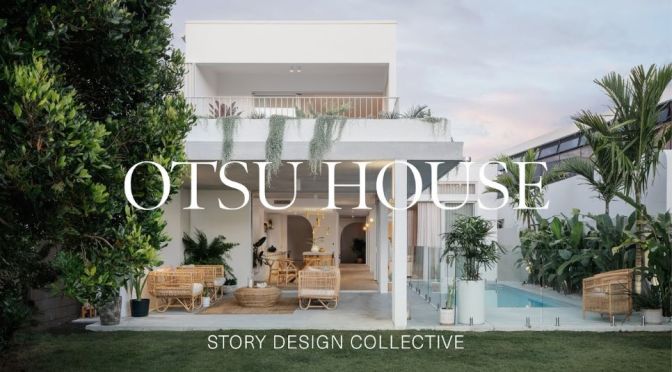
A modern-day dream home, Otsu House is a refreshing and timeless exploration of texture, material and light. The site’s proximity to the beach called for a pared back and neutral colour palette, filling the internal spaces with warmth and reflective character.

Video Timeline: 00:00 – Introduction to the House 00:29 – Design Influenced by the Environment 01:04 – Designing for Light and Airflow 01:25 – Concrete and Clay Finishes 02:57 – The Courtyard 03:15 – Neutral Colour Palette 03:40 – Landscaping and Pool Design 04:10 – Helical Staircase 04:53 – Ensuite Bathroom Features 05:18 – Concrete Kitchen Bench 05:36 – Successful Partnership

With easy access to the beach, it was important that the materials used within the structure were able to be self-maintained and endure the harsh Australian climate and beachside environment.

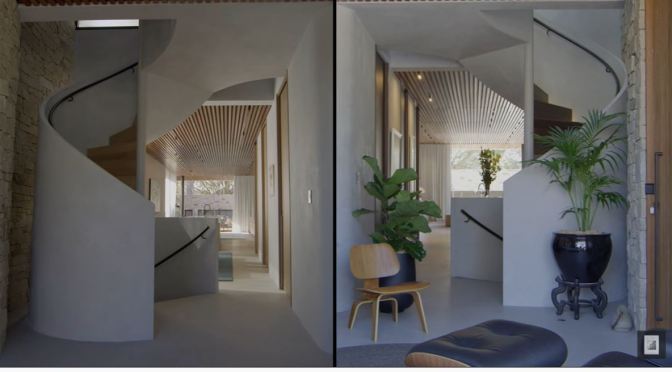
The dream home embraces open spaces, reminiscent of the nearby ocean. A continued theme of open space is felt throughout the house and is extended out towards the garden. The entryway is greeted with a void and an enticing sculptural staircase. Feeling as though it evolved out of the ground, the staircase draws the eye inward and up to the second level. The curve of the stairs reflects the textured clay render, Rockcote Japanese Otsumigaki, used throughout the interior and evokes a visual connection to ocean waves.

The Otsumigaki is both subtle and reflective, interacting with natural light and giving forth a lustre that is completely distinctive to the interior space. The raw nature of the Japanese clay and concrete used throughout the dream home acts as a significant connection to the beachfront. The textured material brings with it a warmth whilst also an endurance to the elements, specifically the salt from the ocean and the strength of the Australian sun.

Concrete is also used in the home’s ceiling, allowing for both thermal and noise barriers within the interior spaces. The material is also used in the kitchen bench and is in keeping with the natural, neutral colour palette present within the dream home. Otsu House also features a courtyard space, acting as both a lightwell and a visual connection for the downstairs rooms. The doors are able to be opened to allow a breeze to flow throughout the dream home, creating patterns with light and shadows. The linen curtains soften the raw concrete throughout and provide a delicate balance within the natural material palette.

Architectural Tours: Malvern House – 100-Year Old ‘Modern’ In Australia

Malvern House sees Lande Architects convert a one-hundred-year-old house into a modern home with a minimal addition. Traditionally, when architects convert a one-hundred-year-old house into a refreshed dwelling, they take care to preserve the heritage features of the property – Malvern House was no different.

Video Timeline: 00:00 – Blueland 00:09 – Introduction to the 100 Year Old House 00:45 – Modernising a Weatherboard Victorian Cottage 01:23 – The Client Brief 02:08 – Green Motif Throughout the House 03:30 – Utilising Natural Light 04:10 – Outdoor Areas 04:25 – Working Together with the Clients 04:58 – Blueland Home Cleaning Products 06:24 – Final Look at the Converted House

Lande Architects retains the original, decorative front of the Victorian weatherboard cottage, maintaining a connection to the defining architecture of the location. Lande Architects reconfigures the extension of Malvern House – located to the rear of the structure and comprising of the kitchen, living and dining spaces – to propose a larger footprint. Seven internal courtyards are added in adherence to the brief, which stipulated that the pockets of green space should feature within the interior design.

Softly defined by functional glazing, the courtyards form an important part of the overall scheme as Lande Architects convert a one-hundred-year-old house into a modern home. The design of Malvern House champions efficiency. Lande Architects insulates the home with double brick walls and a large concrete slab positioned to the north orientation, with the slab absorbing heat during the day and radiating the heat back into the house overnight.

Cross-flow ventilation is provided via the seven courtyards. Such mastery over the internal environment of Malvern House sees Lande Architects convert a one-hundred-year-old house into a home that can meet 21st century standards of liveability. Whilst the heritage front of Malvern House remains purposefully untouched, the rear extension is changed for the better. Lande Architects converts a one-hundred-year-old-house into a residence with a rich and evolving narrative.

Modern Homes: Bunkeren In Newcastle, Australia

Crafted by James Stockwell Architect, Bunkeren could be the best modern house in the world. Considered more landscape than building, the concrete dwelling is a robust insertion within the surrounding natural context. Embedded into a rocky forest edge just south of Newcastle,

Video Timeline: 00:00 – Introduction to the Best Modern House in the World 00:40 – The Concept 01:30 – Designing for Family and the Landscape 02:09 – House Inspired by Danish Design 02:25 – Intimate Spaces 02:44 – Bunker within the Landscape 03:20 – Benefits of a Concrete Bunker House 04:20 – Bringing Natural Light into the House 04:55 – The Cellar 05:30 – Materiality 06:12 – Indoor-Outdoor Living 07:05 – Highlights of the House 07:28 – The Architect’s Favourite Part of the House

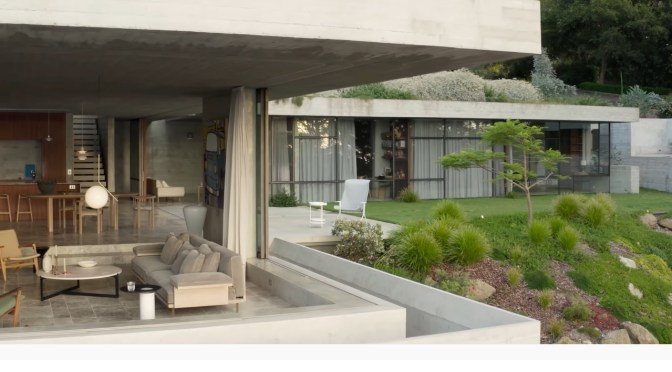
Bunkeren sits on the land of the Awabakal people. Externally, the building is reminiscent of the inspiring botanical garden that once occupied the location in the late 1800s; sprouting greenery covers the top of floating concrete platforms where, beneath, the internal spaces are held. A sense of architectural freedom is permitted by minimising necessary supporting columns and removing the need for load-bearing walls, lending structural significance and an impressive silhouette to what is considered the best modern house in the world.

A house tour of Bunkeren – named according to the Danish translation of ‘bunker’ – reveals the negotiated peaks and pitfalls of the bunker configuration. In materiality and position, the home expresses a reassuring invulnerability; partly shielded by the rocky landscape and comprised of concrete, Bunkeren can retain its structural integrity in the event of a bushfire or storm. Crafted by the architect to be low maintenance, the home does not require painting and cannot be eroded by mould or termites. The enveloping botanical element of the design supports the forest ecosystem and microclimates by interacting with natural species. James Stockwell Architect designs the interior to combat the limited natural light and ventilation associated with the architecture of a traditional bunker. Skylights and an internal garden draw light into the underground aspects of the home in an aesthetically engaging manner, whilst the elevated nature of the concrete platforms allows space for fresh air to travel through the dwelling. The interior design of Bunkeren contributes to its potential as the best modern house in the world. Whilst utilising the work of local artists, James Stockwell Architect also takes care to reflect the influence of Danish design culture in consideration of the homeowners’ lifestyle. In application of the Danish principle of proportion, all decoration is scaled to human level, emphasising the togetherness of the family unit. The design also champions the Danish furniture inherited by the homeowners. A restrained approach to styling sees each space defined by a sense of intimacy, with the absence of elaborate ornamentation establishing an unimposing, experientially gentle atmosphere. The most unique aspect of the home – through which James Stockwell Architects proposes Bunkeren as the best modern house in the world – is the cellar, situated at the lowest level. Inside the space, the rock into which the residence is settled within is left exposed, providing visual drama, natural tactility and a reflection of the external environment, blurring the line between the home and landscape. Warmed by the additional materials of wood, concrete and brass, the cellar exudes individuality. In 20 years, the foliage surrounding Bunkeren will have grown, until the building cannot be clearly distinguished from its natural context. It is this foresight that allows Bunkeren to be considered the best modern house in the world.

Tours: Off The Grid ‘Pine Flat Lodge’ In Tasmania

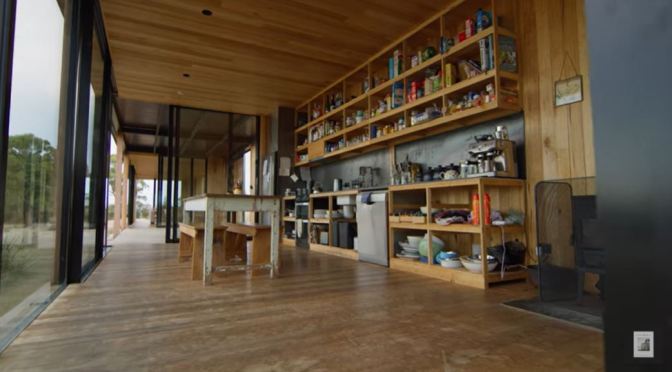
Located on the east coast of Tasmania, Australia, Pine Flat Lodge emerges from the environment as a place of retreat and immersion. The off the grid lodge is proposed as a minimal insertion within the landscape, a simple gesture that holds the space between the pines and the expansive view beyond the site. Imbued with a sense of belonging and placemaking, the off the grid lodge was approached in a deliberate manner, with focus placed on the conservation and rehabilitation of the land.

As a response, the architecture and interior design of the lodge accentuates an outward perspective, blurring the lines between indoors and out. The off the grid lodge is comprised of a series of modules within a continuous envelope, which in turn opens out to the landscape. The communal spaces are separated by decks and continue the structure’s discourse with the external environment, while the sleeping quarters represent an intended moment of quiet and retreat. The lodge tour also highlights Pine Flat Lodge’s solar power and rainwater collection, a physical reminder to visitors to be mindful when experiencing the space and landscape.

When designing a lodge, especially one that operates off grid, sustainability must inform each component. The material of the cabin is motivated by the surrounding context – sustainably sourced timber is used throughout the off the grid lodge. The structure utilises resources in an accountable way by pursuing efficient use of materials and minimising carbon footprint while supporting local craftsman. Bespoke details feature throughout the off the grid lodge, celebrating craft and the natural environment in an authentic and sustainable manner.

Architecture & Design: ‘Courtyard House’ In Hawthorn, Australia

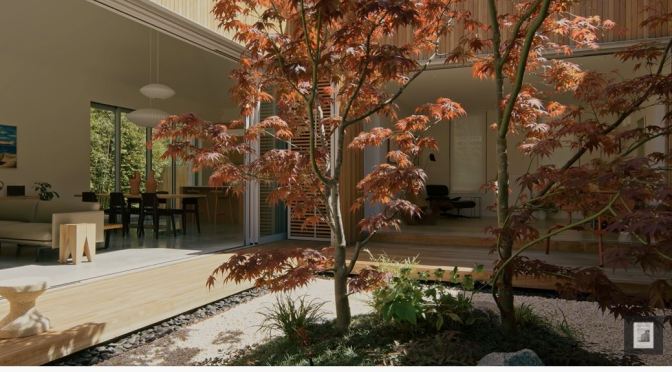
Courtyard House by Ha Architecture is a Japanese inspired home, presented as a merging of heritage and contemporary design. The home’s streetscape heritage overlay allowed the existing home façade to be maintained; it was restored and repaired to its original condition, including the original windows. Internally, a meeting of contemporary and traditional principles imbues the space with a tranquil charm – a quiet space of reflection and rest. Inside the Japanese inspired home, Courtyard House is centred around its internal courtyard.

The brief required an adaption of contemporary Japanese architecture and lifestyle ideologies, with a focus on outdoor spaces and passive design principles. The entryway is intimate, instilled with ambient light and an immediate saturation of timber. This sensory experience allows Courtyard House to emerge as a Japanese inspired home, propelled by an inherent sustainability that underpins the very fabric of the project. Windows frame backdrops of bamboo and showcase selected stone features, creating a constant discourse between the internal and external spaces. The landscape orientation, as well as vantage points, play a considered role in the architecture.

Design: A Modern Home In Australia Is ‘Split In Two’

Located in Manly, this modern house emphasises casual beachside living through a strong connection to the external environment. Sitting in one of the suburb’s leafiest streets, the modern house enjoys optimal views to the surrounding areas, maximising the cross-flow of natural breezes from its elevated position.

The modern house’s material palette draws inspiration from the history of the surrounding area, whilst raw materials provide a contemporary architectural form, blurring the lines between casual and formal life. A long horizontal concrete form with chamfered edges is clad in breeze-admitting passive timber shading devices and bands of glazing that invite views of the carefully curated greenery. Responding to its coastal location, this modern house is defined by a timber-lined ceiling extending to the soffit and polished concrete floors, creating a series of seamless spaces flowing onto each other, from open to closed, informal to formal, refined and robust all at the same time.

Open-plan living spaces spill out to the outdoor living and pool areas on the ground floor, blurring the line between outside and inside, emphasising the garden outlook, natural light-filled spaces and the modern house’s connection to its environment. A large oversized island bench is the meeting point of the modern home, with streamlined kitchen and living room joinery connecting the living spaces. Ancillary spaces are tucked away into the core of the building, allowing maximum natural light to the living spaces.

As a modern house, the concrete stair is a sculptural presence that sweeps upwards, binding the living spaces to the bedrooms and bathrooms on level one, where the external timber screens add ventilation and ever-changing shadows within. In the basement, a wine cellar, laundry, utility and theatre room provide technical support to the rest of the modern house.

Architecture and Interior Design by DKO Architecture. Development by Adjani. Photography by Tom Ferguson and Toby Peet. Filmed and Edited by Cheer Squad Film Co. Production by The Local Project.

Architectural Home Tour: A Converted Warehouse, Melbourne, Australia (4K)

An architect’s own home can be a challenge to design, with no brief or boundaries to adhere to, leaving the architect’s skill set and true style exposed for all to see. This converted warehouse is an architect’s own home, designed by and for Rob Mills of Rob Mills Architecture and Interior Design.

Located in Armadale, a Melbourne suburb known for its character and village atmosphere, the house was created through a warehouse conversion, which gave the architect plenty of scope and space to design a piece of architecture that truly reflected his likes and wishes. Harnessing this space in the converted warehouse home, the house carries over three levels, with an apartment, sauna and garage at ground level, living in the middle, and bedrooms above.

The interior design uses a minimal palette of stone, timber, stucco, glass and metal, with brass playing a large part in the design, especially in the kitchen where it is used extensively and effectively. This glamour and drama are at the heart of the interior design of the converted warehouse. A spiral staircase adds a sculptural element to the house, while also providing an efficient method of travelling between floors.

The office, which has an English aesthetic with lush yet classic-style furniture, features timber shutters that close off to create a focused environment or open to let in plenty of natural daylight. Close connections to nature were important to the architect, Rob Mills of Rob Mills Architecture and Interior Design. A water feature trickles through the living space of the converted warehouse, providing a meditative element to the room. Materials were chosen for their non-toxicity, with stucco walls specified as a natural alternative to paint.

An architect’s own converted warehouse home, Armadale Residence features designer furniture throughout that is carefully chosen to subtly fit with the shine and glamour of the materials. Architecture and Interior Design by Rob Mills Architecture and Interior Design. Filmed and Edited by Cheer Squad Film Co. Production by The Local Project.

Architectural Tours: ‘JARtB House’, Melbourne, Australia (4K Video)

Nestled in a tree-lined street in the affluent suburb of Toorak in Melbourne, JARtB House is an architect’s home that explores art and architecture. Director of international award-winning architecture firm Kavellaris Urban Design (KUD), Billy Kavellaris designed his house with a view to creating both an art gallery and a family home.

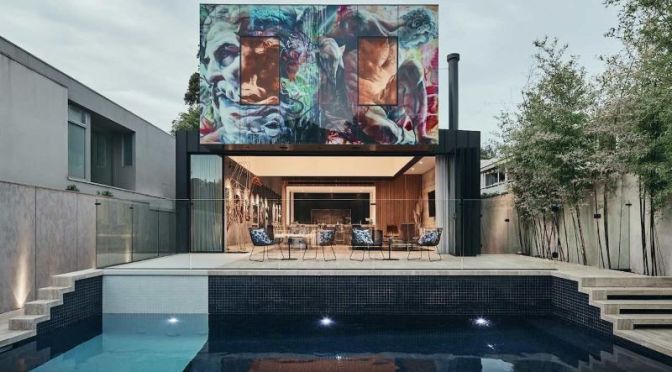
The design explores the idea that art and architecture are separate disciplines but also that art can be fused with everyday life. A white circulation strip through the house doubles as a gallery, displaying the architect’s extensive art collection. Some pieces, such as the lofty giraffe sculptures, were designed especially for the space within the architect’s own home. The upper floor is ensconced in a custom mural created by Spanish artist duo PichiAvo.

Made up of 13 panels stitched together across the facade of the house, this artwork can be experienced from both inside and outside the house. The architecture and interior design can also be seen as art itself, with unusual and opulent staircases connecting floors, and uniquely shaped openings and furniture pieces. Bespoke timber flooring and panelling created by Made by Storey is used throughout the home on walls and floors, creating a sense of cohesion and warmth.

Other materials, such as concrete and steel, are carefully chosen for atmosphere and visual interest, while colour is largely provided by the artworks.

Architecture and Interior Design by Kavellaris Urban Design (KUD). Custom Timber Flooring, Stairs and Ceiling by Made by Storey. Video by Cheer Squad Film Co. Production by The Local Project.