
Tag Archives: Technology

Technology Quarterly: ‘Health And AI’ (April 2024)

Technology Quarterly: A new prescription

The Economist (April 1, 2024): The latest issue of THE ECONOMIST TECHNOLOGY QUARTERLY is focused on:

A new prescription

AIs will make health care safer and better, reports Natasha Loder. It may even get cheaper too

AIs will make health care safer and better

Artificial intelligence has long been improving diagnoses

Medical AIs with human faces are on their way

Artificial intelligence is taking over drug development

Can artificial intelligence make health care more efficient?

Read full report

Commentary Magazine – April 2024 Opinion Preview

Image

Commentary Magazine (March 15, 2024) The latest issue features ‘The Elite War On The American Middle Class…And How To End It’; The Big Lies about Israel’s Big Bombs…

The Elite War on the American Middle Class—and How to End It

by Christine Rosen

Being middle class in America used to mean something—something socially transformative, something even revolutionary. The American middle class represented a form of national social order never before seen on this earth—cultural domination not by the very rich and very educated, or the political domination either by tyrants or the mob, but by a mass of people, relatively well-to-do, who felt themselves fortunate in their circumstances. That was what made the American middle class different from the French or English bourgeoisie. Its members believed, and the country believed, that they were the nation’s backbone, its true governing class, and its moral compass.

The Four Questions of 2024

by Matthew Continetti

President Joe Biden and former president Donald Trump squared off four years ago and are on track for the first major-party rematch since 1892. Biden and Trump are the oldest presidential candidates in history, and each man has an established political brand. Biden first won federal office in 1972, and it’s been over a decade since the GOP nominated someone other than Donald Trump. The 2024 election is like all the SIRIUS XM oldies stations—Classic Vinyl, Classic Rewind, Rock and Roll Hall of Fame Radio—rolled into one.

The Hateful Candace Owens

by Christine Rosen

If you had never heard of Candace Owens until recently, you aren’t alone. Less than a decade ago, she was an unknown college dropout working as a marketing professional in New York, writing pieces for her company’s website about the “bat-s—t crazy antics of the Republican Tea Party.” Then, suddenly, she claimed to have experienced a political conversion. She told the libertarian political commentator Dave Rubin in 2017, “I became a conservative overnight. . . . I realized that liberals were actually the racists. Liberals were actually the trolls.”

Politics: The Guardian Weekly – March 8, 2024

Image

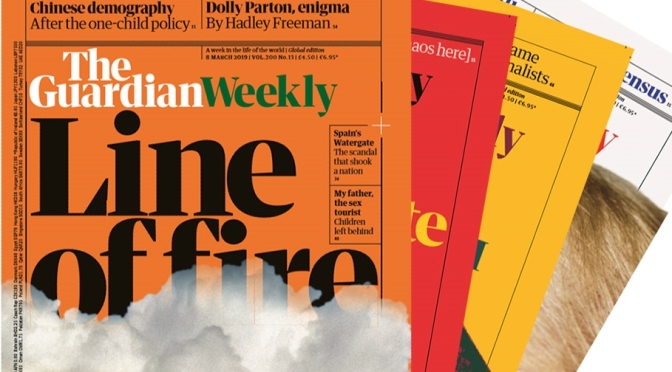
The Guardian Weekly (March 7, 2024) – The new issue features Faint hope of return for Rohingya people. Plus: a journey through Ukraine

It was August 2017 when the world really started to take note of Myanmar’s Rohingya people. Descendants of Arab Muslims who speak a different language to most other people in Myanmar, the Rohingya had up to that point lived mainly in the northern Rakhine state, coexisting uneasily alongside the majority Buddhist population.

But the Rohingya were reviled by many as illegal immigrants and treated by the then government as stateless people. In 2017, when violence broke out in the north of the state, security forces supported by Buddhist militia launched a “clearance operation” that forced more than 1 million Rohingya people to flee their homes and the country, actions that many onlookers saw as ethnic cleansing. Most Rohingya were driven into vast refugee camps in the Cox’s Bazar region of Bangladesh, where they have remained ever since.

The Guardian global development reporter Kaamil Ahmed has been covering the Rohingya crisis for almost a decade, making multiple trips to the region. For this week’s Big Story, Kaamil returned to Cox’s Bazar where, in two moving reports, he details how disease and illness are widespread in the ramshackle camps, and how the desperation to escape has resulted in rich business for people traffickers.

And, with Myanmar now controlled by a military junta and introducing a deeply unpopular conscription drive (as Rebecca Ratcliffe and Aung Naing Soe report), the prospect of any Rohingya people being able to return home to Rakhine state remains as distant as it did in 2017.

Preview: MIT Technology Review – March/April 2024

Image

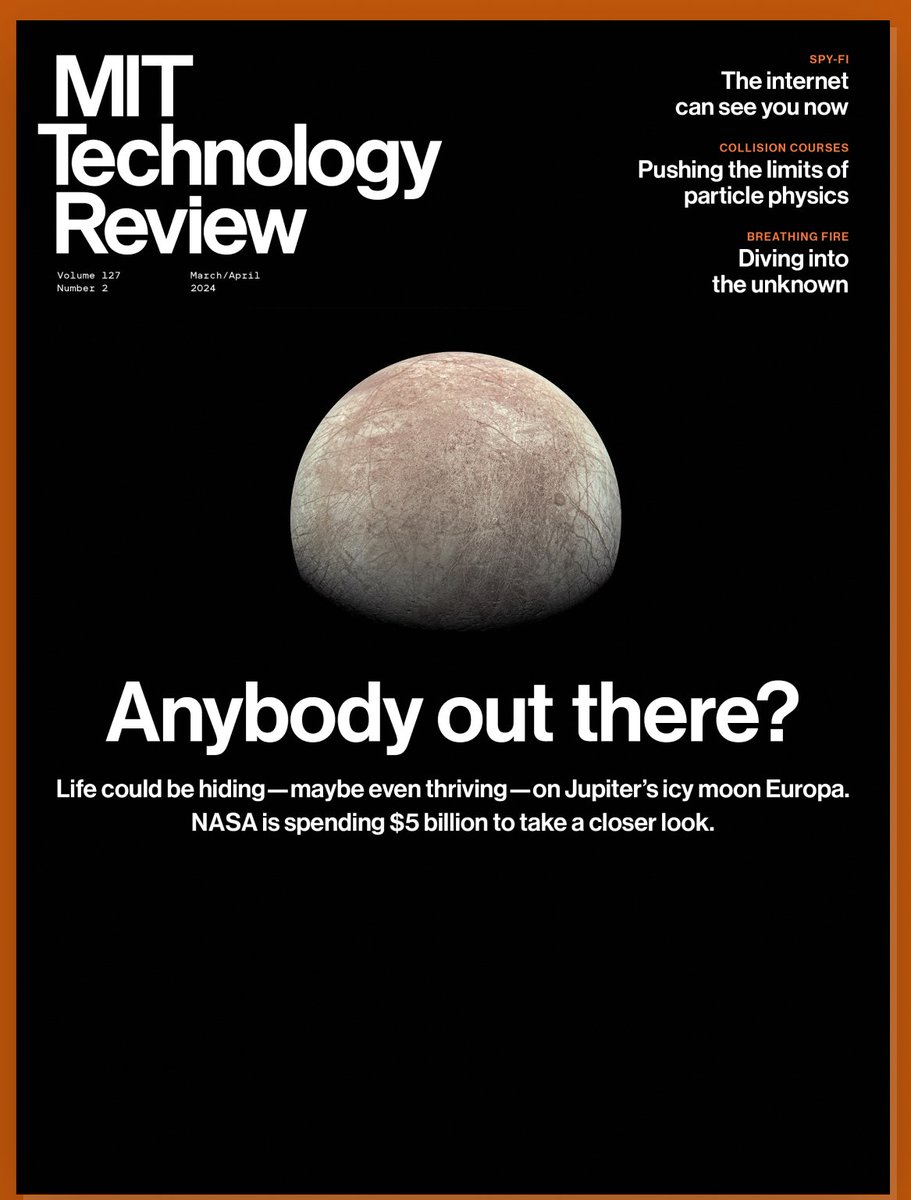
MIT Technology Review (February 29, 2024): The new issue features ‘The Hidden Worlds Issue’ – Is Anybody Out There? Using technology to explore and expose hidden worlds, from enabling deeper dives into ocean depths to journeying to one of Jupiter’s orbiting bodies to pushing the boundaries of particle physics. Plus: wearables for wildlife, Wi-Fi sensing, and a reconsideration of Luddites.

The search for extraterrestrial life is targeting Jupiter’s icy moon Europa

NASA’s Europa Clipper mission will travel to one of Jupiter’s largest moons to look for evidence of conditions that could support life.

Inside the hunt for new physics at the world’s largest particle collider

The Large Hadron Collider hasn’t seen any new particles since the discovery of the Higgs boson in 2012. Here’s what researchers are trying to do about it.

Meet the divers trying to figure out how deep humans can go

Figuring out how the human body can withstand underwater pressure has been a problem for over a century, but a ragtag band of divers is experimenting with hydrogen to find out.

Politics: The Guardian Weekly – February 23, 2024

Image

The Guardian Weekly (February 22, 2024) – The new issue features ‘Ukraine’s Lonely Road’ – After two years, is there a way out of Putin’s war?…

Shaun Walker reports on this week’s big story, the fall of the strategic town of Avdiivka to Russian troops has come at a grim time for Ukraine’s president, Volodymyr Zelenskiy. While the army is struggling to hold ground, war fatigue is setting in among parts of the population and disagreements among the leadership have been spilling into the open.

At the same time, the death of the jailed Russian critic Alexei Navalny last week – widely seen as another political assassination – appears to emphasise the strengthening hand of Vladimir Putin, who is expected to secure another six-year term as Russia’s president in tightly controlled elections next month. Amid a familiar wave of international outrage, our Russia affairs reporter Pjotr Sauer asks what Putin might do next.

Coupled with the possibility of a Donald Trump victory in the US elections later this year, it all makes for a deeply worrying outlook for Ukraine, reflected in the Kyiv-based illustrator Sergiy Maidukov’s haunting cover artwork for the magazine this week.

“This war is the hardest test of my life, similar to an endless ultramarathon,” writes Sergiy. “It is good to try to not think about the finish when running long distance. This is important knowledge to endure.”

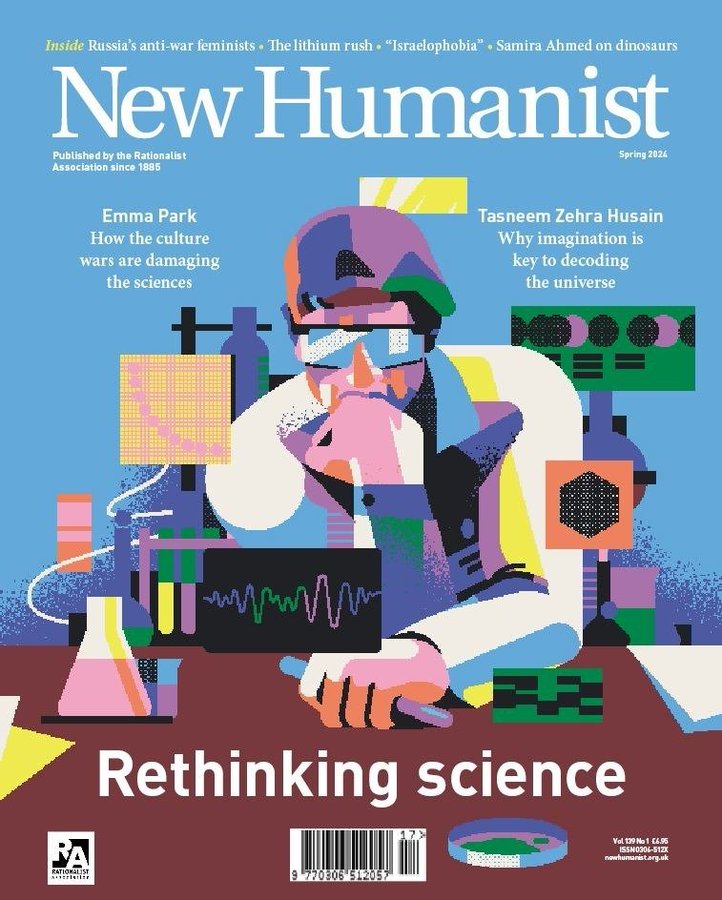
Previews: New Humanist Magazine – Spring 2024

Image

NEW HUMANIST MAGAZINE – SPRING 2024 ISSUE: The new issue features Emma Park on how the culture wars are damaging the sciences, theoretical physicist Tasneem Zehra Husain on why the imagination is key to decoding the universe, and Alom Shaha on what can be gained by thinking like a scientist

Beyond the two cultures

Amid a polarised debate, science and art seem further apart than ever. Emma Park, editor of The Freethinker, explores what humanism has to teach us about the apparent conflict between these ways of thinking and how to bridge the divide.

“While humanities scholars are often (not without justification) accused of being Luddites, those on the science and technology side could also benefit from the knowledge that the humanities have accumulated over the centuries … [And] no intellectual activity worth the name can flourish in a politically repressive environment: freedom of expression and enquiry should be an issue to unite artists, scholars and scientists.”

The poetry of science

Metaphors are key to unlocking the secrets of the universe – scientists should do more to harness their power, writes acclaimed physicist Tasneem Zehra Husain.

“Metaphors aren’t only a means of description, they can also lead to revelations. Centuries ago, Newton was able to calculate the gravitational attraction between two objects … [but] would ‘feign no hypothesis’ as to why it was so. He had the equation, but he did not understand gravitation … With Einstein, we finally have a metaphor. When we picture space-time as a dynamic ‘fabric’ … we begin to understand what gravity means.”

American Scientist Magazine – March 2024

Current Issue

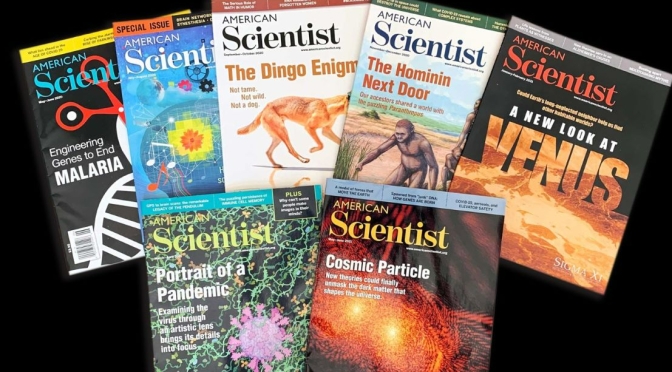
American Scientist (February 15, 2024): The latest issue features “Deconstructing DNA Beyond the Helix” – science educator and artist Caryn Babaian explores through illustration the molecular details and interactions that can affect DNA’s structure. She contends that for people to fully understand DNA, it must be shown in relationship to water. 
Deconstructing DNA Beyond the Helix

BY CARYN BABAIAN

An artist’s experimental approach to Rosalind Franklin’s Photo 51 reveals the molecule’s intricate biochemistry.

When Sharks Eat an Angler’s Haul

BY DAVID SAMUEL SHIFFMAN

Tensions are rising as the ocean’s great predators nab fish on the line, inciting a major new challenge in human–wildlife conflict.

Commentary Magazine – March 2024 Preview

Image

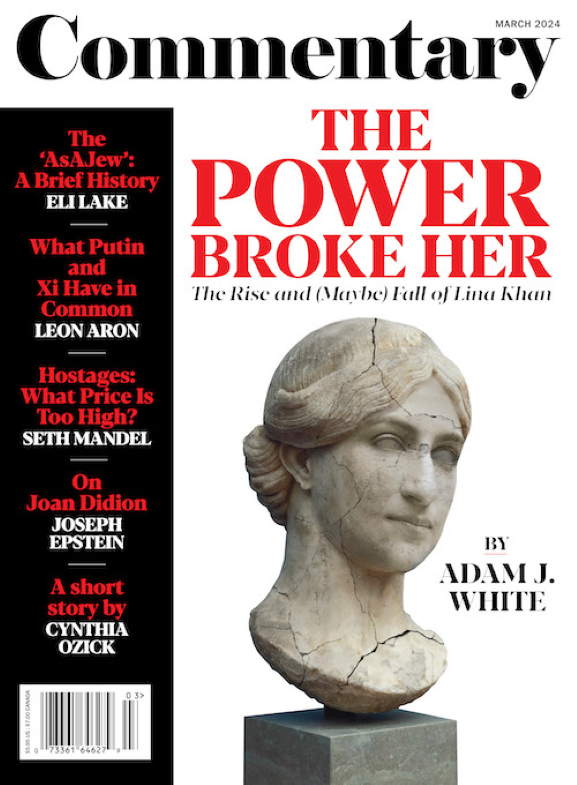
Commentary Magazine (February 10, 2024) The latest issue features ‘Power Broke Her’ – The Rise and (Maybe) Fall of Lina Khan; The ‘As A Jew’: A Brief History; What Putin and Xi have in Common; Hostages – What Price is Too High?; On Joan Didion and more…

The Power Broke Her

The Power Broke Her

The Rise and (Maybe) Fall of Lina Khan

by Adam J. White

Lina Khan was pleased with her progress. Appearing before the Economic Club of New York in July 2023, she outlined her vision as the chairman of the Federal Trade Commission under Joe Biden and its success so far. Never mind the fact that, just days earlier, a federal court had delivered her agency yet another high-profile setback.

Is AI Just Theft Under Another Name?

Is AI Just Theft Under Another Name?

by James B. Meigs

The magazine Popular Mechanics, where I once worked, used to have a column called “Saturday Mechanic.” It was a guide to basic car repair for the weekend tinkerer, and its author had decades of experience both in fixing cars and writing about them. Nonetheless, for each column, he would perform the task in question, carefully documenting each step with photographs. It was a lot of work, in other words.

Politics: The Guardian Weekly – February 9, 2024

Image

The Guardian Weekly (February 8, 2024) – The new issue features ‘Final Straw’ – What’s eating Europe’s Farmers?; Joe Biden’s Middle East masterplan; Can anything stop the AI deepfakes? and The Pet Shop Boys are back in town…

If you live in France, Germany, Belgium, the Netherlands, Poland or Greece, you may well have already run into one of the numerous roadblocks or protests formed in recent weeks by furious farmers. If you’re in Spain and Italy, take cover – because they are coming to you soon, if not already.

In this week’s cover story, we explore what has proved to be the final straw for Europe’s farmers. A combination of rising costs, environmental rules and grievances over EU policies, coupled with more localised complaints, seem to be the factors driving the convoys of tractors. But far-right and anti-establishment parties, who could make major gains in forthcoming European parliament elections, have also picked up on the protests as part of their agenda against EU influence.

Paris correspondent Angelique Chrisafis and Europe correspondent Jon Henley delve into the protests (if not the piles of steaming dung being dumped on the continent’s roads, as illustrated wonderfully by Neil Jamieson on this week’s cover), and ask what can be done to placate them.