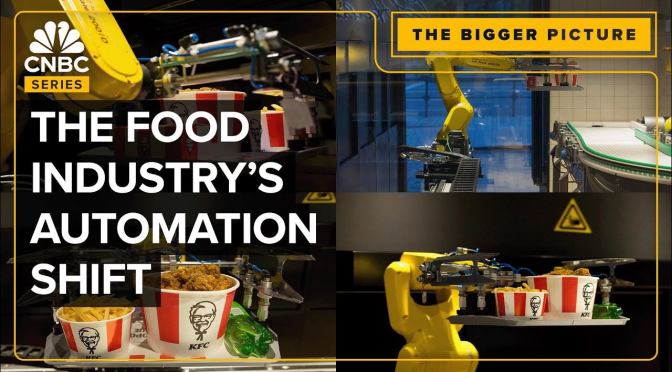
CNBC (July 15, 2024): Fully autonomous fast-food chains to smart carts lining grocery store parking lots, the way the food industry looks is changing due to massive investment in AI technology.
Chapters: 0:00 Introduction 2:34 CH 1. Digitizing food retail 5:35 CH 2. The risk and reward from robots 8:30 CH 3. What’s next?
The American consumer is starting to pull back on spending and rising food and labor costs are causing the food industry to invest more into automation to lower labor costs and improve sales, in order to stay competitive and take advantage of shifting consumer taste.
Discover Magazine (June 30, 2024): The latest issue features ‘Next-Gen Medicine’ – Recreating human organs on microchips; Inside the new Opioid Crisis; History’s strangest sleep study and Prehistoric Family Secrets…
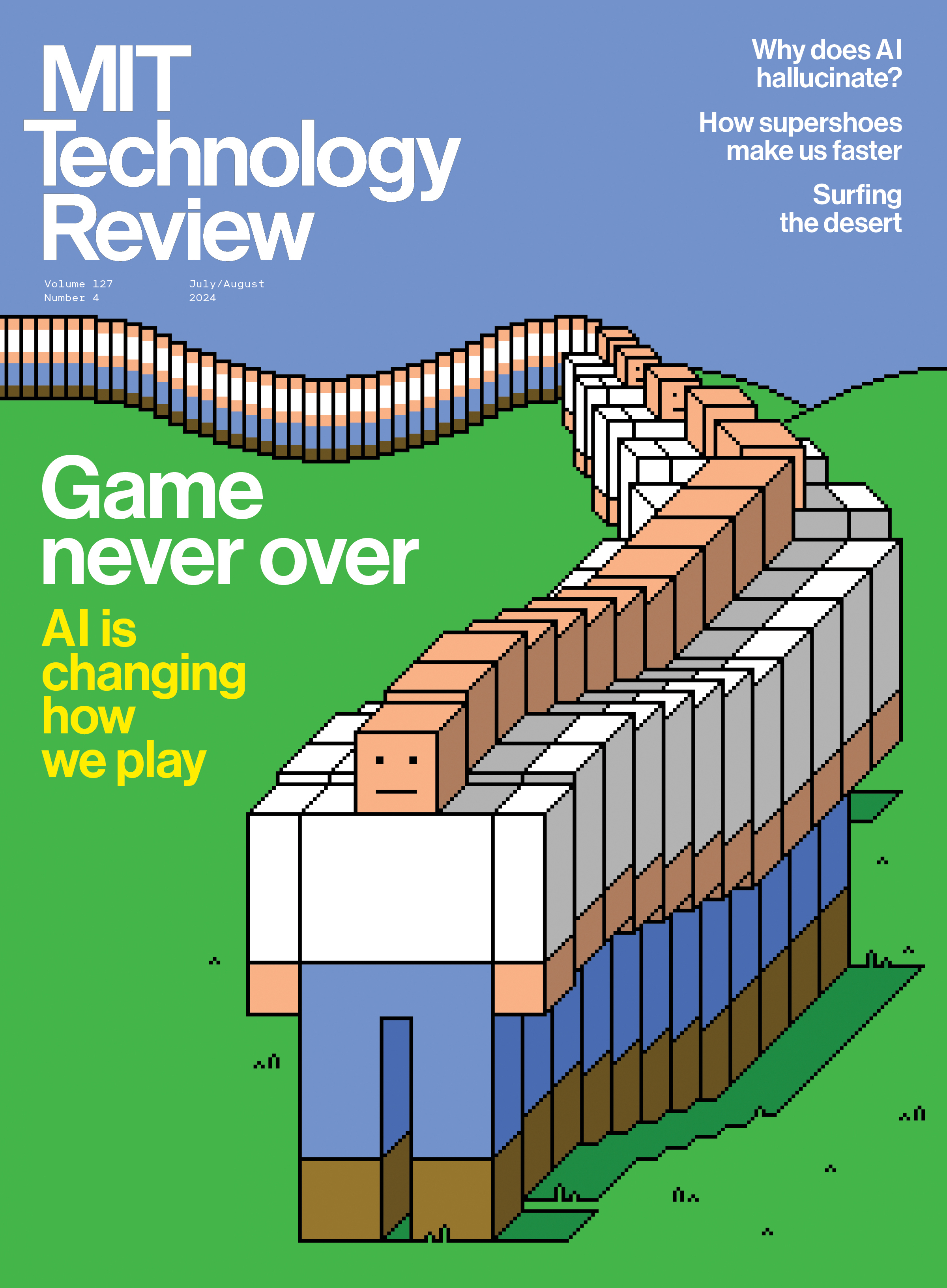
MIT Technology Review (June 26, 2024): The new issue features The Play issue – Did you know you could surf in the desert? New pools make it possible–but at what cost? Learn how AI is bringing an unprecedented expansiveness to computer and video games and how high-tech supershoes are helping athletes run faster and more safely. Plus: Gamification was always a dubious concept–so how did it take over the world?
The Guardian Weekly (June 19, 2024) – The new issue featuresEmmanuel Macron’s ballot box gamble – Could the far right gain political power in France? Plus: the record detectives fighting back against bootleggers
Spotlight | Kharkiv under siege Luke Harding and Artem Mazhulin report from Ukraine’s second city where living conditions are increasingly precarious
Environment | The fight to save Norway’s arctic foxes Captive breeding has helped reduce threats from predators and the climate crisis – but can the species survive long-term?
Feature | The vinyl frontier John Harris meets the record detectives going after music’s retro bootleggers
Opinion | Starmer’s quiet man appeal The UK Labour leader has been accused of being a “political robot”. But, argues Jonathan Freedland, that’s exactly why he’s so far ahead in the opinion polls
Culture | Alive and Kicken On its 50th anniversary, culture writer Eliza Apperly pays tribute to the Berlin gallery that helped pioneer photography as an art discipline
0:15Mini-factories in space – Space Forge says its technology could revolutionize manufacturing. The satellites contain miniature manufacturing systems. They take advantage of the conditions in low-Earth orbit such as microgravity, extreme temperatures and a contaminant-free environment to forge materials that would be impossible to manufacture here on Earth.
1:53Biodiversity credits explained – Nature is under unprecedented threat. Around 2 million plant and animal species could go extinct in the next few decades as climate change and habitat loss push ecosystems towards irreversible tipping points. To fight this crisis, experts are coming up with new ways to protect life on Earth by assigning value to the ecosystems around us. These innovations include biodiversity credits.
6:58 Nairobi switches to electric buses – Private minibuses called matatus are the main mode of public transport in Nairobi. Most matatus are old, diesel-powered and inefficient and 60% of the city’s population rely on them to get around. Electric mobility start-up BasiGo has built an all-electric alternative. The first bus rolled off its Nairobi production line in early 2024. Nairobi bus operators have already ordered 500 more. More than 90% of Kenya’s electricity is generated renewably, which means BasiGo’s buses are virtually emission-free.
8:40How to build healthier cities – This architect designs buildings that bring communities together – Sumayya Vally grew up in post-Apartheid Pretoria, South Africa in what had been an Indian-only township and saw how division kept communities apart. Vally founded the Johannesburg-based architecture practice Counterspace to fight the built legacies of colonization and highlight the peaceful coexistence between communities.
The Guardian Weekly (June 13, 2024) – The new issue features‘Blood Lines’ – The human cost of Europe’s cocaine habit’; The Far Rights surges across EU; A doughnut theory of the universe; The muscular rise of steroids…
In a week when much of the attention in Europe was on far-right political gains in the parliamentary elections, the Guardian Weekly’s cover shines a light on another of the continent’s disturbing undercurrents.
A Guardian investigation has found that hundreds of unaccompanied child migrants across Europe are being forced to work for increasingly powerful drug cartels to meet the continent’s soaring appetite for cocaine.
In cities including Paris and Brussels, gangs are exploiting the “unlimited” supply of vulnerable African children at their disposal, using brutal means to control their victims, including torture and rape if they fail to sell enough drugs, as they seek to expand Europe’s $13bn cocaine market.
Mark Townsend reveals the plight of the illegal trade’s child foot soldiers, while Annie Kelly explains the growing problem of cocaine use in Europe. And from Ecuador, Tom Phillips reports on how death and destruction follow the drug on its complex journey across the Atlantic.
0:15 Banking uplifts women in Pakistan – Pakistan has a large gender gap in financial inclusion. 47% of men have at least one registered financial account but just 13% of women. Even for those with an account, banking can be prohibitively time-consuming, especially for women who are running a business alongside a household. Now a new kind of digital banking service is helping to close this gap.
2:23World’s busiest airports revealed – The world’s busiest airports in 2023 were dominated by the United States, with five airports cracking the top 10. Overall, global airports saw a significant rebound in 2023, handling a total of 8.5 billion trips.
4:39WMO: Asia hardest hit by climate – In 2023, Asia saw a wave of extreme weather events from floods to cyclones. World Economic Forum Head of Climate Adaptation Eric White explains why climate change is making extreme weather more likely.
7:07Saving Earth with space science – Simonetta Di Pippo says that space is already helping tackle the greatest challenges on Earth. Satellite connectivity is improving our management of disasters and powering digital transformation. Which is revolutionizing sectors from healthcare to education, retail and communication.
Elections for the European parliament are less than a month away and far-right parties are predicted to make significant gains in many of the bloc’s 27 member states. The dire shortage of housing, leading to rising rents and property prices, is becoming a unifying focus for voters’ discontent with their current political leaders.
The issue has sparked protests from Amsterdam to Prague and Milan, as the Guardian’s Europe correspondent, Jon Henley, reports. The data is undeniably worrying as young Europeans spend up to 10 times an average salary on rent and mortgage payments, and big cities from the Baltic states to the Iberian peninsula have registered average property price rises of close to 50%. As a result more EU residents live with their parents for longer and put off life-decisions later into adulthood.
While housing does not fall within MEPs’ remit, it is a visible locus for the sense of social unease that has beset the whole bloc and has become a pivot for the far right to turn on racialised minorities. But as European community affairs correspondent Ashifa Kassam discovers, it is those communities that are doubly penalised through discrimination from landlords who, research has shown, turn away potential renters with “foreign” surnames. The political and social ramifications of the housing crisis in Europe is mirrored elsewhere across the globe and is a subject we will return to in the Guardian Weekly in this year of elections.
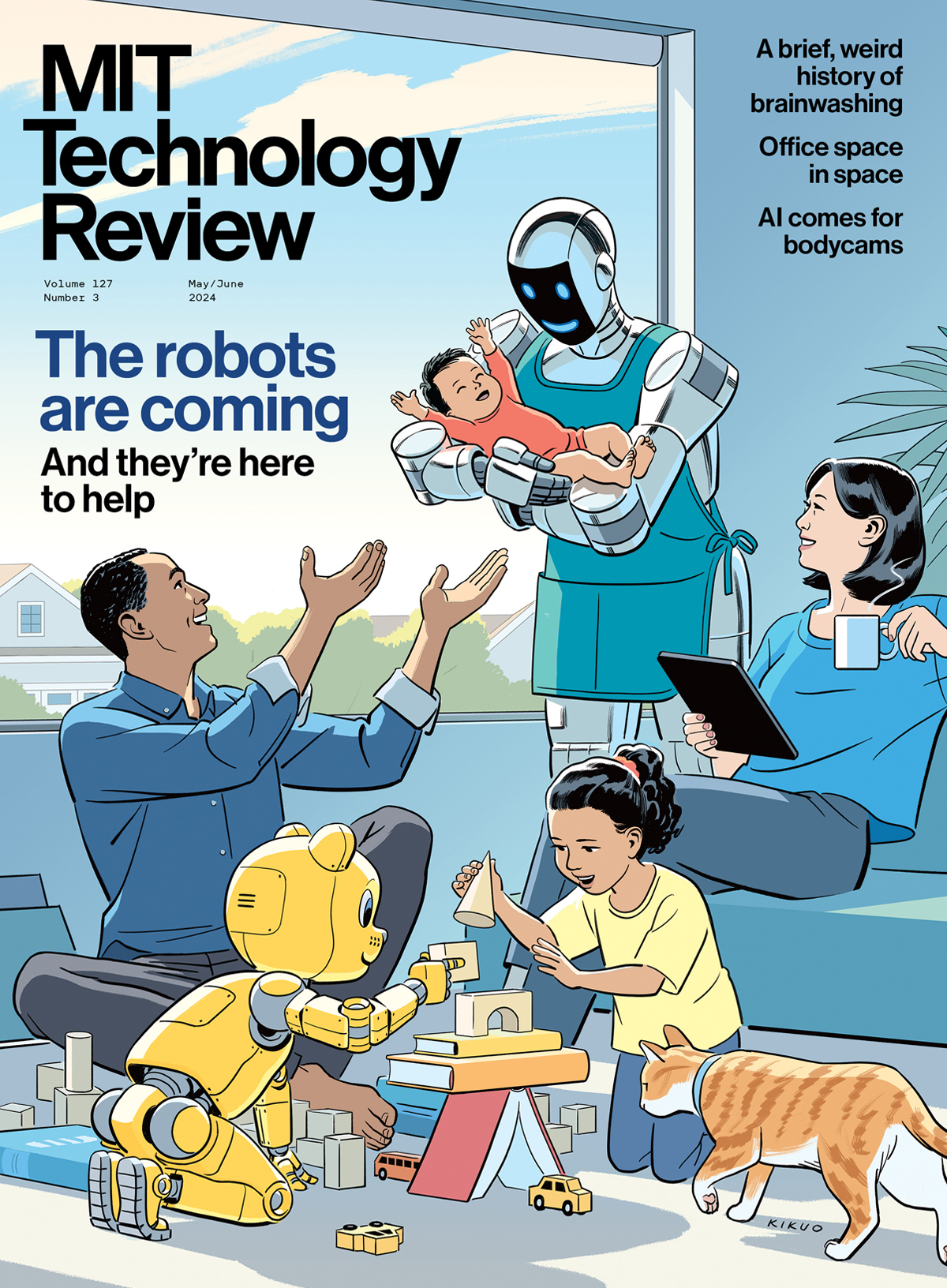
MIT Technology Review (April 29, 2024): The new issue features ‘The Robots Are Coming’ – And they’re here to help; A brief, weird history of brainwashing; Office space in space; AI comes for bodycams…
The Build issue
Who says we can’t still build things? In this issue: a look at the robots we’ve always wanted; a new model for space exploration; and efforts to flood-proof Louisiana’s coastline. Plus a wild, weird history of brainwashing; designing cheese with AI; and glow-in-the dark petunias.








![Discover Magazine Subscription [6 issues]](https://img.discountmags.com/products/extras/4577-discover-cover-2024-july-1-issue.jpg)










 Boomers Daily