
Tag Archives: Shakespeare

The New York Times Book Review – March 10, 2024

Image

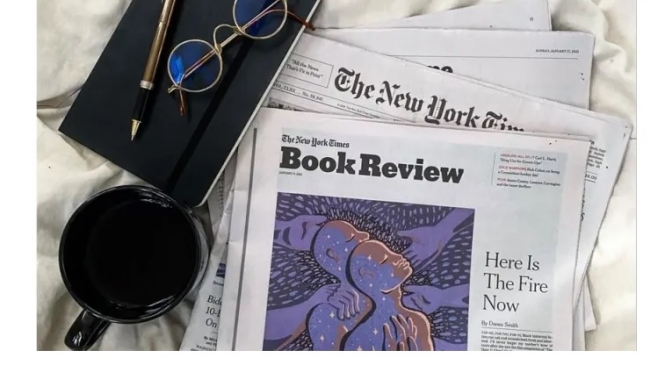
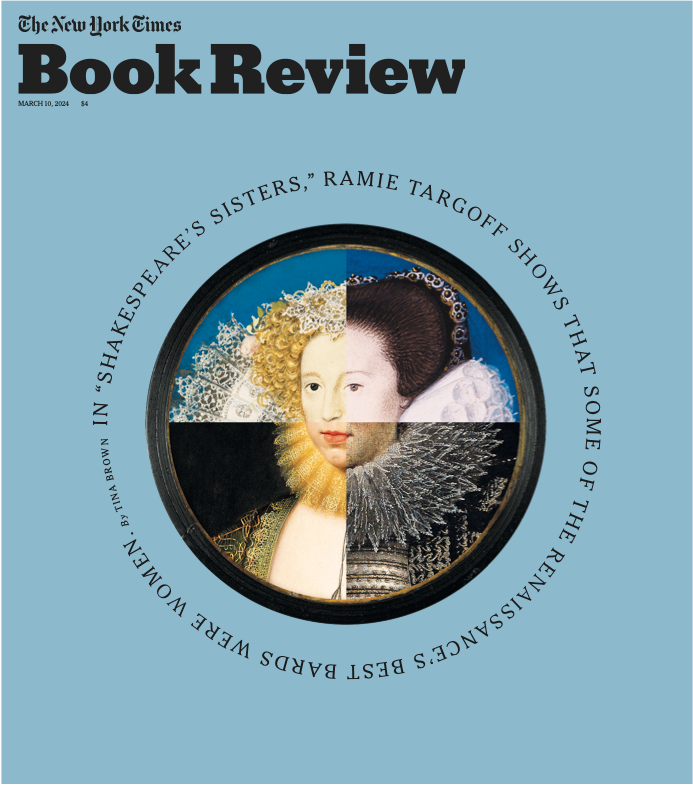
THE NEW YORK TIMES BOOK REVIEW (March ,8 2024): The latest issue features Renaissance scholar Ramie Targoff’s new book, “Shakespeare’s Sisters,” which sets out to show modern readers that the Elizabethan era did indeed produce its share of great women writers, and she details four of them across a range of disciplines. 

Some of the Best Bards Were Women

A round portrait is composed from the quadrants of four different medieval women’s faces.

In “Shakespeare’s Sisters,” the Renaissance scholar Ramie Targoff presents an astounding group of Elizabethan women of letters.

By Tina Brown

SHAKESPEARE’S SISTERS: How Women Wrote the Renaissance, by Ramie Targoff


Judith Shakespeare, Virginia Woolf’s imaginary sister of the Bard, was for years the accepted portrait of the nonexistent writer of Renaissance England. In “A Room of One’s Own,” her seminal feminist essay, Woolf concluded that any glimmer of female creativity in Shakespeare’s time would have been expunged by a pinched life as a breeding machine of children who so often died, disallowed opinions of her own. Had any woman survived these conditions, wrote Woolf, “whatever she had written would have been twisted and deformed, issued from a strained and morbid imagination.”

A Bee’s-Eye View of the World

A photo of a flower with stamen and pistils that appear to glow yellow, purple and orange in UV light.

Using clever camera methods, a new photo book illuminates how honeybees see plants and flowers.

By William Atkins

In WHAT THE BEES SEE: The Honeybee and Its Importance to You and Me, Craig P. Burrows’s ultraviolet-lit photographs mimic the fluorescence his botanical subjects emit when exposed to sunlight, revealing colors and textures usually obscured by the dazzle of visible light. Because bees see in the ultraviolet spectrum, Burrows’s method can afford us a glimpse of the world as they perceive it: His portraits of plants are, in part, prompts for interspecies empathy at a time when bees are under attack on multiple fronts, from air pollution to pesticides.

Commentary Magazine – January 2024 Preview

Image

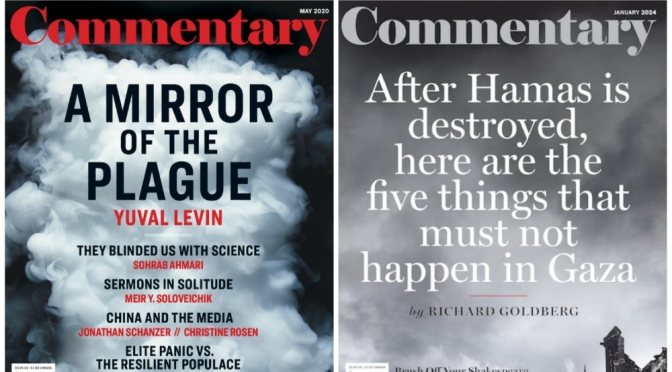
Commentary Magazine (December 14, 2023) – The latest issue features After Hamas Is Destroyed, Here Are the Five Things That Must Not Happen in Gaza; The Future Isn’t Going as Promised; Putin Won’t Stop; Brush Off Your Shakespeare, and more…

After Hamas Is Destroyed, Here Are the Five Things That Must Not Happen in Gaza

After Hamas Is Destroyed, Here Are the Five Things That Must Not Happen in Gaza

by Richard Goldberg

Israel is resolved to remove Hamas and its terrorist infrastructure from the Gaza Strip permanently, and for much of the world, its determination raises one question more than any other: What comes next in Gaza? For those who disapprove of Israel’s actions in the war or those who either passively or actively support the role of Hamas as the Strip’s governing authority, the lack of answers provides a pretext not only to demand a permanent cease-fire but to suggest (often quietly and with a furrowed brow indicating supposed realpolitik wisdom) that the path Israel seems to be making for itself is a dead end from which it needs to be saved.

The Future Isn’t Going as Promised

The Future Isn’t Going as Promised

by James B. Meigs

In his new book, The Conservative Futurist: How to Create the Sci-Fi World We Were Promised,American Enterprise Institute scholar James Pethokoukis writes about the go-go years of the 1960s: Saturn V rockets were blasting to the moon, atomic power promised to make electricity “too cheap to meter,” and sci-fi TV shows like Star Trek depicted new marvels right around the corner.

Brush Off Your Shakespeare

Brush Off Your Shakespeare

by Joseph Epstein

“Joseph,” my friend Edward Shils said to me, “we have spoken about many things, among them about various writers, but we are both too civilized ever to talk about Shakespeare. After all, what could one say?” Yes, what can one say? Over a long writing career, I have never written about Shakespeare, and, best I can recall, among the many millions of words I have produced, have never even quoted him. Truth is, I have long admired Shakespeare without being especially nuts about him. 

Arts/Books: Times Literary Supplement – Nov 17, 2023

Image

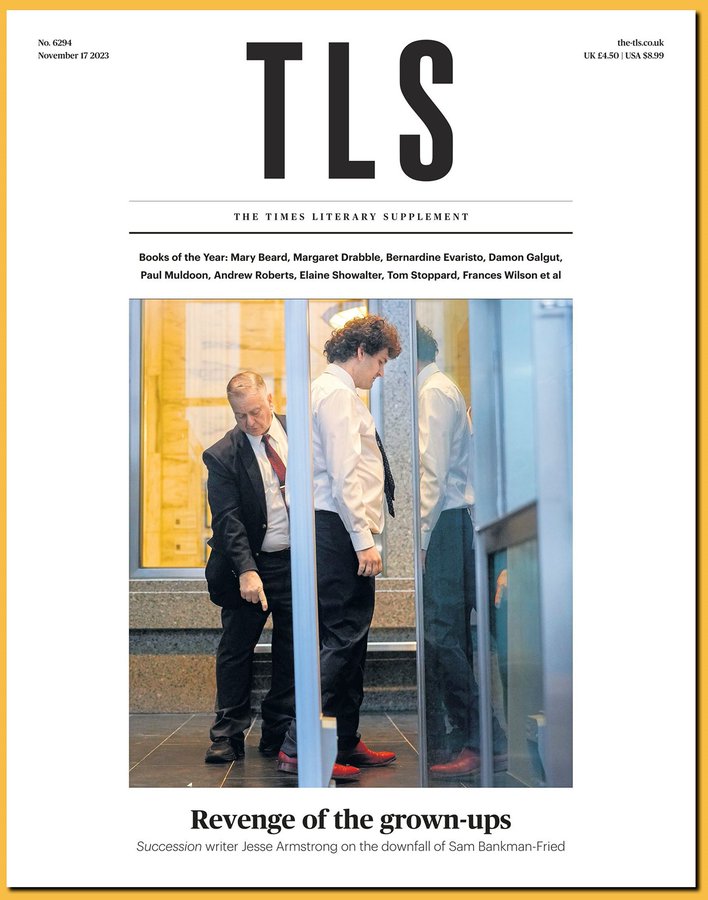
Times Literary Supplement (November 17, 2023): The new issue #TheTLS features Revenge of the grown-ups – The downfall of Sam Bankman-Fried; 2023 Books of the Year; the elusive Shakespeare; Simone Weil; Philosophers and public affairs – and more…

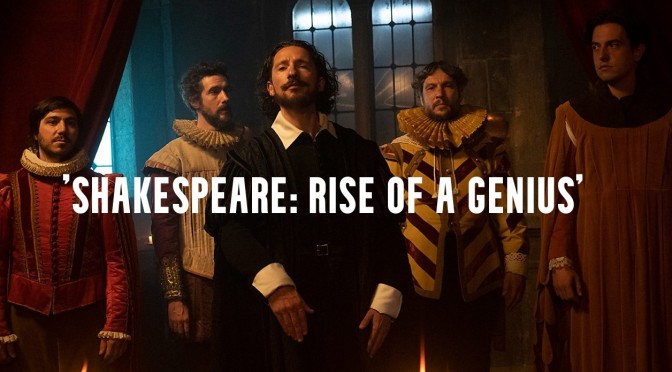
BBC Theater: ‘Shakespeare – Rise Of A Genius’ (2023)

BBC (November 12, 2023) – This gripping three-part documentary series for BBC Two and iPlayer features an A-list cast of actors, including Dame Judi Dench, Dame Helen Mirren, Brian Cox, Adrian Lester, Lolita Chakrabarti, Martin Freeman and Jessie Buckley, alongside academics and writers James Shapiro, Jeanette Winterson, Lucy Jago , Jeremy O’Harris and Ewan Fernie – who provide fresh insights into the incredible story of our greatest writer, the place and time he inhabited and the work he produced.

Shakespeare: Rise of A Genius

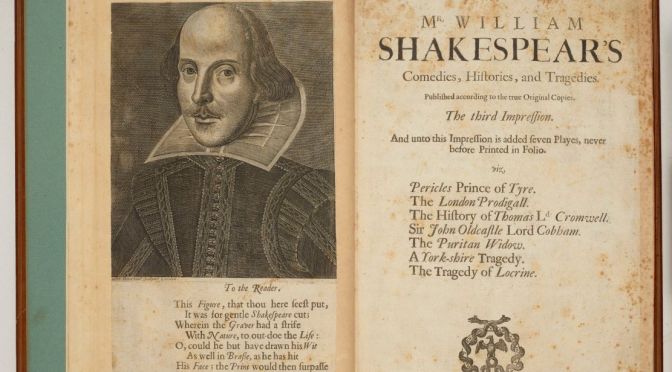
November marks 400 years since arguably the greatest work of English literature was created, the First Folio, published seven years after the death of William Shakespeare and without which much of his work would have been lost for future generations to enjoy today.

The BBC is celebrating this extraordinary anniversary with an ambitious season of content across TV, Radio, BBC iPlayer & BBC Sounds exploring why, 400 years on, Shakespeare’s relevance and influence is as strong as ever. A wealth of programming featuring major actors and leading experts, including new documentaries, performance, music, drama, comedy, news coverage and the best of the BBC archive, as well as special items on flagship BBC shows, will celebrate the man, his world and his timeless writing.

Here’s how you can watch, listen and learn about Shakespeare across the BBC…

Literature: Shakespeare’s First Folio At 400 Years

Royal Collection Trust (November 8, 2023) – Today, November 8, 2023, marks the 400th anniversary of the publication of Shakespeare’s First Folio. Around 235 copies of the First Folio survive today, including a copy in the Royal Library.

Watch our film to learn more about it. The First Folio is the first printed collection of William Shakespeare’s plays. It was produced in 1623, seven years after Shakespeare’s death, and contains 36 of Shakespeare’s works. Without this book we may not have had texts of 18 of Shakespeare’s plays, including Macbeth, Twelfth Night and The Tempest.

Find out more about the First, Second and Third Folios in the Royal Library and which kings owed them. Find out what Charles I wrote in the Second Folio shortly before his execution…

Theater: ‘Simon Schama’s Shakespeare And Us’ (2023)

BBC Select (November 4, 2023) – How much is the personality of England intertwined with the visions of Shakespeare? Acclaimed historian Simon Schama tries to get beneath the skin of the playwright and understand why his stories are so relevant today.

In this insightful documentary we are shown how Shakespeare knew the importance of not just reflecting the lives of the kings and queens who peppered his plays, but ordinary people too – including thieves, clowns and prostitutes.

Watch Simon Schama’s Shakespeare and Us on BBC Select in the US: https://bit.ly/49bpdiK and Canada: https://bit.ly/45WLLAX

Arts/Books: Times Literary Supplement – Sept 29, 2023

Image

Times Literary Supplement (September 29, 2023): The new issue features The First Folio at 400; how disease shaped global history; novels of queer experience; what Britain laughs at; literary thefts and coincidences – and much more…

Germ of an idea

How disease has shaped global history

By Adam Rutherford

Scientists often make poor historians. Their shortcomings in describing and analysing the past include a failure to shed the whiggish stories that academic history moved away from decades ago. Straight lines are still drawn between Great Men and the impact of their brilliant insights on our view of reality. They also sometimes fail to treat the material of history with the seriousness they bring to their own discipline. Simple questions that are drummed into schoolchildren are frequently ignored in analysing documentary evidence: who wrote this, why, and for whom? The result is context-lite narrative that doesn’t stand up to scrutiny.

Our Shakespeare, rise

A copy of the First Folio at Christie's, London, 2016

Works to commemorate the 400th anniversary of the First Folio

Next year, the Folger Shakespeare Library in Washington DC will reopen after a three-year closure for a large-scale renovation of its building, which dates from 1932. The centrepiece of the new Shakespeare Exhibition Hall, will be, as the press release puts it, something “that only the Folger could produce: all 82 copies of the 1623 First Folio of Shakespeare that were collected by Henry and Emily Folger”. The Folger holds slightly more than a third of all extant copies of the book and now eighty of them will be on permanent show in a “20-foot long visible vault”, while two more will be open in cases as part of an “interactive” visitor experience. Peering into the vault says much about the Folgers’ appetite for cornering the market in Folios but, since nearly all copies differ in some respects, it did make some kind of sense to buy many of them.

Travel: Walking Tour Of Verona In Northern Italy

Moveora Films (August 4, 2023) – Verona is a city in northern Italy’s Veneto region, with a medieval old town built between the meandering Adige River. It’s famous for being the setting of Shakespeare’s “Romeo and Juliet.”

A 14th-century residence with a tiny balcony overlooking a courtyard is said be “Juliet’s House.” The Verona Arena is a huge 1st-century Roman amphitheater, which currently hosts concerts and large-scale opera performances. 

Arts/Books: Times Literary Supplement – July 21, 2023

Image

Times Literary Supplement (July 21, 2023) – Moral catastrophe – The great inflation in Germany in 1923 and the Hitler putsch; Pioneer’s in Women’s Sport; Colson Whitehead’s Harlem; Dangerous children; Dating The Tempest and Shakespreare’s tutor….

Books: Literary Review Magazine – April 2023

Image

Literary Review – April 2023 issue: The April issue of Literary Review is out now! In this month’s cover article, Kirsten Tambling looks at how Shakespeare’s Juliet has been reinterpreted and received through the ages.

Such Sweet Sorrow

Searching for Juliet: The Lives and Deaths of Shakespeare’s First Tragic Heroine – In 1611, the Somerset-born traveller Thomas Coryat described an Italian architectural novelty: a ‘very pleasant little tarrasse, that jutteth or butteth out from the maine building: the edge whereof is decked with many pretty little turned pillers … to leane over’.

One Day in October

Killing Thatcher: The IRA, the Manhunt and the Long War on the Crown