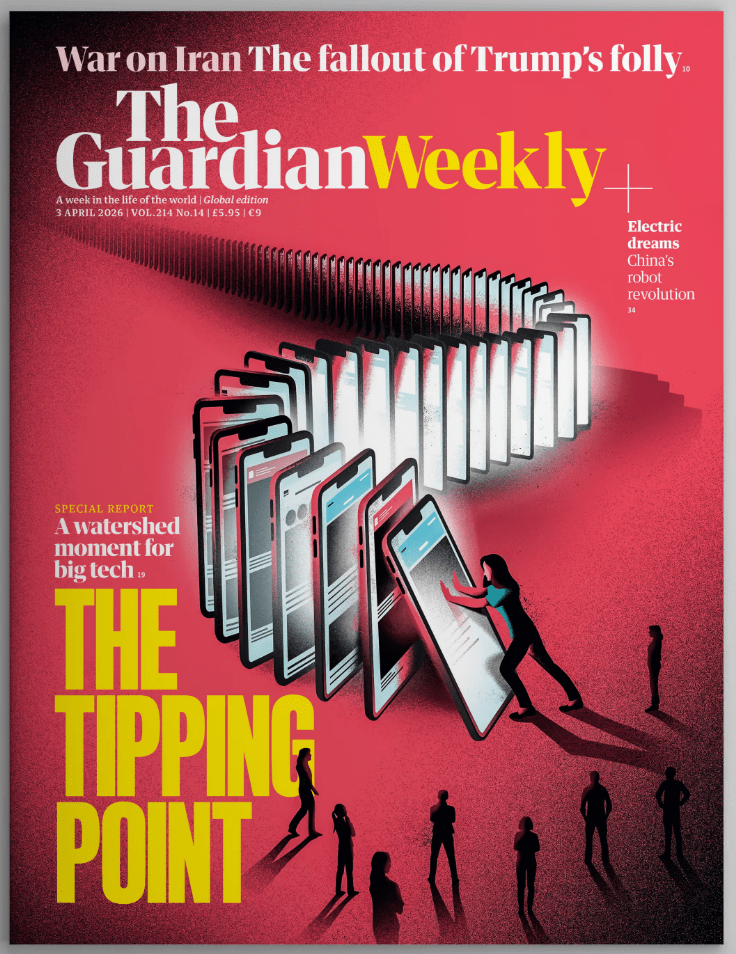
In a landmark case, a California jury last week found social media companies Meta and YouTube liable for deliberately designing addictive products. The ruling came the day after Meta, which owns Facebook and Instagram, was ordered to pay $375m after a jury in a separate trial in New Mexico found it misled consumers about the safety of its platforms.
Meta, YouTube, Snapchat and TikTok are facing thousands of similar lawsuits in US courts, while governments around the world are starting to introduce measures to curb social media’s grip on children’s attention.
Guardian technology editors Dan Milmo and Robert Booth assess whether what has been called a “big tobacco” moment for the industry will lead to significant change. And in our opinion section, Jonathan Freedland argues that the court verdicts must be just the start of a global fightback.
The big story | A war of regression Weeks into a war that was going to take days and has cost billions, Donald Trump has bombed the US into a worse position with Iran, writes Patrick Wintour
Science | ‘On the shoulders of giants’ Plant specimens and teaching materials that inspired Charles Darwin have been unearthed and will be used for the first time to teach contemporary students about botany, Donna Ferguson reports
Feature | Circuit training After touring 11 Chinese companies making humanoid robots, Chang Che asks: just how close are we to a robotic future?
Opinion | Labour needs a thinker Ed Miliband’s stock is rising in a party in need of an old-style intellectual heavyweight, argues Gaby Hinsliff
Culture | Gimme shelter Catherine Slessor visits Henry Moore’s former countryside home Hoglands, now home to studios and a vast sculpture garden, to learn about a new exhibition of the drawings he made as a war artist, capturing people as they took sanctuary from the blitz
Brinkmanship, the ability to take countries to the edge of conflict, was a staple of cold war diplomacy. The remnants of that finely balanced standoff, bound by a rules-based order and spheres of influence, has given way to a world in freefall; to an ever-widening war in the Gulf where the aims are as unclear as the endpoint.
It is approaching a month since the US and Israel launched their attacks on Iran, arguing they were acting to remove the country’s nuclear threat, destroy its ballistic missile capability and free the populace of a tyrannical theocratic regime. Yet it seems it is these civilians and neighbouring Gulf countries who are bearing the brunt of the campaign while the Iranian regime’s willingness to escalate the war seems undimmed.
Spotlight | The ‘anyone but’ election Pippa Crerar looks ahead to local elections in the UK, where voters seem more concerned with who they want to keep out of political office than who they vote in
Science | Not-so silent nights Can a “vacuum cleaner turned the other way” become a popular solution to snoring disorders? Natasha May explores the rise of Cpap machines
Feature | Gamifying government Steeped in gaming and rightwing culture, Elon Musk’s Doge team set out to defeat the enemy of the United States: its people, write Ben Tarnoff and Quinn Slobodian
Opinion | Collateral damage Attacks on synagogues and Jewish shops in the UK, Europe and the US don’t hurt Benjamin Netanyahu, says Jonathan Freedland, they just hurt ordinary Jews
Culture | Rock return “Validation was an insatiable monster”: Dave Grohl talks to Ben Beaumont-Thomas about Foo Fighters, life after his infidelity and grief for bandmate Taylor Hawkins
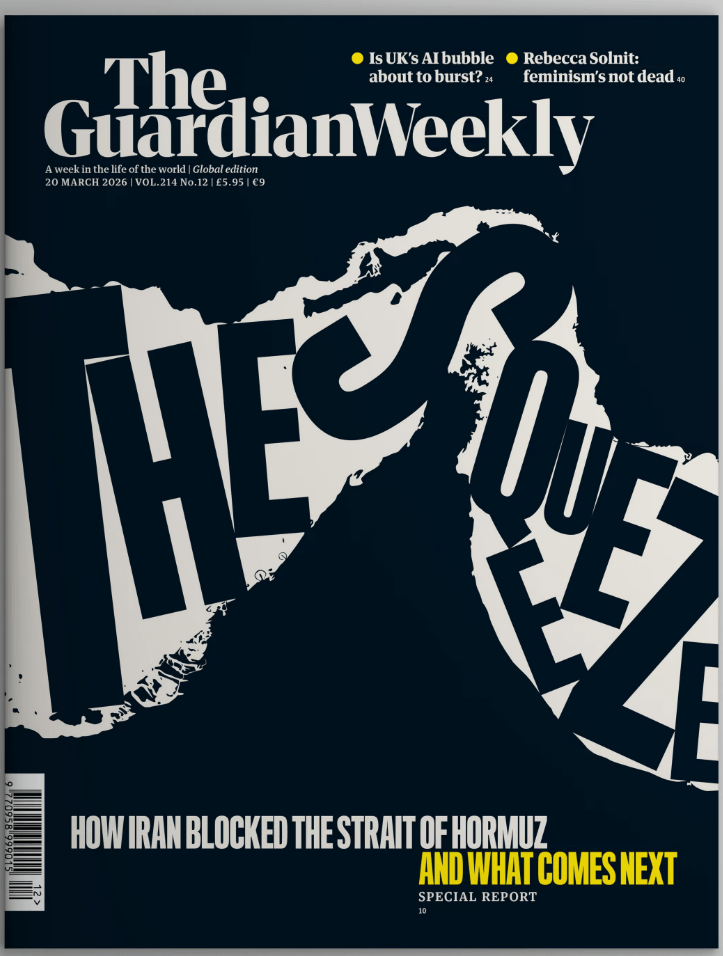
As fighting in the Middle East entered its third week, focus has shifted to Tehran’s closure of a key maritime passage, and the potentially huge global economic impact.
For our big story this week, Jillian Ambrose explains how the war in Iran has effectively blocked the Gulf states from exporting a fifth of the world’s oil supply through the strait of Hormuz. Peter Beaumont sets out the significance of the route and the possible options to counter the blockade, while Hannah Ellis-Petersen reports on the building anger and resentment in the region over being dragged into a war they did not start and had diplomatically tried to prevent.
Peter also looks at “the escalation trap” that lies ahead for both sides in the conflict, and we have on-the-ground reports from Jason Burke in northern Israel and William Christou in southern Lebanon, as well as a stark account of day-to-day life from inside Tehran.
Spotlight | ‘Extraordinary cruelty’ Kaamil Ahmed and Alex Clark examine the evidence that starvation is being used as a weapon of war in Sudan
Technology | Star fruit As Apple reaches its half-century, Chris Stokel-Walker rounds up its biggest triumphs and flops
Feature | Feminism’s not dead! In a stirring riposte to all those who have declared the death of the women’s movement, Rebecca Solnit outlines the advances that have been made and argues it’s no time to give up the fight
Opinion | The British right’s Maga obsession UK conservatives were once hostile to the US, but now are keen to emphasise loyalty to Trump above all else, writesKojo Koram
Culture | One win after another After 11 nominations without a single win, film-maker Paul Thomas Anderson deservedly struck gold at the Oscars with One Battle After Another, says Xan Brooks
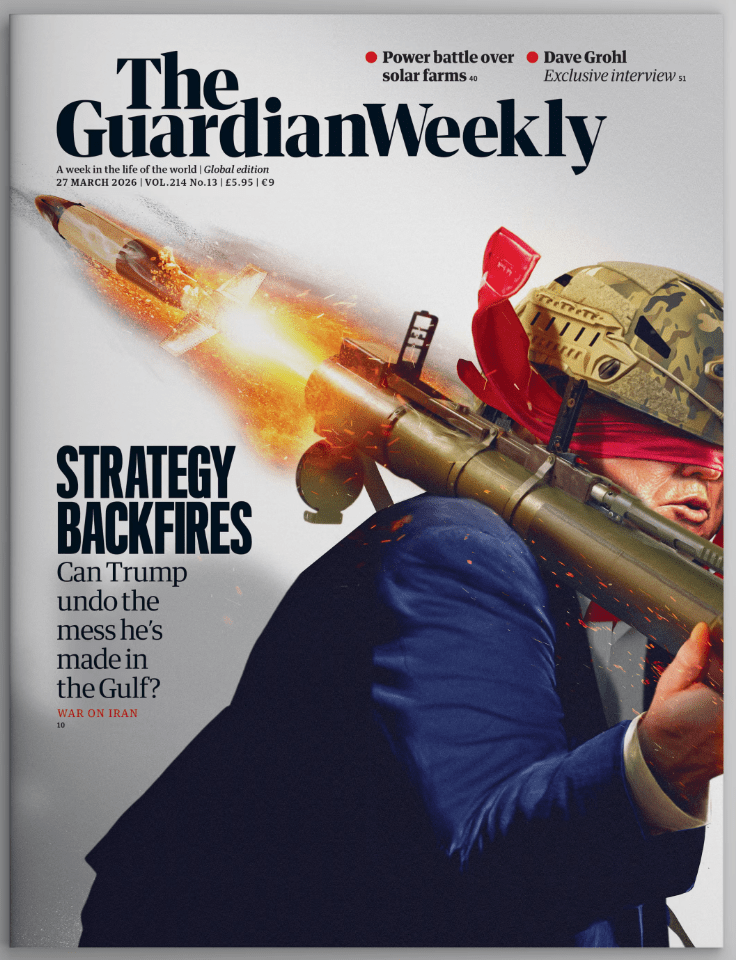
When news breaks that dominates the agenda to the extent of the US-Israeli attack on Iran, one challenge for the Guardian Weekly team is how to keep the magazine’s covers feeling fresh, week after week, while remaining focused on the same story.
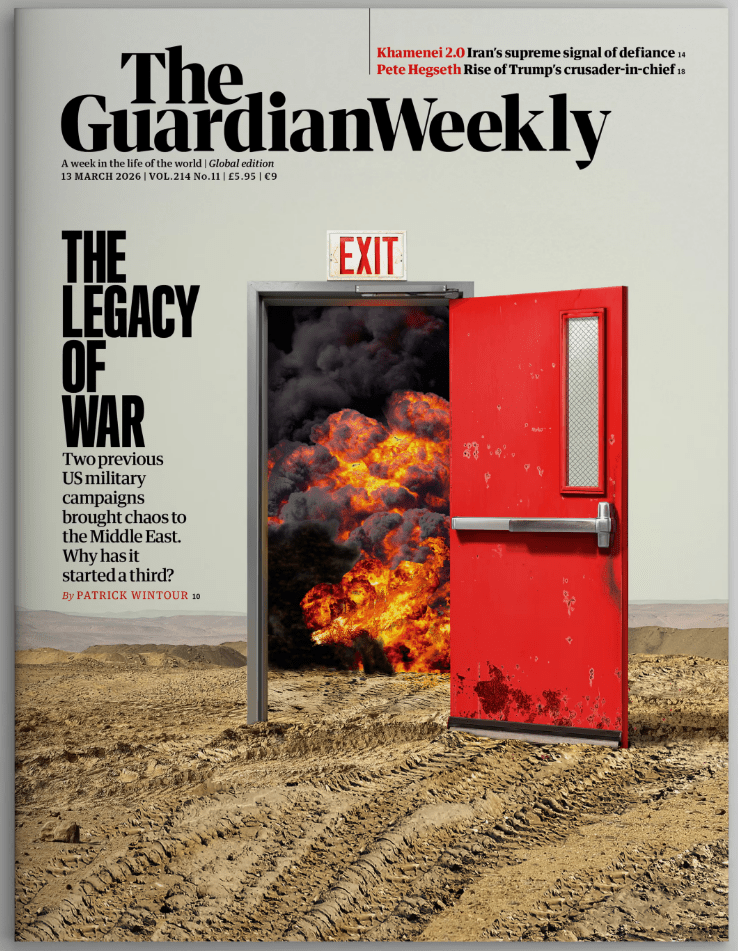
For this week’s edition, in response to Patrick Wintour’s must-read essay on how the US has ignored the lessons of two previous Gulf wars, we asked illustrator Doug Chayka to play with the idea of a Middle East that the US either cannot, or refuses to, see. Doug’s artwork neatly captures the dilemma of a Trump administration that now finds its Iran exit strategy – assuming there was one – cut off by chaos.
Spotlight | War losses mount in rural Russia Residents of a remote village in Komi Republic say dozens have left to fight in Ukraine, leaving behind grieving families and labour shortages. Pjotr Sauer reports
Science | Is the passion for taxonomy in danger of dying out? Insect taxonomist Art Borkent fears his field of science is fading, despite millions of insects, fungi and other organisms waiting to be discovered, he tells Patrick Greenfield
Feature | The miraculous survival of Nada Itrab After a nine-year-old girl was kidnapped and taken from Spain to Bolivia, authorities feared the worst. They found her in the rainforest nine months later – but that wasn’t the end of her ordeal. Giles Tremlett picks up the story
Opinion |In this war, Britain’s enemy now is Donald Trump As the Iran disaster escalates, Simon Tisdall argues that Starmer should treat the US president as someone whose actions threaten the lawful, democratic way of life everywhere
Interview | Corinne Bailey Rae The English singer and songwriter was riding high with a hit album when her husband died tragically young. She discusses grief, fame and rebuilding her life with Simon Hattenstone







 Boomers Daily