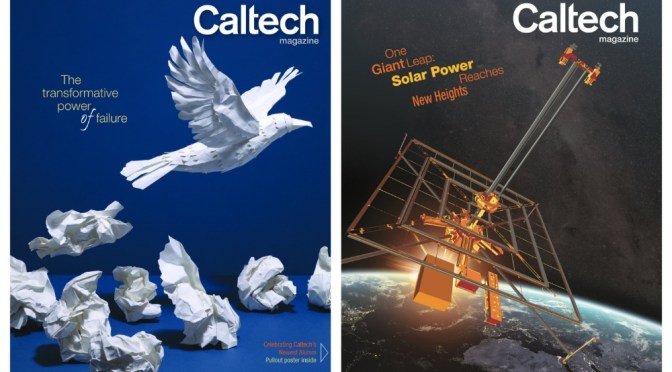
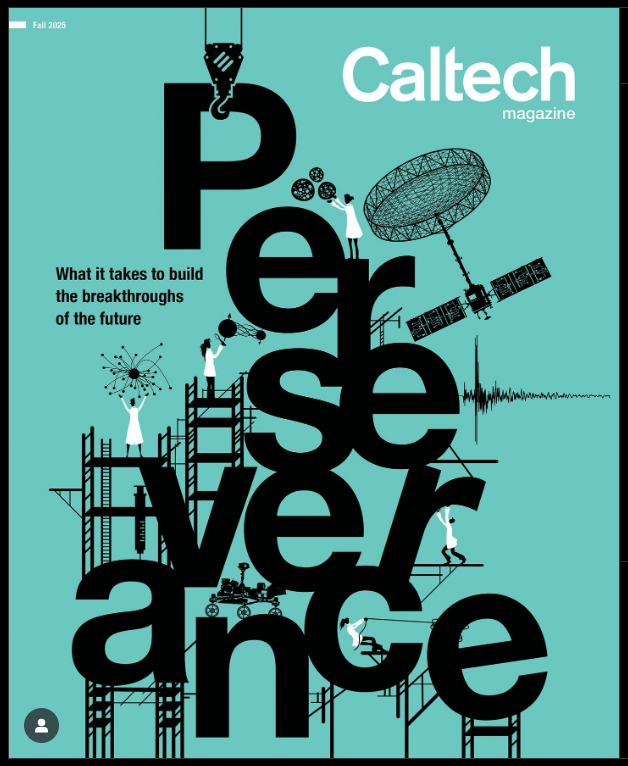

Where Perseverance Meets Discovery
On the power of cathedral-building in science.
The Ice at the Far Ends of Earth
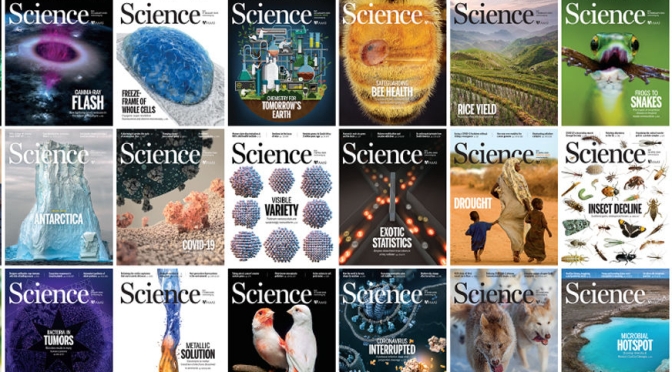
Researchers know the planet’s ice is melting; now, they are uncovering what that will mean for all of us.

On the power of cathedral-building in science.
Researchers know the planet’s ice is melting; now, they are uncovering what that will mean for all of us.
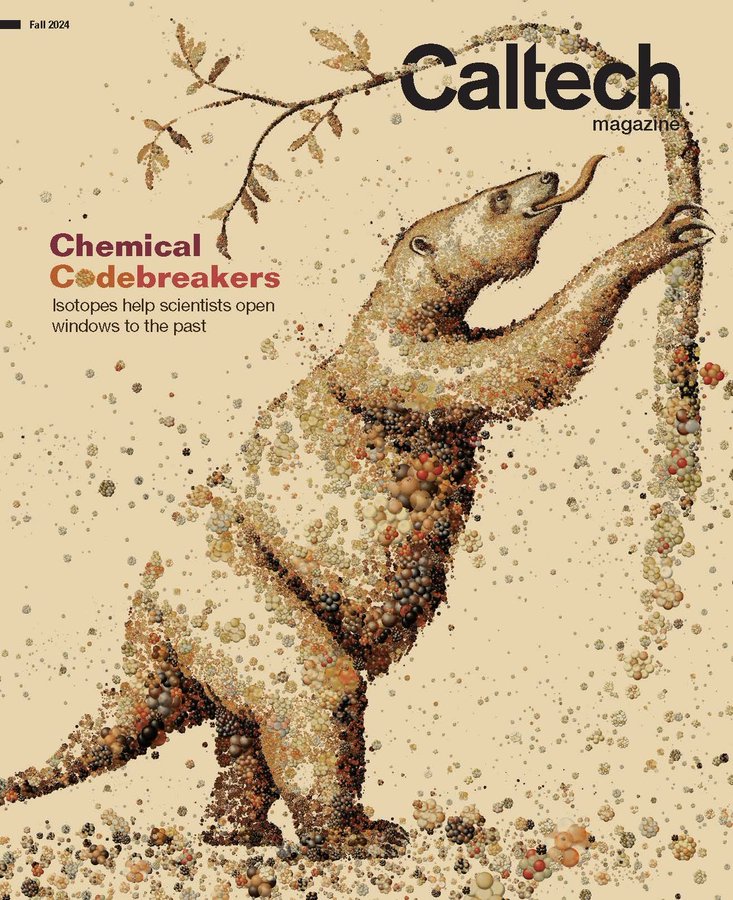
Caltech Magazine (November 8, 2024): The FAll 2024 issue features ‘Chemical Codebreakers’ – Isotopes help scientists open window to the past….
Journeys to the Past: Isotope geochemistry is helping scientists reveal secrets about the molecular histories of Earth, the cosmos, the human body, and more.
An Intriguing Red Planet Rock: The Mars Perseverance rover has found a “compelling” rock that could indicate the planet hosted microbial life billions of years ago.
The 2024 Distinguished Alumni: Meet this year’s awardees: David Brin (BS ’73), Louise Chow (PhD ’73), Bill Coughran (BS, MS ’75), and Timothy M. Swager (PhD ’88).
The Evolution of Trolling: A new theoretical framework explains why social media discourse can be so toxic.
Inside Look: Joe Parker: Step into the office of this evolutionary biologist, whose research nest is filled with real—and illustrated— insects.
Ripples from the Heart: Mory Gharib (PhD ’83) has leveraged his aerospace expertise to tease out some of the heart’s greatest secrets and use them to develop life-saving medical devices.
The Lab in the Sky Says Goodbye: A NASA DC-8 airplane that carried Caltech students around the globe for science has been retired.
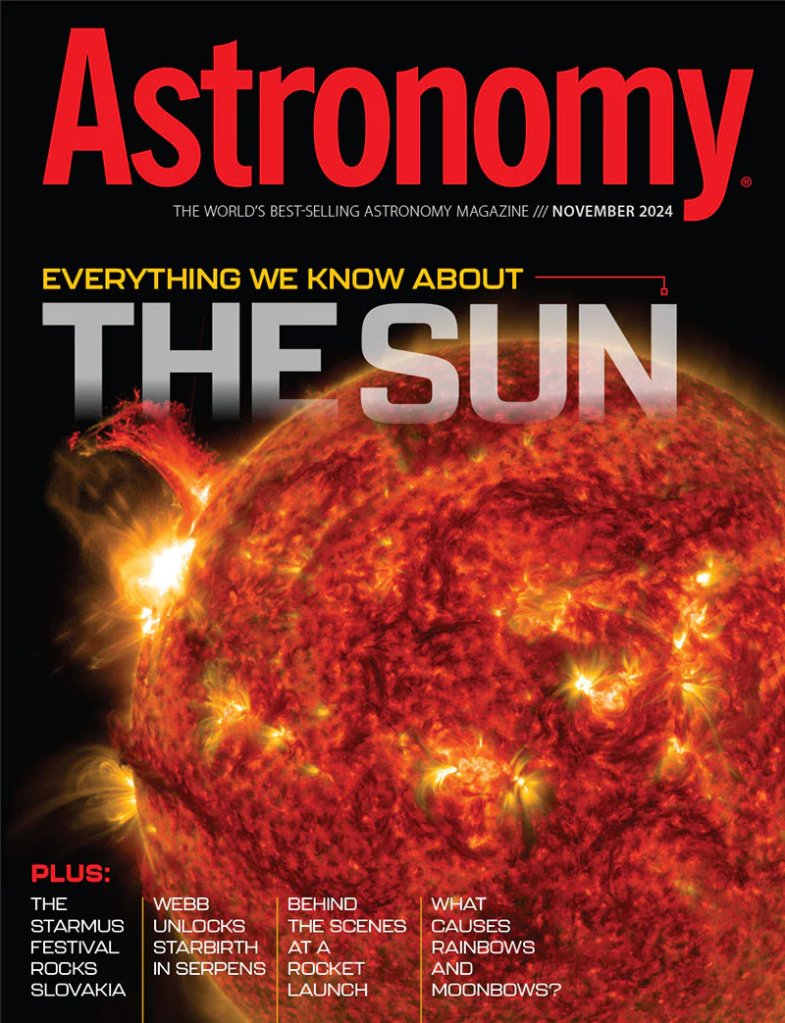

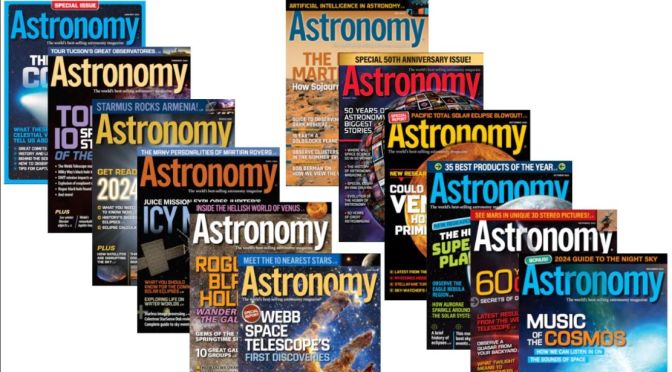
Astronomy magazine (November 1, 2024) – The latest issue features “Everything we kno about the Sun’….
The closest star to Earth is also the best studied, but only recently have we truly begun to uncover its secrets.
For thousands of years, humans have worshipped the Sun. Our ancestors built monuments and temples to it, and used it to mark the annual cycle of seasons. For ancient Egyptians, their most important god, Re, was the personification of the Sun itself.
Today, we are no less in thrall to the wonders and mysteries of our nearest star. We’ve made strides in understanding its major systems and answered many questions about how it produces energy. But the Sun is far from an open book,
Mars is brightening and the giant planet Jupiter is reaching its best apparition in a decade for Northern Hemisphere observers this month.
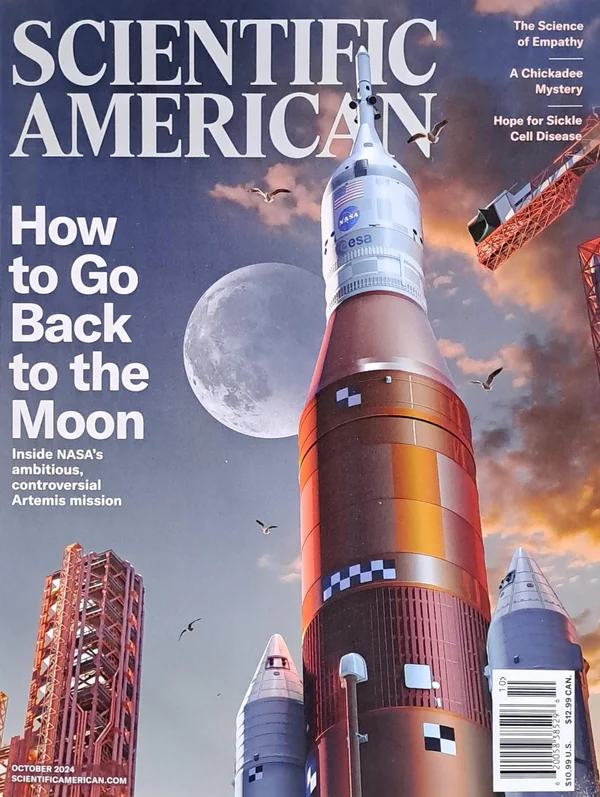
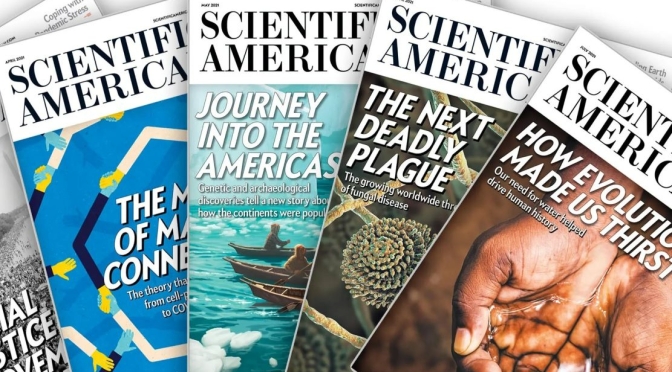
Scientific American (September 16, 2024): The October 2024 issue features ‘How To Go Back To The Moon’ – Inside NASA’s ambitious, controversial Artemis mission; The science of Empathy and Hope for Sickle Cell Disease…

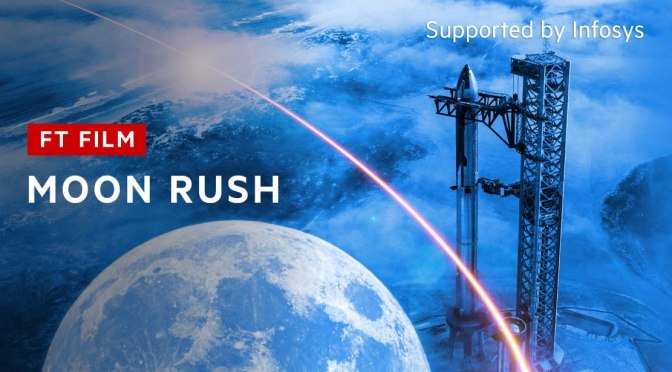
The FT’s Peggy Hollinger asks if the next great leap forward in space is a lunar economy?

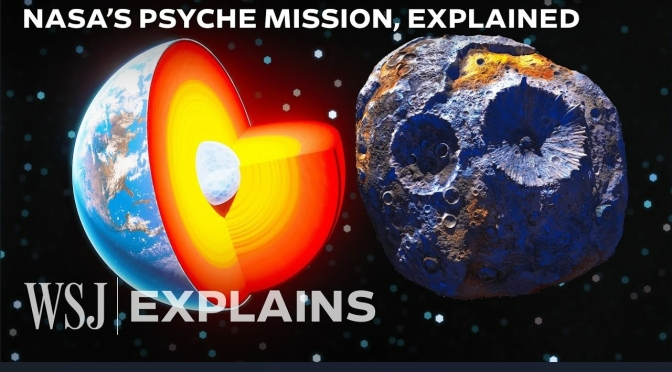
Video timeline: 0:00 NASA’s mission 0:46 The psyche asteroid 1:45 Why metal matters 3:04 What we can learn from the mission
The rocky inner planets of our solar system are thought to have mostly metallic cores. WSJ breaks down why this mission matters and what it could tell us about Earth’s origins.

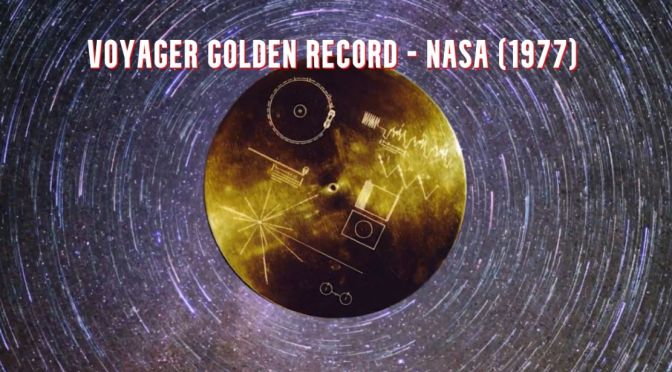
Designed to communicate to possible space-faring civilizations something of the diversity of life and culture on our world, the Golden Record consisted of greetings in 59 human languages and those of the humpback whales, 115 images of life here, the sounds of Earth, and 27 pieces from the world’s musical traditions. It has been called the beginning of the concept of “world music.”
It was Voyager 1 that looked homeward from high above Neptune to take, at Carl Sagan’s behest, the iconic Pale Blue Dot photograph. Upon flawlessly completing the first phase of their mission, the NASA Voyagers 1 and 2 made for the open sea of interstellar space, teaching us the actual shape of our solar system as it moves through the galaxy. The Golden Record is an unparalleled document in the history of space exploration and our civilization.
0:15 Finland’s electricity fell below €0 – It happened twice during one week in May caused by a glut of hydroelectric capacity as a result of heavier-than-usual spring meltwater. This meant the supply of electricity exceeded demand and this, in turn, led to a negative price for electricity.
1:30 NYC gives new mothers $1000 – The no-strings cash payments last for 18 months. Then for the following 18 months, low-income mothers receive $500 a month, covering the first 3 years of their baby’s life. The scheme – known as the Bridge Project – aims to fight child poverty in New York as well as reducing inequality and stress for new parents.
3:19 NASA will send your name to space – It’s asking people to sign a poem written by Ada Limón, the US Poet Laureate. Limón’s poem will be engraved on NASA’s Europa Clipper spacecraft. While signatories’ names will be etched on microchips mounted on the craft.
5:11 Implants help this paralysed man walk – It creates a ‘digital bridge’ between his brain and his spinal cord, Bypassing sections that were damaged in an accident. The implant lets him stand, walk and even climb stairs.
_____________________________________________
The World Economic Forum is the International Organization for Public-Private Cooperation. The Forum engages the foremost political, business, cultural and other leaders of society to shape global, regional and industry agendas. We believe that progress happens by bringing together people from all walks of life who have the drive and the influence to make positive change.
0:15 NASA launches space based pollution monitor – It’s called TEMPO, which stands for Tropospheric Emissions: Monitoring of Pollution. Built by Ball Aerospace, TEMPO will measure levels of major air pollutants every hour from a geostationary orbit 22,000 miles above the equator. It will monitor a huge region of North America from Canada’s oil sands in northern Alberta to below Mexico City at a resolution of up to 4 square miles. Air pollution poses a major threat to human and planetary health as 99% of the global population breathes air that exceeds WHO health guidelines. Air pollution carries a total economic cost of more than $8 trillion. Therefore, monitoring it is critical to understanding its impacts. Though TEMPO is due to launch in April 2023, watch to learn more about how it will monitor air pollution from space.
1:58 8 best countries for working women – The Economist ranked 29 OECD nations according to the role and influence of women in the workplace. Iceland scores well on numerous factors. From low childcare costs to education attainment for women to female representation at senior levels. At the current rate, it will take 132 years to close the global gender gap How does your country support women at work?
3:23 What is the polycrisis? – Today we are once again beset by seemingly unconnected crises. Such as the war in Ukraine, the climate crisis and the aftermath of COVID-19. “So economics, politics, geopolitics and then the natural environment blowing back at us – and those 4 things, they don’t reduce to a single common denominator. They don’t reduce to a single factor. And that’s why I think the polycrisis term has a real utility descriptively as much as anything else, because it’s kind of hand-waving, of course, it’s kind of arm waving. It’s going, look, there’s a lot of stuff happening here all at once. And that precisely is what we’re trying to wrap our minds around.”
6:54 Are Chatbots going to take our jobs? – “I get this question asked 10 times a week, which is that, look, is conversational AI going to take away jobs? And my consistent answer is no. And the best analogy I will give to you is banks and ATMs. So prior to the technology of ATMs, the most common reason why people would walk into a bank would be to take out money. So imagine there’s no ATMs and 90% of the reason why somebody goes inside the bank is to say, I need to take out some cash, I need to take out some money. As a result, you know, you and I don’t even remember these days, but banks used to be crowded. There used to be long lines and so on. Here comes the ATM, which automates really what should be a very simple task.”
_____________________________________________
The World Economic Forum is the International Organization for Public-Private Cooperation. The Forum engages the foremost political, business, cultural and other leaders of society to shape global, regional and industry agendas. We believe that progress happens by bringing together people from all walks of life who have the drive and the influence to make positive change.

Habitable Worlds Observatory would be designed for robotic servicing
Silt overload and mercury pollution endanger river ecosystems—and the people who depend on them
Agency warns about brain swelling and bleeding on drug’s label, but imposes few restrictions on lecanemab’s use

 Boomers Daily