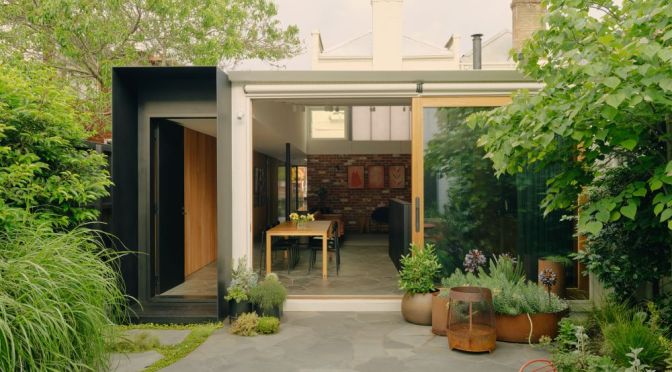
The Local Project (December 29, 2023) – Fitzroy Laneway House is an architects own tiny house grounded in foresight and malleability – attributes that an architect brings when designing their own home.
Video timeline:00:00 – Introduction to the Architects Own Tiny House 01:32 – A Family Centred Brief 02:01 – A Walkthrough and the Layout of the House 03:18 – Integrating the Landscape and Exterior 03:50 – A Robust and Grounded Material Palette 04:54 – The Connected Design Approach
Andrew Child of Andrew Child Architecture creates a family home designed with both the present and the future in mind that eloquently responds to its inner-city Melbourne location. Andrew was immediately drawn to the original home, which is one of five Victorian terrace homes in a historically rich street in Fitzroy – a vibrant locale with lots of old buildings mixed in with new pieces of architecture. The brief for an architects own tiny house was to create a residence that would accommodate Andrew and his family into the future and be open to change.
“I also wanted something quite informal, that felt relaxed. We want to have fun here,” says Andrew. Fitzroy Laneway House is founded on the notion of connection to the site and the surrounding area. “I wanted the house to feel like a sanctuary, but I still wanted it to feel like we are connected to Fitzroy,” notes Andrew. As such, large windows offer views of the garden, neighbouring buildings and across rooftops. “If things change, like trees knocked down, we have installed shading blinds, timber screens, metal screen curtains, drapes and hanging planters, which all help with managing privacy while still making us feel connected to the locale,” says Andrew.
National Geographic Traveller Magazine (December 2023): The latest issue features the 30 best destinations for 2024, Northern Lights in Manitoba, sailing Denmark’s South Funen Archipelago on a tall ship and a long-distance rail trip in the US….
Also inside this issue:
Uganda: The wildlife of Queen Elizabeth National Park. Melbourne: In Victoria’s state capital, local innovators are breathing new life into forgotten spaces. Amman: Culture, cuisine and craft in Jordan’s kaleidoscopic, mountain-fringed capital. Tunisia: From laid-back coastal towns and diving spots to mountain trails in the county’s northern reaches. Warsaw: Traditional Polish flavours have found a new home in fine-dining establishments. Central London: Hotels to escape the crowds at, from budget boutiques to spruced-up luxury boltholes.
Plus, saddling up inGeorgia’s Tusheti region; the salt workers of India’s Habra city; Barcelona’s La Sagrada Família nears completion; Europe’s new UNESCO World Heritage Sites; the flavours of Sierra Leone;a pedal-powered tour of Malmö; design-led stays in Siem Reap; a Christmas break in Lapland; beach views and seafood in Aberdeen; a staycation in Arnside and Silverdale; great illustrated travel books and photography collections; and overnight essentials.
The Local Project (October 8, 2023) – Venturing inside a breathtaking sustainable home obscured behind cascading garden walls, Immersion House is a hidden oasis in the middle of Melbourne’s inner-west suburbia. Creating a family home that offers a sense of refuge,
Video timeline:00:00 – Introduction to the Breathtaking Sustainable Home 00:52 – An Inner-City Location 01:07 – Taking Inspiration from A Family Sanctuary 01:32 – The Seamless Indoor Outdoor Connection 01:54 – A Rich and Natural Material Palette 02:18 – Utilising the Versatile Tongue & Groove Boards 03:47 – Satisfying Aspects of the Design 04:18 – Proud Moments
Matsouri Architects defy the conditions of the corner block location through a series of unique and enveloping experiences. Located on a corner site that slopes gradually towards the back and in a quiet residential area in the inner-western suburb of Melbourne, Australia, Immersion House is a direct response to the client’s very strong brief to have a private sanctuary while retaining aspects of the original heritage home.
This brief was the inspiration behind Matsouri Architects’s architectural approach – creating experiences and spaces so the occupants could have a sanctuary to raise their family and live in the house they always envisaged. Inside the breathtaking sustainable home, the integration of interiors with the surrounding nature is key to the home’s immersive effect. On the first floor, one feels a sense of being perched above the street, implanting an almost subterranean feel. The connection between the indoors and the outdoors feels seamless and natural; there is a view towards nature from every part of the house and a strong sense of a singular indoor and outdoor space in the way that one almost doesn’t detect what is inside and what is outside when all the doors are folded back.
Similarly, a rich and natural materiality inside the breathtaking sustainable home becomes fundamental to creating this sense of sanctuary and immersion. The use of natural and textural materials such as concrete, timber and steel feel elementally connected to the surroundings. This minimal decor and palette have a quality that ties it all together and imbues the home with a sense of harmony and creates a space that feels all-enveloping. A key aspect of this raw materiality is the use of rich timber as a key material inside the breathtaking sustainable home.
The Local Project (September 26, 2023) – Narrow sites and smaller residences tend to provide architects with an opportunity – one that inspires creativity and innovation. This is true of Concrete Curtain, an architect’s own home in inner-city Melbourne, where FGR Architects evocatively draws on materiality and natural light, imbuing the architecture of the family home with a sense of elegance and spaciousness.
Video timeline:00:00 – Introduction to the Architect’s Own Home 01:29 – Designed for a Growing Family 01:39 – A Walkthrough of the Home 03:13 – Playful Additions 03:49 – The Use of Stone Throughout the Home 05:27 – The Calming Materials 05:46 – Proud Moments
Upon entering the architect’s own home, one is met with a garage that is flanked by an ensuite, study and laundry. The house tour then leads into the central foyer area – a core part of the dwelling that allows light to enter from the east and west. The lower part of the residence contains the kitchen, living and dining area that then naturally flows out towards the al fresco dining area.
The spiral staircase leads to the second level, which is split into two segments. On the northern side is the master suite, and on the southern end is the childrens’ bedrooms. This floor also features a playful, blue carpet, which adds vibrancy to the upstairs level. Perhaps the most prominent feature of the architect’s own home is the concrete curtain, which reveals FGR Architects’s intention to illuminate areas with natural light.
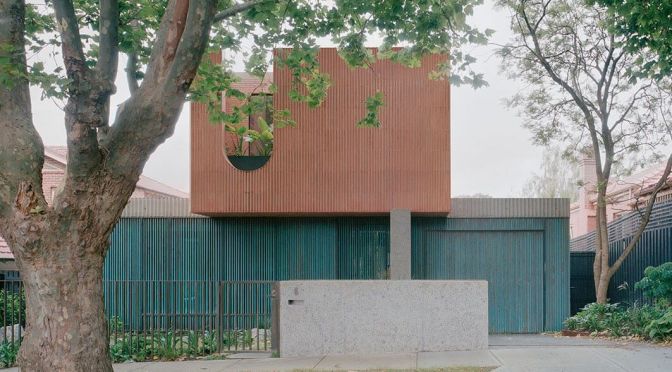
Wanting to create a sense of space, the architect leveraged the idea of a sheer curtain to allow for both privacy and openness. As such, the concrete ‘cylinders’ are spaced out in a way that emulates the fold of a curtain. The result is a remarkable feature with a gentle, pleated style that softens the residence and lets light pass through seamlessly. The interior design and materiality of the architect’s own home is vital to its overall effect.
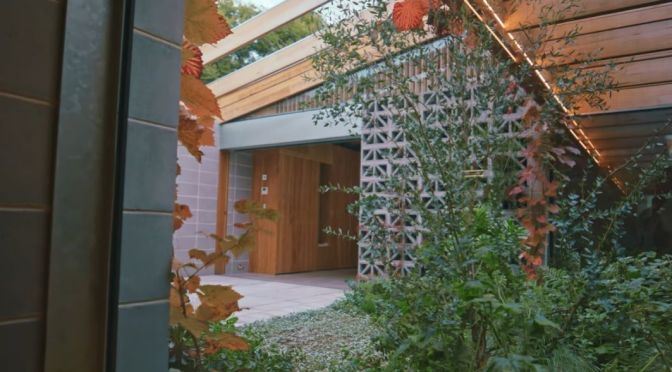
The Local Project (September 1, 2023) – Removed from the busyness of Fitzroy, an inner-urban suburb of Melbourne where the home resides, stepping into Sunday makes one feel as though they are entering a hidden garden house. Architecture partners with Brickworks to create a sanctuary that offers a range of intimate, social and comforting spaces under the one roof.
Video timeline:00:00 – Intro to the Hidden Garden House 00:57 – The Inner-Melbourne Location 01:18 – A Specific and Well Written Brief 01:45 – A Walkthrough of the Home 02:32 – Integrating A Colour Pop 03:10 – An Indoor Jungle 03:39 – Utilising A Robust Material Palette 04:22 – The Brickworks Collaboration 05:40 – An Exciting Future
The client put forth interesting architectural reference points for the renovation. An extension creates the main communal, outdoor and private realms, and two east-west bands further divide each of these realms into two zones. The kitchen and dining are the heart of the home, with a sunken lounge that comes off the kitchen space. Expressed beams, clerestory glazing and concrete pavers connect the communal outdoor areas, which also sees the courtyard act as its own room.
Perhaps the most powerful design concept of the renovation is this assimilation of the courtyard, which further elevates the home as a hidden garden house. Designing a central courtyard not only offers a great sense of connectedness to the landscape but also maximises ventilation and natural light in the living and bedroom areas. As a way of navigating the small size of the site, key themes the architect leverages are that of separation and connection to ensure there are comfortable places to gather and retreat.
Breeze-block walls establish the various zones of the house and allow for an abundance of light, air and outward views. Similarly, accessing the bedroom requires walking across the open-air courtyard – a deliberate retreat from the house. The interior design of Sunday is defined by a robust materiality, muted palettes, clear geometries and spaces sculpted by light. Natural textures dominate, with minimal surface treatments allowing the house to develop its own patina with time that continues throughout internal and external areas of the home. Bold yellow also features throughout the hidden garden house, which is inspired by the client’s love of Luis Barragán’s colours.
The Local Project (August 23, 2023) – The revitalisation of this heritage brick house by Matt Gibson Architecture + Design was grounded on the ethos of changing as much as necessary but as little as possible.
Video timeline:00:00 – Intro to the Modern Brick House 00:32 – The Location of the Home 00:49 – William Tappin and His Designs 01:05 – Handling the Connection Between Old and New 02:01 – Requirements of the Brief 02:25 – The Interpretation of Arts & Crafts 03:07 – Behind the Kitchen Design 03:30 – A Walkthrough of the Upstairs 04:18 – The Architect’s Proud Moments
Located in the eclectic neighbourhood of South Yarra in Melbourne, William Tappin House depicts the sensitive layering of a historical footprint with contemporary innovation. Originally designed and occupied by its namesake, William Tappin – a renowned Queen Anne-style architect – the connection between old and new was something the architect wanted to handle sensitively, and this influenced the positioning of the building on site.
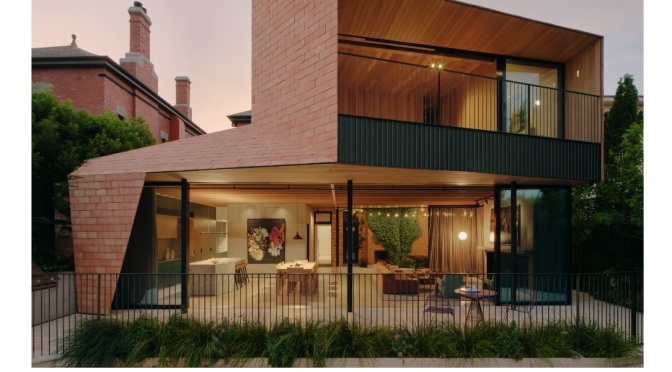
The existing structure is restored to remain the hero, whilst the new addition is recessive and humble in design. Restorations include revealing the original brickwork and limestone, restoring the existing verandah and carved wooden features. Exposed details, such as the fingerprints of makers on the tiles and original brick, become a symbol of the heritage façade of this home. New additions are highly sensitive to the brick home’s foundation.
The rear addition is constructed from limed timber and off-form concrete that calls back to the tonality of the limestone and basalt detailing of the original structure. Terracotta tiles also wrap the faceted roofscape in an ode to the bespoke red brick. What the house tour shows is a strong connection between inside and out, which prevails throughout the home. The entire ground floor, which contains the kitchen and living areas, opens to the exterior, with views extending all the way out to the garden and beyond – made even more accessible through sliding glazed doors.
The Local Project (August 8, 2023) – An inspiring renovation of an existing housing estate – The Secret Garden House that is Mount Eagle Estate – has since retained its relevance to influence a recent renovation by Zen Architects of one of the estate’s original homes, a secret Garden House.
Video timeline:00:00 – Introduction to the Secret Garden House 00:42 – The Original House 01:04 – The Project Brief for the Home 01:30 – The Material Palette 02:00 – A Walkthrough of the Secret Garden House 02:55 – The Kitchen 03:38 – Enhancing the Existing Garden and Landscape 04:30 – Favourite Aspects of the House
Zen Architects enhances the existing natural landscape and ties the garden back into the home. The midcentury architecture of the secret Garden House had been subjected to minimal changes over the years. Referencing the estate’s design and teardrop shape of the community gardens that once populated it, Zen Architects reflected the curved topographical gestures and fluidity with a desire to subdue the house and make the landscape the hero. Light now enters the house at every opportunity, as do views of the garden beyond.
At the front, the secret Garden House is largely in its original form, although updates have been made through furniture and by optimising thermal comfort – insulating floors and ceilings, and fitting seals and flyscreens to windows. The result is a fully electric home that captures the spirit and beauty of its original 1930s form and exceeds the contemporary 6-star home energy rating.
Upon entry, one is immediately greeted with a panoramic view of the garden beyond – Zen Architects retains the original façade and the front three rooms to provide an unassuming entry that heightens the impact of the interventions beyond. Moving into the extension of the secret Garden House, elements of the landscape – including rock forms, native vegetation and gum trees – inform the natural and organic material palette of the home.
The Local Project (May 21, 2023) -Located in the northern suburbs of Melbourne and a short distance from the Yarra River, Arthur by Oscar Sainsbury Architects (OSA) is an architects own house that extends upon the ideas of family living and connection to nature.
Video timeline: 00:00 – Introduction to the Architects Own House 00:31 – Designing for Yourself 00:59 – The Initial Design Ideas 01:13 – Encouraging Usage of the Garden 01:33 – A Focus on the Garden 01:56 – The Original Double Brick House 02:12 – The Central Part of the House 02:58 – Challenges Designing with Heritage Homes 03:39 – The Materials Used 04:35 – Favourite Aspects of the Home
As the owner, architect and builder, OSA dances across the separate realms with ease in order to deliver a home that allows the family to grow in place. Following a desire to open up an architects own house to the outside, OSA uses contemporary methods of design, allowing for the family to easily manoeuvre about.
With the house tour of an architects own house beginning at the double-bricked façade, OSA has additionally maintained three of the original bedrooms, with two facing the street and one opening up to the rear decking. Designed to be the central part of the house, the kitchen is laid out to encourage flow and connection from the private quarters and into the public living spaces. Known to spend a lot of time in the kitchen, the owner and architect has incorporated functionality by allowing it to serve its purpose as well as be easy to live and entertain in.
The Local Project – (May 5, 2023) – A bold interpretation of an architectural farm house, Daylesford Longhouse seeks to rediscover how to live with the land. Recentering on the fundamental nature of our existence and self-sustained living, Partners Hill expertly imagines a beautiful home that sets the tone for a revived way of living that may be crucial for a sustainable future.
Video timeline: 00:00 – Introduction to the Architectural Farmhouse 00:37 – The Architect and Design Custodian 01:25 – A Walkthrough of the Home 02:30 – Research of the Agricultural Model 03:12 – The Concept of the Space 03:44 – Living and Working in the Space 04:04 – Establishing a Greenhouse 04:30 – The Extraordinary Kitchen 05:02 – The Unfolding of the Multifaceted Home 05:44 – Leaving the Location A Changed Person 06:02 – A Collection of Small Ideas 06:41 – The Architects Proud Moments
Located in a charming country town near Melbourne, Daylesford Longhouse sits on an elevated ridge, accommodating the sweeping views of the Australian landscape that the house sits so well within. The challenge was to uncover how an architectural farm house could flourish in a place where the land is deeply exposed to vast populations of ravenous grazing wildlife, extreme temperature variations, strong winds and a lack of water.
The concept for the architectural farm house was about having a community hub to hone skills of self-sufficiency, exchange knowledge and run programs where other people can learn. The home’s façade blends into the landscape in a way that doesn’t dominate, echoing the ethos of the residence. The multi-functional estate includes a large shed that houses a domestic dwelling at the eastern end, a garden kitchen and an intimate Airbnb and sleeping quarters.
The Local Project – (April 18, 2023) – Located in the established suburb of Glen Iris, the modern dream house by Pandolfini Architects responds to the desire for a home built of hard-wearing materials and to tell the story of the client’s most recent travels.
Video timeline:00:00 – Introduction to the Ultra Modern Dream House 00:28 – Main Components of The Brief 01:00 – The Composition of the Home 01:42 – Contrasting of the Pavilions 02:17 – The Car Workshop 02:32 – Glass Links and Palette Cleansers 03:03 – The Theme of Discovering New Things and Surprising Moments 03:55 – The External Raw Materials vs. The Internal Materials 04:38 – Effortless and Simple Materials
Reinterpreting the story of floating down rivers, going around bends and discovering new landscapes, the form of the modern dream house creates a journey through distinct architectural and material choices. Composed of three main pavilions, Glen Iris House holds the private wing at the front, a middle pavilion for the dining and living areas, and the last pavilion, which hosts a car workshop that is inherent to the storytelling of the home.
The desire for hard-wearing materials struck a chord with Pandolfini Architects, therefore, raw elements were employed for the exposed form of architecture along the exterior façade. Providing beauty to the home’s shape, bricks have been laid vertically and then rotated 45 degrees to create a strikingly complex surface that the light dances across. As the home faces west, the addition of copper screens has been employed to mediate the natural illuminance that comes inside, providing dappled light throughout the bedrooms.
Similarly, in each pavilion, the glass links provide the opportunity to cleanse the palette so that one can transition seamlessly between zones. Additionally, the links offer a connection to the surrounding landscape of the modern dream house. Used to contrast the brick pavilion, the living barn – the middle pavilion – uses exposed concrete ribs to form the shape of the interior design. Containing materials such as American Oak timber, travertine and soft hard-plaster walls, the living room barn has been broken up with structural elements so that each space can shine independently.
Additionally, a curved breakfast nook formed out of travertine adds to the middle pavilion’s internal structure, while a sculptural fireplace sits between the living and dining rooms and delineates the spaces. Continuing with the theme of discovery, the architect has created surprising moments throughout the interior with timber batten walls and concealed doors that open up to other corridors or into new areas that are not expected. Though arches are present throughout the modern dream house, the choices were not premeditated and instead have evolved naturally throughout the design process. Furthermore, the hard and dense materials used for the exterior of the home are complemented by the arches to insert a playfulness and respite over the home’s form. Providing a contrast to the internal materials, which are softer and more refined, only three materials were used for the home’s exterior.
With bush-hammered concrete, terracotta brickwork and copper, Pandolfini Architects chose the materials due to their hard-bearing nature and ability to age with the property. Incredibly proud of how the materials have come together, Pandolfini Architects recognises the joint effort with the builders, interior designer and the clients who helped to create their own modern dream house.
News, Views and Reviews For The Intellectually Curious




 N
N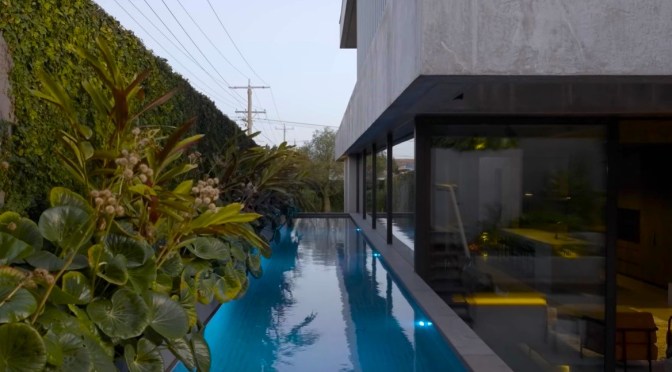

 The Local Project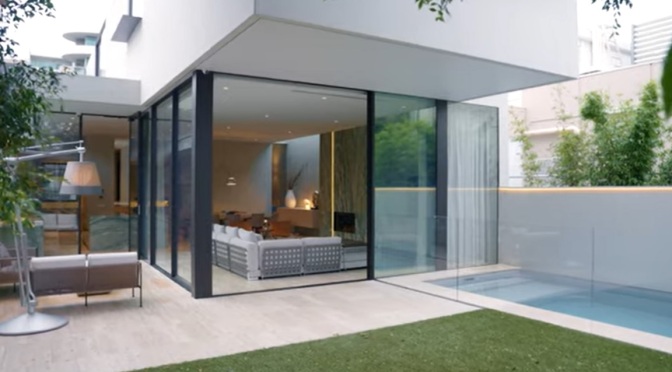


 Boomers Daily