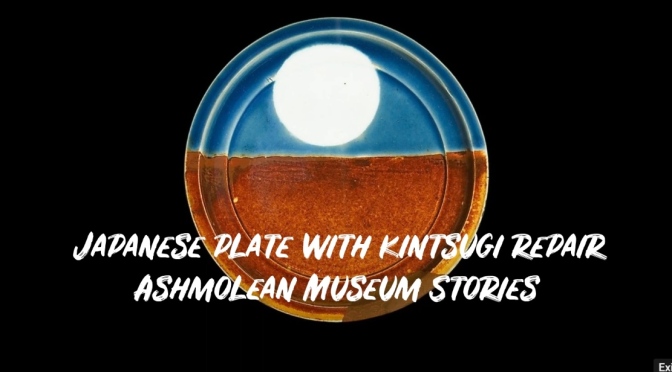
Ashmolean Museum (June 7, 2023): Here, animator Charlie Black brings the poetic story behind this beautifully broken 17th-century Japanese plate to life.
The Japanese collection is now best known for its ceramics, in particular the collection of seventeenth- and eighteenth-century export porcelain which is one of the most comprehensive collections in the world. Ceramics for the Japanese market are also well represented, including fine examples of Arita, Nabeshima and Hirado porcelain, tea ceremony wares and Kyoto earthenwares.
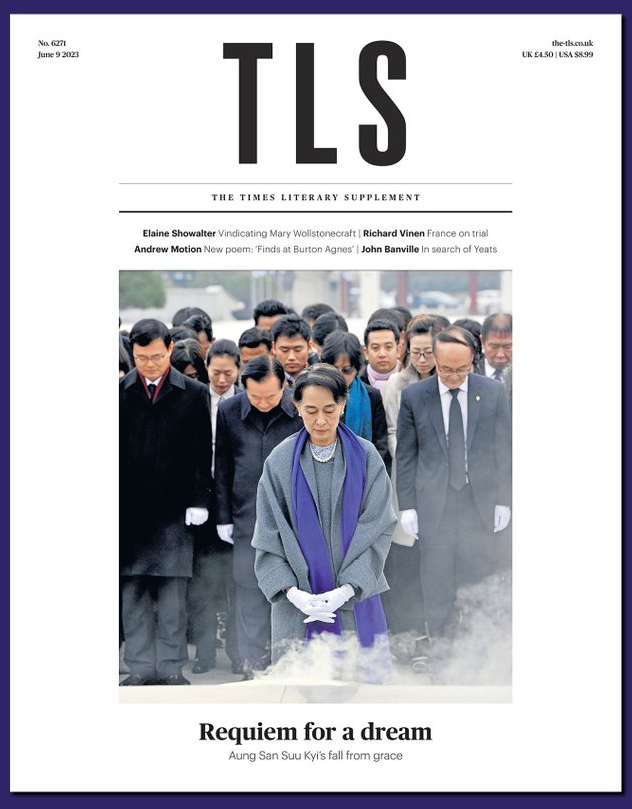
Times Literary Supplement (June 9, 2023): Requiem for a dream – Aung San Suu Kyi’s fall from grace; Vindicating Mary Wollstonecraft; France on Trial; In search of Yeats, and more…
This short biography explains why the West misunderstood the Myanmar leader. Review by Richard Lloyd Parry
In humanity’s long history of toppled heroes, shattered reputations and honour besmirched, it is difficult to think of a more extreme case than that of Aung San Suu Kyi. A decade ago, the Myanmar leader was among the most adored and respected figures in the world — winner of the Nobel peace prize, long-term political prisoner, an emblem of peaceful, uncompromising democratic struggle. Her ascension to the national leadership felt like the vindication of precious hopes and principles; today, “the Lady”, as she used to be known, is face down in the mud.
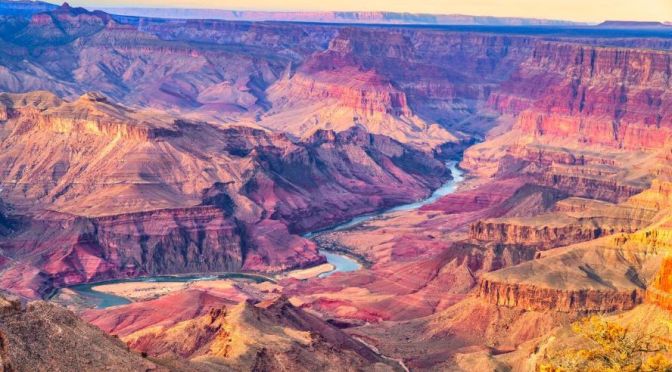
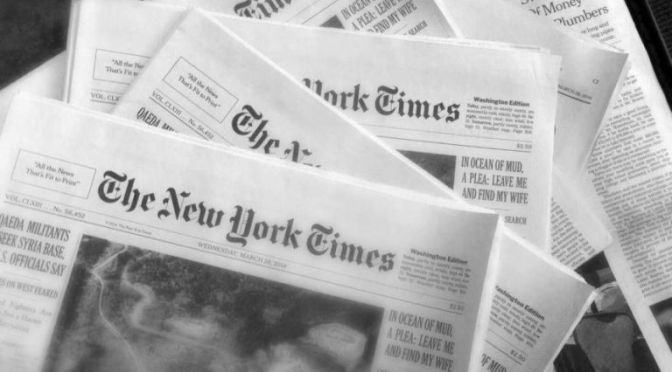
The New York Times (June 6, 2023) – Down beneath the tourist lodges and shops selling keychains and incense, past windswept arroyos and brown valleys speckled with agave, juniper and sagebrush, the rocks of the Grand Canyon seem untethered from time. The oldest ones date back 1.8 billion years, not just eons before humans laid eyes on them, but eons before evolution endowed any organism on this planet with eyes.
Written and photographed by Raymond Zhong, who joined scientists on a 90-mile raft expedition through the canyon.
Since 1963, the Glen Canyon Dam has been backing up the Colorado for nearly 200 miles, in the form of America’s second-largest reservoir, Lake Powell. Engineers constantly evaluate water and electricity needs to decide how much of the river to let through the dam’s works and out the other end, first into the Grand Canyon, then into Lake Mead and, eventually, into fields and homes in Arizona, California, Nevada and Mexico.
Spend long enough in the canyon, and you might start feeling a little unmoored from time yourself.
North Canyon, and a spring at Vasey’s Paradise.
The immense walls form a kind of cocoon, sealing you off from the modern world, with its cell signal and light pollution and disappointments. They draw your eyes relentlessly upward, as in a cathedral.
You might think you are seeing all the way to the top. But up and above are more walls, and above them even more, out of sight except for the occasional glimpse. For the canyon is not just deep. It is broad, too — 18 miles, rim to rim, at its widest. This is no mere cathedral of stone. It is a kingdom: sprawling, self-contained, an alternate reality existing magnificently outside of our own.
And yet, the Grand Canyon remains yoked to the present in one key respect. The Colorado River, whose wild energy incised the canyon over millions of years, is in crisis.
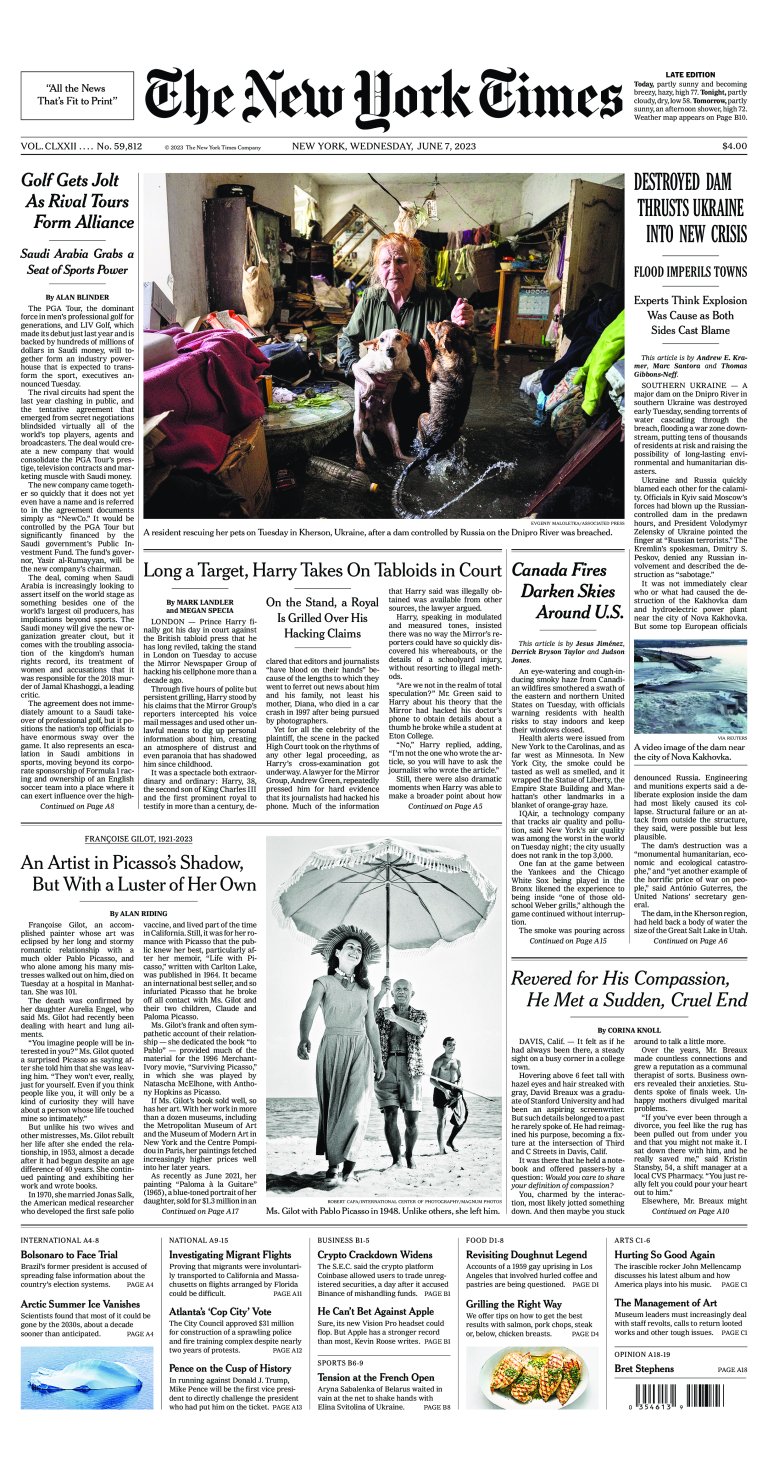
Plus: US secretary of state Antony Blinken visits Saudi Arabia, Brazil says goodbye to a bossa nova legend and why the French military working with science-fiction writers.
Experts suspect an explosion collapsed the dam on the Dnipro River. Kyiv and Moscow blamed each other, and residents downstream were forced to evacuate to escape the cascading waves.
In a stunning announcement, the tour, along with the DP World Tour and Saudi Arabia’s sovereign wealth fund, said the rivals had agreed to create a “new, collectively owned, for-profit entity.”
The smoke was pouring across the border from Canada, where hundreds of wildfires remain unchecked, and the hazardous smoke conditions are expected to linger through Wednesday and perhaps until later in the week.
In a remarkable court scene, the prince took the stand for five hours to make his case that his phone was hacked by a newspaper group, as a lawyer for the defense grilled him about his claims.
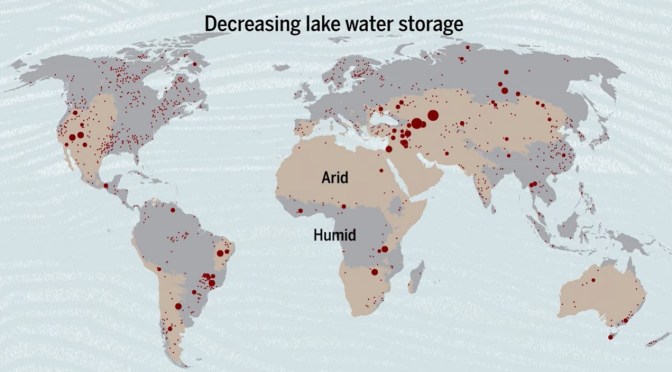
SCIENCE MAGAZINE VIDEOS – JUNE 6, 2023: Some of the most notable lakes in the world, from the Great Salt Lake to Poyang Lake, have shrunk dramatically in recent decades. But because most lakes lack long-term, on-the-ground measurements, it was hard to say whether this was a widespread phenomenon.
Now, researchers have published a first-of-its-kind data set to look at how lake water storage has changed in nearly 2000 of the world’s largest lakes. They find significant global losses and tease out what might be driving these decreases.
FRANCE 24 (June 6, 2023) – It’s one of the most iconic motor races in the world. The “24 hours of Le Mans” race marks a centenary this year. Seven auto manufacturers will be fighting for overall victory with 16 teams represented.
The unique race tests its participants’ reliability and endurance and encourages innovation. The 13,626km track attracts hundreds of thousands of fans from around the world every year. The endurance classic is both a physical and mental challenge for the drivers; the car that covers the greatest distance in 24 hours wins.
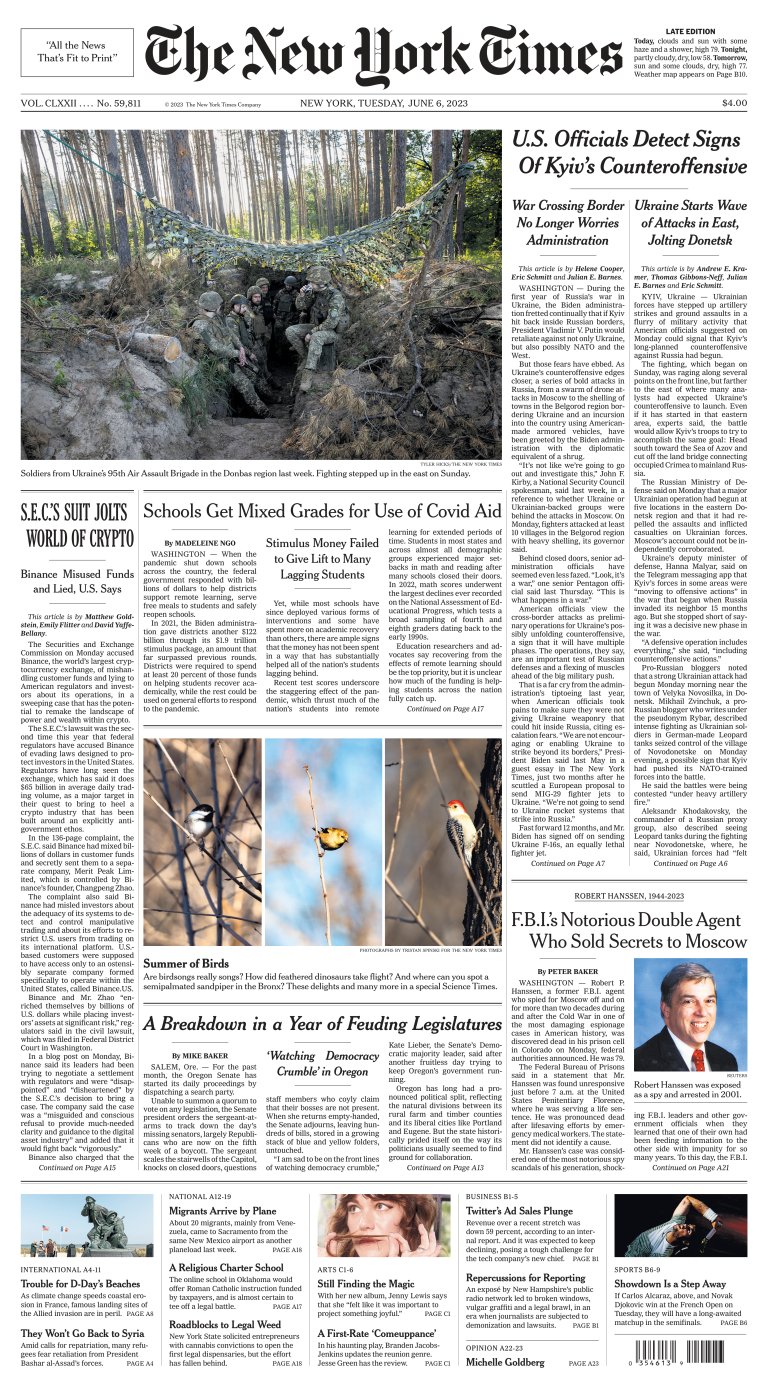
The Globalist Podcast, Tuesday, June 6, 2023: Ukraine‘s Kakhovska dam was completely destroyed; naval drills in Indonesia bring together Chinese, Russian and US forces, we get the latest from Jakarta.
Plus: reports of mass arrests in Kyrgyzstan, our technology correspondent is in California as Apple announces its newest releases and why Studio Ghibli’s forthcoming film will be unique.
Kyiv has not formally announced the start of operations. But on Tuesday, Ukraine said the Russians had blown up a dam on the Dnipro River, potentially imperiling residents and the Zaporizhzhia Nuclear Power Plant.
The S.E.C. said the world’s largest cryptocurrency exchange mixed billions of dollars in customer funds and secretly sent them to a separate company controlled by Binance’s founder, Changpeng Zhao.
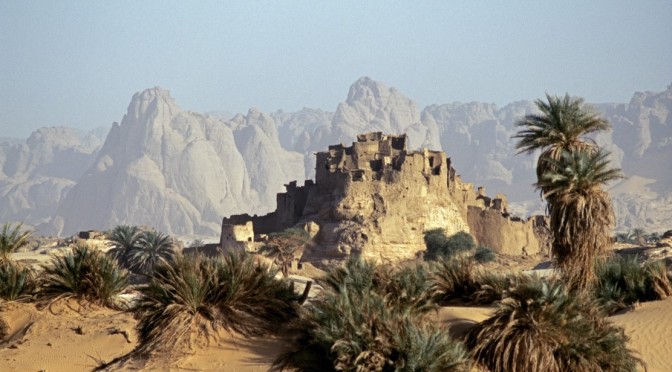
FRANCE 24 (June 5, 2023) – A long trek across the desert of northeastern Niger brings visitors to one of the most astonishing and rewarding sights in the Sahel: fortified villages of salt and clay built on rocks, besieged by the Sahara sands.
Generations of travelers have stood before the “ksars” of Djado, wandering their crenellated walls, watchtowers, secretive passages and wells, all of them testifying to a skilled but unknown hand.
The now ruined city Djado is located on the southern end of the Djado Pleateau in the Sahara in northern Niger. It is not clear who built the complex of fortified mud buildings (ksars). The city was a part Trans-Saharan trading network of the Kanuri people whose Kanem-Bornu Empire was founded before 1000 CE and at its greater extent covered what is now Cameroon, Chad, Nigeria, southern Lybia and Eastern Niger.
It is not clear what caused the abandonment of the city after the 1860s: increased desertification, conflict or even a mosquito infestation have been proposed as possible causes. Since then it has been used by Toubou nomads for the cultivation of dates. The site also contains rock drawings and carvings from 12,000 to 6,000 BCE, depicting the fauna that roved the prehistoric Sahara. The Djado Plateau was added to the UNESCO Tenative List in 2006.
Niger or the Niger, officially the Republic of the Niger, is a landlocked country in West Africa. It is a unitary state bordered by Libya to the northeast, Chad to the east, Nigeria to the south, Benin and Burkina Faso to the southwest, Mali to the west, and Algeria to the northwest.
















 Boomers Daily