Tag Archives: Essays

Foreign Affairs Essays: ‘China’s Trump Strategy’

FOREIGN AFFAIRS MAGAZINE (February 6, 2025): In the months since Donald Trump won the U.S. presidential election in November, policymakers in Beijing have been looking to the next four years of U.S.-Chinese relations with trepidation. Beijing has been expecting the Trump administration to pursue tough policies toward China, potentially escalating the two countries’ trade war, tech war, and confrontation over Taiwan. The prevailing wisdom is that China must prepare for storms ahead in its dealings with the United States. 

Trump’s imposition of ten percent tariffs on all Chinese goods this week seemed to justify those worries. China retaliated swiftly, announcing its own tariffs on certain U.S. goods, as well as restrictions on exports of critical minerals and an antimonopoly investigation into the U.S.-based company Google. But even though Beijing has such tools at its disposal, its ability to outmaneuver Washington in a tit-for-tat exchange is limited by the United States’ relative power and large trade deficit with China. Chinese policymakers, aware of the problem, have been planning more than trade war tactics. Since Trump’s first term, they have been adapting their approach to the United States, and they have spent the past three months further developing their strategy to anticipate, counter, and minimize the damage of Trump’s volatile policymaking. As a result of that planning, a broad effort to shore up China’s domestic economy and foreign relations has been quietly underway.
READ MORE

Essay: ‘Russia’s Costly Conquest In Ukraine’

FOREIGN AFFAIRS MAGAZINE (February 5, 2025): Today, about 20 percent of southeastern Ukraine is under Russian occupation, including Crimea and large parts of the Donetsk, Luhansk, Kherson, and Zaporizhzhia regions. Russian President Vladimir Putin has painted the war in Ukraine as a nationalist campaign to repel Western advances and reclaim territory that, in his view, rightfully belongs to Russia. But conquest has another motivation: economic gain. If Russia maintains military control over these regions, it may be hoping to reap that benefit. At this stage, however, it is hardly clear that they would become economic assets for Moscow; supporting the war-torn territories could just as easily become a drain on its coffers.

The human costs of this war are enormous. Russian forces are ruling occupied Ukraine with an iron fist, engaging in a ruthless campaign of torture, kidnapping, violence, and arbitrary killing. Any assessment of the war’s economic consequences should not minimize its awful depravity or the immense suffering it has inflicted. But its economic outcome will affect future judgments of Putin’s decision to invade in February 2022. If Russia benefits economically from the occupation of Ukraine, the war may be remembered as a strategic success, albeit a coldblooded one. If Russia instead suffers economically, the invasion will be seen as a self-defeating, barbaric blunder.

Essay: ‘Despite Fears Of A Global Tax War, Trump Has A Chance To Make Peace’

THE ECONOMIST MAGAZINE (February 3, 2025): That Donald Trump may unleash a global trade war is a frightening but familiar risk. Less well understood is the danger that he may also provoke a tax war. One of his first actions on returning to the White House was to warn other countries that if they adopt tax policies America dislikes, he may double tax rates on their companies and even their citizens.

READ MORE

Politics: ‘The Path To A Transformed Middle East’

FOREIGN AFFAIRS MAGAZINE (February 3, 2025): Donald Trump begins his presidency with ambitions of being a peacemaker. He laid out this vision in his inaugural address, declaring that his administration “will measure our success not only by the battles we win but also by the wars we end, and perhaps most importantly, by the wars we never get into.” Later that day, he basked in the success of the hostage cease-fire deal in Gaza, including by bringing the families of Israeli hostages to the inaugural parade. “We’re getting a lot of people out in a short period of time,” he proclaimed.

There is no doubt that Trump helped secure the cease-fire deal. But to be a peacemaker who transforms the Middle East, he has more work to do. The main issues he confronts are Gaza and Iran. In Gaza, Israel and Hamas have different views of what is required to achieve the second phase of the deal, which would save the remaining hostages and produce a permanent cease-fire. Iran, meanwhile, is accelerating its nuclear program—with its “foot on the gas pedal” according to Rafael Grossi, the head of the International Atomic Energy Agency. Tehran thus continues to existentially threaten Israel. Both issues are likely to dominate upcoming talks between Trump and Israeli Prime Minister Benjamin Netanyahu at the White House.

DAVID MAKOVSKY is the Director of the Program on Arab-Israel Relations at the Washington Institute of Near East Policy and an Adjunct Professor of Middle East Studies at Johns Hopkins University School of Advanced International Studies. He served as a Senior Adviser to the special envoy of Israeli-Palestinian negotiations in the Office of the Secretary of State during the Obama administration.

DENNIS ROSS is Counselor at the Washington Institute for Near East Policy and a Professor at Georgetown University. A former U.S. Envoy to the Middle East, he served in senior national security positions in the Reagan, George H. W. Bush, Clinton, and Obama administrations.

Share &
Download

Print

Save

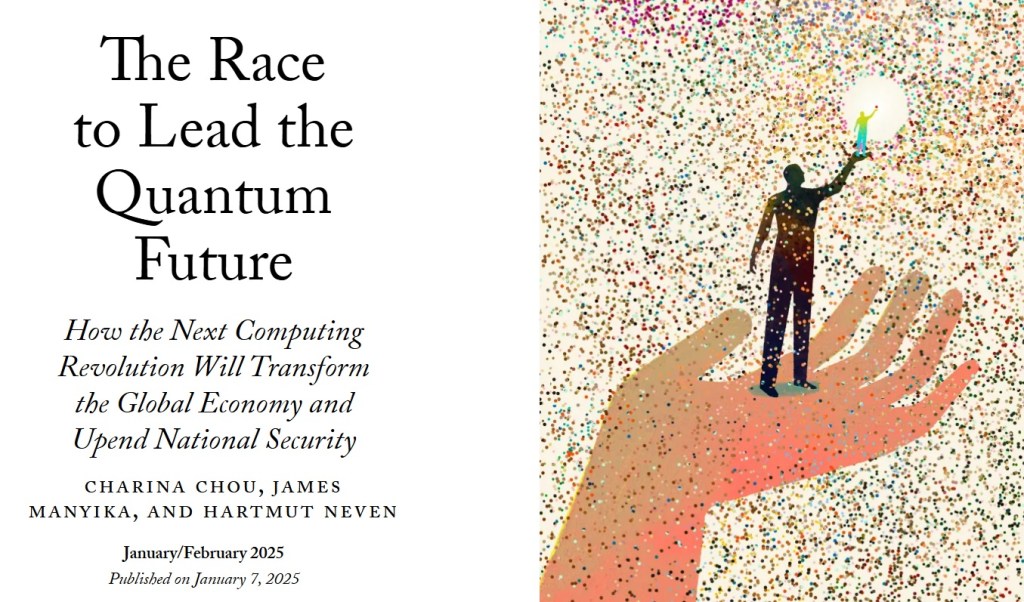
Foreign Affairs: A Race To Lead The Quantum Future

Foreign Affairs Magazine (January 12, 2025): How the Next Computing Revolution Will Transform the Global Economy and Upend National Security

Over the last several years, as rapid advances in artificial intelligence have gained enormous public attention and critical scrutiny, another crucial technology has been evolving largely out of public view. Once confined to the province of abstract theory, quantum computing seeks to use operations based on quantum mechanics to crack computational problems that were previously considered unsolvable. Although the technology is still in its infancy, it is already clear that quantum computing could have profound implications for national security and the global economy in the decades to come.

Read full article

Foreign Affairs Magazine: The Best Essays Of 2024

FOREIGN AFFAIRS MAGAZINE (December 22, 2024): The top essays of the year include…

The Self-Doubting Superpower

By Fareed Zakaria

America shouldn’t give up on the world it made.

Why Gaza Matters

By Jean-Pierre Filiu

Since antiquity, the territory has shaped the quest for power in the Middle East.

Israel’s Self-Destruction

By Aluf Benn

Netanyahu, the Palestinians, and the price of neglect.

Russia Is Burning Up Its Future

By Andrei Kolesnikov

How Putin’s pursuit of power has hollowed out the country and its people.

The Trouble With “the Global South”

By Comfort Ero

What the West gets wrong about the rest.

Culture/Politics: Harper’s Magazine – January 2025

Harper’s Magazine (December 18, 2024): The latest issue features ‘Ghost Music’ – Inside Spotify’s Fake-Artist Scheme; Among the Ruins of Lebanon and Cynthia Ozick on the Pleasures of Letter Writing…

The Ghosts in the Machine

Spotify’s plot against musicians by Liz Pelly

The Forever Cure

Is civil commitment rehabilitating sex offenders—or punishing them? by Jordan Michael Smith

Voices from the Dead Letter Office

On the epistolary life by Cynthia Ozick

Los Angeles Review Of Books – Winter 2024-2025

LA Review of Books (December 11, 2024)The latest issue, #43 – Fixation, features:

Conversation

A Precise Excavation of the Soul: A Conversation with Hilton Als by Melissa Seley

Nonfiction

Mean Mommies: Care in Contemporary Queer Literature by Jenny Fran Davis

Our Ambassadors to the Future: Relics of—and for—ourselves by Christina Wood

The Only Girl in the World: On Madonna and ‘Desperately Seeking Susan’ by Brontez Purnell

Homespun Tiara: A Profile of Model and Activist Geena Rocero by Enzo Escober

Syria’s Forgotten Island of Opposition: A report from the al-Tanf military compound by Charlie Clewis

Bedrock: On gravesites literal and not by Charley Burlock

American Blondes: Are we having more fun yet? by Arielle Gordon

Fiction

Bright by Grace Byron

Finishing Moves by Evan McGarvey

Witches of Fresno and Pigfoot by Venita Blackburn

The Good Life by Brady Brickner-Wood

The Aforementioned Journal by David Hollander

Poetry

Srdičko Bolí by Claressinka Anderson

Has Your Spirit Dried Up? by emet ezell

I Haven’t Heard My Brother’s Voice in Ten Years by Douglas Manuel

Montauk by Connie Voisine

Straining for the Noise by Jenny Xie

Art

Lida Abdul

The Atlantic Magazine – December 2024 Preview

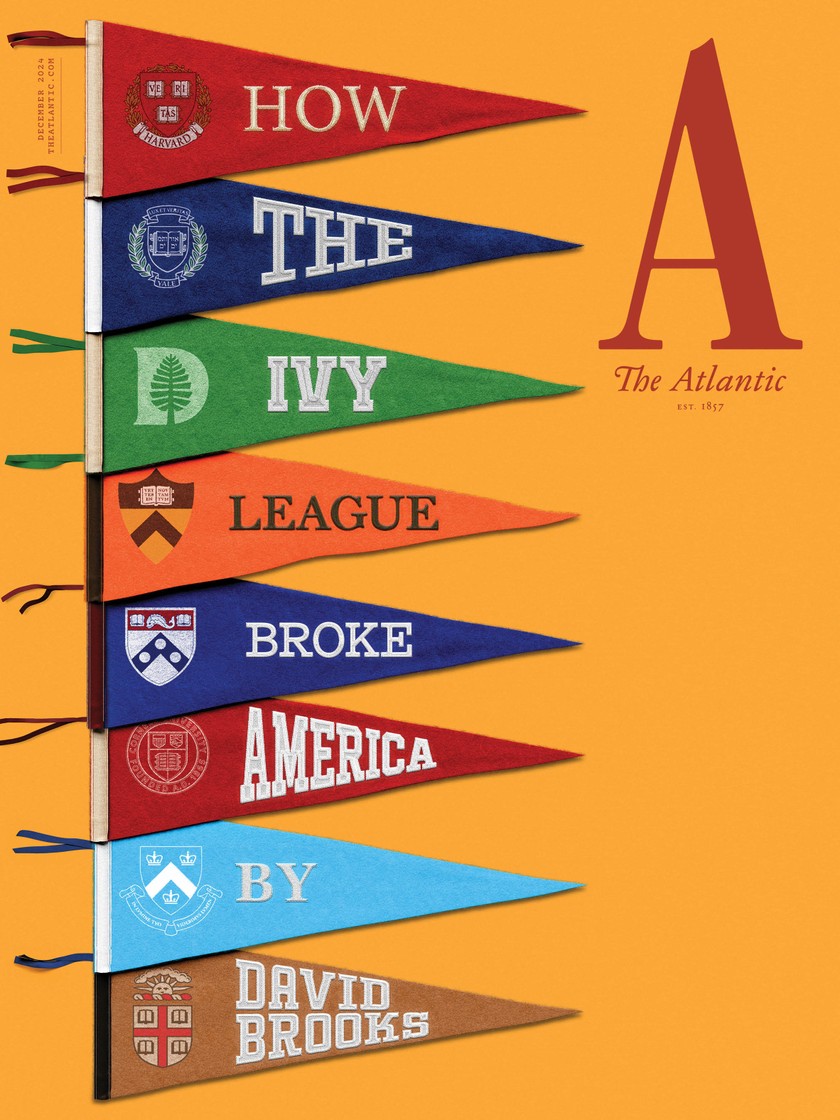
The Atlantic Magazine – November 20, 2024: The latest issue features ‘How the Ivy League Broke America’ – The meritocracy isn’t working. We need something new.

How the Ivy League Broke America

The meritocracy isn’t working. We need something new. By David Brooks

How One Woman Became the Scapegoat for America’s Reading Crisis

Lucy Calkins was an education superstar. Now she’s cast as the reason a generation of students struggles to read. Can she reclaim her good name?

The Exhibit That Will Change How You See Impressionism

The National Gallery’s “Paris 1874” explores the movement’s dark origins.

Culture/Politics: Harper’s Magazine – December 2024

HARPER’S MAGAZINE – November 18, 2024: The latest issue features ‘The Painted Protest’ – How politics destroyed contemporary art…

The Painted Protest

How politics destroyed contemporary art by Dean Kissick

In the Rockets’ Red Glare

 The past and future of hot-rodding in America by Rachel Kushner

After the Deluge

A small town faces down climate disaster by Gary Greenberg