
Tag Archives: Elections

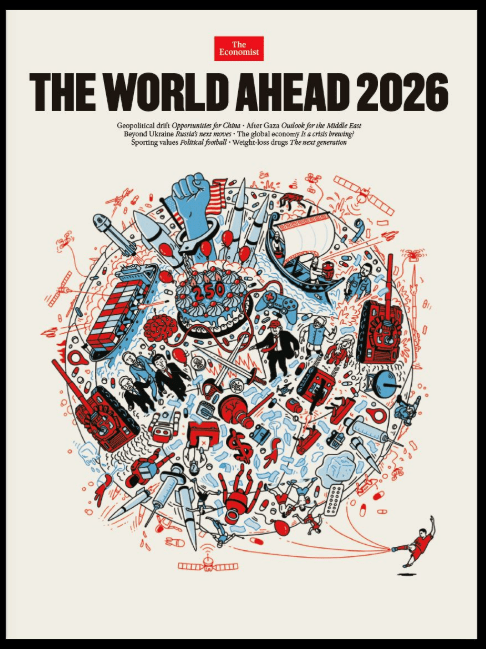
Analysis: The World Ahead In 2026 – The Economist

The Economist The World Ahead 2026 (November 13, 2025):

This is Donald Trump’s world—we’re all just living in it. The disruptor-in-chief was the biggest factor shaping global affairs in 2025, and that will be the case for as long as he remains in the White House. His norm-shattering approach has caused turmoil in some areas (as in trade) but has also delivered diplomatic results (as in Gaza) and forced necessary change (as with European defence spending). As the Trumpnado spins on in 2026, here are ten trends and themes to watch in the coming year.

1. America’s 250th.

Expect to hear wildly diverging accounts of America’s past, present and future, as Republicans and Democrats describe the same country in irreconcilably different terms to mark the 250th anniversary of its founding. Voters will then give their verdict on America’s future in the midterm elections in November. But even if the Democrats take the House, Mr Trump’s rule by bullying, tariffs and executive orders will go on.

2. Geopolitical drift.

Foreign-policy analysts are divided: is the world in a new cold war, between blocs led by America and China, or will a Trumpian deal divide the planet into American, Russian and Chinese “spheres of influence”, in which each can do as they please? Don’t count on either. Mr Trump prefers a transactional approach based on instinct, not grand geopolitical paradigms. The old global rules-based order will drift and decay further. But “coalitions of the willing” will strike new deals in areas such as defence, trade and climate.

3. War or peace? Yes.

With luck, the fragile peace in Gaza will hold. But conflicts will grind on in Ukraine, Sudan and Myanmar. Russia and China will test America’s commitment to its allies with “grey-zone” provocations in northern Europe and the South China Sea. As the line between war and peace becomes ever more blurred, tensions will rise in the Arctic, in orbit, on the sea floor and in cyberspace.

4. Problems for Europe.

All this poses a particular test for Europe. It must increase defence spending, keep America on side, boost economic growth and deal with huge deficits, even though austerity risks stoking support for hard-right parties. It also wants to remain a leading advocate for free trade and greenery. It cannot do all of these at once. A splurge on defence spending may lift growth, but only slightly.

5. China’s opportunity.

China has its own problems, with deflation, slowing growth and an industrial glut, but Mr Trump’s “America First” policy opens up new opportunities for China to boost its global influence. It will present itself as a more reliable partner, particularly in the global south, where it is striking a string of trade agreements. It is happy to do tactical deals with Mr Trump on soyabeans or chips. The trick will be to keep relations with America transactional, not confrontational.With rich countries living beyond their means, the risk of a bond-market crisis is growing

6. Economic worries.

So far America’s economy is proving more resilient than many expected to Mr Trump’s tariffs, but they will dampen global growth. And with rich countries living beyond their means, the risk of a bond-market crisis is growing. Much will depend on the replacement of Jerome Powell as chair of the Federal Reserve in May; politicising the Fed could trigger a market showdown.

7. Concerns over AI.

Rampant spending on infrastructure for artificial intelligence may also be concealing economic weakness in America. Will the bubble burst? As with railways, electricity and the internet, a crash would not mean that the technology does not have real value. But it could have wide economic impact. Either way, concern about AI’s impact on jobs, particularly those of graduates, will deepen.

8. A mixed climate picture.

Limiting warming to 1.5°C is off the table, and Mr Trump hates renewables. But global emissions have probably peaked, clean tech is booming across the global south and firms will meet or exceed their climate targets—but will keep quiet about it to avoid Mr Trump’s ire. Geothermal energy is worth watching.

9. Sporting values.

Sport can always be relied upon to provide a break from politics, right? Well, maybe not in 2026. The football World Cup is being jointly hosted by America, Canada and Mexico, whose relations are strained. Fans may stay away. But the Enhanced Games, in Las Vegas, may be even more controversial: athletes can use performance-enhancing drugs. Is it cheating—or just different?

10. Ozempic, but better.

Better, cheaper GLP-1 weight-loss drugs are coming, and in pill form, too. That will expand access. But is taking them cheating? GLP-1s extend the debate about the ethics of performance-enhancing drugs to a far wider group than athletes or bodybuilders. Few people compete in the Olympics. But anyone can take part in the Ozempic games.
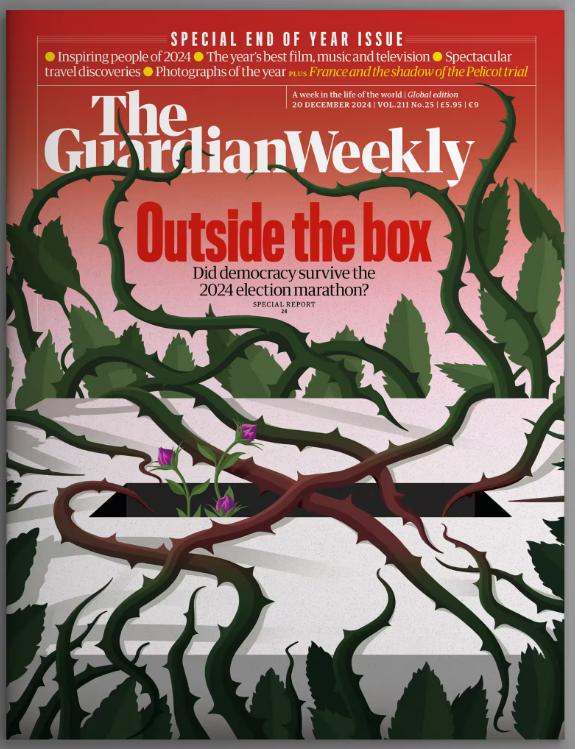
Politics: The Guardian Weekly – December 20, 2024

Image

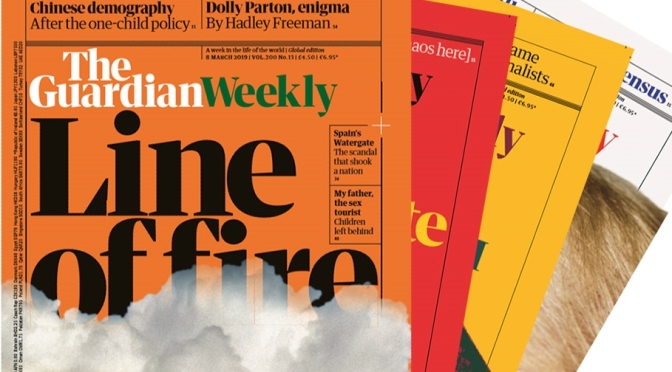
The Guardian Weekly (December 18, 2024): The latest issue features Did democracy survive? Reflections on a year of elections. Plus The best film, music and TV of 2024

This was a year in which billions of people living in more than 80 countries had the right to cast their democratic votes in elections. But with democracy around the world under ever-greater threats – from attacks on freedom of speech, equality of participation and plurality of media to name a few – how did the election process bear up? Jonathan Yerushalmy and Oliver Holmes find reasons for hope amid the pressure.

1

The big story | France and the shadow of the Pelicot trial
The mass rape case, in which verdicts and sentencing are expected this week, has horrified the world. But this is not French society’s first attempt to confront a sexually abusive culture, writes Kim Willsher, who has witnessed the harrowing proceedings in Avignon

2

Spotlight | How Ukrainian power plant workers keep the country running
As winter closes in, Shaun Walker visits a Soviet-era coal-fired thermal installation to explore how it has held up to Russian attacks

3

Opinion | After the fall of Assad, the least Syrians deserve is our optimism
With the tyrannical dynasty gone, it’s important not to impose a negative script on what comes next. Syrians deserve support and hope, argues Nesrine Malik

4

The shamelessness of Fifa’s process in awarding the 2034 tournament to Riyadh was a display of contempt for governance, democracy and good sense, writes Barney Ronay


What else we’ve been reading

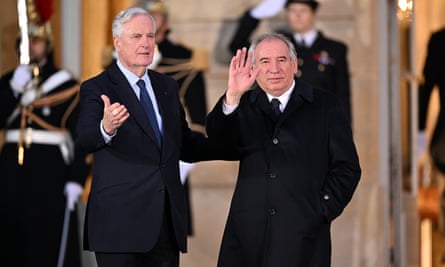
Former French prime minister Michel Barnier, left, and the newly appointed François Bayrou.

With France on its fourth prime minister in a year and Germany facing a snap election in February, Paris and Berlin correspondents Jon Henley and Deborah Cole explain why the driving forces of the European Union are in the doldrums. An excellent primer to understand what will be a shaky start to next year for European politics. Isobel Montgomery, deputy editor

Politics: The Guardian Weekly-December 13, 2024

Image

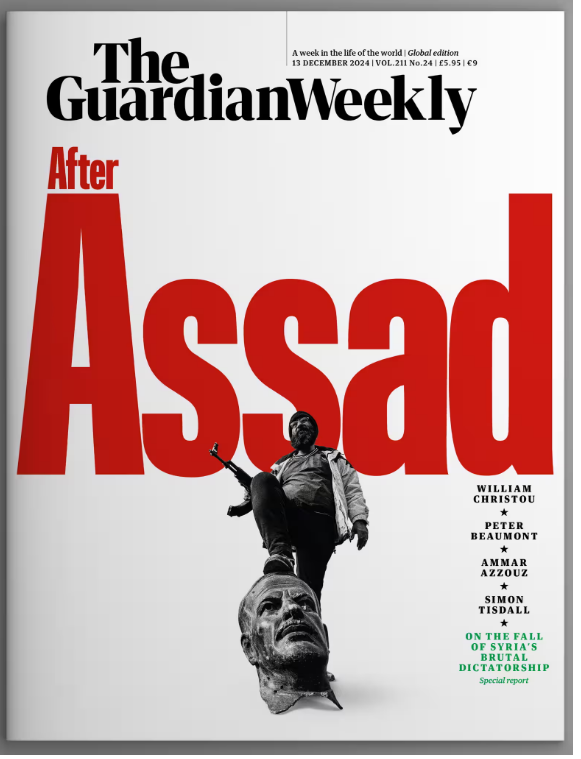
The Guardian Weekly (December 11, 2024): The new issue features The fall of Syria’s brutal dictatorship. Plus The best books of 2024.

Not even the most optimistic of rebels could have predicted the rapid collapse, last weekend, of the Assad dynasty that ruled Syria with an iron fist for more than 50 years. Yet while there was relief and joy both inside Syria and among the nation’s vast displaced diaspora, it was also accompanied by apprehension over what might come next.

1

Spotlight | Russia and Ukraine wait warily for Trump transition
The idea of the US president-election as a saviour for Ukraine, as unlikely as it may seem, holds an appeal for an exhausted nation without a clear path to victory. Shaun Walker and Pjotr Sauer report

2

Environment | The jailed anti-whaler defiant in face of extradition threat
Capt Paul Watson talks to Daniel Boffey about his arrest on behalf of the Japanese government, his ‘interesting’ Greenland prison, and separation from his children

3

Feature | The growing threat of firearms that can be made at home
One far-right cell wanted to use 3D-printed guns to cause ‘maximum confusion and fear’ on the streets of Finland. Could the police intercept them in time? By Samira Shackle

4

Opinion | Farage is lying in wait. Britain can’t afford for Starmer to fail
It is not enough for the Labour leader’s ‘milestones’ to be achieved. Voters must feel the improvement in their daily lives, says Guardian columnist Jonathan Freedland

5

Culture | The best books of 2024
From a radical retelling of Huckleberry Finn to Al Pacino’s autobiography, our critics round up their favourite reads of the year

Politics: The Guardian Weekly – Nov. 29, 2024

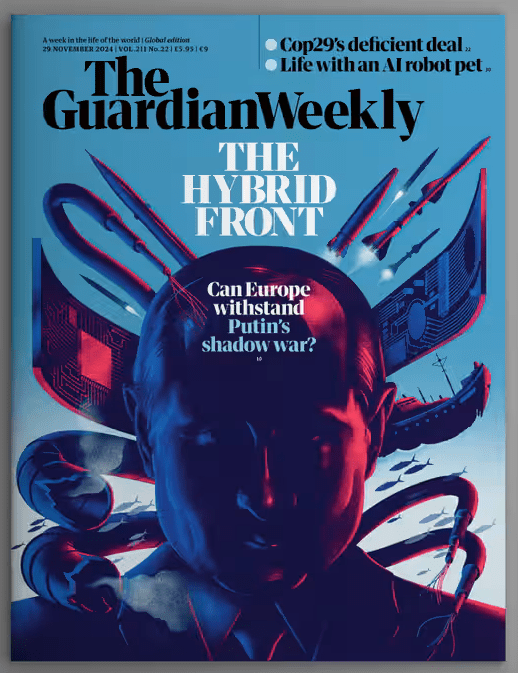
The Guardian Weekly (November 28, 2024): The new issue features last week’s escalation of Nato ballistic missile activity, in which UK and US-made missiles were launched into Russia for the first time, brought a predictably cold response from Vladimir Putin – who loosened Moscow’s nuclear doctrines and promised more attacks with a new, experimental ballistic missile.

1

Spotlight | Does lame duck Biden have time to Trump-proof democracy?
The outgoing US president may only have weeks left in the White House, but activists say he can secure civil liberties, accelerate spending on climate and healthcare, and spare death row prisoners. David Smith reports

2

Science | My weird, emotional week with an AI pet
Casio says Moflin can develop its own personality and build a rapport with its owner – and it doesn’t need food, exercise or a litter tray. But is it essentially comforting or alienating? Justin McCurry finds out

3

Feature | Are we right to strive to save the world’s tiniest babies?
Doctors are pushing the limits of science and human biology to save more extremely premature babies than ever before. But when so few survive, are we putting them through needless suffering? By Sophie McBain

4

Opinion | A social media ban is in everyone’s interests – not just kids under 16
Van Badham on why she resents being excluded from protection against monetised fear, anger and toxicity

5

Culture | A road trip like no other: an epic drive on the Autobahn
Fifty years after electronic pioneers Kraftwerk released a 23-minute song about a road – and changed pop music for ever – Tim Jonze hits the highways of Düsseldorf and Hamburg in search of its futuristic brilliance

Politics: The Guardian Weekly – Nov. 22, 2024

Image

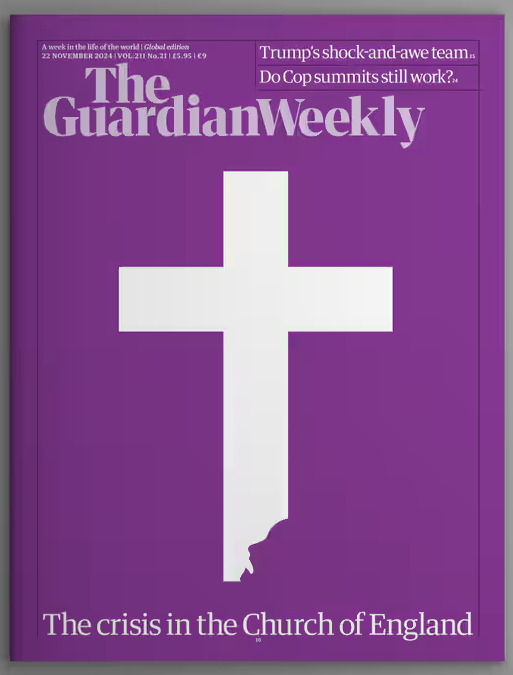
The Guardian Weekly (November 21, 2024): The new issue features ‘The crisis in the Church of England’…

Existentialist crises might more commonly be associated with some who seek out religion, rather than with those religions themselves, but that’s where the Church of England has found itself in recent days.

The resignation of Justin Welby, the archbishop of Canterbury, followed a damning report into the church’s shameful failures over the serial child abuser John Smyth, which detailed even more disturbing details of cover-ups by some senior clergy.

1

Spotlight | Trump’s shock-and-awe team
A flurry of controversial and extremist picks for Trump’s administration has provoked criticism and made heads spin. David Smith reports from Washington

2

Science | The inverse link between cancer and dementia
Scientists have long been aware of a curious connection between these common and feared diseases. At last, a clearer picture is emerging, writes Theres Lüthi

3

Feature | Kernels of hope
During the siege of Leningrad, botanists in charge of an irreplaceable seed collection, the first of its kind, had to protect it from fire, rodents – and hunger. By Simon Parkin

4

Opinion | Seven lessons from a long-serving economics editor
From Thatcher to Trump and Brexit, the Guardian’s outgoing economics editor, Larry Elliott, reflects on his 28 years in the role.

5

Culture | Faking history
Film and TV have a slippery relationship with the truth when it comes to historical epics. Simon Usborne meets the experts whose advice goes unheeded

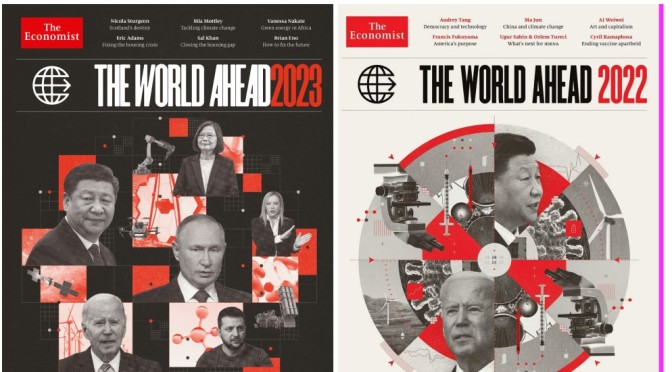
Analysis: The World Ahead In 2025 – The Economist

Image

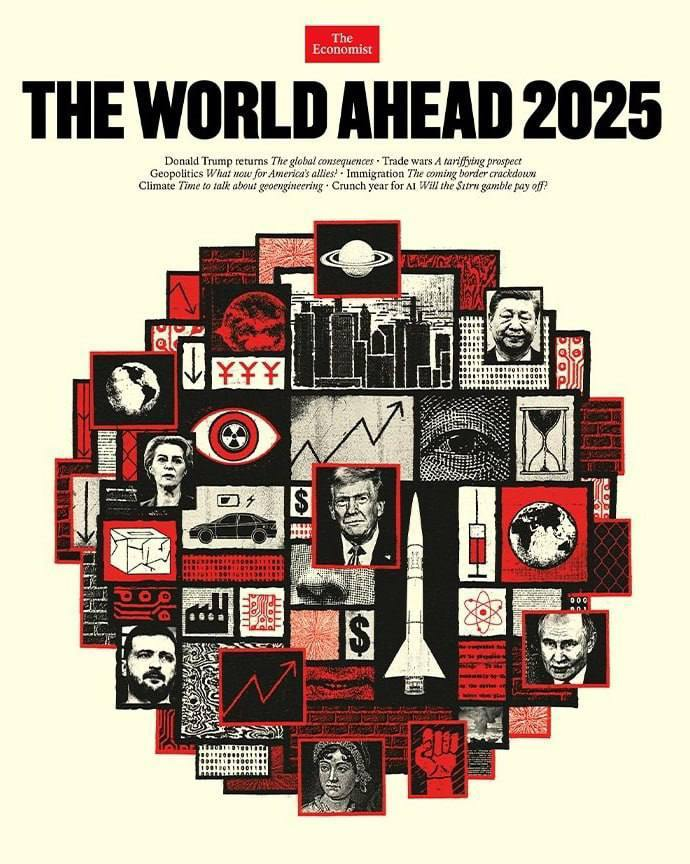
The Economist The World Ahead 2025 (November 20, 2024) : In 2025, as seen on the cover, the main event is Trump’s return to the White House and the global consequences of his policies, such as a new wave of trade wars with China. There is also an expected rise in technologies such as artificial intelligence and autonomous vehicles.

Tom Standage’s ten trends to watch in 2025

A letter from the editor of The World Ahead

The three forces that will shape 2025

Watch the interplay between Donald Trump, technology and radical uncertainty

The cover mentions climate issues and hints at a new phase in the fight for social equality, especially among women. Last year, the cover predicted geopolitical instability, an economic crisis, climate disasters, and the g

How U.S. Voted In Every Election From 1789 – 2024

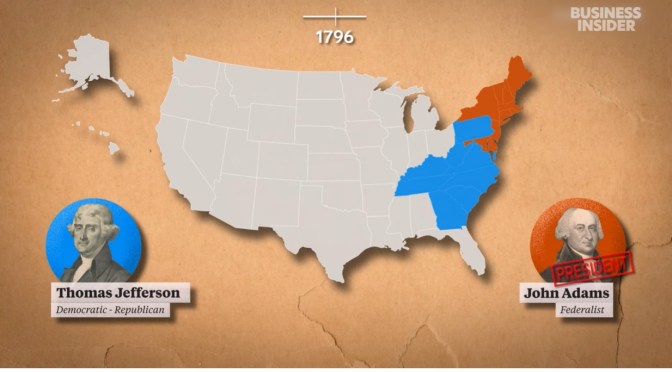
Business Insider (November 15, 2024): The United States has had 60 presidential elections starting in 1789. New parties have come and gone, while new states expanded the electoral map.

Video timeline: 0:00 – Intro 0:28 – First Party System (1792-1824) 1:30 – Second Party System (1828-1854) 2:40 – Third Party System (1854-1895) 5:46 – The Early 1900s (Progressive Era) 7:14 – Fifth Party System – FDR/New Deal Coalition 9:48 – Sixth Party System (1964-present) 16:42 – Credits

Maps show us how each state has voted over time — and who have been the winners and losers along the way.

Politics: The Guardian Weekly – Nov. 15, 2024

Image

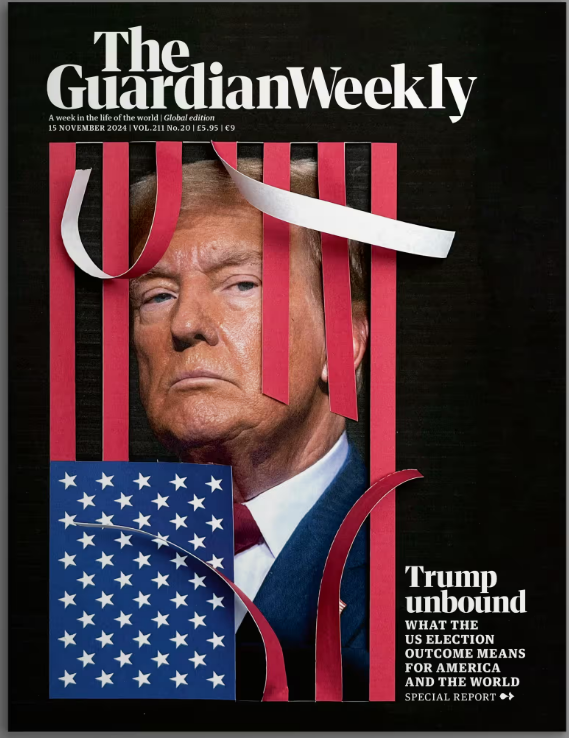
The Guardian Weekly (November 14, 2024): The new issue features ‘Trump Unbound’ – What the US Election outcome means for America and the World…

In a special edition of the Guardian Weekly, our Washington bureau chief David Smith and diplomatic editor Patrick Wintour reflect on how Trump 2.0 is likely to play out for the US and for the rest of the world.

We look at the role played by the president-elect’s key supporter, Elon Musk, and ask what the world’s richest man can now expect back in return. We also trace the rise of the vice-president elect JD Vance, who is now just a heartbeat away from the presidency.

And senior US political reporter Joan E Greve considers the Democrats – bereft, broken and facing an internal civil war after a campaign that ended in disaster.

1
Spotlight | Odour of oil and return of Trump hang heavy over Cop29
As the annual UN climate summit got under way in Azerbaijan this week, Fiona Harvey sizes up the hopes for progressThe video player is currently playing an ad. You can skip the ad in 5 sec with a mouse or keyboard

2
Science | Unravelling the paradoxes of plankton
Scientists are sequencing the DNA of microscopic marine life – to help us learn more about ourselves, reports Brianna Randall

3
Feature | When adult children cut the cord
Grownups who cut of f contact with their family are often trying to break away after a traumatic childhood. But sometimes the estrangement can be totally unexpected for parents. By Gaby Hinsliff

4
Opinion | Trump unleashed will be even worse than last time’s dress reherarsal
From a public health crisis to the end of Nato, the threats are clear, writes Jonathan Freedland

5
Culture | Sportswriters and arts critics swap jobs
How does the English National Opera compare to the Premier League … or the NFL to a West End musical? Our sports and culture experts found out

Views: Novelist Margaret Atwood On Democracy – “Is It Fragile Or Resilient?”

Financial Times (January 17, 2024) – In a year in which more than half the world goes to the polls, acclaimed novelist Margaret Atwood asks whether democracy is fragile and easily destroyed or flexible and resilient.

This animated monologue is the first of four films examining the state of government, representation, rights and freedom.

Read more at https://www.ft.com/democracy

Opinion: Only America Can Save Israel, Elections In Poland, Surge In Bedbugs

‘Editor’s Picks’ Podcast (October 23, 2023) A selection of three essential articles read aloud from the latest issue of The Economist. This week, why only America can save Israel and Gaza from a greater catastrophe. Also, the recent election in Poland offers a lesson in how to push back on populism (10:30) and the resurgence of bedbugs, beyond the hype (16:00).