
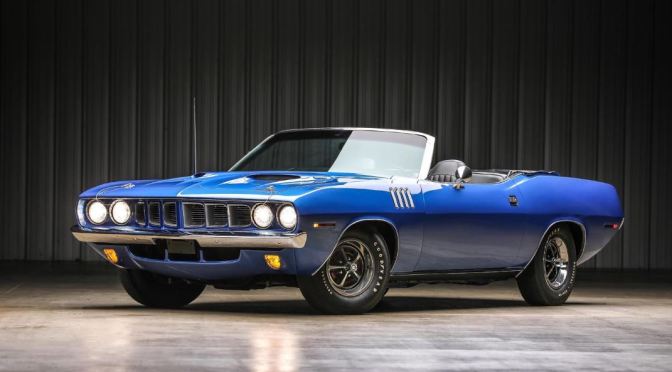
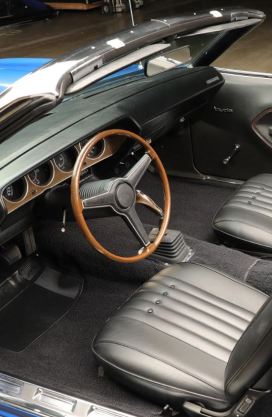
 The Plymouth Barracuda is a two-door pony car manufactured by Plymouth from 1964 to 1974.
The third generation, offered from 1970 to 1974, was no longer based on the A-body, but on the Chrysler E-body. The completely new design was similar to the Dodge Challenger and available in hardtop and convertible body styles. The Barracuda was discontinued after the 1974 model year.
 The redesign for the 1970 Barracuda removed all its previous commonality with the Valiant. The original fastback design was deleted from the line and the Barracuda now consisted of coupe and convertible models. The all-new model, styled by John E. Herlitz, was built on a shorter, wider version of Chrysler’s existing B platform, called the E-body. Sharing this platform was the newly launched Dodge Challenger; however no exterior sheet metal interchanged between the two cars, and the Challenger, at 110 inches (2,794 mm), had a wheelbase that was 2 inches (51 mm) longer than the Barracuda.
The E-body Barracuda was now “able to shake the stigma of ‘economy car’.”
From Wikipedia
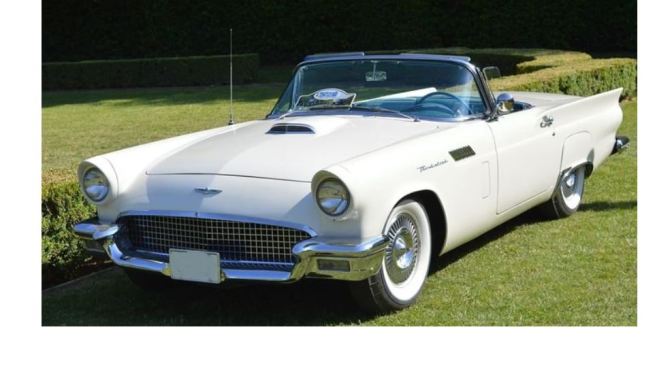
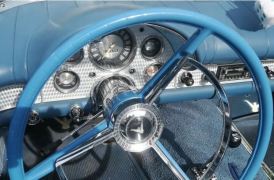 Ford Thunderbird (colloquially called the T-Bird) is a nameplate that was used by Ford from model years 1955 to 1997 and 2002 to 2005 over eleven model generations. Introduced as a two-seat convertible, the Thunderbird was produced in a number of body configurations through its production life, including four-seat hardtop coupe, four-seat convertible, five-seat convertible and hardtop, four-door pillared hardtop sedan, six-passenger hardtop coupe, and five passenger pillared coupe, with the final generation produced as a two-seat convertible.
 The Thunderbird was revised for 1957 with a reshaped front bumper, a larger grille and tailfins, and larger tail lamps. The instrument panel was heavily re-styled with round gauges in a single pod, and the rear of the car was lengthened, allowing the spare tire to be positioned back in the trunk. The 312 cu in (5.1 L) V8 became the Thunderbird’s standard engine, and now produced 245 horsepower (183 kW). Other, even more powerful versions of the 312 cu in (5.1 L) V8 were available including one with two four-barrel Holley carburetors and another with a Paxton supercharger delivering 300 horsepower (220 kW). Though Ford was pleased to see sales of the Thunderbird rise to a record-breaking 21,380 units for 1957, company executives felt the car could do even better, leading to a substantial redesign of the car for 1958.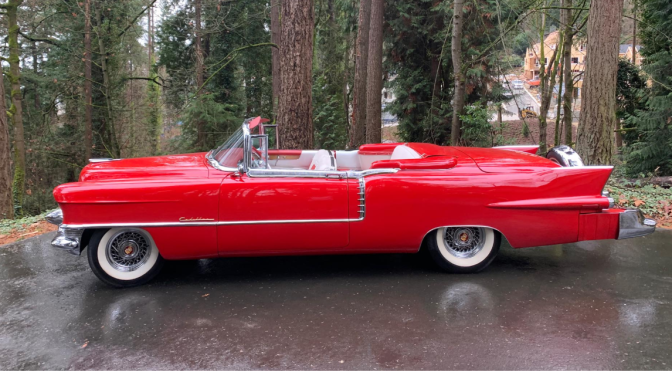
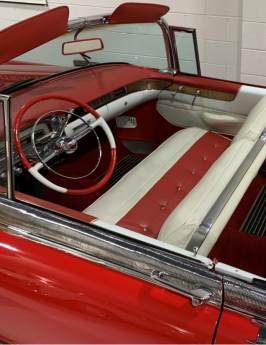 The Cadillac Eldorado is a premium luxury car that was manufactured and marketed by Cadillac from 1952 to 2002 over twelve generations. Competitors and similar vehicles included the Continental Mark series, Buick Riviera, Oldsmobile Toronado and Chrysler’s Imperial Coupe.
 For 1955, the Eldorado’s body gained its own rear end styling with high, slender, pointed tailfins. These contrasted with the rather thick, bulbous fins which were common at the time and were an example of the Eldorado once again pointing the way forward. The Eldorado sport convertible featured extras such as wide chrome body belt moldings and twin round taillights halfway up the fenders. Sales nearly doubled to 3,950.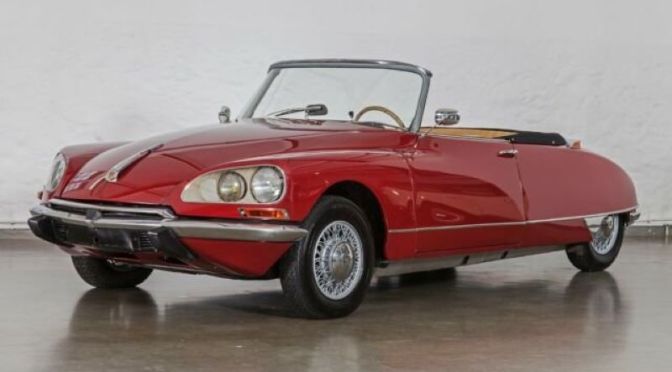
 The Citroën DS is a front-engine, front-wheel-drive executive car that was manufactured and marketed by the French company Citroën from 1955 to 1975 in sedan, wagon/estate and convertible body configurations across three series/generations.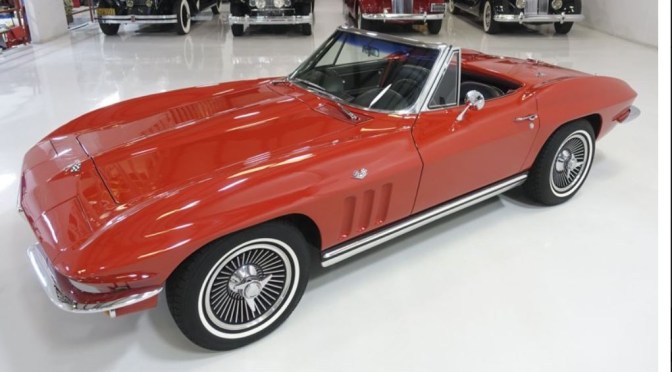
 For its third season, the 1965 Corvette Sting Ray further cleaned up style-wise and was muscled up with the addition of an all-new braking system and larger powerplants. 1965 styling alterations were subtle, confined to a smoothed-out hood now devoid of scoop indentations, a trio of working vertical exhaust vents in the front fenders that replaced the previous nonfunctional horizontal “speedlines,” restyled wheel covers and rocker-panel moldings, and minor interior trim revisions. The 1965 Corvette Sting Ray became ferocious with the mid-year debut of the
  1965 also added another 350 hp small block engine (Option L79) which used hydraulic rather than solid lifters, a milder camshaft and a modestly redesigned smaller oil pan.
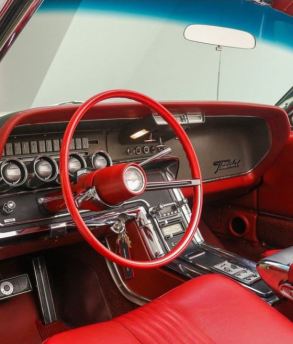 The revised model was initially offered as a hardtop, convertible, Sports Roadster with dealer-installed tonneau cover and wire wheels, and Landau with vinyl roof, simulated landau irons, and wood grain interior appointments. Total 1964 sales were excellent: 92,465, up nearly fifty per cent from the previous year, but with only 50 Sports Roadster kits were sold from the factory. The 1964 Thunderbird was the only car of this generation to have the word ‘Thunderbird’ spelled out on the front hood instead of a chrome Thunderbird emblem. The only transmission available was the Cruise-O-Matic MX 3 speed automatic.
 The fourth generation of the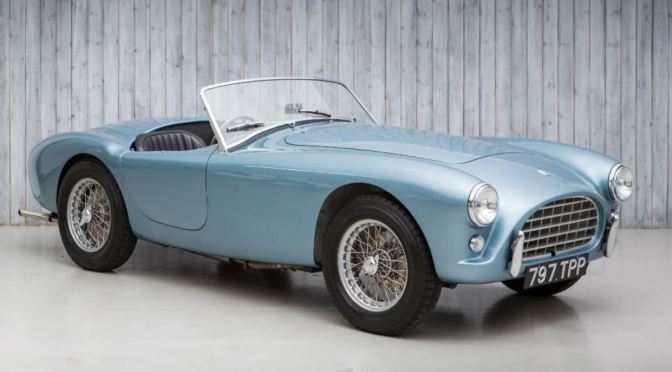
 In 1961 a new 2.6-litre (2,553 cc (155.8 cu in)) straight-six ‘Ruddspeed’ option was available, adapted by Ken Rudd from the unit used in the Ford Zephyr. It used three Weber or SU carburettors and either a ‘Mays’ or an iron cast head. This setup boosted the car’s performance further, with some versions tuned to 170 bhp (127 kW), providing a top speed of 130 mph (209 km/h) and 0–60 mph (0–100 km/h) in 8.1 seconds. However, it was not long before Carroll Shelby drew AC’s attention to the Cobra, so only 37 of the 2.6 models were made. These Ford engined models had a smaller grille which was carried over to the Cobra.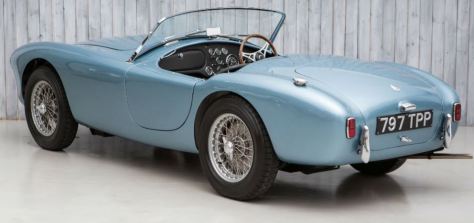
 Boomers Daily