Tag Archives: Books

“Why Socialism”: Albert Einstein’s Resplendent Impertinence of Genius

The following essay was written by ChatGPT, and edited by Intellicurean, through the creative filter of Oscar Wilde’s barbed wit and George Bernard Shaw’s moral seriousness, of a review of John Bellamy Foster’s “Albert Einstein’s ‘Why Socialism?’: The Enduring Legacy of His Classic Essay” as it would appear in an esteemed magazine or journal.

In an era where celebrity chatter often drowns out meaningful discourse—ephemeral as the pixels that transmit it—it is both refreshing and necessary to recall that Albert Einstein was not merely a demigod of science, floating above the affairs of humankind. He was a thinker with moral conviction and intellectual courage. John Bellamy Foster’s timely volume, Albert Einstein’s “Why Socialism?”: The Enduring Legacy of His Classic Essay (Monthly Review, July 2025), excavates an overlooked manifesto whose radical clarity remains provocatively undiminished by time.


Unpacking Einstein’s Socialist Vision

More than seventy-five years have passed since Einstein contributed his essay Why Socialism? to the inaugural issue of Monthly Review in May 1949—right in the throes of America’s Red Scare. In that climate of ideological hysteria, even reason itself was suspect. Yet Einstein, with characteristic directness, named capitalism as the source of modern spiritual and economic malaise. “The economic anarchy of capitalist society,” he wrote, “is, in my opinion, the real source of the evil.”

This was no armchair abstraction. It was an act of moral and intellectual defiance in an era of conformity. Rather than tempering his critique to placate the political climate, Einstein diagnosed capitalism as a system that cripples the individual, erodes social cohesion, and mistakes profit for purpose. His socialism, then, was not bureaucratic dogma, but a humane vision: a call for solidarity, responsibility, and human dignity.

Foster’s introduction accomplishes three critical feats. First, it confirms Einstein’s consistent—if unfashionable—commitment to socialist ideals. Second, it situates Why Socialism? within a contemporary moment of deepening ecological and geopolitical crisis, not unlike the postwar anxieties Einstein addressed. Third, and most compellingly, Foster refuses to treat Einstein’s words as nostalgic artifacts. Instead, he reads them as instruments of moral interrogation for the present.


Einstein’s Moral Urgency in a Cynical Age

A powerful moment recounted in Foster’s commentary draws from a recently unearthed interview transcript titled, YES, ALBERT EINSTEIN WAS A SOCIALIST. In it, Einstein recounts a chilling conversation: a friend, contemplating nuclear annihilation, casually asks why Einstein is so concerned about humanity’s extinction. The question is as nihilistic as it is sincere—eerily prefiguring today’s fatalism disguised as realism.

Einstein’s response was telling. He saw this resignation not as philosophical sophistication, but as a symptom of capitalism’s emotional deadening. A world driven by profit, he argued, had alienated people not only from one another but from their very capacity to find joy. “The naive, simple and unsophisticated enjoyment of life,” he mourned, had become a casualty. The resulting solitude, he observed, was not noble introspection but a prison built of egotism and insecurity.

In Why Socialism?, Einstein extends this observation: “Man is, at one and the same time, a solitary being and a social being… As a social being, he seeks to gain the recognition and affection of his fellow human beings… and to improve their conditions of life.” The essay thus offers not just an economic critique, but a portrait of the spiritual crisis induced by capitalism.


A Socialism of Decency, Not Dogma

Einstein did not envision socialism as the rigid apparatus of state control feared by his critics. Instead, he imagined a cultural and moral transformation—one that would replace competition with cooperation, and empty success with meaningful contribution. “In addition to promoting his own innate abilities,” he wrote, “education would attempt to develop in [the individual] a sense of responsibility for his fellow man in place of the glorification of power and success in our present society.”

This human-centered socialism bears more resemblance to George Bernard Shaw’s ethical idealism than to any centralized Leninist command structure. It’s a socialism that asks not only how society is organized, but what kind of people it produces.


Economic Insecurity and the Specter of Waste

Foster’s commentary reaches its most powerful moments when it highlights the relevance of Einstein’s critique in light of today’s contradictions. Technological progress has not delivered leisure or security—it has exacerbated anxiety. “The worker is constantly in fear of losing his job,” Einstein observed. “Technological progress frequently results in more unemployment rather than an easing of the burden of work for all.”

The implications are strikingly modern. The rise of AI, automation, and gig economies has done little to stabilize human life. Meanwhile, the grotesque spectacle of billionaires launching vanity rockets while basic needs go unmet seems to fulfill Einstein’s warning: “Private capital tends to become concentrated in few hands… at the expense of smaller ones.”

Einstein’s insights cut deeper than economics. He warned that unbridled competition produces “a huge waste of labor and… crippling of the social consciousness of individuals.” Foster echoes this, showing how the very mechanisms that promise efficiency often produce alienation and redundancy. In a world where millions remain hungry while supply chains overflow, the diagnosis of “planned chaos” is tragically apt.


The Courage to Imagine a Better World

To Foster’s credit, the book does not shy away from the difficulties of implementing socialism. It acknowledges Einstein’s own candor: that centralized systems can create new forms of domination. “How can the rights of the individual be protected,” he asked, “and therewith a democratic counterweight to the power of bureaucracy be assured?”

Foster does not offer easy answers, nor does he romanticize Einstein’s views. But what he recovers is the philosopher’s refusal to retreat into cynicism. Einstein, like Shaw, understood that history does not advance through comfort or caution. It advances through the courage to propose—and live by—dangerous ideals.

This moral clarity is what makes Why Socialism? enduring. In an era when capitalism insists that no alternatives exist, Einstein reminds us that alternatives are always possible—so long as we preserve the moral imagination to conceive them.


No Middle Ground—And That’s the Point

If one criticism can be leveled at Foster’s approach, it is that he leaves little room for ambiguity. This is no quiet meditation on gradual reform. It is a call to judgment. In a time when readers often seek the past as comfort, Foster compels us to read it as confrontation. The result is not a nostalgic ode to Einstein’s politics but a provocation: What kind of civilization do we want?

Einstein wrote, “I am convinced there is only one way to eliminate these grave evils, namely through the establishment of a socialist economy, accompanied by an educational system which would be oriented towards social goals.” The boldness of that sentence still stings in a society that treats cooperation as utopian and hoarding as genius.

Foster’s restraint is notable throughout—he avoids both hagiography and polemic. He invites the reader to wrestle with Einstein’s ideas, not worship them. The book’s greatest achievement is that it makes us take Einstein seriously—not just as a physicist, but as a moral thinker who challenged the logic of his time and, perhaps, still ours.


Conclusion: A Dangerous Hope

To read Why Socialism? in 2025 is to hear a still-resonant signal from a thinker who refused to let go of the future. Einstein’s socialism was never about bureaucracies—it was about the possibility of decency, of cooperation, of lives lived without fear. And if that vision sounds naive today, then perhaps the problem lies not in the vision, but in the world that has taught us to dismiss it.

As Foster’s book makes clear, the choice remains what it was in 1949: between solidarity and atomization, between a society built on care or one cannibalized by competition. It is, at bottom, a choice between life and extinction.

One imagines Einstein, ever the pragmatist with a poet’s soul, would have approved.

Literary Essay: “Infinite Interiors – On the Twenty Best Novels of All Time”

The following essay was written by ChatGPT and edited by Intellicurean from an article titled “The 20 best novels of all time” written by Claire Allfree and published in The Telegraph book section on July 6, 2025.

When a culture attempts to consecrate a definitive list of its greatest novels, it risks both an admirable arrogance and a kind of elegiac futility. The recent selection of The 20 Best Novels of All Time, published by The Telegraph, seems at once a celebration of the novel’s inexhaustible possibility and an implicit acknowledgment of our own waning capacity for reading with genuine urgency. It is as though we assemble these canons less to instruct our descendants than to reassure ourselves that we have not entirely forgotten how literature once moved the soul.

One cannot help but admire the breadth and seriousness of this catalogue. It stretches from the dreamlike elegance of The Tale of Genji—a work whose thousand-year distance intensifies its immediacy—to the compulsive self-dissection of Knausgaard’s My Struggle, a testament to our age’s faith that self-disclosure can substitute for narrative shape. What holds these disparate texts together is not merely their historical significance but their shared aspiration to render life in all its unmastered perplexity.

If Harold Bloom were to begin here, he might call attention to The Tale of Genji as an early demonstration of what he once termed the “internalization of romance.” It is a book that transcends its courtly gossip to become an inexhaustible study in desire’s transformations, a mirror to the reader’s own fluctuations of attachment and estrangement. We encounter Genji’s erotic restlessness as both scandalous and poignantly familiar, for the novel’s true subject is the incommensurability between longing and fulfillment—an incommensurability that modern fiction has inherited as its principal obsession.

James Wood, by contrast, might focus on Middlemarch as the novelistic apogee of moral realism. Eliot’s genius lay in her refusal to reduce her characters to mere emblems of ideology or historical process. Instead, she endowed them with what Wood has called “free indirect style’s psychic oscillation,” a prose capable of inhabiting and exposing consciousness in the same instant. It is a book that dares to be both panoramic and exquisitely local, to weigh the ambitions of a nation against the disappointments of a single marriage bed. If there is a single argument to be made for the continued relevance of the realist novel, it is that Middlemarch remains more acute about our interiority than any contemporary memoir.

And yet one cannot ignore how this list gestures toward the novel’s capacity for formal subversion. Ulysses, with its irreverent transformations of the Homeric epic into the trivial routines of Dublin, still feels scandalous in its abundance. Joyce’s genius is not only in his linguistic pyrotechnics but in his suspicion that consciousness itself can never be adequately represented. His prose, that shifting mosaic of styles and registers, offers no comfort to the reader who seeks transparency. Instead, it confronts us with the knowledge that the novel’s greatest power may reside in its refusal to cohere.

This refusal—to simplify, to console, to moralize—animates many of the twenty selections. Invisible Man is less a conventional narrative than a hallucinatory initiation into the American underworld of racial invisibility. Ellison’s rhetorical bravado, his blending of surrealism and jeremiad, still outpaces the efforts of more contemporary chroniclers of identity. To read Invisible Man today is to recognize how easily literary radicalism becomes cultural commonplace, but also to remember how singular its achievement remains.

Nor does the list shy from novels that embrace the uncanny. Bulgakov’s The Master and Margarita may be the most exuberant refutation of realist pieties ever composed. Its supernatural comedy is both a rebuke to Stalinist orthodoxy and a reminder that the imagination is an inherently seditious faculty. If much of the 20th-century novel sought to dismantle the illusions of bourgeois life, Bulgakov’s masterpiece demonstrates that irony and enchantment can be revolutionary forces.

Yet if Bloom were to caution us, he would do so against the temptation to read these novels exclusively as instruments of social critique. Literature endures precisely because it exceeds its momentary political applications. War and Peace is indeed an anatomy of the Napoleonic Wars, but it is more crucially a demonstration of how historical consciousness itself can become an object of artistic inquiry. Tolstoy’s genius was to discover that the novelist’s truest fidelity is not to facts but to the felt perplexity of lived experience.

It is striking how Robinson Crusoe stands at the inception of the English novel, bearing within it the seeds of many later contradictions. Defoe’s narrative is, on the surface, a hymn to industry and resourcefulness. But the same story—of a man claiming dominion over an island—also encodes the imperial impulse, the confidence that the world exists to be measured, catalogued, and possessed. What once seemed the purest adventure has become, to modern readers, an uneasy parable of conquest.

One also encounters here the severe naturalism of Thérèse Raquin, a work whose lurid determinism feels almost an affront to Victorian piety. Zola’s lovers are not tragic in any redemptive sense; they are specimens trapped in an experiment of their own appetites. And yet there is a perverse grandeur in the novel’s refusal to pretend that desire leads anywhere but into the pit.

New Grub Street too is a novel about entrapment—this time not by passion but by commerce. Gissing’s weary chronicling of literary London feels uncannily prophetic, as if he anticipated the rise of every ghostwritten bestseller and every writer forced to commodify a persona. What is most unsettling is that he offers no counterexample: no heroic idealist who transcends the marketplace, no unspoiled domain of “pure” art. In this sense, the book remains an indispensable autopsy of cultural production.

If Zola and Gissing reveal the suffocating material conditions of life, Moby-Dick reveals the existential abyss. No novel is more saturated with the terror of cosmic indifference. Melville’s prose—sometimes biblical, sometimes madcap—collapses the distance between metaphysics and anatomy, making the whale not merely an animal but an emblem of the universe’s mute resistance to comprehension. In Bloom’s phrase, it is the American epic that devours all interpretations, a text that renders the critic humble before its incommensurate ambition.

One finds a different kind of ambition in Party Going, where Henry Green distills modernist unease into something almost glacial. Its stranded revellers, imprisoned in their own frivolity while fog swallows the city below, seem to embody an entire civilization’s failure to apprehend its own decline. The novel is both slight in incident and inexhaustible in implication—a reminder that the modernist fascination with stasis can be as provocative as any narrative pyrotechnics.

Proust’s In Search of Lost Time remains the most exhaustive testimony to literature’s faith in consciousness as a world unto itself. No novel before or since has so patiently mapped the minute inflections of memory, the subtle humiliations and triumphs of social life. It is a book that tests the limits of our attention but also rewards it with an intimacy that becomes, paradoxically, universal.

The Great Gatsby, meanwhile, retains its status as a parable of aspiration’s inevitable corrosion. Fitzgerald’s sentences are so lapidary that their loveliness can almost distract from the novel’s acrid judgment. Gatsby’s dream—at once romantic and predatory—has become the template for American self-mythology. That the dream collapses under the weight of its illusions is precisely what grants it the force of prophecy.

It is striking, too, how many of these novels seek to articulate the experience of cultures in collision. Things Fall Apart is the most lucid demonstration of Achebe’s conviction that narrative authority must be reclaimed by those whom empire has consigned to silence. Okonkwo’s tragedy is not only that he fails to adapt but that his story has been written over by the conqueror’s language. Achebe’s triumph is to create a form that both inhabits and transforms that language.

Closer to our own era, The Country Girls quietly ignited a literary insurrection. O’Brien’s candid portrayal of female desire and disillusionment, so scandalous in 1960s Ireland, now seems almost decorous in its gentleness. Yet its influence remains incalculable. It taught a generation of writers that the domestic could be radical, that the most private confessions might unsettle entire cultures.

No less ambitious, though in a different register, is The Golden Notebook. Lessing’s formal fragmentation enacts the very psychic disintegration it describes. Anna Wulf’s notebooks—political, personal, artistic—refuse to reconcile into any coherent identity. In this refusal, Lessing anticipates the confessional experiments of Knausgaard and the autofiction that now dominates so much literary discourse.

The Rings of Saturn, by W.G. Sebald, is a late testament to literature’s capacity to hover between genres—memoir, travelogue, essay—and to become, in that ambiguity, something more resonant than any of them alone. Sebald’s melancholy is not performative but almost geological: the sorrow of civilizations grinding into dust, of memory dissolving into rumor.

If Sebald writes out of mourning, Knausgaard writes out of a hunger so relentless it often seems pathological. My Struggle is both monument and provocation: an assertion that the granular details of ordinary life deserve the same attention Proust once gave to aristocratic salons. Whether this is a triumph of honesty or a capitulation to narcissism is a question the reader must answer alone.

And then there is Conversations with Friends, whose subdued prose and emotional diffidence reflect an era uneasy with grandeur. Rooney’s novel is not so much plotted as observed: a record of glancing attachments, tentative betrayals, and the provisional negotiations of millennial intimacy. Some will dismiss it as slight, but its cool detachment has a disquieting relevance. It suggests that the novel no longer needs epic ambition to be significant; it need only be exact.


A Closing Reflection

Surveying these twenty novels, we see not a single tradition but a plurality of experiments—each one extending the novel’s reach. To read them is to join a conversation that has never ended, in which each new book answers its predecessors with admiration, dissent, or surpassing ambition. Perhaps that is the most heartening lesson: that literature, in all its contradictions, remains the most durable form we possess for contemplating the inexhaustible strangeness of being alive.

A LIST OF THE BOOKS FROM THE ESSAY AND REVIEW IS BELOW:

  1. The Tale of Genji (1021) – Murasaki Shikibu
    Often called the first novel ever written, this thousand-year-old Japanese masterpiece recounts the romantic adventures of Prince Genji and the inner lives of the women he pursues, offering an exquisite portrayal of courtly love and social intrigue.
  2. The Pilgrim’s Progress (1678) – John Bunyan
    A religious allegory composed in prison, telling the story of Christian’s perilous journey to the Celestial City. Simultaneously quest narrative, moral parable, and spiritual confession, it became one of English literature’s most influential texts.
  3. Robinson Crusoe (1719) – Daniel Defoe
    A castaway narrative presented as a true account, blending adventure and colonial ideology. Crusoe’s survival on an island and mastery over his domain has sparked both admiration and fierce debates over its imperialist assumptions.
  4. Moby-Dick (1851) – Herman Melville
    Captain Ahab’s vengeful pursuit of the white whale becomes an existential epic exploring obsession, fate, and humanity’s place in the cosmos. Famous for its lyrical prose and encyclopedic digressions on whales and whaling.
  5. Thérèse Raquin (1867) – Émile Zola
    A grim study of adultery and guilt, depicting the murderous passion between Thérèse and her lover, Laurent. Their crime leads to psychological disintegration and ghostly hauntings in this early work of French naturalism.
  6. War and Peace (1867) – Leo Tolstoy
    Tolstoy’s sprawling saga of Russian aristocrats during the Napoleonic Wars interweaves personal transformation with sweeping history, offering a masterful portrait of love, fate, and the forces that shape nations.
  7. Middlemarch (1871) – George Eliot
    Set in a provincial English town, this realist masterpiece follows the intellectual and emotional struggles of Dorothea Brooke and other characters as they confront marriage, ambition, and disappointment.
  8. New Grub Street (1891) – George Gissing
    An unflinching look at the late-Victorian literary marketplace, chronicling the rivalry between idealistic writers and pragmatic hacks, and exploring the compromises required to survive as a professional author.
  9. Ulysses (1922) – James Joyce
    A modernist reimagining of Homer’s Odyssey, set over a single day in Dublin. Famous for its stream-of-consciousness style, linguistic experimentation, and celebration of ordinary life’s hidden richness.
  10. In Search of Lost Time (1913–1927) – Marcel Proust
    A monumental seven-volume exploration of memory, time, and desire, chronicling the narrator’s life and the decline of French aristocracy with lush psychological and social detail.
  11. The Great Gatsby (1925) – F. Scott Fitzgerald
    A glittering tragedy of the Jazz Age, centering on the mysterious Jay Gatsby’s doomed pursuit of wealth and love, and exposing the hollowness of the American Dream.
  12. Party Going (1939) – Henry Green
    A surreal, modernist novel about a group of privileged young people stranded in a railway hotel, whose trivial gossip masks a pervasive sense of dread as Europe hovers on the brink of war.
  13. Invisible Man (1952) – Ralph Ellison
    An unnamed Black narrator journeys through racism and disillusionment in America, blending surreal episodes, biting satire, and profound reflections on identity and invisibility.
  14. Things Fall Apart (1958) – Chinua Achebe
    Set in a 19th-century Igbo village, this landmark postcolonial novel traces the cultural collision between indigenous African traditions and British missionaries, through the tragic story of Okonkwo.
  15. The Country Girls (1960) – Edna O’Brien
    The coming-of-age story of two Irish girls escaping their repressive Catholic upbringing, whose quest for independence transformed Irish literature and scandalized conservative audiences.
  16. The Golden Notebook (1962) – Doris Lessing
    An ambitious, formally fragmented narrative about a woman writer dividing her life into separate notebooks—political, personal, creative—and attempting to reconcile them during a breakdown.
  17. The Master and Margarita (1966) – Mikhail Bulgakov
    A satirical fantasy in which the Devil arrives in Stalinist Moscow with a retinue that includes a giant talking cat, exposing the absurdity and cruelty of totalitarian society.
  18. The Rings of Saturn (1995) – W.G. Sebald
    A genre-defying meditation combining travelogue, memoir, history, and philosophy, as a narrator’s walk along the English coast sparks digressions on decay, memory, and loss.
  19. My Struggle (2009–2011) – Karl Ove Knausgaard
    A six-volume autofiction epic chronicling the author’s life in exhaustive detail, from childhood to fatherhood, redefining confessional writing and stirring controversy over privacy and truth.
  20. Conversations with Friends (2017) – Sally Rooney
    A millennial love story about a young Dublin student entangled in an affair with an older married man, written in Rooney’s lucid, understated style that captures the textures of contemporary intimacy.

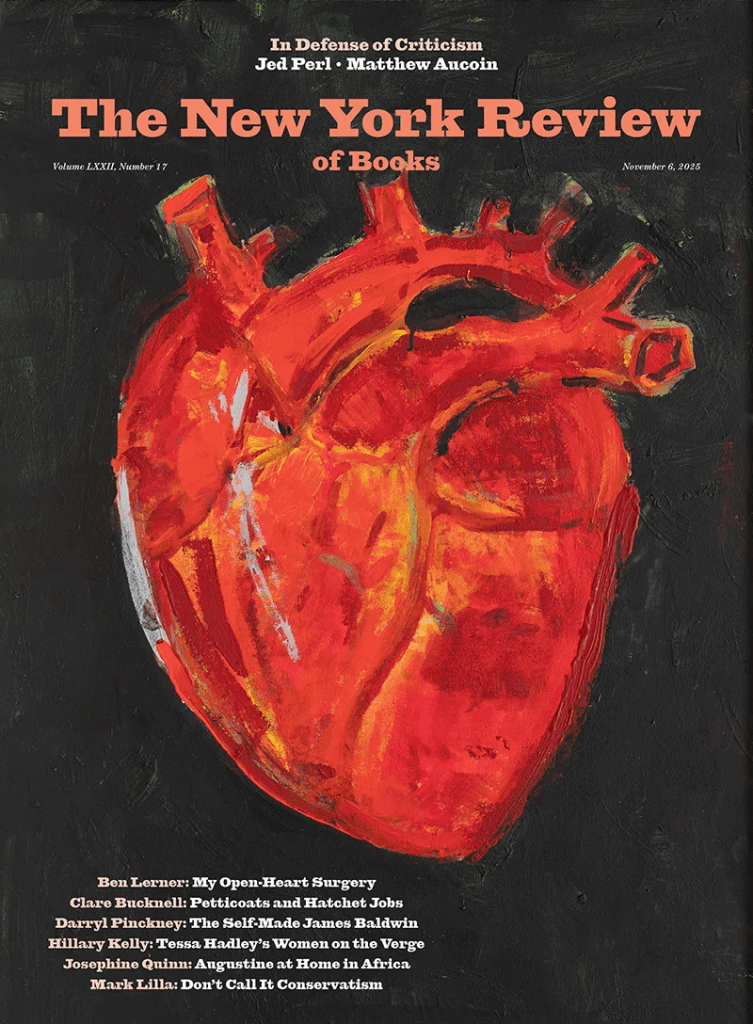
THE NEW YORK REVIEW OF BOOKS – JULY 24, 2025

Image

THE NEW YORK REVIEW OF BOOKS: The latest issue features Joyce Carol Oates on serial killers and toxic metals, Fintan O’Toole on Trump’s domestic army, David Shulman on the second Nakba, Regina Marler on the Brothers Grimm, Michelle Nijhuis on what we save, Peter Canby on the murder of a priest, Ruth Bernard Yeazell on Albert Barnes’s art sense, Ian Johnson on Xi père, Lola Seaton on Sheila Heti’s deceptive ease, James Gleick on AI nonsense, poems by Milan Děžinský and Devon Walker-Figueroa, and much more.

‘I Am the Heir to Delacroix’

Jack Whitten’s brilliantly restless innovation is a rigorous interrogation and a surging expansion of what painting can do.

Jack Whitten: The Messenger an exhibition at the Museum of Modern Art, New York City, March 23–August 2, 2025

Jack Whitten: Notes from the Woodshed, Second Edition edited by Katy Siegel

The Parrot in the Machine

The artificial intelligence industry depends on plagiarism, mimicry, and exploited labor, not intelligence.

The AI Con: How to Fight Big Tech’s Hype and Create the Future We Want by Emily M. Bender and Alex Hanna

The Line: AI and the Future of Personhood by James Boyle

Locked Up by Erdogan

For his work as an activist and philanthropist, Osman Kavala has been unjustly imprisoned in Turkey for seven and a half years.

COUNTRY LIFE MAGAZINE – JULY 2, 2025 PREVIEW

Country Life Cover 2 July 2025

COUNTRY LIFE MAGAZINE: The latest issue features “Take The Plunge’… –

Come on in, the water’s lovely

The seaside lido is enjoying a fresh wave of popularity a century and more after its first appearance on the British coast. Kathryn Ferry dives in

Spreads from Country Life 2 July 2025

Winging it

Watch out, watch out, there’s a thief about! Mark Cocker warns that no undergarment is safe from the resurgent red kite, a bird soaring back from near extinction

Travel

• Christopher Wallace checks in to a new opening in Marrakech, Morocco’s Mecca for luxury hotels

• Teresa Levonian Cole blazes a trail in the Spanish Pyrenees

• Pamela Goodman gets on her bike to explore the Welsh border country

Spreads from Country Life 2 July 2025

Life’s a pretty picnic

Deborah Nicholls-Lee shares a hamper-full of tasty morsels from the long and varied history of alfresco dining on canvas

Ricardo Afonso’s favourite painting

The musical-theatre actor chooses an ‘otherworldly’ work that stirs complex emotions

The legacy

Amie Elizabeth White salutes Sir James Clark Ross, the vastly experienced naval officer who discovered Antarctica in 1841

In God’s acre we trust

Laura Parker learns how the absence of interference over centuries enabled our wildlife-rich graveyards to become a ‘Noah’s Ark of species’

Spreads from Country Life 2 July 2025

Keeping a low profile

The countryside is littered with storm-damaged trees that simply refuse to die. Jack Watkins celebrates great arboreal survivors

The good stuff

Hetty Lintell puts her best foot forward with a selection of sandals

Interiors

Arabella Youens commends an elegant townhouse kitchen and Amelia Thorpe picks out rhubarb accessories to brighten the home

London Life

• Will Hosie assesses the cost of our partying in the parks

• How the style set are reaffirming that west is best

Lost, but not forgotten

George Plumptre applauds the masterful restoration of the Arts-and-Crafts garden at Knowle House in East Sussex

Spreads from Country Life 2 July 2025

Arts & antiques

Laura Dadswell believes her pair of 18th-century Venetian mirrors is the fairest of them all, as she tells Carlo Passino

LITERARY REVIEW – JULY 2025

Image

LITERARY REVIEW (July 1, 2025): The latest issue features ‘Will Wiles on the Art of Purism…

Hung, Drawn & Courted – Family Romance: John Singer Sargent and the Wertheimers By Jean Strouse

John Singer Sargent: The Charcoal Portraits By Richard Ormond

No Sketching! – Monsieur Ozenfant’s Academy By Charles Darwent

Artists on Tour – Art on the Move in Renaissance Italy By David Landau

Literary Lives

THE NEW YORKER MAGAZINE – JULY 7 & 14, 2025 PREVIEW

The cover for the July 7  14 2025 Fiction Issue of The New Yorker in which a building cleaner hangs from a harness off...

THE NEW YORKER MAGAZINE: The latest issue features Malika Favre’s “Literary Heights”…

Trump, Congress, and the War Powers Resolution

How we got to a situation where a President can reasonably claim that it is lawful, without congressional approval, to bomb a country that has not attacked the U.S. By Jeannie Suk Gersen

Anne Enright’s Literary Journeys to Australia and New Zealand

The Booker Prize-winning author recommends three works by writers who, thanks to geography, may have never received their due.

What Happens After A.I. Destroys College Writing?

The demise of the English paper will end a long intellectual tradition, but it’s also an opportunity to reëxamine the purpose of higher education. By Hua Hsu

THE INDEPENDENT REVIEW – SUMMER 2025 PREVIEW

Book Review: Creative Destruction: An Introduction, John T. Dalton and  Andrew J. Logan

THE INDEPENDENT REVIEW (June 26, 2025): The latest issue features ‘Corporate America’s Ideological Tilt’….

Corporate America’s Ideological Tilt: An Introduction

Rosolino A. Candela, Caleb S. Fuller

Beyond Interest: What May Motivate DEI

Douglas J. Den Uyl

Philosophy, Law and Culture of Liberal Democracy and the Authoritarian Challenge

By Suri Ratnapala

Reviewed by  Paul Dragos Aligica

Martin Van Buren: America’s First Politician

By James M. Bradley

Reviewed by  Garion Frankel

Capitalism: The Story Behind the Word

By Michael Sonenscher

Reviewed by Richard M. Salsman

WORLD LITERATURE TODAY – JULY 2025 PREVIEW

WORLD LITERATURE TODAY (June 26, 2025): The latest issue features Writing with Light – The 2025 Puterbaugh Lecture, by Guadalupe Nettel

Gaza Voices

Introduction: Eyes of the Pen, Voices of the Cameraby Yousef Khanfar

Writing on War’s Edgeby Yousri Alghoul

They Call It Displacement—In Reality, It’s Hell (This Is My Story)by Nour Abo-Rokb

This Is What I Haveby Shrouq Mohammed Doghmosh

Nun and War (She and War)by Kifah Salama Al-Ghseen

CREATIVE NONFICTION

Ghost by Basem Nabres

Ringtones of My Mobile Phoneby Omar Hammash

DRIFT MAGAZINE – SUMMER 2025 LITERARY PREVIEW

THE DRIFT MAGAZINE (June 24, 2025): The latest issue Fifteen features It’s morning in America. Daphne, chased by Apollo, grows hooves. We live in an age of conspiracism and insincerity. Spring and summer will not follow. Staying below two degrees might be a challenge. It’d be corny to call it Orwellian. We reached the limits of what moral outrage can do. Miraculously, we still made decisions. Acting recklessly. Lining up at the barricades. The more you have, the more you have to protect. Eye contact is everything. Already, the oil field was quieter. Misogyny converts reality. All that love for objects. It sanctifies him. He wore a face that spoke of multiple divorces. She was bitter about her beauty. That’s all in an evening screening. We’re in a definitional war. Publicity beats truth. Art that risks nothing is worth nothing. A negation of the possibility of forgetting. A private fiefdom. A child on whom childhood was wasted. A game of inches. Ask a pundit or professor. There are only so many laughs to be had.
Interviews

“They’re Using Megaphones”​ | An Interview with Wendy Brown

The Drift Editors

“Losing Any Claim to Moral Leadership”​ | An Interview with Nikhil Pal Singh

The Drift Editors

“We Will Not Win on Our Own”​ | An Interview with Eman Abdelhadi

The Drift Editors

“Politics Is Conflictual”​ | An Interview with Olúfẹ́mi O. Táíwò

The Drift Editors

“All Sticks, No Carrots”​ | An Interview with Adam Tooze

The Drift Editors

Dispatches on the New Regime

Unified Purpose and Total Vision​ | Our New Department of Justice

Piper French

State of Exception​ | National Security Governance, Then and Now

David Klion

A Bureaucratic and Feminine Mind​ | The Right’s Misogyny Politics

Becca Rothfeld

Brutality and Opacity​ | Birthright Citizenship Under Attack

Elisa Gonzalez

Agit-Slop​ | The White House’s Numbing Aesthetic

Mitch Therieau

A Disaster Big Enough​ | Climate Policy on Life Support

Jake Bittle

Competing Moral Visions​ | Two Paths for Pronatalism

Gaby Del Valle

Easy to Exploit​ | Collapsing the Urban-Rural Divide

Nick Bowlin

Collective Political Activity​ | Reclaiming the First Amendment

Rhiannon Hamam

Anti-Anti-Rape​ | On the #MeToo Backlash

Jamie Hood

God-Like Confidence​ | Donald Trump’s Cult of Faith

Tope Folarin