

Tag Archives: Blood Pressure

Health Studies: Women’s Blood Vessels Age Faster Than Men’s, Increasing Heart Disease Risks
From a Cedars-Sinai.org online release:
 “Our data showed that rates of accelerating blood pressure elevation were significantly higher in women than men, starting earlier in life,” said Cheng, the Erika J. Glazer Chair in Women’s Cardiovascular Health, who also serves as director of Cardiovascular Population Sciences at the Barbra Streisand Women’s Heart Center. “This means that if we define the hypertension threshold the exact same way, a 30-year old woman with high blood pressure is probably at higher risk for cardiovascular disease than a man with high blood pressure at the same age.”

(January 15, 2020) – New research from the Smidt Heart Institute at Cedars-Sinai showed for the first time that women’s blood vessels – including both large and small arteries – age at a faster rate than men’s. The findings, published Wednesday in the journal JAMA Cardiology, could help to explain why women tend to develop different types of cardiovascular disease and with different timing than men.
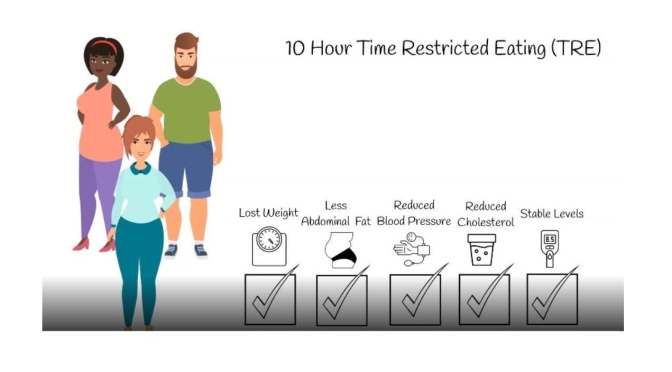
Diet Studies: “10-Hour Time -Restricted Eating” (TRE) Lowers Weight, Visceral Fat & Blood Pressure
From a Cell Metabolism online study release:
 Ten-hour time-restricted eating (TRE) limits daily dietary intake to a consistent 10-h window, creating a 14-h nightly fast. Researchers studied whether TRE for 12 weeks in people with metabolic syndrome receiving standard medical care (including medications to lower cholesterol and blood pressure) improves markers of health. TRE led to weight loss, healthier body composition (including decreased waist circumference), lower blood pressure and levels of cardiovascular disease-promoting lipids (i.e., “bad cholesterol” levels), and more restful sleep. TRE could be an effective dietary intervention to help those with metabolic syndrome.
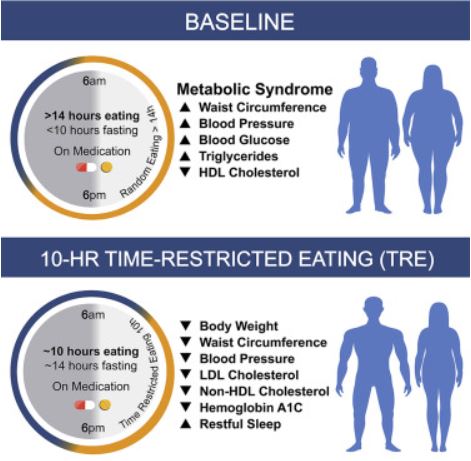
Time-restricted eating (TRE) is an emerging dietary intervention that aims to maintain a consistent daily cycle of feeding and fasting to support robust circadian rhythms (Panda, 2016). Circadian regulation of the endocrine system, autonomic nervous system, and nutrient metabolism contributes to metabolic and physiological homeostasis (Asher and Sassone-Corsi, 2015,Panda, 2016). Both erratic eating patterns and eating over an extended period of time during the 24-h day can disrupt circadian rhythms.
To read entire study: https://www.cell.com/cell-metabolism/fulltext/S1550-4131(19)30611-4
Brain Health Research: Controlling Blood Pressure Reduces Age-Related Cognitive Loss
From a National Institute on Aging news release:
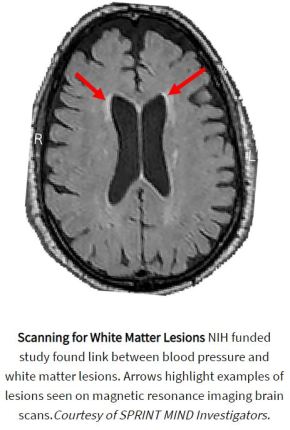 “These initial results support a growing body of evidence suggesting that controlling blood pressure may not only reduce the risk of stroke and heart disease but also of age-related cognitive loss,” said Walter J. Koroshetz, M.D., director of the NIH’s National Institute of Neurological Disorders and Stroke (NINDS). “I strongly urge people to know your blood pressure and discuss with your doctors how to optimize control. It may be a key to your future brain health.”
In a nationwide study, researchers used magnetic resonance imaging (MRI) to scan the brains of hundreds of participants in the National Institutes of Health’s Systolic Blood Pressure Intervention Trial (SPRINT) and found that intensively controlling a person’s blood pressure was more effective at slowing the accumulation of white matter lesions than standard treatment of high blood pressure. The results complement a previous study published by the same research group which showed that intensive treatment significantly lowered the chances that participants developed mild cognitive impairment.
To read more click on following link: https://www.nia.nih.gov/news/intensive-blood-pressure-control-may-slow-age-related-brain-damage
Health Issues: Seizures and Blood Pressure Swings Complicate a Medical Diagnosis
“Seizures are not uncommon in the elderly. Nearly a quarter of those who have a first seizure are over 65. Most are caused by a stroke or a mass; traumatic head injuries can cause them. So can abnormalities in blood chemistry. In the emergency room, the man had no sign of any of these, despite a thorough exam and extensive testing and imaging.”
The patient had both neurological and psychiatric symptom, which complicated a speedy diagnosis. A “new group of disorders” involving the “immune system wrongly attacking the brain” was a final diagnosis. Read the NY Times Magazine article in the link below to learn more:
 Boomers Daily