From Wikipedia:
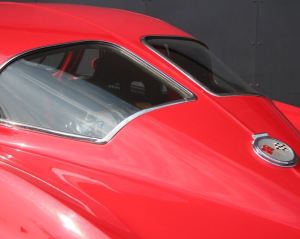 The 1963 Sting Ray production car’s lineage can be traced to two separate GM projects: the Q-Corvette, and perhaps more directly, Mitchell’s racing Sting Ray. The Q-Corvette, initiated in 1957, envisioned a smaller, more advanced Corvette as a coupe-only model, boasting a rear transaxle, independent rear suspension, and four-wheel disc brakes, with the rear brakes mounted inboard. Exterior styling was purposeful, with peaked fenders, a long nose, and a short, bobbed tail.
While Duntov was developing an innovative new chassis for the 1963 Corvette, designers were adapting and refining the basic look of the racing Sting Ray for the production model. A fully functional space buck (a wooden mock-up created to work out interior dimensions) was completed by early 1960, production coupe styling was locked up for the most part by April, and the interior, instrument panel included was in place by November. Only in the fall of 1960 did the designers turn their creative attention to a new version of the traditional Corvette convertible and, still later, its detachable hardtop. For the first time in the Corvette’s history, wind tunnel testing helped refine the final shape, as did practical matters like interior space, windshield curvatures, and tooling limitations. Both body styles were extensively evaluated as production-ready 3/8-scale models at the Caltech wind tunnel.
To see more photos and listing: https://www.classicdriver.com/en/car/chevrolet/corvette/1963/724523

 During this year’s Monterey Car Week, all four of Bugatti’s hallowed Type 59s were reunited for the first time since 1935. We spoke to the man who pulled off arguably the most historically significant automotive rendezvous of the decade…
 driving forces behind the introduction of the twin-cam engine, Ettore Bugatti created the ultimate expression of his jewel-like Grand Prix car.
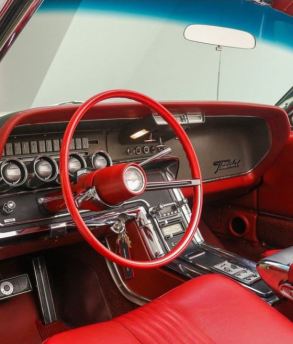 The revised model was initially offered as a hardtop, convertible, Sports Roadster with dealer-installed tonneau cover and wire wheels, and Landau with vinyl roof, simulated landau irons, and wood grain interior appointments. Total 1964 sales were excellent: 92,465, up nearly fifty per cent from the previous year, but with only 50 Sports Roadster kits were sold from the factory. The 1964 Thunderbird was the only car of this generation to have the word ‘Thunderbird’ spelled out on the front hood instead of a chrome Thunderbird emblem. The only transmission available was the Cruise-O-Matic MX 3 speed automatic.
 The fourth generation of the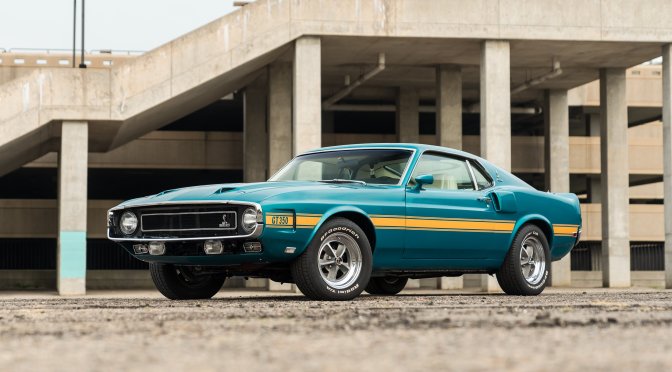
 As the Mustang line grew in size and comfort features, so too did the Shelby branded vehicles on which they are based. Never one to settle for standard, Carroll Shelby decided to take the already aggressive and bold styling of the 1969 Mustang even further. New front fenders, which included functioning brake ducts, were added which terminated in a big, full-width grill and bright chrome bumper set forward of this. Some other interesting design elements were included as well such as NACA ducts on the hood, rather than the traditional raised hood scoops.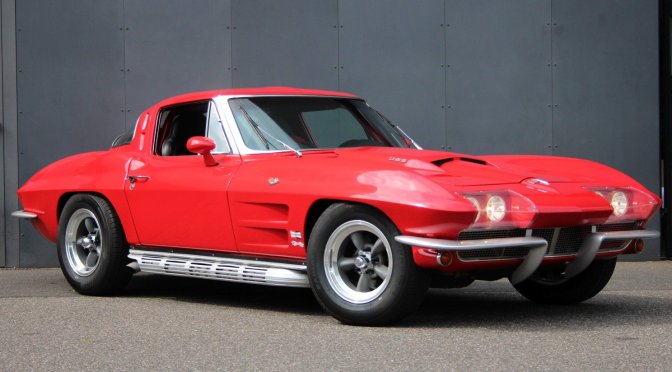
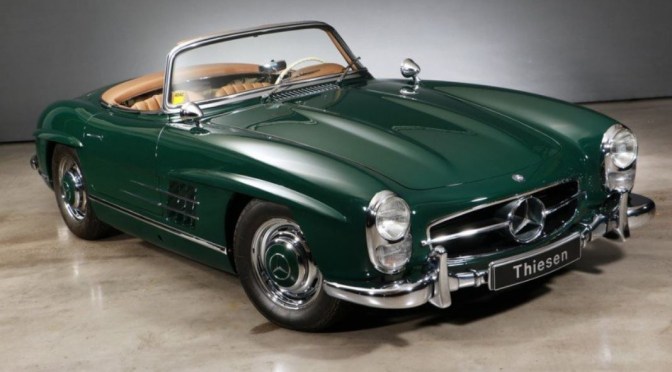
 The 300 SL celebrated its premiere at the? International Motor Sports Show? in New York, which took place from February 6th to 14th, 1954. Mercedes-Benz experienced an enormously positive response from visitors to the 300 SL at the Motor Show, so series production began in August 1954 at the Sindelfingen plant.
 This 300 SL Roadster was delivered in Germany on September 22, 1960. In the mid-1980s, the car came into the possession of an experienced Mercedes specialist. The roadster underwent extensive restoration under his direction. According to the available documentation, the body was separated from the chassis and completely overhauled. Since then, the car has only been moved about 28,000 km and serviced regularly. A few years ago, the vehicle changed hands within Germany to a businessman and classic car enthusiast who used the roadster for nice trips and events.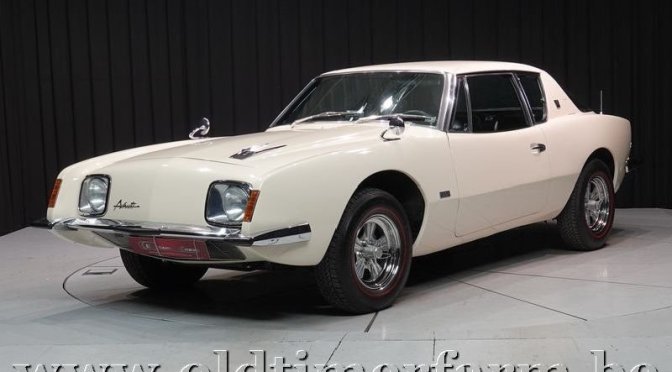
 Described as “one of the more significant milestones of the postwar industry”, the car offered combined safety and high-speed performance. Subsequent to Studebaker’s discontinuation of the model, a series of five owner arrangements continued manufacture and marketing of the Avanti model.
 The Avanti was developed at the direction of Studebaker president, Sherwood Agbert. “The car’s design theme is the result of sketches Egbert “doodled” on a jet-plane flight west from Chicago 37 days after becoming president of Studebaker in February 1961.” Designed by Raymond Loewy’s team, the Avanti featured a radical fiberglass body mounted on a modified studebaker Lark Daytona 109-inch convertible chassis and powered by a modified 289 Hawk engine. APaxton supercharger was offered as an option.

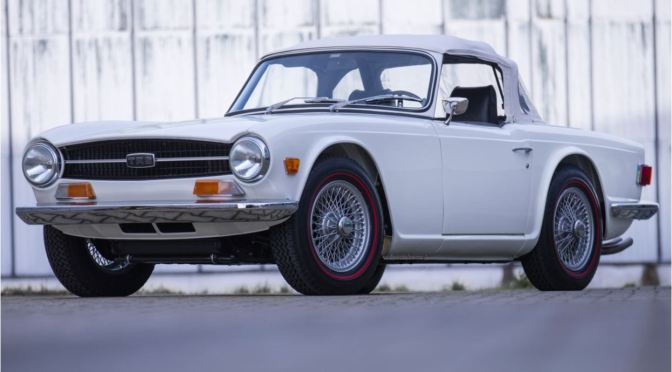

 The Type E Series III had the privilege of launching the new Jaguar V12 engine in 1971. This superb 5.3L engine with two overhead cams, derived from a prototype for the 24 Hours of Le Mans, was powered by four carburettors. and developed 272CV DIN upon its release, it will give up to 700CV in competition versions.
 The result is a testimony to the true meaning of haute couture – this car doesn’t need to impress or be flashy. It’s first and foremost superb craftsmanship, which has been married to extreme refinement. Next time you venture into Paris and notice a dark blue Eden Roc being driven by a young and elegant tattooed man, don’t hesitate to look closer and try to spot Leroy’s intricate tailor-made feathery details.
 Maxime Leroy is anything but your typical classic car collector. He is a visionary creator with a strong personality whose adult life has been devoted to showcasing feathers. He discovered the art of plumasserie at school thanks to two of his professors. At that time, the school was the last school in France dedicated to teaching this dying art. And thanks to Leroy, who now spends two days a week there teaching, it still is.
 Boomers Daily