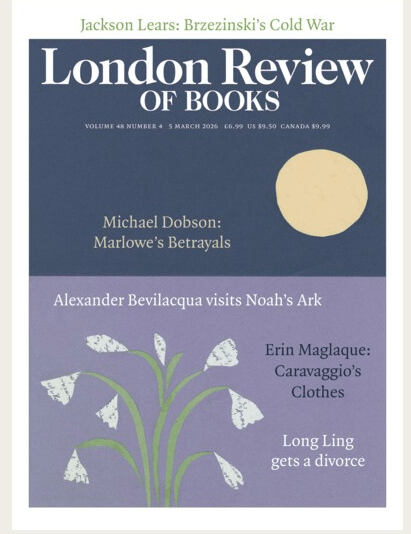

LONDON REVIEW OF BOOKS: The latest issue features ‘Robert Frost’s ugly feelings’….

LONDON REVIEW OF BOOKS: The latest issue features ‘Robert Frost’s ugly feelings’….

THE NEW YORKER MAGAZINE: The latest cover features Malika Favre’s and Rea Irvin’s Eustace Tilley – The covers for the fourth and final centenary special issue.
Not only is the department’s behavior not normal; it is also, as is becoming increasingly clear, self-defeating. By Ruth Marcus
The Trump Administration is deporting people to countries they have no ties to, where many are being detained indefinitely or forcibly returned to the places they fled. By Sarah Stillman
When you’re waiting for a flight, what’s the difference between out there and in here? By Zach Helfand

THE NEW YORKER MAGAZINE: The latest cover features Kenton Nelson’s “Early Morning” – Opening hours.
The President granted two hundred and thirty-eight pardons and commutations in his first term; less than a year into his second, he has issued nearly two thousand. By Benjamin Wallace-Well
The polymathic entertainer has had a lifelong bond with the wittiest—and the most tortured—of writers. And now he’s starring in “The Importance of Being Earnest.” By Rebecca Mead
It used to be that drawing heat from deep in the Earth was practical only in geyser-filled places such as Iceland. But new approaches may have us on the cusp of an energy revolution. By Rivka Galchen

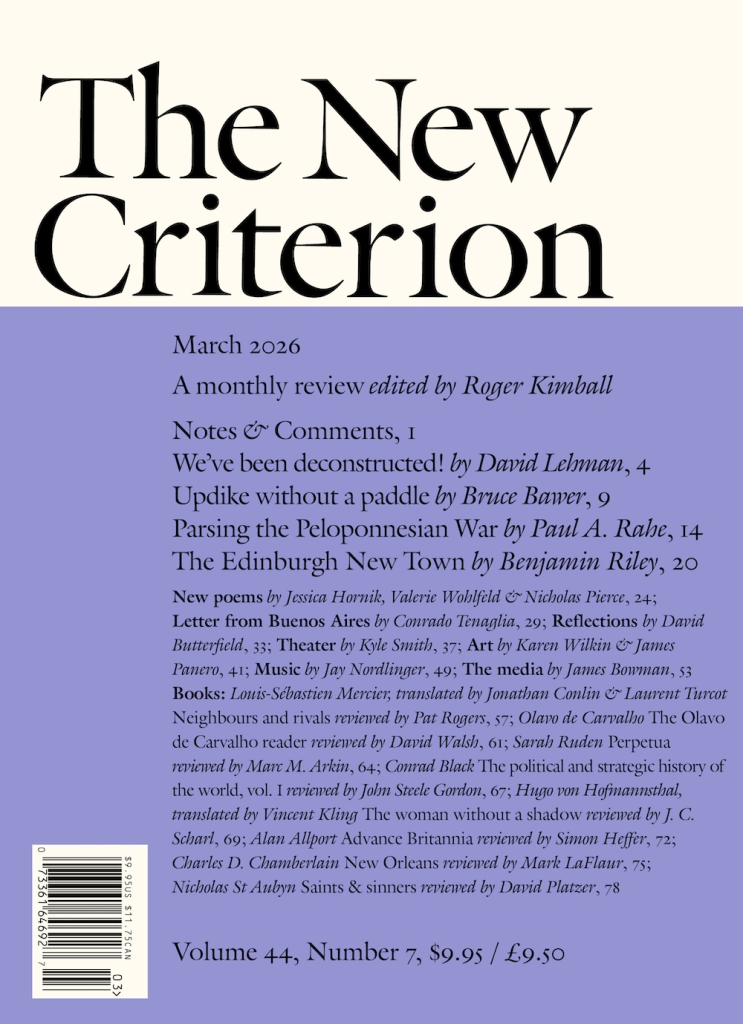
THE NEW CRITERION: The latest issue features…
My Grandma Moses by Jane Kallir
America beautiful by James Panero
Leiden lights by Karen Wilkin
Behind the scenes by Michele H. Bogart
The consonant Cushing by Alexandra Cushing Howard
A bull with his own china shop by Eric Gibson
Mittel march by Peter Pennoyer
The unsentimental builder by Michael J. Lewis
The mage of Torino by Philip Rylands
“Architecture unshackled” by Harry Adams

I’m starting to feel some pre-emptive nostalgia when I do a Google search. Yes, it’s true, search can sometimes take you to places you don’t want to go. But at least a ‘classical’ search engine like Google in the 2000s and 2010s took you outside itself, and perhaps implicitly prompted you to evaluate critically what you found there. by Donald MacKenzie
Slavery was accepted across most of the early modern world. No one wanted to be a slave, except when the alternative was being executed after a battle, or made a human sacrifice, but the institution was taken for granted until the growth of abolitionism in the later 18th century. Liverpool could hardly be an exception when the slave trade was so embedded in its economy. By John Kerrigan
We still live in the long shadow of Habsburg disintegration. In addition to the lingering legacy of 19th-century state formations, European and global politics are shaken by continuing reverberations in states that have disappeared from Europe since 1990: Yugoslavia, Czechoslovakia, the GDR and, above all, the Soviet Union. By Holly Case

Charting Seamus Heaney’s Wordsworthian journey By Roy Foster
Writing novels by AI – and committee By Gordon Fraser
Our contributors choose their favourites
Simone Weil’s ethical life class By A. Rebecca Rozelle-Stone

THE NEW YORKER MAGAZINE: The latest cover features Edel Rodriguez’s “Mayor Mamdani”
His opponents tried to smear him for his youth, inexperience, and leftist politics. But New Yorkers didn’t want a hardened political insider to be mayor—they wanted Zohran Mamdani.
For years before taking office, the former Vice-President appeared less dogmatic than he was.
On “West End Girl,” all the gritty bits are there: messages with a husband’s mistress, the discovery of a cache of sex toys.

THE NEW YORKER MAGAZINE: The latest cover features ‘Sudden Shower’ by Sergio-Garcia Sanchez.
ChatGPT does not have an inner life. Yet it seems to know what it’s talking about. By James Somers
The President’s goals were clear on the first day of his term, when he issued an executive order overruling the Fourteenth Amendment’s birthright-citizenship clause. By Jelani Cobb
The jewel heist at the Louvre reminded Brooklynites of the time, in 1952, when two bejewelled crowns were swiped from a beloved local church—the one with a Mob boss on the ceiling. By Susan Mulcahy

The Poems of Seamus Heaney By Rosie Lavan, Bernard O’Donoghue and Matthew Hollis (edd.)
A woman stands, oblivious to our gaze, absorbed entirely in her activity – reading, pouring, weighing, holding out her pearls. A window to the left admits a radiance, which falls variously on the common stuff the room contains. The light enters as an absolute blank, but infuses colour as it illuminates the scene.
The rush to tell the story of Katherine Mansfield’s short, fascinating life began as soon as she died. Her husband, John Middleton Murry, a gifted editor, notoriously turned the publication of her writing into an industry.

TIMES LITERARY SUPPLEMENT: The latest issue features ‘Extinction rebellion’ – How Tennyson speaks to our fears.
The troubled history of US-China relations By Katie Stallard
Iris Murdoch’s unseen poetry, transcribed for the first time By Miles Leeson
Tennyson’s embrace of science and catastrophe theory By Angela Leighton
Tales of the uncanny from a master of ambiguity By Joyce Carol Oates